Most SaaS growth strategy guides list every tactic as equally valid. They're not. What works at $1M ARR actively hurts you at $10M ARR. This guide frames every core strategy through the lens of stage, sequencing, and growth loops.

Founder, Digital Gratified
The right SaaS growth strategy depends on your stage. Tactics like product-led growth, content marketing, freemium, upsells, referrals and partnerships all work, but the ones that drive results at $1M ARR differ from those that work at $10M ARR, and some scale-stage tactics will actively slow you down early.
Doing too many things at the wrong stage spreads resources thin and builds nothing that compounds. This guide maps the major SaaS growth strategies to the stages where they deliver, introduces interlocking growth loops, and names the traps that kill momentum before it builds.
The Three SaaS Growth Models: How to Pick Yours
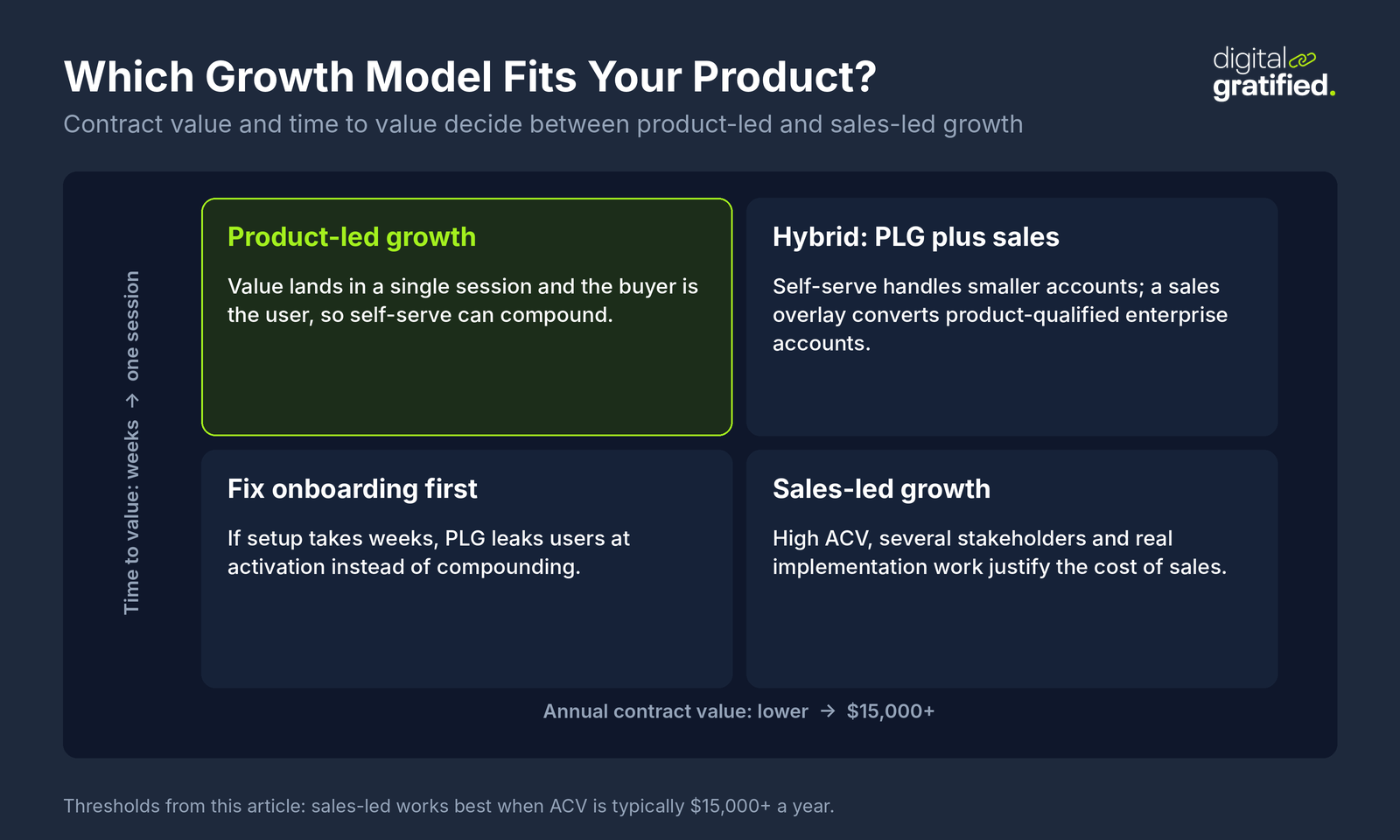
Before choosing specific tactics, you need to understand which of the three fundamental growth models your business operates on. This determines everything: your funnel structure, your hiring sequence, your pricing architecture, and how you measure success.
Product-Led Growth (PLG)
The product itself is the primary acquisition and expansion mechanism. Users discover the product through a free tier or trial, experience value directly, and convert or expand without meaningful sales involvement. Slack, Notion, Figma, and Calendly are canonical examples.
Works best when: The product delivers immediate value in a single session, the buyer is the user (or a small group), and the problem is broad enough to support self-serve discovery.
The real requirement most guides skip: PLG demands exceptional product onboarding and a very short time-to-value. If your product takes two weeks to set up or requires training to understand, PLG won't compound. It'll just leak users at the activation step.
Sales-Led Growth (SLG)
A sales team drives acquisition through outbound prospecting, demos, and negotiation. The product is complex, high-ACV, or sold to enterprise buyers who won't self-serve. ServiceNow, Salesforce, and most enterprise infrastructure companies operate this way.
Works best when: ACV justifies sales cost (typically $15,000+ annually), the purchase involves multiple stakeholders, or the product requires significant implementation and customisation.
The real requirement: SLG needs sales infrastructure from day one: CRM, a repeatable outbound process, clear ICP definition, and SDR/AE capacity. Founders trying to close deals without this infrastructure burn time on non-scalable effort.
Hybrid (PLG + SLG)
The model most established B2B SaaS companies move toward. A self-serve motion handles SMB and individual users at lower ACV; a sales overlay identifies product-qualified accounts and converts them to enterprise contracts.
The transition point: Companies typically layer in a sales motion when they notice teams or enterprises signing up through the self-serve channel and using the product in ways that suggest enterprise value. This is the GTM transition most growth guides ignore entirely.
Understanding your current model (and the model you need to transition to) is the prerequisite for every specific strategy below.
Growth Strategy by ARR Stage
The single most useful reframe in SaaS growth strategy is replacing the question "what should we do?" with "what should we do right now, given where we are?" Here's how the priorities shift:
Pre-PMF to $1M ARR: Find Your One Channel
Before product-market fit, almost nothing works reliably, and that's normal. The job at this stage isn't growth; it's learning. Who are the customers who genuinely can't live without the product? What language do they use to describe the problem? Where do they find solutions?
After PMF, the strategy is ruthless focus: find one acquisition channel that works and dominate it before adding a second. This is the stage where doing too many things kills you. Paid ads, content, outbound, community, partnerships: each requires real operational investment to work. Doing all five at 20% effort produces nothing. Doing one at 100% builds the compounding foundation.
$1M–$10M ARR: Build the Acquisition Engine
At this stage, you've validated the channel. Now the job is systematising it so it can scale without the founders running it. This is where process and operational investment matter: content editorial calendars, outbound sequences, sales playbooks, SDR hiring, or PLG onboarding optimisation (depending on which motion you're running).
This is also the stage to introduce your first secondary channel. Typically that means adding inbound (content/SEO) alongside a primary outbound or PLG motion: building the organic traffic asset that will become progressively more valuable over years. For most B2B SaaS companies, SEO starts delivering meaningful pipeline in months 9–18, which means the investment needs to start here to produce results at the next stage.
$10M–$30M ARR: Expand the Surface Area
Primary acquisition is working. Now the questions shift to: Are we expanding within existing accounts? Are we entering new segments or markets? Are we capturing demand across the full funnel, or only at the bottom?
Expansion revenue becomes the major lever at this stage: upselling existing customers to higher tiers, cross-selling into adjacent use cases, moving from departmental adoption to company-wide contracts. Expansion revenue carries far lower CAC than new customer acquisition, and at this stage the installed base is large enough to make it meaningful.
$30M+ ARR: Defend and Diversify
At this scale, brand and community become relevant strategic levers (they weren't before: you needed customers first). International expansion is worth the operational complexity. Partnerships with complementary products generate referral volume that wasn't available at earlier stages. And new product lines targeting adjacent problems create new growth vectors without relying entirely on market penetration in the core category.
The 7 Core B2B SaaS Growth Strategies
1. Content Marketing and SEO
The most commonly recommended strategy and the one most frequently underinvested. Content-driven SEO works as a SaaS growth strategy because your buyers research before they buy, and the SaaS company that appears consistently during their research phase builds familiarity advantage before the sales conversation even starts.
The distinguishing factor between content programs that grow pipelines and those that produce traffic with no commercial impact is intent alignment. Blog posts targeting problem-aware searches build brand at scale. Posts targeting solution-aware and decision-stage searches drive evaluations. Both matter, but the ratio should tilt toward commercial intent as you grow.
For B2B SaaS businesses evaluating content and SEO as a growth channel, understanding how SEO specifically drives SaaS growth (and what realistic timelines look like) is worth studying before committing the budget.
2. Product-Led Growth and Freemium
PLG's appeal is obvious: the product sells itself, CAC is low, and successful PLG businesses scale with fewer people. But PLG is often attempted by companies whose products aren't ready for it.
PLG requires three things most companies underestimate: (1) a time-to-value short enough that a user experiences the core benefit within a single session, (2) onboarding that gets users to that moment without human intervention, and (3) a natural viral or network mechanism (inviting teammates, sharing outputs, connecting with external contacts) that makes the product spread through organisations organically.
Without all three, freemium just becomes a free support burden with low conversion rates. Audit your onboarding completion rates and time-to-first-value before committing to a PLG motion.
3. Outbound Sales and Sales-Assisted Growth
Outbound works better than most PLG evangelists admit, especially for B2B SaaS with ACV above $10,000. The challenge is that modern outbound requires a level of personalisation and signal-based prospecting that generic email sequences can't achieve. Spray-and-pray outbound is dead. Signal-based outbound, reaching prospects at moments of demonstrated intent (technology changes, hiring signals, funding events), still generates strong pipeline when executed well.
The mistake SaaS companies make is treating outbound as purely a sales activity. The best outbound programs are coordinated with marketing: prospects that didn't convert get nurtured with content, not re-blasted with the same sequence.
4. Referral and Partner Programs
Word-of-mouth is the top acquisition channel for B2B SaaS companies, consistently cited by 30% of high-growth companies in BCG's research as their primary lead source. Formalising that word-of-mouth into a referral program amplifies a mechanism already working in your favour.
Integration partners (complementary tools whose customers overlap with yours) can become significant referral channels without the cost of direct acquisition. The Salesforce AppExchange, Atlassian Marketplace, and HubSpot App ecosystem generate enormous acquisition volume for their partners because they sit in the evaluation workflow of buyers already making decisions.
For SaaS companies building organic authority alongside their partner strategy, the team at Digital Gratified works with B2B SaaS businesses on the SEO and link building foundation that makes partners and analysts more likely to recommend and reference your product: brand visibility and credibility in search reinforce partnership-driven growth.
5. Expansion Revenue: The Most Underrated Growth Lever
Industry data is clear: for SaaS companies with more than $1M ARR, monetisation improvements (better pricing, packaging, and upsell) have 2–4x the impact on growth rate compared to equivalent investment in acquisition. Yet almost all growth content focuses on acquisition.
Expansion revenue comes from three sources: seat expansion (more users within an existing account), tier upgrades (customers moving to higher plans as their needs grow), and cross-sell (additional products or modules). Each requires a different trigger. Seat expansion is often driven by product adoption data. Tier upgrades happen when customers hit limits, which means you need to design limits intentionally. Cross-sell requires a customer success function that understands what else the customer needs.
6. Pricing as a Growth Strategy
Most SaaS companies set their initial price, then avoid revisiting it for as long as possible. This is a strategic mistake. Research shows companies that make a pricing or packaging change every three months outperform on average revenue per user by 103% compared to companies that don't. Pricing is a growth lever, and it's underused.
The modern pricing conversation for B2B SaaS centres on three models: seat-based (predictable but doesn't scale with value for high-usage customers), usage-based (aligns cost with value delivered, but harder to forecast), and outcome-based (charges for results achieved: highest alignment, hardest to measure). Most companies are moving toward hybrid models that combine predictable base costs with usage-based uplift.
Whatever model you use: price to value, not to cost. The CAC you spent acquiring a customer is irrelevant to what they're willing to pay. What matters is the value they derive.
7. Community and Brand
The last lever, and the one with the longest build time. A genuine community around your product category (not just a customer forum) creates advantages that no other strategy can replicate: organic content generation, peer-to-peer recommendations at scale, and a brand signal that search algorithms, AI tools, and buyers all respond to.
Community is not a strategy for early-stage companies with limited capacity. But for companies at $5M+ ARR with a real installed base, investing in a community of practitioners around the problem your product solves (not just the product itself) creates defensibility that compounds for years.
The Compounding Growth Loop: How the Best SaaS Companies Connect These Strategies
The companies that achieve sustained hypergrowth don't just run multiple strategies in parallel. They build interlocking loops where each strategy feeds the next.
A typical compounding loop looks like this: strong SEO content attracts the right audience → some percentage starts a free trial (PLG) → a subset activates and invites teammates (viral coefficient) → success with the product generates case study content → case studies improve conversion rates on paid campaigns and sales → higher-quality customers generate more word-of-mouth → referrals improve the quality of organic content through contribution and community participation → repeat.
The loop creates momentum: each component makes the others more effective. Breaking into the loop at any point strengthens every other component over time. The companies that build this architecture early (even when individual components are small) are the ones that look unstoppable two years later.
The Growth Traps That Kill Momentum
Acquisition Addiction
The most well-documented trap. An analysis of over 3,000 SaaS companies found that many high-growth startups treat acquisition as the only growth lever while ignoring the revenue leaking through churn and underpricing. Acquisition is necessary, but it can't compensate for a business that monetises poorly or retains customers weakly. Each new customer who churns in 6 months raises your effective CAC permanently.
The Feature Trap
Building more features as a response to slow growth. The logic seems sound: more features = more value = more customers. In practice, feature-bloated products create onboarding complexity, slow time-to-value, and make the product harder to communicate to new buyers. The best-growing SaaS products are often narrower than their competitors: they do one thing exceptionally well, which makes word-of-mouth compelling and onboarding fast.
The Content Trap
Publishing content without distribution. Many SaaS companies invest heavily in producing guides and thought leadership that generates almost no traffic because the underlying domain has no authority and no backlinks. Content marketing is not a strategy on its own: it's a strategy paired with distribution. Without building domain authority through quality backlinks, content sits unread. The role of link building in SEO is specifically to solve this: content earns rankings when authoritative sites link to it, signalling to Google that the content is worth surfacing.
Premature Channel Diversification
Adding new acquisition channels before the first one is systemised and efficient. Every new channel requires dedicated operational capacity to work at even a modest level. Spreading resources across five channels before any one of them has been optimised means none of them reach the efficiency threshold where they produce compounding results. Focus first. Diversify from a position of strength.
Frequently Asked Questions
What is a SaaS growth strategy?
A SaaS growth strategy is the set of decisions a software company makes about how to acquire customers, retain them, and expand revenue over time. Effective SaaS growth strategy is stage-specific (the tactics that work at $1M ARR are different from those at $20M ARR) and increasingly focused on building compounding loops where each strategy reinforces the others.
What is the most effective SaaS growth strategy?
There is no single most effective strategy: it depends on your ARR stage, growth model (PLG vs SLG), ACV, and market. That said, the companies with the most sustainable growth tend to combine a primary acquisition channel (content/SEO, outbound, or PLG) with strong retention and expansion revenue infrastructure. Content and SEO in particular compound over time in a way paid acquisition doesn't, making it the most durable long-term lever for most B2B SaaS businesses.
What is a B2B SaaS growth strategy?
B2B SaaS growth strategy adds the complexity of multi-stakeholder purchasing decisions, longer sales cycles, and higher ACV. B2B SaaS growth tends to require more sales-assisted infrastructure even in PLG-oriented companies, with a greater emphasis on account expansion (moving from departmental to company-wide contracts) and integration ecosystem partnerships as growth levers.
What growth metrics matter most for SaaS?
The core set: Monthly Recurring Revenue (MRR) and growth rate, Net Revenue Retention (NRR), Customer Acquisition Cost (CAC) by channel, CAC Payback Period, and Churn Rate. NRR above 100% means the existing customer base grows on its own: the benchmark for best-in-class SaaS is 120%+ NRR.
When should a SaaS company invest in product-led growth?
When the product delivers clear value within a short initial session, the target user can evaluate it without requiring training, and the ACV is low enough that self-serve conversion economics work. If your product takes weeks to onboard, focus on sales-assisted growth first and consider PLG for a lower-tier offering once the core product is established.
How do SaaS companies grow through partnerships?
Integration partnerships, referral partnerships, reseller/channel partnerships, and marketplace listings all generate acquisition volume. The most scalable partnership growth comes from being embedded in the evaluation workflow of active buyers, which marketplace listings and deep integration partnerships achieve better than referral arrangements alone.
About the author
Let's Scale Your SaaS Together
Get a custom SEO and link building strategy tailored for your SaaS business.
Get SEO insights that actually move rankings
Link building tactics, case studies, and SaaS SEO playbooks. No fluff, no spam.
You're subscribed!
SEO and link building insights, straight to your inbox.