The same search term covers $4.50-an-hour gig work and $500-per-link agencies. Here's a SaaS buyer's guide to the real price tiers, the red flags, and the questions that expose fake "manual" outreach.

Founder, Digital Gratified
Hiring a manual link building service should be a simple purchase, yet it's one of the trickiest buying decisions in SEO. The same label can describe a $4.50-an-hour gig worker pasting your URL into directories or a specialist agency charging $500 for a single editorial placement, and the outcomes are not even in the same sport.
This guide is for SaaS teams who've already decided they need links and now have to figure out who to trust with the work. It's not a listicle, and there's no vendor ranking at the end. It's the vetting framework we wish more buyers had before they signed anything.
What "Manual" Actually Buys You
Manual link building means a human finds relevant sites, contacts a real editor or site owner, and earns a placement in content that people actually read. The opposite is automation: scraped email blasts, link farms, private blog networks (PBNs), and software that drops your URL across thousands of pages nobody visits.
The distinction matters because Google treats it as the line between marketing and spam. Google's spam policies explicitly call out link schemes, automated placements at scale, and PBNs as violations that can tank rankings. A genuinely manual process supports white hat link building only when publishers retain editorial control and the placement helps their readers. That work is slower and more expensive precisely because it produces the kind of links that survive algorithm updates instead of triggering them.
If you want the full picture of how link acquisition works for software companies, our SaaS link building guide covers strategy end to end. This post stays focused on the buying decision.
One warning before we get to pricing: "manual" is the most abused word in this niche. Plenty of providers do manually place links, into networks of thin sites they own. The placement was technically done by hand. The risk profile is identical to automation. Manual describes the labor, not the quality. You still have to check where the links actually live.
Why This Matters More for SaaS Than Most Industries
A local restaurant with three spammy backlinks will survive. A SaaS company is in a different position for a few reasons:
Your buyers check you out. B2B purchase decisions involve research. When a prospect googles your product and finds you mentioned on credible industry sites, that's a trust signal doing sales work. A footprint of junk placements does the reverse.
Editorial context drives qualified traffic. A link inside a genuine article about your category (a comparison, an integration roundup, a how-to that mentions your tool) sends readers who are already in your market. A directory drop sends nobody.
Brand risk compounds. SaaS companies live and die by organic pipeline. A penalty or a rankings slide from cheap links doesn't just cost traffic; it costs the demos and signups that traffic was producing. Recovering can take months of cleanup and disavows.
This is why the cheap end of the market is a worse deal for SaaS specifically. The downside isn't just wasted spend. It's damage to the channel you were trying to grow.
What Manual Link Building Actually Costs
Pricing signals in this market are scattered across gig listings, agency pages, and forum threads, so here's the consolidated view:
Gig marketplaces (Fiverr, Upwork's low end): $4.50 to $50 per hour. At the bottom of this range, the math tells the story. Nobody does real prospecting, personalized outreach, and editorial negotiation for $4.50 an hour. What you're buying is directory submissions, blog comments, or PBN drops with a "manual" label.
Experienced freelancers: roughly $50 to $100 per hour. A skilled solo operator can absolutely deliver real placements. The constraints are capacity (a handful of links per month) and consistency (you're one vacation or one bigger client away from a dead month).
Specialist agencies: $80 to $500+ per link. The wide range tracks the authority and relevance of the placement site. Expect 2 to 6 week turnarounds per batch, because real outreach involves real editors with real publishing schedules. We've broken down what drives the per-link math in our link building pricing guide.
Monthly retainers: $3,000 to $10,000+ per month. This is the model for companies where links are an ongoing growth input rather than a one-off fix. Retainers fund the parts that compound: relationships with editors, content assets that earn links, and a pipeline of prospects that doesn't restart from zero each month.
A useful sanity check when comparing quotes: work backwards from labor. A quality placement takes several hours of prospecting, outreach, follow-up, and coordination by someone competent. If the price can't plausibly cover those hours, the process behind it isn't the one being advertised.
Red Flags That Should End the Conversation
Most bad providers advertise the same tells. Watch for these:
Guaranteed link counts. "20 links per month, guaranteed" sounds like accountability. It's actually a confession: real editorial outreach has a variable hit rate, so the only way to guarantee volume is to control the destination sites. That means networks, not outreach.
No recent, checkable samples. Ask for live placements from the last 60 days with URLs. Then actually visit them: does the site have real content, real authors, an audience you can imagine existing? A provider who resists this request has a reason.
PBN links sold as "manual outreach." Signs to check: sites with generic names, thin posts on wildly mixed topics, no named authors, and suspiciously fast placement times. Editorial sites take weeks; networks take hours.
Off-niche placements. A backlink from a gambling blog or a generic "business tips" content mill does nothing for a SaaS product. Relevance is most of the value. Volume of irrelevant links is a liability, not an asset.
Fourth-party outreach. Some shops sell you their process, then quietly subcontract the actual emailing to a cheaper offshore team. Ask directly who sends the outreach and whether the work stays in-house. Get the answer in writing.
Vague or missing reporting. You should know what was pitched, what's pending, and what went live, on a fixed cadence. "We'll report as links are placed" makes slow months indistinguishable from idle ones.
Questions to Ask Before You Sign
Five questions separate real providers from packaged spam faster than any sales call:
"Show me three placements you landed for a SaaS or tech client in the last two months." Recency matters (old wins may predate a team change) and niche matters (local SEO wins don't transfer).
"Walk me through your outreach process for one of those links." A real answer names prospecting criteria, the pitch angle, and the back-and-forth with the editor. A fake answer is a word salad about "high DA sites in our network." The moment you hear "our network," you've learned what you needed to. If you want to understand what a legitimate process looks like from the inside, our link building outreach guide shows the actual mechanics.
"What's your reporting cadence and what's in the report?" You want pitched/pending/live status, not just a monthly list of URLs.
"How do you decide a site is worth a placement?" Good answers talk about topical relevance, real traffic, and editorial standards. Weak answers cite a single metric threshold, because single metrics are easy to inflate.
"Who does the work, and where?" Not a gotcha about geography; a question about accountability. You want to know whether the people you're evaluating are the people doing the outreach.
When a Freelancer Is Genuinely the Right Call
The honest answer the listicles won't give you: sometimes the cheap option is correct.
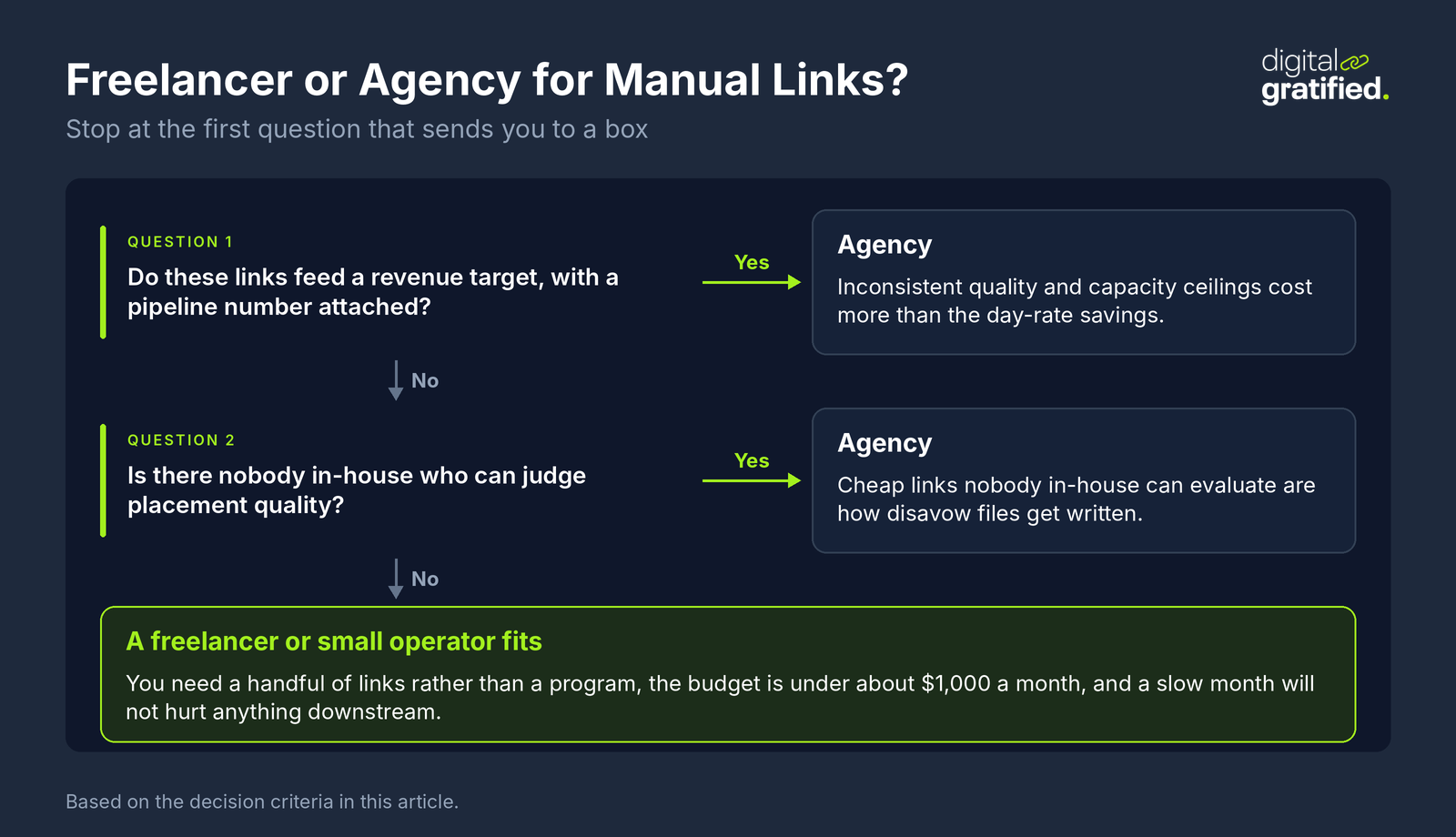
A freelancer or small operator makes sense when you need a handful of links rather than a program, your budget is under about $1,000 a month, someone on your team can independently judge placement quality, and a slow month won't hurt anything downstream. Early-stage companies filling specific gaps often fit this profile, and paying agency rates for it would be overkill.
It becomes a false economy when links are feeding a revenue target. If your organic pipeline has a number attached to it, the cost of inconsistent quality, capacity ceilings, and zero process redundancy exceeds the day-rate savings quickly. The same is true when nobody in-house can vet the placements: buying links you can't evaluate from the cheapest source available is how disavow files get written.
And if you're realizing mid-read that what you actually need is an ongoing partner rather than a one-off vendor, that's a different evaluation with different criteria. Our guide to choosing the best SaaS link building agency covers that decision properly.
The Bottom Line
"Manual link building service" spans everything from $4.50-an-hour gig work to five-figure retainers, and the label alone tells you almost nothing. What separates the tiers isn't the word manual; it's whether the process behind it involves real sites, real editors, and real editorial judgment.
Vet the process, not the pitch. Ask for recent SaaS placements, make providers walk through one link end to end, confirm who actually does the work, and treat guaranteed link counts as a closed door. Get those answers first, and the pricing tiers sort themselves: pay freelancer rates for freelancer-sized problems, agency rates when links carry a revenue number, and nothing at all to anyone who can't show you where their links live.
Manual Link Building Service: Frequently Asked Questions
What does a manual link building service do?
A human prospects relevant websites, contacts editors or site owners directly, and earns backlink placements in genuine content. It's the opposite of automated link building, which relies on software, link farms, or PBNs to place links at scale without editorial review.
How much does manual link building cost?
Gig marketplace rates start around $4.50 to $50 per hour, experienced freelancers charge $50 to $100 per hour, specialist agencies charge $80 to $500+ per link, and ongoing retainers run $3,000 to $10,000+ per month. Turnarounds for agency placements typically run 2 to 6 weeks.
Are cheap manual backlink services safe?
Usually not. At the lowest price points, the labor math can't support real outreach, so "manual" typically means hand-placed links on directories or private blog networks. Those placements violate Google's spam policies and put your rankings at risk, which is a bigger cost for SaaS companies that depend on organic pipeline.
How do I know if a provider's links are actually manual outreach?
Ask for live placements from the past 60 days and visit the sites: look for real authors, real audiences, and topically relevant content. Ask them to walk through one placement's outreach process end to end. Providers relying on networks can't describe genuine editorial back-and-forth, and their placements appear suspiciously fast.
Should a SaaS company hire a freelancer or an agency for link building?
A freelancer fits when you need a few links, budget is limited, and you can judge placement quality yourself. An agency fits when links support a revenue target, you need consistent volume, or you need SaaS-specific placements that require established editorial relationships and a repeatable process.
About the author
Let's Scale Your SaaS Together
Get a custom SEO and link building strategy tailored for your SaaS business.
Get SEO insights that actually move rankings
Link building tactics, case studies, and SaaS SEO playbooks. No fluff, no spam.
You're subscribed!
SEO and link building insights, straight to your inbox.