How SEO reseller services actually work, what every pricing model costs in 2026, the red flags that predict a bad partner, and when reselling beats full white label, written for agencies buying, not vendors selling.

Founder, Digital Gratified
SEO reseller services let agencies add SEO to their menu, keep their own brand on every deliverable, and skip the cost of hiring an in-house team. For many agencies the model works well. The most important decision, though, comes before choosing a provider. Is reselling right for your agency, and if it is, how do you pick a partner without inheriting their shortcuts?
This guide is written from the buyer's side, with no program to sign you up for at the end. It explains how the model works, what it costs across every pricing structure, the red flags that predict a bad partnership, and how the calculus changes when your clients are SaaS companies.
What an SEO Reseller Service Actually Is
An SEO reseller service is a productized version of outsourced SEO: a provider builds standardized SEO plans (deliverables, dashboards, rebrandable reports), and your agency resells those plans to clients under your own brand at a markup. The client sees your logo and your invoice. The provider stays invisible.
The workflow has one more hop than most agencies expect:
Your client buys an SEO package from you, believing your team delivers it.
Your agency resells a plan from the reseller provider, typically marking up 1.5x–2.5x.
The reseller provider manages the account through their platform and returns white-labeled deliverables and reports.
A backend team does the actual writing, link outreach, and technical work, and this is the hop that matters, because at some providers that team is a second layer of subcontractors you'll never meet.
That last link in the chain is where most reseller horror stories start, so hold onto it; it comes back in the red flags section.
SEO Reseller vs. White Label SEO: The Real Difference
The two terms get used interchangeably, and the overlap is real: in both models the client never sees the provider. The difference is depth.
Reselling is buying a product. You pick from the provider's fixed menu (Silver, Gold, Platinum), quote your margin on top, and the provider runs their standard playbook through their standard platform. Fast to start, minimal involvement required, minimal customization available.
White labeling is renting a team. The provider works from your briefs, adapts strategy per client, and functions like an invisible extension of your agency. More margin control and more strategic depth, but it demands more from you: detailed briefs, quality review, and enough SEO fluency to defend the strategy in a client meeting.
We've covered the full white-label model (economics, deliverables, client-relationship mechanics) in our guide to how agencies use white label SEO, so this post won't re-tread it. The short version for deciding between them: resell when clients have standard needs and SEO is a secondary offer; white label when SEO is a revenue line you're building deliberately. More on that decision at the end.
How Reseller Plans Are Packaged
Almost every reseller program sells through one of four structures, and knowing which one you're looking at makes vendor comparisons much faster:
Fixed packages: a set bundle (say 2 articles, 5 links, and a monthly report) at a set wholesale price. The easiest to resell and the easiest to outgrow, because no fixed bundle fits every client.
Tiered plans: the Basic/Standard/Premium ladder. Useful when your clients span very different budgets; risky when the bottom tier is deliberately thin so the provider can upsell your clients through you.
Monthly retainers: a wholesale monthly fee for an evolving scope. Closest to how real SEO work behaves, but demands the most trust, since "ongoing optimization" can hide a lot of idle months if reporting is vague.
Results-based pricing: pay per ranking achieved or a percentage of measured upside. It sounds like aligned incentives; in practice it incentivizes chasing easy, low-value keywords and cutting corners on link quality to hit trigger metrics. Approach with skepticism.
Many providers also sell à la carte services (individual links, single audits, content by the article) which work well for filling one specific gap without committing to a program.
What SEO Reseller Services Cost in 2026
Vendors quote pricing in fragments (a per-link rate here, an hourly band there) which makes comparison deliberately hard. Consolidated, the market looks like this:
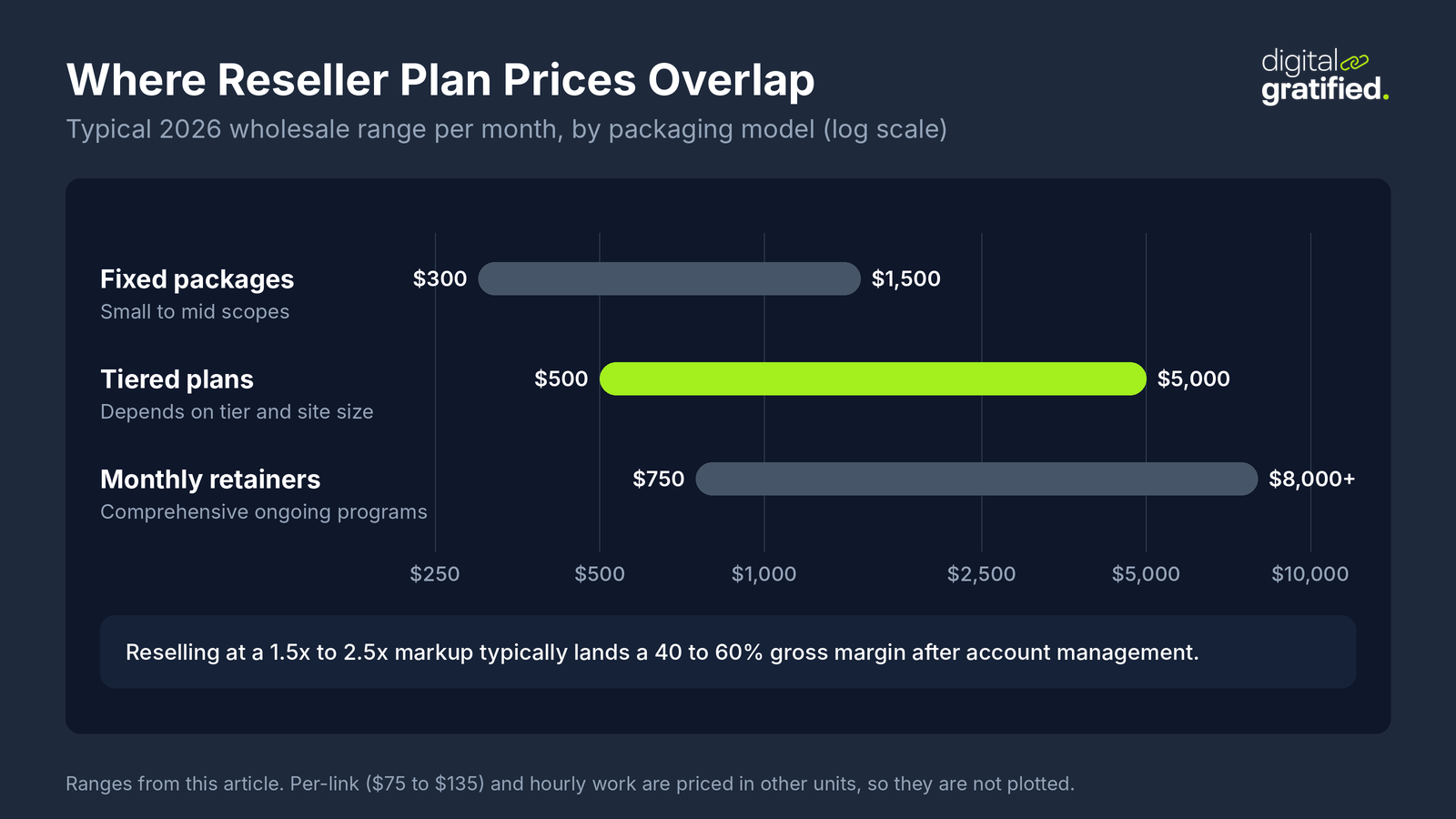
Fixed packages: roughly $300–$1,500/month wholesale for small-to-mid scopes.
Tiered plans: about $500–$5,000/month depending on tier and site size.
Retainers: $750–$8,000+/month for comprehensive ongoing programs.
Per-link pricing: quality placements typically run $75–$135 per link at reseller rates. Meaningfully below that range, assume link farms or PBNs until proven otherwise. (For what link pricing buys at each level, see our breakdown of link building pricing.)
Hourly and consulting work: individual specialists commonly bill $50–$150/hr, while established teams and agencies quote $500–$1,500/hr for senior strategic and technical work, the band you'll hit for audits, migrations, and penalty recovery.
On your side of the equation, most agencies mark reseller plans up 1.5x–2.5x, landing gross margins in the 40–60% range after account-management time. The margin math only works if the underlying deliverables hold up: a cheap plan you resell at 2.5x is still a cheap plan, and the client's results will eventually say so on your letterhead.
Red Flags When Vetting a Reseller Partner
Every reseller program's sales page says "white-hat" and "transparent reporting." These are the signals that actually separate partners from liabilities:
They won't tell you who does the work. The biggest structural risk in reselling is 4th-party subcontracting: the provider you vetted quietly farms delivery out to a cheaper team you never evaluated. Ask directly whether work is done in-house, and get it in the contract. A vague answer here is a complete answer.
Link sources they won't show you. If sample placements or a live link report aren't available before you sign, the links are coming from somewhere they'd rather you not see. Cheap-link practices are the single most common way a reseller relationship converts into a client penalty, and the penalty lands on your client's domain and your agency's reputation, not the provider's.
No QA layer before deliverables reach you. You should never be the first person reviewing an article or a link report. Ask what their internal review step looks like; if the answer is a blank stare, you've just been told you're the QA department.
Guaranteed rankings. Still the classic. Guarantees are only achievable on keywords with no competition and no revenue value, or through tactics that trade short-term movement for long-term risk.
Long lock-ins before any proof. A 12-month minimum before you've seen a single deliverable shifts all the risk onto you. Confident providers offer trial scopes or month-to-month starts.
Pricing far below the ranges above. Someone in the chain is absorbing that discount, and it's usually quality. A $40 "authority link" is not a bargain; it's a future disavow file.
Choosing a Partner When Your Clients Are SaaS Companies
Most reseller programs were built for local-business volume: citations, Google Business Profile tuning, generic blog content at scale. Sold to a plumber, that package is fine. Sold to a B2B SaaS client, it produces rankings that never touch pipeline, and the client's board notices the difference even if the ranking report looks green.
If your client roster is SaaS-heavy, add these filters on top of everything above:
Ask for SaaS-specific samples. Comparison pages, integration pages, use-case content: not "10 blog posts about your industry." If every sample is local or e-commerce, the playbook won't transfer.
Scrutinize link relevance over raw metrics. A placement on a niche developer blog or a G2-adjacent publication moves a SaaS client further than a higher-DR link from a general lifestyle site. A provider that only talks DR thresholds hasn't done this work. (If the fundamentals here are fuzzy, our primer on what link building is in SEO is the place to start.)
Check keyword intent in their reporting samples. SaaS buyers search narrow, high-intent phrases. A provider whose sample reports celebrate broad-volume keywords will burn your client's budget ranking for traffic that never signs up.
Confirm they can talk CAC and pipeline, not just sessions. Your SaaS clients will. Your partner needs to survive that conversation, because you'll be relaying it.
When Reseller Beats White Label (and When It Doesn't)
The honest version of this decision, without a program to sell you:
Reselling makes more sense when SEO is an add-on to your core service, your clients' needs are standard enough for a package to cover, you want to validate demand before hiring or committing to a deeper partnership, and speed to market matters more than strategic control. It's the lowest-effort way to stop saying no to SEO revenue.
Full white label makes more sense when SEO is becoming a real revenue line, your clients need custom strategy rather than fixed bundles, and you're prepared to invest in briefs and quality review in exchange for better margins and better results. This is almost always the right answer for agencies serving SaaS clients, whose needs rarely fit a productized tier, and if link building is the piece you'd hand off first, that's exactly what our white label link building program is built for.
Neither makes sense when your total outsourced spend consistently exceeds the fully loaded cost of an in-house hire, or when your agency's pitch is deep hands-on involvement that outsourcing would quietly contradict. We've run the full build-vs-buy numbers in our guide to outsourcing SEO if you're near that threshold.
The Bottom Line
The reseller model works. What doesn't work is treating the decision as a formality and the vendor list as interchangeable. Resell when SEO is a side offer and a standardized package genuinely covers your clients' needs; go white label when SEO is a revenue line you're building on purpose, especially if your clients are SaaS companies, whose playbooks rarely fit a productized tier.
Whichever model you land on, the vetting bar is the same: know who actually does the work all the way down the chain, see real deliverables before you commit, and never sign a lock-in before the first proof of quality. Pick the model that matches where SEO sits in your business today, and re-evaluate once a year: the right answer at 5 clients is rarely still the right answer at 25.
SEO Reseller Services: Frequently Asked Questions
What is an SEO reseller program?
An SEO reseller program is a provider's packaged offering that lets agencies sell SEO services under their own brand. The provider supplies the plans, platform, and white-labeled deliverables at wholesale rates; the agency sets client pricing and owns the relationship.
How much do SEO reseller services cost?
Wholesale pricing runs roughly $300–$1,500/month for fixed packages, $500–$5,000/month for tiered plans, and $750–$8,000+/month for retainers. Quality links resell at $75–$135 each, and senior consulting from established teams runs $500–$1,500/hour. Agencies typically mark plans up 1.5x–2.5x.
Is an SEO reseller the same as white label SEO?
They overlap but aren't identical. Reselling means selling a provider's fixed, productized plans under your brand; white labeling means a provider works from your briefs like an invisible extension of your team. Reselling is faster to start; white labeling offers more customization and strategic depth.
What's the biggest risk of using an SEO reseller?
Losing visibility into who actually does the work. Some providers subcontract delivery to a fourth party you never vetted, which is where quality collapses and penalty-risk link practices creep in. Always confirm (contractually) whether work stays in-house.
Should a SaaS-focused agency use an SEO reseller program?
Usually only for narrow, standardized gaps. Most reseller packages were designed for local businesses, and their content and link playbooks translate poorly to SaaS, where page types, keyword intent, and link relevance are more specific. SaaS-heavy agencies generally get better results from a white label partner with demonstrated SaaS experience.
About the author
Let's Scale Your SaaS Together
Get a custom SEO and link building strategy tailored for your SaaS business.
Get SEO insights that actually move rankings
Link building tactics, case studies, and SaaS SEO playbooks. No fluff, no spam.
You're subscribed!
SEO and link building insights, straight to your inbox.