Most guides say link building helps SEO because links are 'like votes.' That's incomplete. This guide explains the actual mechanism: how PageRank flows, what makes a link valuable, realistic timelines, and when links aren't even your bottleneck.
Digital Gratified
SaaS SEO Experts
Ask most people how link building helps SEO and they'll say something like "it helps Google trust your site." That's true, but it's also incomplete in ways that matter. Because understanding the precise mechanism behind how links work changes everything: which sites you target, what volume you need, and what patience is actually justified.
This guide covers what link building actually is in SEO, the mechanism by which it moves rankings, what separates a valuable link from a useless one, and an honest look at when links aren't even the problem you should be solving.
If you're focused on software businesses specifically, our complete playbook on SaaS link building covers the strategies, agency vs. in-house decision, and budget frameworks that apply to B2B SaaS.
What Is Link Building in SEO?
Link building is the process of acquiring hyperlinks from other websites that point to pages on your own site. These inbound links (commonly called backlinks) are signals that search engines like Google use to evaluate how trustworthy, authoritative, and relevant a webpage is.
It's worth separating two things people often conflate:
- Earning links naturally someone links to your content because they found it genuinely useful, without you having to ask
- Building links proactively outreach, digital PR, creating link-worthy assets specifically designed to attract backlinks
Both contribute to the same outcome: a stronger backlink profile that helps your pages rank in competitive search results. Most businesses need to pursue both, especially in competitive niches where waiting for organic link acquisition isn't a viable strategy.
Link building sits firmly under off-page SEO: actions taken outside your website that affect how search engines perceive it. It's distinct from on-page SEO (your content, headings, and metadata) and technical SEO (crawlability, site speed, indexation). All three matter, but in competitive spaces, backlinks are often the decisive factor.
The Mechanism: How Links Actually Move Rankings
Most guides stop at "it's like a vote." The actual mechanism is more specific, and understanding it makes you a better link builder.
Google's original PageRank algorithm works on a recursive principle: a page that is linked to by many high-quality pages is itself likely a high-quality page. And crucially, that quality is transferred when a trusted page links to your page, a portion of its authority flows through to yours.
Think of it less like a vote and more like a referral from someone whose opinion carries real weight in your industry. A recommendation from a widely-read publication carries more signal than a mention from a newly created blog with no readership. The same logic applies to links.
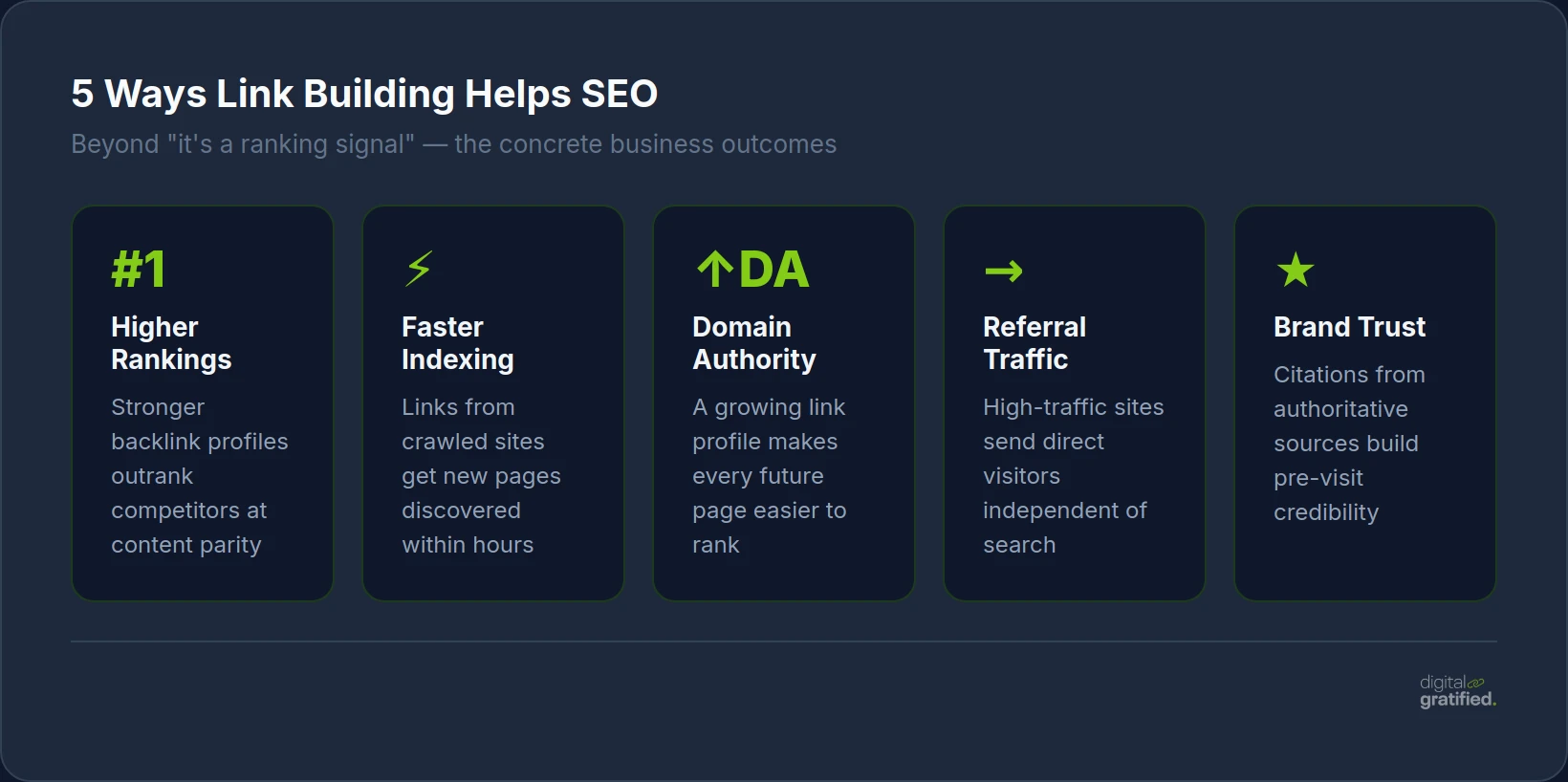
Here's what actually happens when you earn a quality backlink:
- Crawl discovery Google's crawlers follow links. When an already-crawled site links to a new page on your site, that page gets discovered and indexed faster than if it existed without any inbound links.
- PageRank flow A portion of the referring page's PageRank score flows through the link to your page. The more PageRank the linking page has, the more it can pass.
- Trust transfer Links from sites with established trust (built over years, across many topics) transfer credibility signals in ways that newer sites cannot replicate.
- Topical relevance signals The anchor text and the surrounding content context tell Google what your linked page is about, reinforcing its topical relevance for target keywords.
- Link profile diversity A natural mix of referring domains, link types, and anchor texts signals an organic, non-manipulated backlink profile that Google is less likely to discount.
This flow isn't unlimited. Each link on a page dilutes the PageRank it can pass: a link buried among 200 others on a page passes far less than one featured prominently on a focused editorial piece. Placement matters.
For a data-driven view of how this translates into real ranking differences, our link building statistics round-up shows that top-ranking pages carry 3.8x more backlinks than pages ranked #2–#10: a consistent pattern across studies.
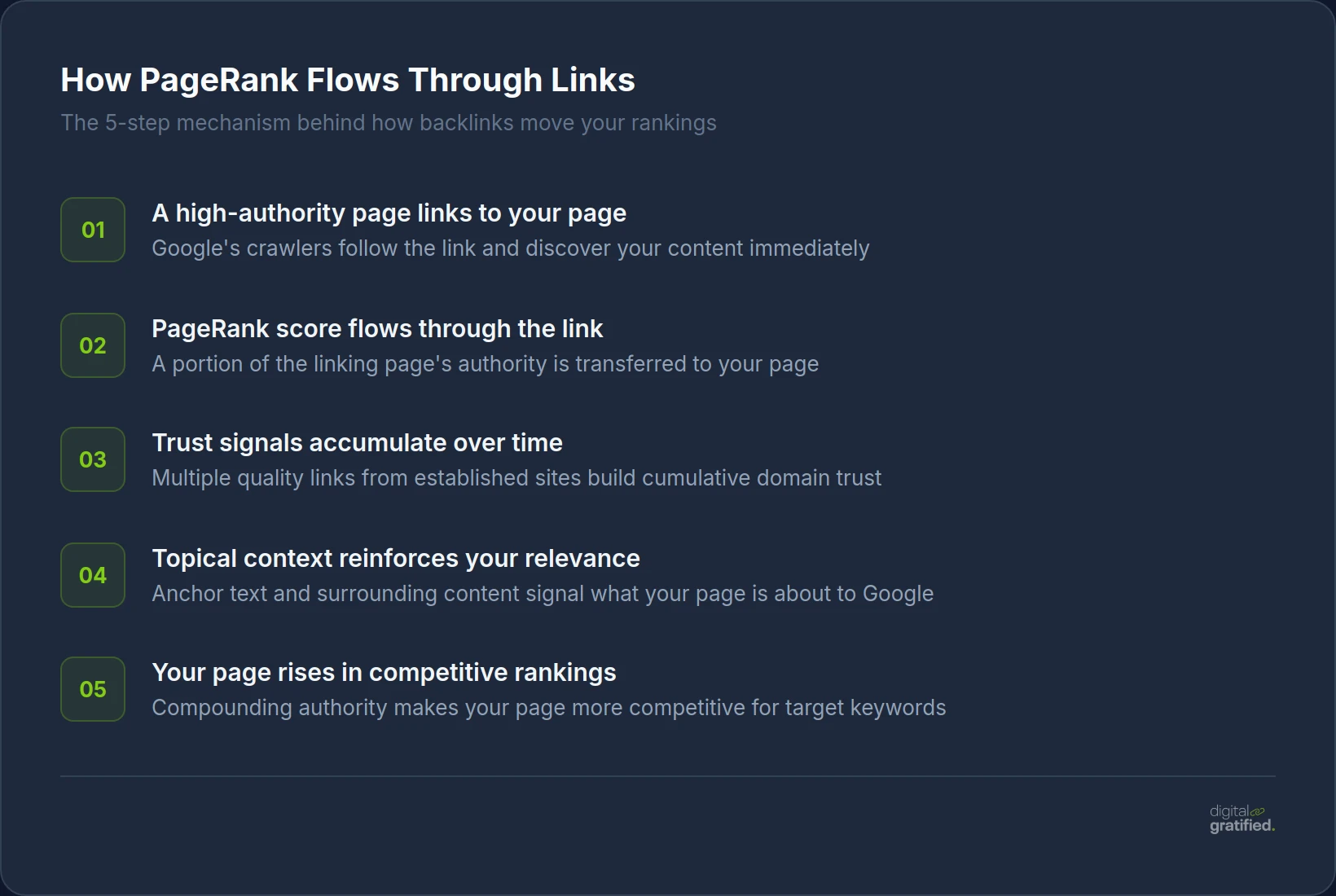
5 Concrete Ways Link Building Helps SEO
1. Rankings
The most direct benefit. Pages with stronger, more relevant backlink profiles tend to outrank pages with weaker ones (assuming content quality is comparable). Google has publicly confirmed that backlinks are one of its top three ranking signals. At parity of content quality and technical SEO, the page with the better link profile typically wins.
2. Faster Indexing
Google discovers new content by crawling links. A page with no inbound links may wait days or weeks to be indexed. A page that earns a link from a site that Google crawls frequently gets discovered and indexed much faster, sometimes within hours. For businesses publishing time-sensitive content, this difference matters significantly.
3. Domain Authority (Halo Effect)
Strong backlinks don't just help the specific page they point to. Over time, a consistently growing link profile raises the overall authority of your domain, making it easier to rank new pages (even before those pages have accumulated their own direct backlinks). This halo effect compounds: the stronger your domain becomes, the easier each subsequent piece of content is to rank.
4. Referral Traffic
Links from high-traffic publications and industry sites send direct visitors to your pages, completely independent of search rankings. These visitors tend to convert better than average organic traffic because they arrived from a contextually relevant source that implicitly endorsed your content. A single link from the right publication can drive consistent referral traffic for years.
5. Brand Visibility and Trust
Being cited by authoritative sources in your industry increases brand recognition in ways that advertising can't fully replicate. If a prospective customer encounters your brand cited in three industry publications before they reach your site, they arrive with pre-built trust, affecting conversion rates, lead quality, and the ease of sales conversations.
What Makes a Link Actually Valuable?
Not all backlinks help equally. Some have almost no SEO impact. Some (if acquired through manipulation) can actively harm your rankings. Here's what separates a link that moves the needle from one that doesn't:
Authority of the Linking Domain
A link from a site with a high Domain Rating (DR) or Domain Authority (DA) carries more PageRank weight than a link from a brand-new or low-traffic site. However, an unnaturally uniform profile of only high-DR links can itself look suspicious. A healthy backlink profile includes a natural distribution across authority levels.
Topical Relevance
A link from a site in your industry, or from a piece of content directly related to your page's topic, carries significantly more weight than a link from an unrelated domain with the same authority score. If you run a SaaS company, a backlink from a SaaS-focused publication is worth considerably more than a generic directory listing with equivalent DR.
Anchor Text
The clickable text of a link signals to search engines what the linked page is about. Exact-match anchors are powerful but should represent a small percentage of your overall anchor text profile. A natural mix includes branded anchors, partial-match phrases, generic terms like "read more," and naked URLs. Over-optimising anchor text is one of the clearest signs of a manipulated link profile.
Link Placement
A link embedded within the body copy of an editorial article is worth substantially more than a link in a sidebar, footer, author bio, or navigation. In-content links carry the implicit endorsement of the editorial team. Google's "reasonable surfer" model factors in how likely a user is to actually click a given link: prominent, contextually relevant in-content links score higher.
Follow vs. Nofollow
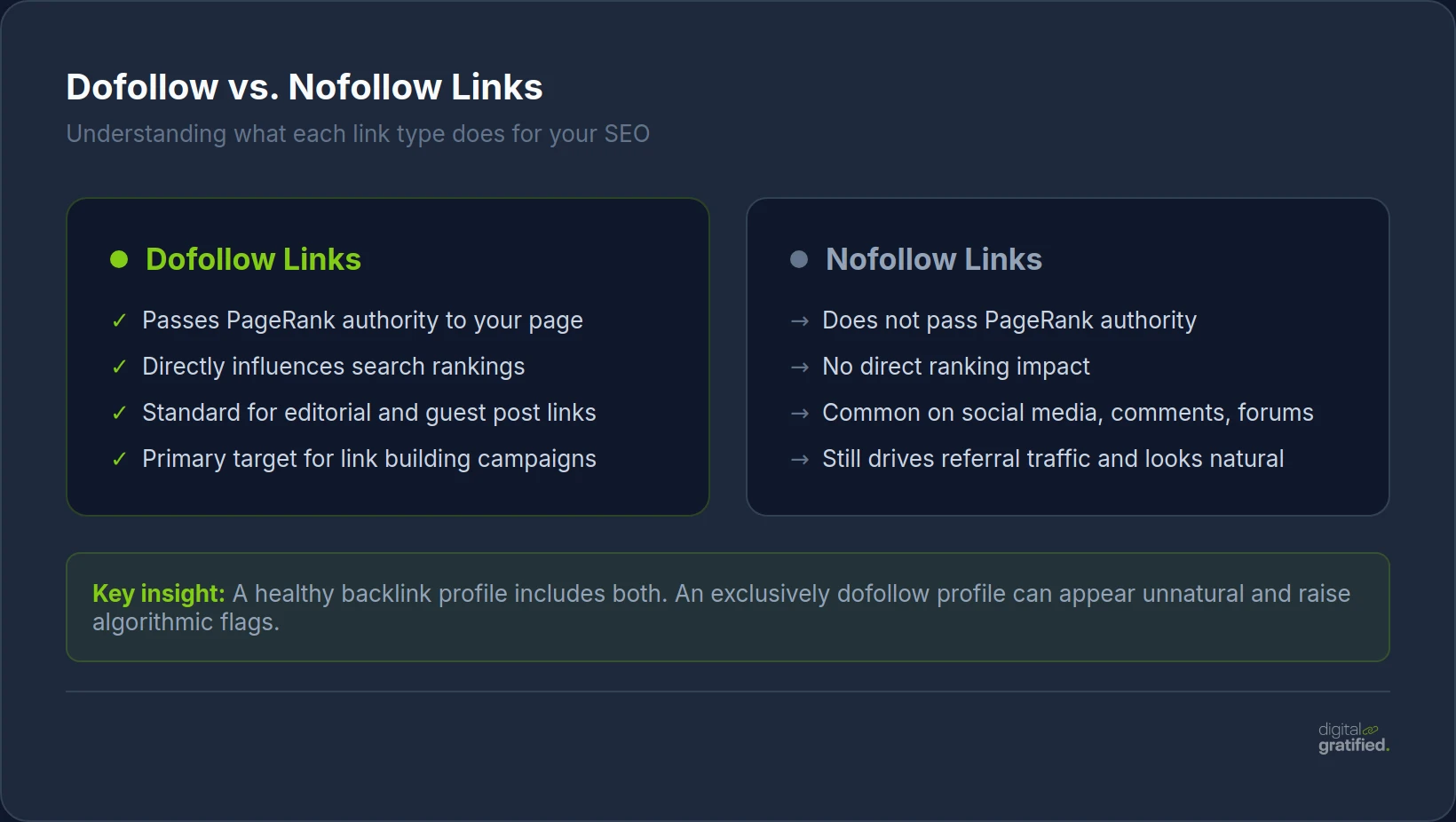
Dofollow links pass PageRank and count toward your authority. Nofollow links (marked with rel="nofollow") tell search engines not to pass authority through the link. Most editorial backlinks and guest posts are dofollow. Social media links, comment sections, and many press releases are nofollow. Both types contribute to a natural-looking backlink profile, but dofollow links are what directly influence rankings.
Link Types: What They Mean for SEO
Understanding the different link types helps you build a profile that's both effective and defensible.
Dofollow vs. Nofollow Links
Dofollow links pass PageRank and authority to the linked page. These are what most link building efforts target. Nofollow links contain a rel="nofollow" attribute that tells search engines not to pass ranking credit. While nofollow links don't directly move rankings, they contribute to a natural-looking profile and can still drive valuable referral traffic.
A red flag in backlink auditing is a profile that's overwhelmingly dofollow with suspicious uniformity: a natural profile always includes a mix of both.
Internal vs. External Links
External backlinks (from other websites to yours) build your domain's authority in the eyes of search engines. the complete internal linking guides (between pages on your own website) distribute that authority across your site and help search engines understand your content hierarchy and topical depth. Link building typically refers to external backlinks, but internal linking strategy is equally important for ensuring your domain authority reaches the pages that need it most.
Earned vs. Built vs. Bought
Earned links are naturally acquired without outreach. Built links come from proactive campaigns: guest posts, digital PR, outreach. Bought links (paid placements without disclosure) violate Google's guidelines and risk manual penalties. Google has become increasingly sophisticated at identifying patterns of paid link acquisition, making the risk-reward calculus clearly unfavourable.
Realistic Timelines: How Long Before Link Building Shows Results?
This is where most people get link building wrong: not strategically, but in their expectations. Link building is a compounding investment, not an immediate fix.
- 0–3 months: New links get indexed. Some minor ranking fluctuations may appear, particularly on pages that previously had a very weak link profile. Don't expect dramatic changes yet.
- 3–6 months: Links from high-authority sites begin influencing rankings on pages targeting lower-competition keywords. Referral traffic from linked placements starts materialising.
- 6–12 months: Measurable ranking improvements on target keywords. Domain authority trends upward, making new pages easier to rank with less direct link effort.
- 12+ months: Compounding effect. A consistently built backlink profile creates a competitive moat that takes competitors significant time and budget to match.
The pace depends on: the current strength of your backlink profile, the competitiveness of your target keywords, the quality and relevance of links you're building, and the strength of the content those links point to. Weak content, regardless of link volume, doesn't sustain rankings.
Link Building in the AI Search Era
The rise of AI-powered search (Google AI Overviews, ChatGPT, Perplexity) hasn't made link building obsolete. If anything, it's made the quality of your authority profile more consequential.
AI systems still draw heavily from pages that rank in traditional search results, and those results still depend significantly on backlinks. As we cover in depth in our guide to the future of link building in the AI search era, brand mentions and entity recognition are becoming parallel authority signals alongside links, meaning your goal isn't just link quantity, but becoming a frequently cited, trusted source that both humans and AI systems recognise as authoritative.
The practical implication: investing in digital PR and editorial placements that earn both backlinks and brand mentions is higher-value than ever. Links that come without brand recognition are increasingly less valuable than links that accompany it.
When Link Building Is NOT Your Bottleneck
Here's the honest part most link building guides skip: sometimes, links aren't the problem.
If your pages aren't ranking despite having a reasonable number of backlinks, the bottleneck might be elsewhere:
- Search intent mismatch Targeting the right keyword with the wrong content format. If Google is ranking comparison pages and you published a blog post, more links won't fix the mismatch.
- Technical SEO issues Crawl errors, slow page speed, poor Core Web Vitals, or indexation blocks can prevent rankings regardless of link strength.
- Competing for keywords beyond your current authority Building topical depth on lower-competition keywords first compounds into easier wins on head terms later.
- Thin or low-quality content Links amplify strong content. They don't compensate for content that doesn't satisfy the search query.
At Digital Gratified, we audit these fundamentals before scaling any link building campaign. Links built on a weak foundation are effort and budget that could have been better spent, and in some cases, they can mask underlying issues that would have been cheaper to fix earlier.
How to Start Building Links
The approaches that consistently deliver results across industries and budgets:
- Digital PR Create research, data studies, or genuinely newsworthy content that journalists and bloggers want to cite. High effort, high reward, and the best source of high-authority editorial links.
- Guest posting Write original, high-quality articles for publications in your industry in exchange for an editorial backlink. The relevance and authority of the publication matters far more than volume.
- Link-worthy content assets Build tools, calculators, original research, or comprehensive guides that attract natural links over time without ongoing outreach effort.
- Broken link building Find broken links on relevant sites pointing to resources that no longer exist, then offer your content as a replacement. Mutually beneficial and highly scalable.
- Outreach campaigns Proactively reach out to site owners, editors, and journalists who would genuinely benefit from linking to your content. Our guide to link building outreach covers how to build a system that consistently gets replies.
If you're evaluating whether to do link building in-house, work with freelancers, or engage a specialist agency, our link building pricing guide breaks down realistic costs and what you actually get at each investment level.
Frequently Asked Questions
Is link building still important in 2026?
Yes. Google continues to list backlinks among its top three ranking signals. Our link building statistics round-up shows that 93.8% of link builders report positive ranking improvements, and 52% of SEO professionals say link building delivers the highest ROI of any SEO activity. The tactics have evolved; the underlying signal hasn't diminished.
How many backlinks do I need to rank?
There's no universal number. What matters is having a stronger and more relevant link profile than the pages you're competing against for a given keyword. Use tools like Ahrefs or Semrush to audit competitor backlink profiles for the specific keywords you're targeting. That gives you a realistic benchmark.
What's the difference between link building and link earning?
Link earning is organic: people link to you because your content is genuinely valuable, without you having to ask. Link building is proactive: you create assets and run outreach specifically to acquire backlinks. The most effective strategies incorporate both: build content worth linking to, then actively get it in front of people who would benefit from referencing it.
Can bad backlinks hurt my rankings?
Links from spammy, irrelevant, or manipulative sources can harm your rankings, particularly if Google interprets the pattern as an attempt to game the algorithm. Regularly auditing your backlink profile and using Google's Disavow Tool for genuinely toxic links is good housekeeping, especially for sites with several years of history or those that have changed ownership.
What's the difference between dofollow and nofollow links?
Dofollow links pass PageRank and authority to the linked page, directly influencing rankings. Nofollow links carry an attribute telling search engines not to follow the link or pass authority. Most high-value editorial links are dofollow. A healthy backlink profile includes both types: an exclusively dofollow profile can itself appear unnatural to search engines.
Let's Scale Your SaaS Together
Get a custom SEO and link building strategy tailored for your SaaS business.
Get SEO insights that actually move rankings
Link building tactics, case studies, and SaaS SEO playbooks. No fluff, no spam.
You're subscribed!
SEO and link building insights, straight to your inbox.