What white label SEO actually means, how it works step by step, what it costs in 2026, and how agencies serving SaaS clients use it to scale without getting burned.

Founder, Digital Gratified
If you've ever taken on a client who wants SEO, and you don't have anyone in-house who can actually deliver it, you've probably already looked into white label SEO. Maybe you're mid-way through a Google search right now trying to figure out if it's a legit option or a way to get burned by an agency that doesn't care about your client's rankings as much as you do.
Here's the short version: it's legit, and most agencies use some version of it whether they call it that or not. The harder question isn't whether white labeling works. It's whether it's the right call for your agency right now, what it should cost, how to avoid the providers who'll quietly damage a client relationship you spent months building, and why the playbook looks different if your clients happen to be SaaS companies.
That's what the rest of this guide covers.
What Is White Label SEO?
White label SEO is when an outside provider does the actual SEO work (audits, content, link building, technical fixes, whatever the scope calls for) and you deliver it to your client under your own agency's name. The client never knows a third party touched it. You keep the relationship, you keep the invoice, and the provider stays completely out of sight. Viewed from the agency's side, packaging and marking up that outsourced work, this same arrangement is what most providers call SEO reseller services.
It's not the same as just subcontracting a freelancer. With true white labeling, the provider builds their entire process around staying invisible: no branded reports, no direct client contact, sometimes not even their name on an NDA the client could stumble across. Reports come with your logo already on them. Emails, if the provider sends any at all, come from an address with your domain. You're not managing a vendor your client knows about. You're running a service they think you built yourself.
This distinction matters more than it sounds like it should, because the two models create very different risks. Subcontracting a freelancer who occasionally emails a client directly, or whose name shows up in a shared Google Doc, is one accidental slip away from the client finding out. A properly structured white label relationship removes that risk almost entirely, because the provider was built from day one to never be seen.
How It Actually Works, Step by Step
You sign on with a provider. This is where the pricing, deliverables, turnaround windows, and NDA terms get set. Most providers have a standard onboarding call to understand your typical client profile so they can calibrate scope and pricing before you send your first project.
You quote the client under your own pricing, with your margin built in on top of whatever the provider charges you. The client sees a single line item on your invoice, not a breakdown of what you're paying someone else.
You hand off the details: the client's site, their competitors, their goals, any existing SEO history you have. This step is where most white label relationships succeed or fail. A thin brief with just a URL and "do SEO" produces generic work. A detailed brief with context on the client's business, their previous SEO attempts, and what "success" actually looks like to them produces work that's genuinely usable.
The provider does the work and sends it back to you, usually with data and reporting you can rebrand. Turnaround times vary by deliverable: content and audits typically take days, link building campaigns often take weeks since outreach and placement aren't instant.
You deliver it to the client as your own. They see your logo, your report template, your account manager. That's it. If they ask a follow-up question, you're the one answering it, which means you need to understand the work well enough to field that question without going back to the provider first.
The part agencies get wrong most often is step 3. If you hand a provider a thin brief, you get thin work back, and then you're the one explaining to the client why the results feel generic. The best white label relationships look almost like an internal team handoff: detailed context in, detailed strategy out.
Why Agencies Actually Do This
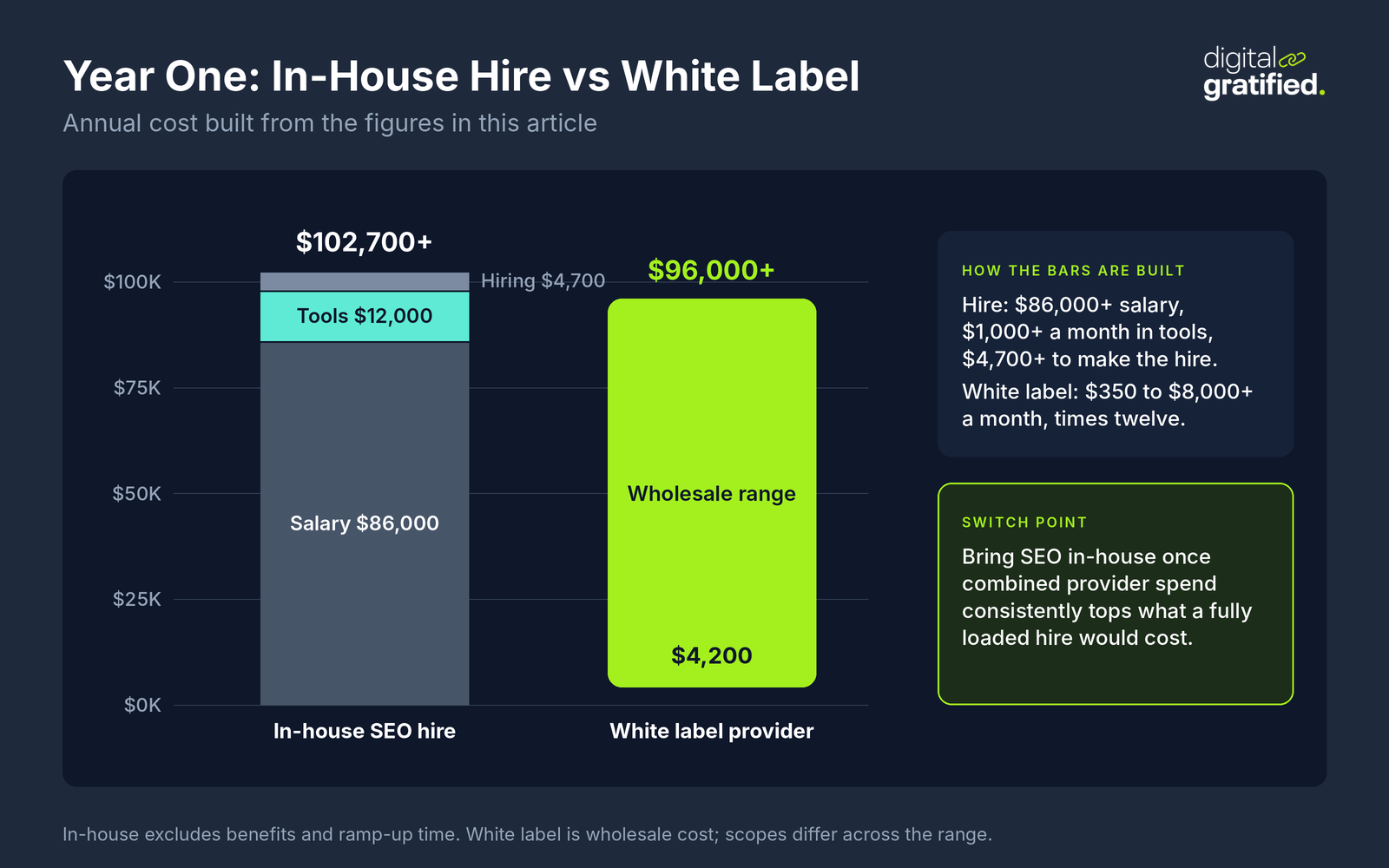
They can't hire fast enough. A decent SEO specialist runs over $86,000 a year on average in the US before benefits, tools, and the months it takes to actually get someone productive, and that's before you factor in the roughly $4,700+ average cost just to make the hire in the first place. If you land a client this week and they expect work starting next week, hiring simply isn't fast enough. White labeling gets you that expertise immediately.
The tooling cost disappears. An SEO suite, a crawler, a rank tracker: that's easily $1,000+ a month before anyone's even done any work, and that's assuming you only need one seat per tool. A white label partner already has all of it, amortized across dozens of client accounts instead of just yours.
You can say yes to more clients. If your pipeline is unpredictable, hiring ahead of demand is a bad bet, and hiring behind demand means turning down work or delivering it late. White labeling scales up or down with whatever's actually in front of you this month, without the fixed cost of a salary sitting on your books during a slow quarter.
You get access to specialists you couldn't justify hiring. Technical SEO, link building outreach, and increasingly AI SEO for SaaS companies are each their own skill set, and genuinely good people in each of those lanes are hard to find and expensive to keep. Very few agencies have all three in-house, and white labeling is often the only realistic way to offer all of them without hiring three different specialists for a handful of clients who might not stick around long enough to justify the headcount.
What You Can (and Can't) Reasonably White Label
Almost any SEO deliverable can be outsourced this way, but some hold up better than others when you're the one whose name is on it:
Link building: probably the single most commonly white-labeled service, and for good reason. Outreach, relationship-building, and how link building actually works take real time most agencies don't have spare, and quality varies enormously between providers based on whether they're doing genuine outreach or buying placements on link farms.
Content writing: blog posts, landing pages, anything that needs to be both readable and structured for search. This is usually the easiest thing to white label well, since a good writer with a clear brief and access to a style guide can match your client's voice closely enough that the seams don't show.
Technical audits: crawl issues, Core Web Vitals, schema, the stuff that requires someone who lives in the weeds of how search engines actually crawl and render a site. This work is highly technical but also highly standardized, which makes it well suited to a provider who runs the same audit framework across many clients.
Local SEO and citations: repetitive, detail-heavy, and easy to hand off cleanly, since the work involves getting business information consistent across dozens of directories rather than anything that requires deep familiarity with a specific client's brand voice.
Keyword research: time-consuming but well-suited to a specialist who does it daily across many clients and has developed a fast, repeatable process for separating genuinely valuable keyword opportunities from vanity-metric volume.
What holds up less well: strategy and client-facing communication. You can white label the execution, but if you also white label the thinking behind it, you'll eventually get caught flat when a client asks a strategic question you can't answer in the room. Keep the strategy layer close, even if the delivery layer is outsourced. The agencies that get burned by white labeling are usually the ones who outsourced the thinking along with the doing.
What White Label SEO Actually Costs in 2026
Pricing varies a lot depending on scope, but three models show up again and again:
Flat monthly retainers: a fixed set of deliverables (say, 4 blog posts and 10 backlinks) for a fixed monthly fee. Predictable, easy to resell, the most common model by far. This works well when a client's needs are steady month to month and you both know roughly what to expect.
Hourly or bank-of-hours: better suited to one-off work like a technical audit or a migration, where scope is hard to pin down in advance. You buy a block of hours (commonly 15-25) and the provider works through whatever's highest priority within that window.
Tiered packages: Basic/Standard/Premium style structures that let you serve very different client budgets through one provider relationship. A basic tier might cover local citations and a couple of blog posts; a premium tier adds comprehensive link building, ongoing technical work, and more frequent reporting.
Wholesale pricing (what the provider charges you) commonly runs anywhere from $350 a month for a light local package up to $8,000+ a month for a comprehensive program on a larger site. On markup: most agencies charge their clients somewhere between 1.5x and 2.5x what they pay the provider, which typically lands in the 45-60% gross margin range once you account for account management time. If a provider is quoting you $1,500 a month, charging the client $2,250-$3,000 is a normal, sustainable range, not price gouging. Link building pricing tends to follow its own logic worth understanding separately, since it's usually the single biggest line item in a white label scope and the one where quality varies the most for a given price point.
The cheapest providers are rarely worth it. A bargain-basement retainer that produces thin content or spammy links doesn't just fail to rank. It can actively damage a client's site through low-quality backlinks or duplicate, thin content, and that damage lands on your agency's reputation, not the provider's, since the client only ever sees your name on it.
The SaaS Angle: Why This Looks Different for Agencies Serving SaaS Clients
Most white label SEO guides are written with local businesses in mind: plumbers, dentists, regional e-commerce. If your clients are SaaS companies, the playbook shifts in a few important ways, and a provider who's only ever done local citation work will default to a strategy that doesn't fit.
SaaS SEO isn't really about ranking a blog. It's about ranking the right page types: comparison pages, integration pages, category pages, alongside a link building strategy built around SaaS-specific opportunities like review platforms (G2, Capterra) and integration partner directories. A generic white label provider used to churning out local citations and volume-driven blog content usually doesn't have this playbook memorized, and it shows up in the results within the first few months, when rankings move but pipeline doesn't.
There's also a keyword-intent gap worth watching for. A local-focused provider is trained to chase high-volume, broad terms. SaaS buyers search narrower, more specific phrases (a particular integration, a particular use case, a comparison against a named competitor), and a provider who defaults to broad-volume targeting will burn budget on content that ranks but never converts.
If you're an agency picking up SaaS clients, look specifically for a white label partner who understands SaaS-specific link building, one that gets why a backlink from a niche dev tool blog can outperform a backlink from a huge but irrelevant general publication. This is a narrower ask than "does SEO," and it's worth being picky about, even if it means paying a bit more for genuine specialization instead of a generalist rate. If you'd rather hand this off entirely, this is also exactly what our white label link building program was built for.
When White Labeling Doesn't Make Sense
It's worth being honest that white labeling isn't the right call for every agency at every stage. If you have exactly one or two SEO clients and the workload is steady and predictable, the margin you're giving up to a provider might not be worth it compared to hiring a single generalist who can also help with other services. White labeling earns its keep specifically when demand is uneven, when you need specialist skills you can't justify a full salary for, or when you're testing whether SEO is a service worth building around before committing to headcount.
It's also worth pausing if your agency's whole value proposition to clients is deep, hands-on strategic involvement. If a client chose you specifically because they wanted your team's brains on their account, quietly outsourcing most of the execution (even well) can feel like a bait and switch if they ever find out, regardless of the quality of the work itself.
How to Pick a White Label Partner You Won't Regret
A few things worth actually checking before you sign anything:
Ask for real case studies, not just testimonials. Testimonials are easy to cherry-pick; a case study with real numbers, a real timeline, and enough detail to be checkable is harder to fake.
Check their turnaround commitments against your client promises. If you're telling clients "monthly reporting," make sure your provider can hit that reliably, not "usually," and ask what happens operationally when they fall behind on a batch of clients at once.
Look for flexible contract terms. Anyone locking you into a 12-month commitment before you've seen a single deliverable is asking you to take on risk they won't share. A provider confident in their own work should be comfortable starting with a shorter trial period.
Ask directly how they handle AI search and GEO. This isn't a niche question anymore. A provider with no answer here is behind, not just cautious, and that gap will show up in your client's results within a year.
Get clear on communication channels up front. Regular updates and a shared project tool prevent the "what's actually happening with this client" panic three weeks in, and they give you something concrete to point to if a client ever asks for a status update you weren't expecting.
Red Flags Worth Walking Away From
Pricing that seems too good to be true for the deliverables promised. It usually is, and the gap gets made up somewhere: thinner content, fewer or lower-quality links, or a provider who's overextended across too many accounts to give yours real attention.
No willingness to share sample deliverables or past work before you commit. A provider confident in their quality will show you examples without much resistance.
Vague answers about who's actually doing the work. Some providers subcontract further down the chain without telling you, which means you've lost visibility into quality control entirely and have no real idea whose hands your client's site is in.
Long-term lock-in contracts with no easy exit. If the relationship sours or the work underperforms, you need a way out that doesn't require a legal fight.
No process for quality assurance before work reaches you. You should never be the first set of eyes on a deliverable before it goes to a client, and a provider who skips their own QA step is telling you something about how they operate under pressure.
Keeping the Client Relationship Intact
The biggest operational risk in white labeling isn't the SEO work itself. It's the moment a client finds out a third party is involved and starts wondering what else you've been hiding. A few habits keep that from happening:
Never forward a provider's report unedited. Even a well-branded template from your provider carries small tells (a phrase you wouldn't use, a formatting choice that doesn't match your other client deliverables). Take the extra 20 minutes to rewrite the summary in your own voice before it goes out.
Own the strategic calls, even when you didn't do the analysis. If a provider recommends a change in direction, don't just relay it. Understand why they're recommending it well enough that you could defend the decision in a client call without notes. Clients aren't paying for someone to be a mail carrier between them and a vendor; they're paying for judgment.
Build in a review step before anything ships. This is the single most common thing agencies skip when they're busy, and it's the one that causes the most damage when a provider has an off week. A 15-minute skim before delivery catches typos, tone mismatches, and the occasional factual error that a client would absolutely notice.
Decide in advance what you'll say if a client asks directly. You don't need to volunteer that you use a white label partner, but if a client asks outright whether you outsource any work, have an honest answer ready. Getting caught improvising in that moment is far worse than the actual disclosure would have been, and most clients care less about the outsourcing itself than about feeling like they were misled.
Bringing It In-House Later
White labeling isn't necessarily forever. Plenty of agencies use it as a bridge, proving out client demand and revenue before investing in a full in-house team. If that's your plan, keep detailed documentation from your provider along the way (what's been done, why, what's working, what the client's specific quirks and preferences are) so the eventual handoff to an internal team doesn't start from zero.
A reasonable trigger point for making the switch: once you're consistently paying a provider more per month, across all your accounts combined, than a full-time hire would cost you fully loaded. Before that threshold, the flexibility usually outweighs the savings. After it, the math starts to favor bringing the work in-house, assuming you can find and keep the right person.
If you're weighing white labeling against building in-house from the start, the real cost of outsourcing SEO is worth running the numbers on directly, since the breakeven point is usually further out than people expect.
White Label SEO: Frequently Asked Questions
Is white label SEO the same as outsourcing?
Not quite. All white labeling is a form of outsourcing, but not all outsourcing is white labeled. The defining feature of white label SEO is that the client never knows a third party is involved: the work is delivered entirely under your brand, with no visible trace of who actually did it.
Is white label SEO ethical?
Yes, as long as the work itself is legitimate and delivers real results. The client is paying your agency for an outcome, not for the org chart behind it. Where it becomes a problem is when quality is sacrificed and the client is misled about what they're getting for their money. That's a quality and honesty issue, not an issue with the white label model itself.
How much does white label SEO cost?
Wholesale pricing from providers typically runs $350-$8,000+ a month depending on scope, with agencies marking up 1.5x-2.5x to set client pricing. Small local packages start lower; comprehensive programs for larger sites cost more, and link building specifically tends to be the largest single line item in most scopes.
Can I white label SEO for SaaS clients specifically?
Yes, but look for a provider with actual SaaS experience. The page types, keyword intent, and link building channels that work for SaaS are different from local or e-commerce SEO, and a generalist provider often defaults to a playbook that doesn't fit, which shows up as rankings without pipeline.
When should an agency bring SEO in-house instead of white labeling?
Once your combined monthly spend across white label providers consistently exceeds what a fully loaded in-house hire would cost, the math usually starts favoring bringing the work in-house, assuming you have enough steady volume to keep that person busy year-round.
About the author
Let's Scale Your SaaS Together
Get a custom SEO and link building strategy tailored for your SaaS business.
Get SEO insights that actually move rankings
Link building tactics, case studies, and SaaS SEO playbooks. No fluff, no spam.
You're subscribed!
SEO and link building insights, straight to your inbox.