When SaaS teams search for 'AI SEO,' they're usually looking for one of two things: using AI to do SEO faster, or getting found in AI-powered search like ChatGPT and Perplexity. These are related but structurally different challenges. This guide separates them, explains what's actually changed, and gives you a framework to address both.

Founder, Digital Gratified
AI SEO for SaaS describes two different things, and a complete strategy needs to handle both.
Thing one is using AI to do SEO work faster, such as keyword clustering, content briefs, on-page optimisation at scale, and technical audits.
Thing two is optimising your SaaS to be found by AI-powered search. ChatGPT, Perplexity, Google AI Overviews, Claude and Gemini now generate answers that cite sources and name specific SaaS products.
The two are related, but their failure modes and the actions they require are distinct. This guide separates them and gives you a framework for both.
Part 1: Using AI to Execute SaaS SEO Faster
AI has changed the execution economics of SEO. Work that used to take weeks (keyword gap analysis, content cluster mapping, on-page audits across hundreds of pages) now takes hours. For SaaS marketing teams, this has real implications for what's achievable with a given headcount, and for how you structure your SEO team around an AI-augmented workflow.
Where AI Really Accelerates SaaS SEO
Keyword Research and Clustering
Generating a keyword universe for a SaaS product, grouping terms into topic clusters, and mapping clusters to appropriate page types (blog post, solution page, comparison page, integration page) is well-suited to AI.
SEO research tools and purpose-built AI SEO platforms can compress a multi-day manual process into under an hour. The strategic judgment (which clusters to prioritise, which intent signals matter for your ICP) still requires human input. The data assembly doesn't.
Content Briefs and Outlines
AI accelerates brief creation significantly: pulling top-ranking pages for a keyword, extracting structural patterns, identifying questions users are asking, and flagging gaps.
Briefing used to take an experienced SEO writer 90 minutes per article. AI can compress it to 15 minutes while improving coverage. The result is more consistent quality at higher production volume.
On-Page Optimisation at Scale
SaaS marketing sites tend to be large: blog posts, product pages, help articles, integration pages, comparison pages. Auditing all of them for title tag quality, heading hierarchy, internal link density, and schema was slow work. AI tools that generate page-level recommendations from a crawl significantly reduce the time from audit to implementation.
Technical Audit Triage
Rather than a raw list of 400 crawl errors, AI-assisted analysis can prioritise by estimated impact and generate implementation instructions specific to your tech stack. For SaaS teams where engineering bandwidth is the constraint, this triage is valuable.
Where AI Creates Risk
AI content generation is where the efficiency gains are highest and the failure mode is most common.
Large-scale AI content without editorial quality control produces a predictable pattern:
- Technically accurate but undifferentiated content
- Initial rankings because the content is comprehensive and well-structured
- Rankings lost over time because the content doesn't demonstrate first-hand expertise or genuine value beyond what 20 other pages already say
Google's ranking systems are built to reward helpful, people-first content and demote content written primarily for search engines. Mass-produced AI content without human expertise layered on top falls squarely in this category.
The teams winning with AI are using it to work faster on research, briefing, and optimisation, while investing more editorial time in the substance of what gets published. The ones losing are treating AI as a replacement for the thinking.
Part 2: Optimising Your SaaS for AI-Powered Search
The shift is real. Google's AI Overviews now appear above traditional organic results for a significant portion of commercial queries. ChatGPT, Perplexity, and Claude are generating tool recommendations and vendor shortlists directly, without the user visiting a search results page.
For SaaS companies, being named in those AI-generated answers is an acquisition channel that is already operating and growing. Here's what's actually driving it.
The Two Sources AI Models Draw From
AI answer engines pull from two places when generating responses about SaaS products:
Training data. The model's base knowledge, built from web content scraped before its training cutoff. If your SaaS had a thin content presence before a model was trained, it may simply not know you exist at a level of confidence that leads to recommendations. Long-term, consistent, well-cited content presence is the fix.
Real-time retrieval (RAG). Perplexity does this by default. Google AI Overviews pull from indexed results. Claude and ChatGPT increasingly do it for time-sensitive queries. For retrieved content, the same signals that drive Google rankings drive AI citation selection: authority, relevance, and content quality.
The implication: traditional SEO fundamentals are the foundation of AI visibility. A SaaS company with strong domain authority, comprehensive topical coverage, and a clean technical foundation will appear in AI-generated answers more often because the retrieval systems use the same signals Google does.
The JavaScript Rendering Problem SaaS Companies Must Fix
This is the most acute, underaddressed technical issue for SaaS companies specifically.
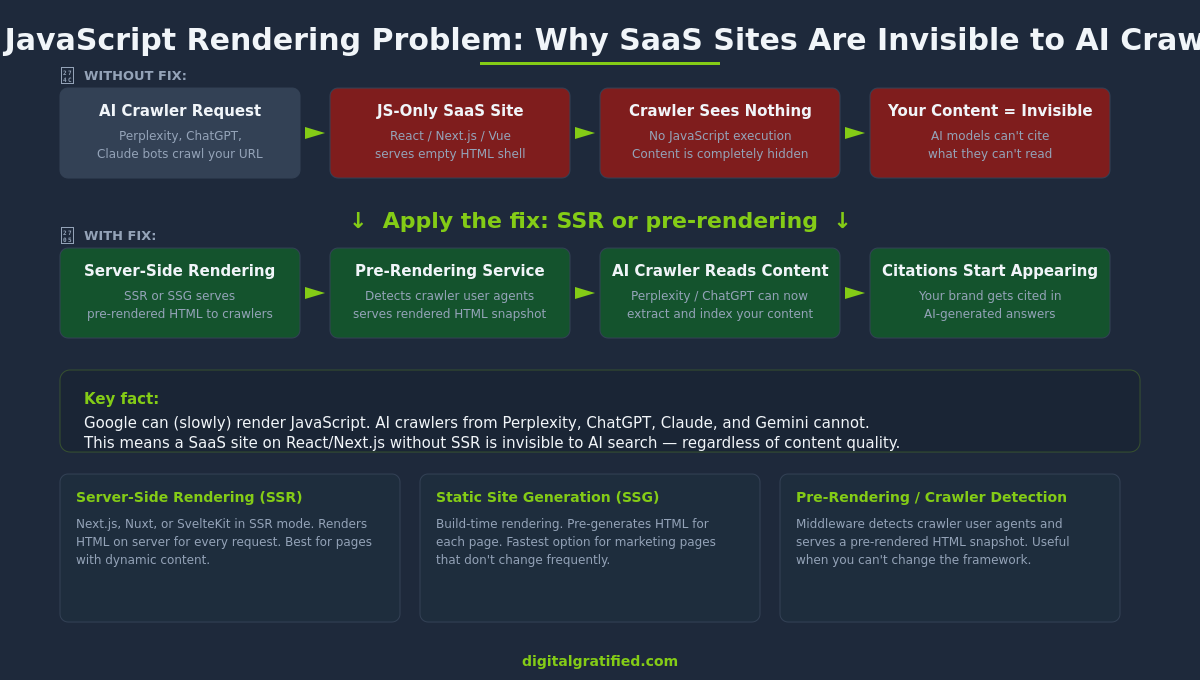
Most modern SaaS marketing sites are built on React, Next.js, or Vue. These frameworks deliver content via JavaScript rendering: the HTML crawlers initially receive is largely empty, and content only becomes visible after JavaScript executes.
- Google has invested heavily in JS rendering and handles it reasonably well, with some latency
- Most AI crawlers (the bots behind ChatGPT, Claude and Perplexity) do not execute JavaScript at all
When an AI crawler requests your page, it receives a blank shell. Your content is invisible to it regardless of how good it is.
The fix: Server-side rendering (SSR) or static site generation (SSG) for your marketing pages, or a pre-rendering service that delivers rendered HTML to identified crawler user agents. Our technical SEO audit framework for SaaS sites covers how to test what each crawler actually receives. This is a prerequisite for AI search visibility. No amount of content quality solves a problem the crawler can't see.
Topical Authority Is How AI Learns to Trust You
AI models develop confidence in sources differently from a single ranking algorithm. When a source consistently produces accurate, well-structured content across a topic cluster, and that content is widely cited, AI models develop a pattern of associating that source with authority on that topic.
This operates at the cluster level, not the individual page level. A SaaS company with 40 well-researched articles on a specific topic and earned links to those articles has a significantly higher probability of being cited by AI than a company with three blog posts and a generic homepage.
Building topical authority requires four things:
- Coverage: Address the full spectrum of questions across your topic cluster: not just head terms, but long-tail questions, comparison searches, and integration queries
- Depth: Each piece demonstrating genuine expertise rather than shallow coverage of the obvious points
- Internal structure: Pillar pages, cluster articles, and clear internal linking that signals how your content relates to the broader topic (our internal linking guide for topic clusters shows the structure)
- External citations: Authoritative sources linking to your content, confirming to AI models that it's trusted in your space
This is the work we focus on for SaaS clients: authority content and link building that establish a brand as the source of truth in its category, in Google and in the AI engines buyers ask. The same work drives Google rankings; AI citation is an additional outcome, not a separate programme.
Structured Content and Schema for AI Readability
AI models parse structured content more reliably than unstructured prose. Four practical implications:
Direct answers early. AI retrieval systems surface content that answers the user's query near the top of the page, not content that builds to the answer after extensive context-setting. Structure your posts to answer first, expand second.
FAQ sections with question-format headings. These serve a dual purpose: targeting long-tail question queries in traditional search and providing a structured, parseable format that AI models can extract cleanly. Comparison and category pages benefit most.
Schema markup by page type. Implementing FAQPage, HowTo, Article, SoftwareApplication, and Review schema helps both Google and AI parsers understand what your content is. For SaaS companies, SoftwareApplication schema on product pages and AggregateRating schema on evidence pages are consistently underimplemented despite being relatively low-effort.
External citations within content. AI models evaluate credibility partly by whether content references authoritative external sources. SaaS content that cites primary research and recognised authorities appears more credible to AI parsers, and is more likely to be used as a source itself.
The Integrated Framework: SaaS AI SEO in Practice
Rather than treating "AI for SEO" and "SEO for AI" as separate programmes, the effective approach integrates them into a single operational framework.
Step 1: Fix the Technical Foundation for Both Google and AI Crawlers
Ensure your marketing site delivers rendered HTML to all crawlers, not just Google's. The practical checklist:
- Implement SSR, SSG, or pre-rendering for JavaScript-heavy pages
- Add schema markup by page type
- Address Core Web Vitals on key pages
- Audit crawl budget waste from pagination, filtered URLs, and app subdomain leakage
These fundamentals are the prerequisite for everything else. Both traditional rankings and AI citation depend on content being accessible and well-structured. The technical SEO issues specific to SaaS architecture (app subdomains, content behind login walls, Core Web Vitals) are covered in the SaaS SEO guide.
Step 2: Build Topic Cluster Coverage Using AI-Accelerated Research
Use AI tools to map your full keyword universe across the buyer journey: from problem-aware head terms to long-tail question queries to comparison and integration searches. Group into clusters. Identify the gaps.
Use AI to accelerate the research and briefing phase. Invest editorial resources in producing content that demonstrates genuine expertise and product-specific insight. The goal is comprehensive topical coverage that makes your brand the authoritative source in your category, for both Google and AI models.
Step 3: Build Domain Authority Through Link Acquisition
Links from authoritative external sources are the most important signal that AI retrieval systems and Google share for assessing credibility. Content without link equity rarely achieves either strong Google rankings or consistent AI citation, no matter how well-written.
For SaaS companies, the most efficient link acquisition channels are:
- Software review platforms (G2, Capterra, Software Advice)
- Integration partner directories
- Data-driven original research that earns editorial links
- Earned PR from category-relevant publications
Agencies that specialise in SaaS-specific link programmes, including white-label link building for agencies serving SaaS clients, can compress the timeline for building the authority level that drives both ranking and AI citation performance.
Step 4: Monitor AI Citation and Traditional Rankings Together
SaaS marketing teams now need to monitor two surfaces:
- Traditional rank tracking (target keywords in Google, Bing)
- AI citation monitoring (how often your brand appears in ChatGPT, Perplexity, and Google AI Overviews responses for category-relevant queries)
Dedicated AI visibility tools track AI citation frequency. The patterns tell you which content is being surfaced by AI retrieval and which competitor content is earning citations you're missing. Improvement in traditional rankings typically precedes improvement in AI citations, because the same authority signals drive both. Fewer clicks reach a page when an AI Overview sits above it, so discount AI Overview queries in your SEO forecast rather than reading flat traffic as failure.
Step 5: Structure Content for AI Extraction from the Outset
Apply AI readability principles consistently across new content: direct answers early, FAQ sections with question-format headings, authoritative data citations, appropriate schema by page type.
These aren't optimisation layers applied after writing. They're formatting principles baked into the brief and template for every piece. The compounding effect of consistent application across a growing content library builds AI readability into your organic asset base over time.
The Honest Assessment
AI-powered search is a new surface that SaaS companies need to account for in their organic strategy. But most of what determines AI citation performance is strong foundational SEO: domain authority, comprehensive topical coverage, technical accessibility, and quality content.
The new work (fixing JavaScript rendering for AI crawlers, monitoring citation performance across AI tools, structuring content for AI extraction) is additive to a strong foundation, not a replacement for it.
SaaS companies that haven't built that foundation yet should start there. The teams already executing solid SaaS content marketing and technical SEO will find the AI optimisation layer is a relatively small addition to what they're already doing.
The teams trying to "optimise for AI" without the underlying foundation of topical authority and domain credibility are building on air.
Frequently Asked Questions
What is AI SEO for SaaS?
"AI SEO for SaaS" refers to two related things: using AI tools to accelerate the execution of SEO tasks (keyword research, content briefs, technical audits, on-page optimisation at scale), and optimising your SaaS company's content and technical foundation to earn citations in AI-powered search tools like ChatGPT, Perplexity, Google AI Overviews, and Gemini. Both require a strong foundational SEO programme: the AI-specific layer builds on, not replaces, traditional organic strategy.
How does AI search affect SaaS SEO strategy?
AI answer engines change the visibility surface: instead of only ranking in a list of ten blue links, you can be cited in a directly generated answer. This makes topical authority more important (AI models trust comprehensive, well-cited sources), makes technical accessibility more critical (most AI crawlers don't execute JavaScript, so React and Next.js sites need server-side rendering to be visible), and adds a monitoring requirement (tracking citation frequency in AI tools alongside traditional rank tracking).
Why are SaaS websites often invisible to AI crawlers?
Most SaaS marketing sites are built on JavaScript frameworks (React, Next.js, Vue) that render content client-side. Most AI crawlers, unlike Google's crawler, do not execute JavaScript. When they request your page, they receive an empty HTML shell. Your content is invisible to them regardless of its quality. The fix is server-side rendering, static site generation, or a pre-rendering service that detects crawler user agents and serves rendered HTML. This is a prerequisite for AI search visibility, not an optimisation layer.
How do you get your SaaS cited by ChatGPT or Perplexity?
AI citation comes primarily from two sources: appearing in training data (built through long-term, widely-cited content presence) and being retrieved in real-time queries (driven by the same signals as Google rankings: domain authority, relevance, content quality, and technical accessibility). The most reliable path to consistent AI citation is building real topical authority in your category: comprehensive content coverage, strong backlink profile from authoritative sources, and technically accessible pages that AI crawlers can actually read.
Is traditional SEO still relevant in the AI era?
Yes, and it's the foundation of AI citation performance. The sites earning the most AI citations are, overwhelmingly, the same sites with the strongest traditional SEO profiles: high domain authority, comprehensive topical coverage, well-earned backlinks, and technically sound pages. AI retrieval systems use authority and relevance signals that closely mirror Google's. Abandoning traditional SEO in favour of "AI optimisation" misunderstands how AI search actually works.
About the author
Let's Scale Your SaaS Together
Get a custom SEO and link building strategy tailored for your SaaS business.
Get SEO insights that actually move rankings
Link building tactics, case studies, and SaaS SEO playbooks. No fluff, no spam.
You're subscribed!
SEO and link building insights, straight to your inbox.