Most SaaS SEO guides teach generic search optimisation dressed up with SaaS examples. This guide covers what's structurally different about SEO for software companies: the unique page types, the conversion architecture, the technical pitfalls, how to choose an agency, and how to connect organic growth directly to ARR.

Founder, Digital Gratified
SaaS SEO is the practice of turning organic search into a predictable source of trials, demos and recurring revenue for a software company. It builds on familiar foundations like keyword research, technical SEO and SaaS link building, but applies them to a business model that works very differently from a typical website.
SaaS businesses have subscription revenue, long multi-touch buyer journeys, content that must serve very different stages of awareness, and page types that traditional sites don't have. Those differences call for a genuinely different SEO approach. This guide is that playbook, covering strategy, execution and the direct connection to ARR. If you'd rather hand the work off, our SaaS SEO agency guide covers how to choose a partner.
What Is SaaS SEO?
SaaS SEO is the process of optimising a software company's web presence to attract qualified organic traffic: visitors who are actively searching for the problems your product solves, evaluating solutions like yours, or comparing specific tools. The end goal isn't rankings or traffic in isolation; it's free trial sign-ups, demo requests, and ultimately ARR growth driven by organic acquisition.
The definition is simple. The execution is harder than most companies expect, for reasons that are specific to the SaaS business model.
Why SaaS SEO Is Genuinely Different from Traditional SEO
SaaS SEO shares the same foundational mechanics as all SEO (crawlability, relevance, authority) but three structural differences make the strategy fundamentally distinct:
1. The Subscription Model Changes the Conversion Target
Traditional e-commerce SEO optimises for a transaction: someone lands, browses, buys. The conversion window can be hours. SaaS B2B buying cycles run weeks to months, involve multiple stakeholders, and the "conversion" at the content stage is usually a free trial start or demo request, not a purchase. This means SaaS SEO must account for a much longer nurture path, and content that serves someone at the awareness stage needs to be connected to content that serves them at the evaluation stage, which needs to connect to content that supports the purchase stage. The funnel architecture is the strategy, not just a framework to organise it.
2. The Keyword Universe Includes Page Types That Don't Exist Elsewhere
SaaS websites need to rank for types of queries that don't appear in traditional SEO playbooks: integration pages ("HubSpot Salesforce integration"), comparison and alternatives pages ("[competitor] alternative"), use-case and template pages, and pricing-adjacent queries ("best [category] software for [persona]"). These high-commercial-intent page types are where most SaaS SEO programmes leave the most organic revenue on the table, because agencies trained on traditional SEO focus on the blog and ignore the product marketing pages.
3. Organic Traffic Quality Matters More Than Volume
In SaaS, attracting 100,000 monthly visitors from audiences that don't match the ideal customer profile is significantly less valuable than attracting 5,000 monthly visitors from ICP-match prospects who are actively evaluating solutions. This is the "problem-aware vs. solution-aware" distinction that shapes every strategic decision in SaaS SEO: traffic volume is a vanity metric; traffic from the right intent clusters at the right funnel stages is what drives ARR. This connects directly to how SEO actually drives results for SaaS businesses and why most early-stage programmes underperform.
The 5 SaaS-Specific Page Types (Most SEO Guides Miss These)
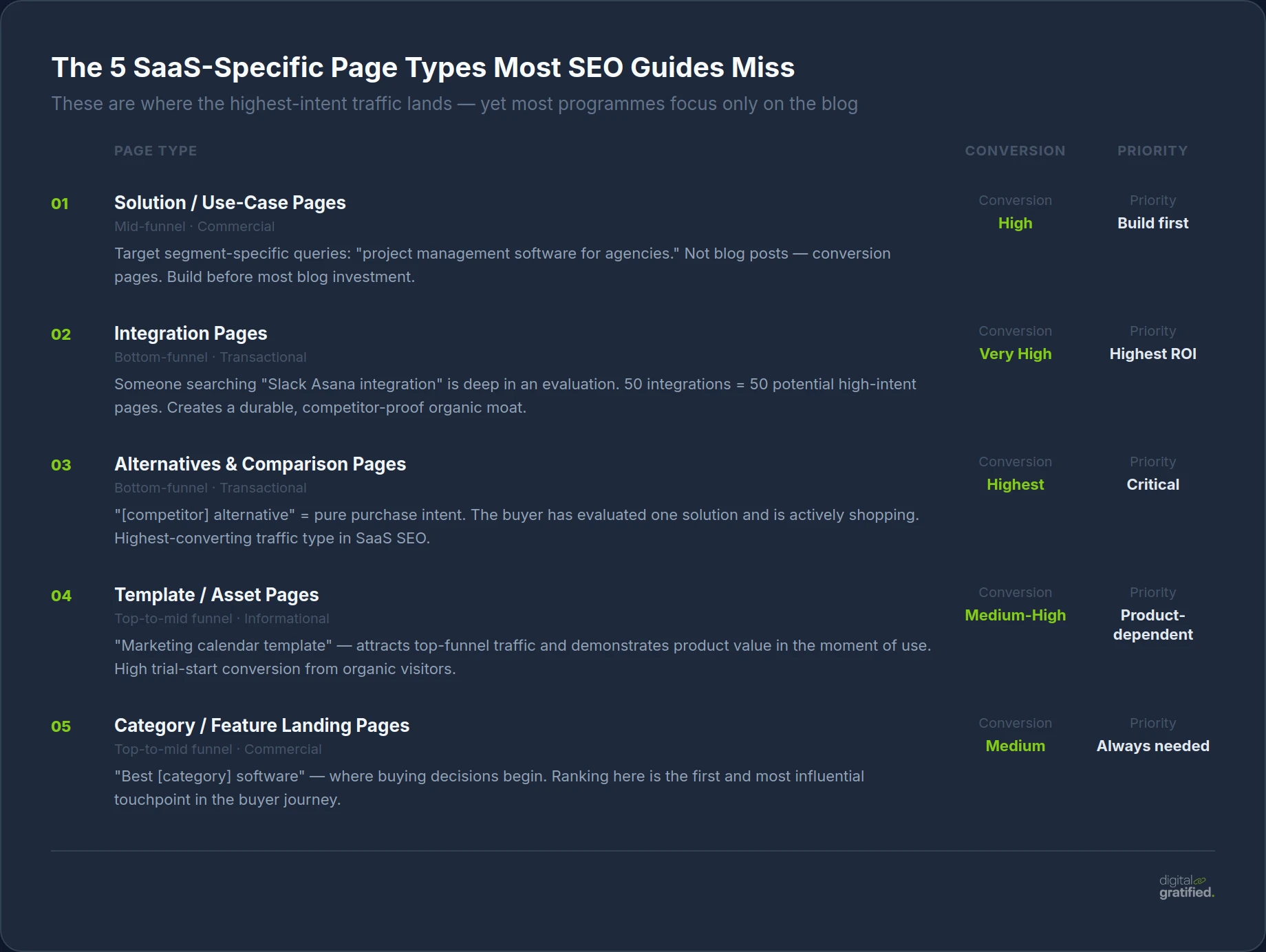
Every SaaS website needs a set of page types that have no direct equivalent in traditional websites. These are where the highest-intent organic traffic lands, and where SEO investment produces the fastest pipeline impact, yet most SaaS SEO guides focus almost entirely on the blog.
1. Solution / Use-Case Pages
These pages target searches from buyers who know the category exists but are evaluating fit for their specific context. A project management tool needs pages not just for "project management software" but for "project management software for marketing teams," "project management software for remote teams," "project management for agencies," and so on.
Each sub-audience conducts different searches with different jobs-to-be-done. Solution pages serve this demand. They're not blog posts. They're conversion pages targeting specific commercial intent. They rank for mid-funnel queries and should be built before most blog content investment begins.
2. Integration Pages
Integration queries are among the highest-commercial-intent searches in the SaaS universe. Someone searching "Slack Asana integration" is almost certainly already a user of one tool and actively evaluating the other. They're deep in the buying process, they have high intent, and they convert at significantly higher rates than top-of-funnel blog readers.
A SaaS company with 50 integrations has 50 potential high-intent landing pages. Most don't build them. The ones that do rank for queries their competitors can't compete on without the same integrations, creating a durable, difficult-to-replicate organic moat.
3. Alternatives and Comparison Pages
Searches for "[your competitor] alternative" or "[your product] vs [competitor]" are pure bottom-of-funnel commercial intent. The person conducting this search has already identified a category, evaluated at least one solution, and is actively shopping alternatives. Appearing here for the right competitor names is among the highest-ROI content investments in SaaS SEO.
These pages require careful positioning: you're not writing hit pieces on competitors, you're making an honest case for why your product is a better fit for a specific type of buyer. Done well, they attract the highest-converting traffic on your site.
4. Template / Asset Pages
For SaaS products where the core workflow involves creating or using structured documents (spreadsheets, project plans, reports, marketing briefs) template pages serve a dual purpose. They attract top-of-funnel searches ("marketing calendar template," "project plan template") and they demonstrate the product's value in the moment of use, making them unusually effective at driving trial sign-ups from organic visitors.
Not every SaaS product has a template surface area, but for those that do (project management, design, analytics, HR, finance) template pages represent a scalable, low-ongoing-cost organic acquisition channel.
5. Category / Feature Landing Pages
Category pages target the searches buyers use when they're in the early evaluation stage: "best [category] software," "top [category] tools," "[feature] tool for [persona]." These are competitive searches, but they're also where buying decisions begin. A SaaS company that doesn't rank in the top 10 for its own category descriptors is missing the earliest and most influential touchpoint in its buyers' journeys.
SaaS SEO Keyword Strategy: Mapping Intent to Funnel Stage
The standard ToFu/MoFu/BoFu framework applies to SaaS SEO, but it needs to be translated into the specific keyword types that appear at each stage in a software buying journey. Our pipeline-first B2B SEO strategy shows why we build the bottom of the funnel first, with keyword difficulty data from one SaaS category.
Top of Funnel: Problem-Aware Keywords
These are informational searches from buyers who have identified a problem but haven't started evaluating solutions. For a CRM company, this is "how to organise sales pipeline," "sales cycle management tips," "how to reduce sales cycle length." The buyer is not yet in market for your product, but they're developing the problem awareness that will eventually drive them to search for solutions like yours.
Top-of-funnel content serves two SEO functions: building authority signals in your category (which helps your more commercial pages rank) and creating the first touchpoints with buyers who will return months later when they're ready to evaluate. It's a long game, and the ROI is invisible in months 1–6.
Middle of Funnel: Solution-Aware Keywords
The buyer now knows solutions exist and is starting to evaluate categories. "Best CRM for small business," "CRM software comparison," "how to choose a CRM": these are mid-funnel queries. The buyer is doing research, building a shortlist, and defining evaluation criteria.
Mid-funnel content should demonstrate expertise in the space, establish your product's position relative to the category, and include clear paths forward for buyers who want to go deeper. Internal linking from these pages to your comparison/alternatives pages and solution pages is where funnel architecture becomes tangible.
Bottom of Funnel: Purchase-Ready Keywords
Highly commercial, high-intent queries from buyers close to a decision: "[your product] pricing," "[your product] vs [competitor]," "[competitor] alternative," "best [category] software for [specific persona/use case]." Traffic volumes are lower; conversion rates are dramatically higher.
Bottom-of-funnel pages are where most SaaS companies underinvest. The traffic numbers look unimpressive in a dashboard compared to top-of-funnel blog posts, so they receive less attention. But the pipeline value per visitor is often 10–20x higher. Optimising these pages (and earning backlinks to them) is frequently the highest-ROI SEO action available to a SaaS marketing strategy.
Technical SEO for SaaS: The Issues Specific to Software Companies
Technical SEO principles are universal, but SaaS websites have a set of structural patterns that create specific technical problems most guides don't address.
The App Subdomain Problem
Most SaaS products run the application on app.domain.com while the marketing site runs on domain.com. This creates an important SEO question: the application is often the most-used part of the product, the most natural place to link to, and the part with the highest user engagement, but if it's on a subdomain with no SEO-relevant content, it contributes nothing to organic visibility. Worse, if the app generates any URLs that are accessible without login (public dashboards, share links), they can create duplicate content or cannibalization issues.
The fix: ensure your app subdomain has an explicit noindex directive on any URLs not intended for organic search. Don't ignore this at early stage: cleaning it up later is significantly harder than preventing it.
Content Behind Login Walls
Feature documentation, help articles, and tutorials often live inside the product rather than on the marketing site. This content answers exactly the kinds of queries your users search for, but it's invisible to search engines. Moving high-value documentation to a public-facing help centre or knowledge base, at help.domain.com or a /docs subdirectory creates an organic traffic surface area from queries that are highly conversion-relevant ("how to [do X in your product]").
Pagination and Filter Pages
SaaS products with directories, marketplaces, or template libraries often generate thousands of paginated or filtered URLs that are near-duplicates of each other. Without proper canonical tags, noindex directives on low-value combinations, or structured URL handling, these pages can dilute crawl budget and create thin-content signals that depress rankings across the entire site.
Core Web Vitals and Conversion Rate
Core Web Vitals (Largest Contentful Paint (LCP), Cumulative Layout Shift (CLS), and Interaction to Next Paint (INP)) are direct ranking factors but also directly affect conversion rates. A SaaS marketing site where key pages load slowly or have layout instability will both rank lower and convert less traffic into trials. The SEO and CRO cases for fixing Core Web Vitals are aligned: it's the same work serving both outcomes simultaneously.
Schema Markup for SaaS
SaaS websites benefit from specific schema types that most companies haven't implemented: SoftwareApplication schema on product pages (enabling rich snippets in results), Review and AggregateRating schema on customer evidence pages, and FAQPage schema on content pages targeting question-format queries. Schema implementation is low-effort relative to its benefit, particularly for competitive SaaS categories where SERP features like rich snippets provide a visibility premium.
Link Building for SaaS: The Opportunities Most Companies Miss
SaaS companies have a set of link acquisition opportunities that don't exist for traditional websites, and a set of common link building activities that are less effective for SaaS than for other business types.
Software Review Platform Profiles
G2, Capterra, GetApp, Software Advice, Trustpilot, and category-specific review platforms are high-domain-authority sites with direct commercial intent. A comprehensive, actively managed profile on the relevant platforms provides both link equity and referral traffic from buyers who use these platforms as part of their evaluation process. Many SaaS companies have claimed profiles but haven't optimised them (incomplete descriptions, no screenshots, few reviews) which limits both their SEO and conversion value.
Integration Partner Link Building
Every integration partnership is a link acquisition opportunity. When you integrate with Zapier, Salesforce, HubSpot, Stripe, or any other software platform, you should be listed in their integration directory or app marketplace. These links carry high authority and are uniquely available to SaaS companies. A SaaS product with 40 integrations and only 10 active directory listings is leaving 30 high-authority links on the table: simply by not completing the submission process for each partner's marketplace.
Data-Driven Content for Link Acquisition
Original research, industry benchmark reports, and data-driven studies are among the highest link-earning content types for SaaS companies. When you publish data that no one else has (survey results, aggregated product usage insights, original analysis of industry trends) other publications in your category link to it as a source. This approach generates links naturally rather than requiring active outreach for every link. For SaaS companies with access to anonymised product usage data, this is an underutilised asset for building domain authority.
For SaaS companies in the earlier stages of building domain authority, working with a specialist agency on a programmatic and editorial link building programme accelerates this process. Whether you build in-house or partner with an agency, getting your SEO team structure right matters more than the headcount. Digital Gratified works with SaaS companies specifically on organic growth, combining a SaaS content engine with the link building infrastructure that makes content rank for competitive commercial keywords, including a white-label link building programme for agencies serving SaaS clients.
Customer Case Study Co-Promotion
Case studies featuring recognisable customer brands are natural link magnets: the customer organisation often links to the case study from their own site, which carries meaningful authority if they're a notable brand. Many SaaS companies publish case studies as essentially gated PDFs or text-only pages with no SEO optimisation. Publishing case studies as properly optimised, indexed pages (with keyword-targeted titles, customer quotes, and specific metrics) turns a brand asset into an SEO asset simultaneously.
How SaaS SEO Connects to ARR and MRR Growth
One of the most common failures in SaaS SEO programmes is the disconnect between organic search activity and revenue metrics. Marketing teams track rankings and traffic; finance and leadership track ARR and net new MRR. The two teams often measure the same programme with completely different instruments, which makes budget defence difficult and programme continuity fragile.
Here's how the connection runs, and what to track to make it visible:
Organic traffic → trial/demo starts. The first conversion metric is the number of organic visitors who initiate a trial or book a demo. This is the clearest signal that SEO is reaching the right audience with the right intent. If organic traffic is growing but trial starts from organic are flat, you have a traffic quality problem (wrong keywords) or a conversion architecture problem (right traffic, wrong landing page).
Trial/demo starts → activated users. Not all trial starts are equal. An activated user (someone who completes a meaningful action in your product during their trial) is significantly more likely to convert to paid than one who signs up and never returns. Tracking activation rates by acquisition channel lets you evaluate whether organic traffic is producing higher or lower quality trials than other channels.
Activated users → paid conversions → MRR contribution. When a trial converts to a paid plan, the closed-loop attribution from organic channel to new MRR is complete. Building this attribution requires clean UTM tracking from every organic touchpoint to CRM to billing. It's infrastructure work, but it's the work that makes SEO investment defensible at the board level.
Retention differential. A metric most programmes never track: do customers acquired through organic search retain at higher, lower, or equal rates compared to paid acquisition? There's good reason to expect that buyers who discovered you through content (who were educated about your category, evaluated alternatives, and chose you on the merits) have higher intent and therefore higher long-term retention. If your data confirms this, it strengthens the ARR case for organic investment significantly beyond what the initial CAC comparison shows.
The full picture of how to build and track this measurement system is covered in the guide to measuring SaaS content marketing ROI which applies directly to the organic channel measurement question. To project the same chain before you invest, build an SEO forecast in pipeline and ARR terms.
What to Look for in a SaaS SEO Agency
The agency market for SaaS SEO has expanded dramatically as the category has grown, and "SaaS SEO specialist" has become a marketing claim rather than a meaningful qualification. If you are still pre-scale, our guide to SEO services for startups covers how to evaluate providers on an early-stage budget. If you would rather hire one person than an agency, our guide to hiring a SaaS SEO consultant covers the vetting questions. Here's what separates agencies that produce results from those that produce reports:
They build a content strategy from product positioning, not just keyword volume. A generic SEO agency optimises for keywords with high search volume. A SaaS-specialist agency starts from your ICP, your competitive positioning, and your product's specific use cases, and builds a keyword map from there. The output looks different: less emphasis on broad informational terms, more emphasis on solution-aware, comparison, and integration queries. The strategy should demonstrate an understanding of how your buyers buy, not just what they search.
They cover all five page types, not just the blog. An agency that focuses exclusively on blog content while ignoring your solution pages, integration pages, and comparison pages is not executing a complete SaaS SEO strategy. The blog is the fuel; the product-adjacent pages are where the fuel converts into pipeline. A complete programme works on both simultaneously.
They can demonstrate off-page authority building alongside content. Content without domain authority growth is one of the most common reasons SaaS SEO programmes plateau after initial gains. The agency should have a clear, documented approach to link acquisition that goes beyond guest posting, including the SaaS-specific channels (review platforms, integration directories, data-driven content) covered earlier in this guide.
They connect SEO activity to pipeline, not just traffic. If an agency's standard reporting deck shows rankings and organic traffic growth but no connection to leads, trials, or revenue contribution, you're paying for an activity that may or may not be driving business outcomes. Demand that your reporting includes organic-sourced conversion metrics, even if the initial numbers are rough.
They understand technical SEO for SaaS architecture specifically. The app subdomain problem, login-walled content, Core Web Vitals, schema markup: these aren't general SEO issues, they're SaaS-specific. An agency that hasn't encountered and solved them before will learn on your account.
Common SaaS SEO Mistakes That Stall Programmes
Beyond the technical and strategic issues already covered, three mistakes show up consistently in SaaS SEO programmes that plateau or underperform:
Targeting problem-aware keywords only. Many SaaS content programmes are top-heavy: lots of awareness-stage informational content, very little solution-aware or evaluation-stage content. This generates traffic but not trials, because the audience coming in on problem-aware keywords is too early in their journey to convert. A healthy programme targets the full intent spectrum, with deliberate investment in the mid-to-bottom funnel content that converts. This is one of the consistent patterns in SaaS content marketing mistakes that holds programmes back.
Treating technical SEO as a one-time project. Technical SEO audits are commonly done at programme launch, but SaaS websites are living products: new features ship, the application evolves, new content surfaces get added. Crawl coverage, Core Web Vitals, and schema implementation should be on a recurring review cadence, not a one-time checklist.
Under-investing in authority before scaling content. Content quality and volume matter, but without domain authority, even excellent content won't rank for competitive keywords. The sequencing error is producing large volumes of content on a young or low-authority domain without the link building investment that would make that content visible. The compounding benefit of content and authority working together is what makes mature SaaS SEO programmes dramatically more efficient per dollar than the same spend in the first year. Investing in link building in parallel with (not after) content is what separates the fast-compounding programmes from the ones that plateau at 20K monthly visitors and never break through.
SaaS SEO: Frequently Asked Questions
What is SaaS SEO?
SaaS SEO is the practice of optimising a software company's web presence to attract organic search traffic from buyers who are searching for the problems your product solves, evaluating solutions in your category, or comparing specific tools. The goal is not just traffic but qualified pipeline: free trial starts, demo requests, and ultimately ARR growth driven by organic acquisition.
How is SaaS SEO different from regular SEO?
SaaS SEO differs in three key ways: the conversion target is a trial or demo (not a purchase), requiring a longer nurture architecture; the keyword universe includes page types unique to software (integration pages, alternatives pages, template pages) that don't exist in traditional websites; and traffic quality matters more than volume because ICP-match visitors are far more valuable than generic informational traffic.
How long does it take for SaaS SEO to show results?
Meaningfully attributable pipeline from organic search typically emerges at months 9–18 for new programmes. Before that point, the programme is building the organic infrastructure (domain authority, keyword rankings, indexed content) that converts to attributable leads later. Realistic expectations and leading indicators (ranking progress, organic conversion rate) are what allow SaaS leadership to make sound investment decisions before the compounding effect is visible. The detailed timeline and what to track at each stage is covered in the guide to how important SEO is for SaaS companies.
What are the best SaaS SEO strategies?
The highest-impact SaaS SEO strategies, in rough order of ROI: (1) building the five SaaS-specific page types: solution pages, integration pages, comparison pages, template pages, and category landing pages; (2) targeting evaluation-stage and comparison keywords, not just problem-aware top-of-funnel terms; (3) investing in domain authority through link building in parallel with content production; (4) fixing SaaS-specific technical issues (app subdomain indexing, login-walled content, Core Web Vitals); and (5) closing the attribution loop from organic traffic to trial starts to MRR contribution.
How can SEO increase SaaS sign-ups?
SEO increases sign-ups by creating organic visibility at the exact points in the buyer journey where purchase intent is highest. Integration pages and comparison pages attract visitors who are deep in an evaluation process, converting at rates significantly above typical blog content. Properly structured free trial CTAs on ranking content pages, combined with optimised landing pages for high-intent commercial keywords, turn organic traffic directly into trial starts. The organic-to-trial conversion rate is the key metric connecting SEO activity to sign-up growth.
What should I look for in a SaaS SEO agency?
Look for an agency that builds strategy from your ICP and product positioning (not just keyword volume), that covers all five SaaS-specific page types rather than just the blog, that has a documented approach to link acquisition beyond guest posting, that connects SEO reporting to pipeline metrics, and that demonstrates specific experience with SaaS-specific technical challenges. An agency that can show you case studies of organic programmes that increased trial volume and ARR contribution (not just rankings) is the standard to hold them to.
How do you do keyword research for SaaS SEO?
SaaS keyword research should start with three entry points: (1) your product's feature set: what would someone search when looking for each feature you offer; (2) your competitor's branded terms: who ranks for "[competitor] alternative" and "best alternative to [competitor]"; (3) the problems your ICP experiences: what do they search when experiencing the pain your product solves. Map the output across the funnel (problem-aware → solution-aware → evaluation → decision) and populate each stage with both blog content targets and product page targets.
About the author
Let's Scale Your SaaS Together
Get a custom SEO and link building strategy tailored for your SaaS business.
Get SEO insights that actually move rankings
Link building tactics, case studies, and SaaS SEO playbooks. No fluff, no spam.
You're subscribed!
SEO and link building insights, straight to your inbox.