![SaaS Content Marketing Strategy: The Complete 10-Step Playbook [2026]](/images/blog-saas-content-marketing.webp)
A complete 10-step framework for building a SaaS content marketing strategy that drives demos, trials, and revenue. Covers goal-setting, audience research, BOFU-first content mapping, distribution, and link building amplification.

Digital Gratified
SaaS SEO Experts
Most SaaS content marketing strategies fail before they start. Not because companies create bad content, but because they skip the strategic foundation that makes content actually work.
After helping dozens of B2B SaaS companies build content engines that drive real pipeline, we've identified the patterns that separate high-performing content programs from the 80% that never gain traction.
This guide gives you the complete 10-step playbook for building a SaaS content marketing strategy that converts. Not just traffic: actual demos, trials, and revenue.
Why SaaS Content Marketing Requires a Different Approach
Before diving into the framework, it's worth understanding why generic content marketing advice fails for SaaS companies:
Longer sales cycles: B2B SaaS buyers don't convert on the first visit. Your content needs to nurture prospects across weeks or months of evaluation.
Multiple stakeholders: Enterprise deals involve 6-10 decision makers. Each needs content that addresses their specific concerns, from technical feasibility to ROI justification.
Complex products: You're not selling a commodity. Your content must educate prospects on problems they may not know they have, then position your solution as the answer.
Competitive landscapes: The SaaS space is crowded. Ranking for high-intent keywords requires more than good writing: it demands strategic link building and distribution.
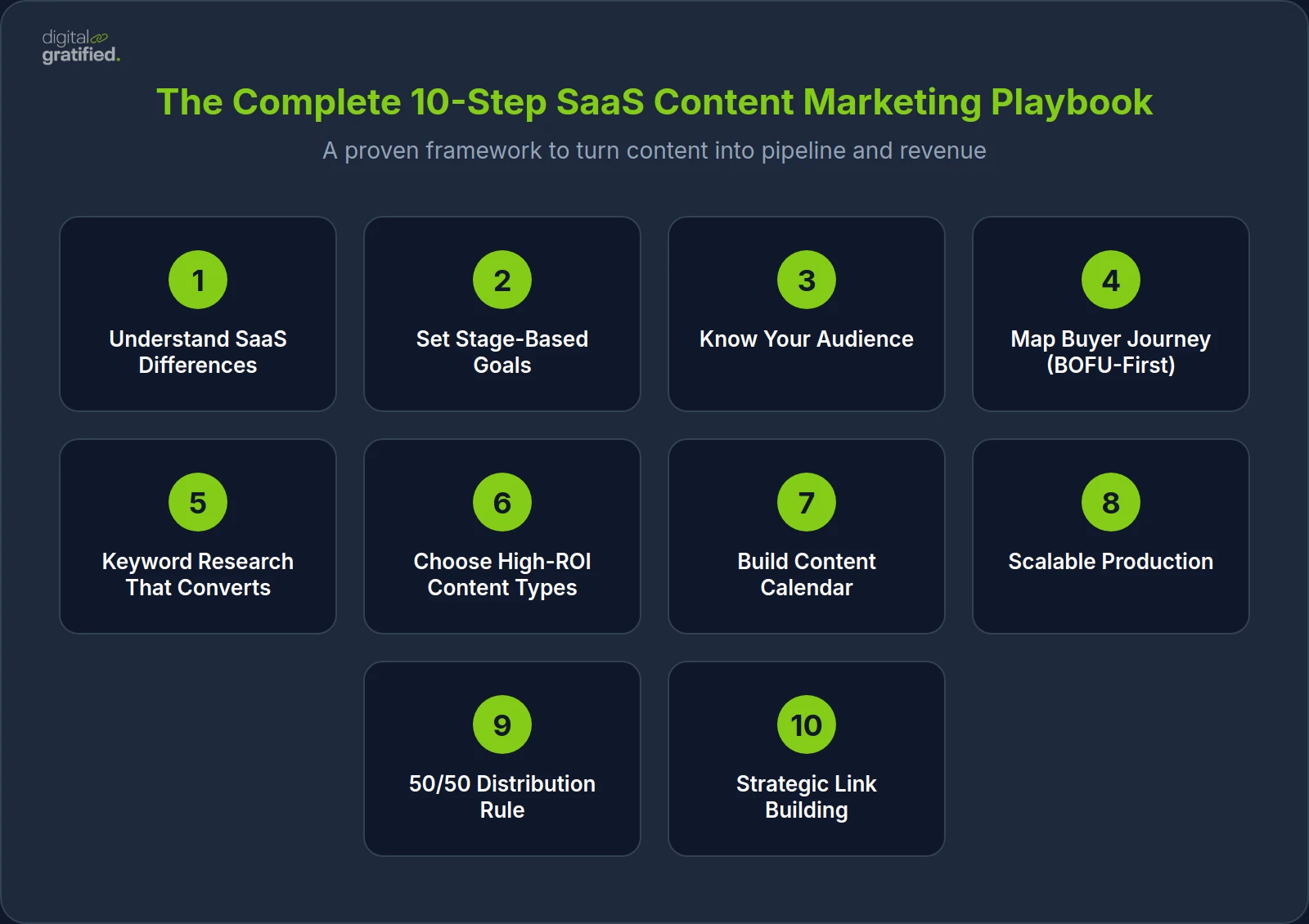
This is why we developed a 10-step framework specifically for B2B SaaS companies. Let's break it down.
Step 1: Understand Why SaaS Content Marketing Is Different
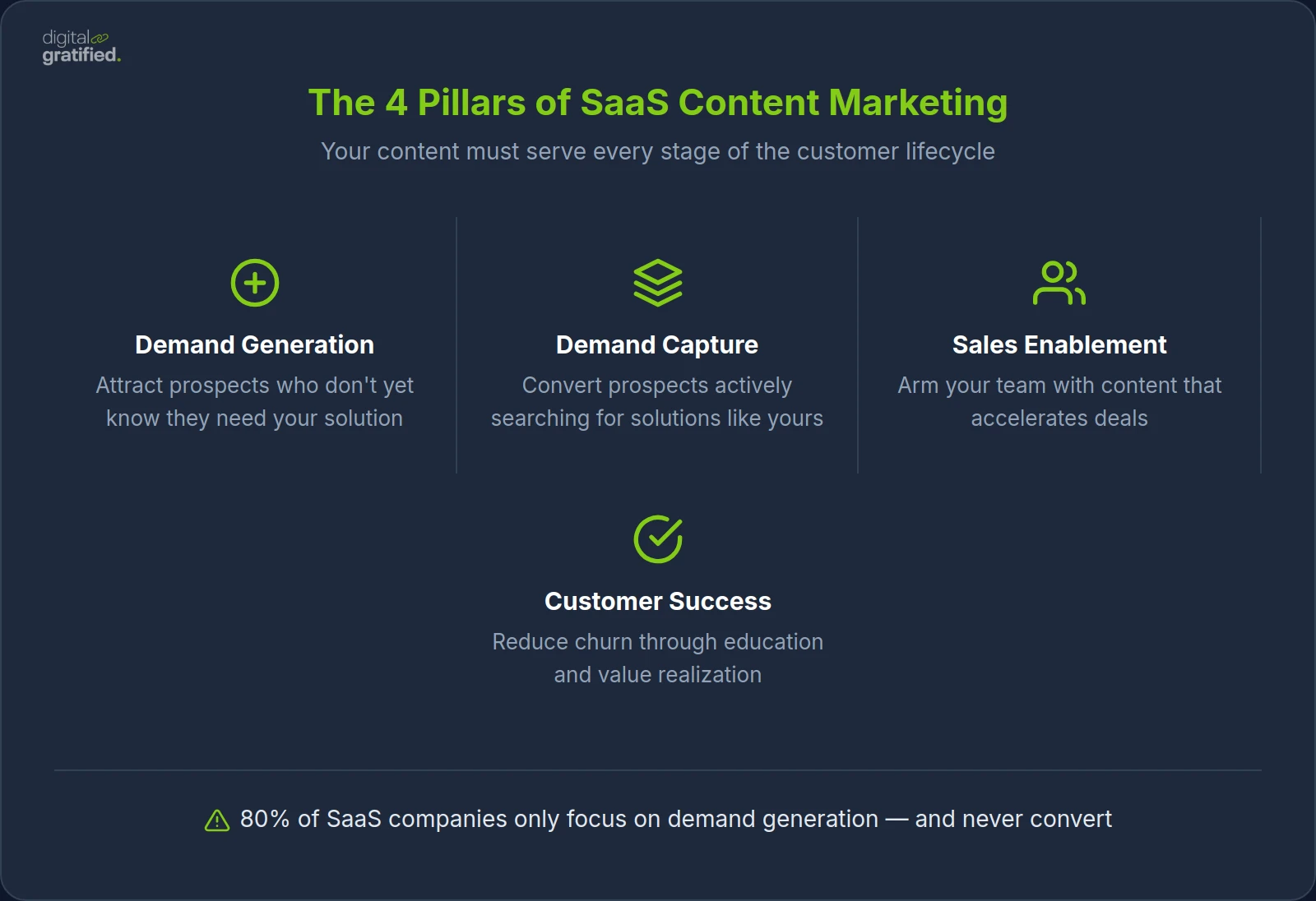
SaaS content marketing isn't just blogging. It's a strategic function that impacts every stage of your funnel:
Demand generation: Attracting prospects who don't yet know they need your solution
Demand capture: Converting prospects actively searching for solutions like yours
Sales enablement: Arming your team with content that accelerates deals
Customer success: Reducing churn through education and value realization
The best SaaS content programs address all four. But most companies only focus on the first, creating top-of-funnel awareness content that never converts.
Understanding this distinction is the foundation for everything that follows.
Step 2: Set Goals by Company Stage
Your content marketing goals should align with where your company is today, not where you hope to be in five years.
Bootstrapped / Pre-Seed ($0-$500K ARR)
Primary focus: Validate messaging and drive initial conversions
Realistic goals:
- 10-25 qualified leads per month from content
- Establish initial keyword rankings for 5-10 bottom-funnel terms
- Build an email list of 500-1,000 engaged subscribers
Content priorities: Bottom-funnel comparison content, product-led tutorials, founder thought leadership. For a deeper dive into early-stage priorities, see our guide on how to grow a SaaS business.
Seed / Series A ($500K-$5M ARR)
Primary focus: Scale organic traffic and establish category authority
Realistic goals:
- 50-100 qualified leads per month from content
- Rank on page 1 for 20-50 target keywords
- Build topical authority in 2-3 core content clusters
Content priorities: SEO-driven blog content, case studies, comparison pages, and strategic link building investment
Series B+ ($5M+ ARR)
Primary focus: Dominate category and diversify content channels
Realistic goals:
- 200+ qualified leads per month from content
- Top 3 rankings for all high-intent category keywords
- Multi-channel content presence (blog, video, podcast, social)
Content priorities: Original research, multimedia content, customer advocacy programs, international expansion
Step 3: Know Your Audience Deeply
Generic buyer personas are useless. "Marketing Mary, 35, likes productivity tools" tells you nothing about what content to create.
Instead, build audience intelligence around these dimensions:
Pain Points and Triggers
What problems drive someone to search for a solution like yours? What events trigger that search?
Research methods:
- Sit in on sales calls and note common objections
- Review customer support tickets for recurring questions
- Analyze competitor reviews on G2 and Capterra
- Monitor Reddit and LinkedIn discussions in your space
Information Sources
Where does your audience go to learn? What publications, podcasts, and communities do they trust?
This informs not just what content to create, but where to distribute it.
Buying Committee Roles
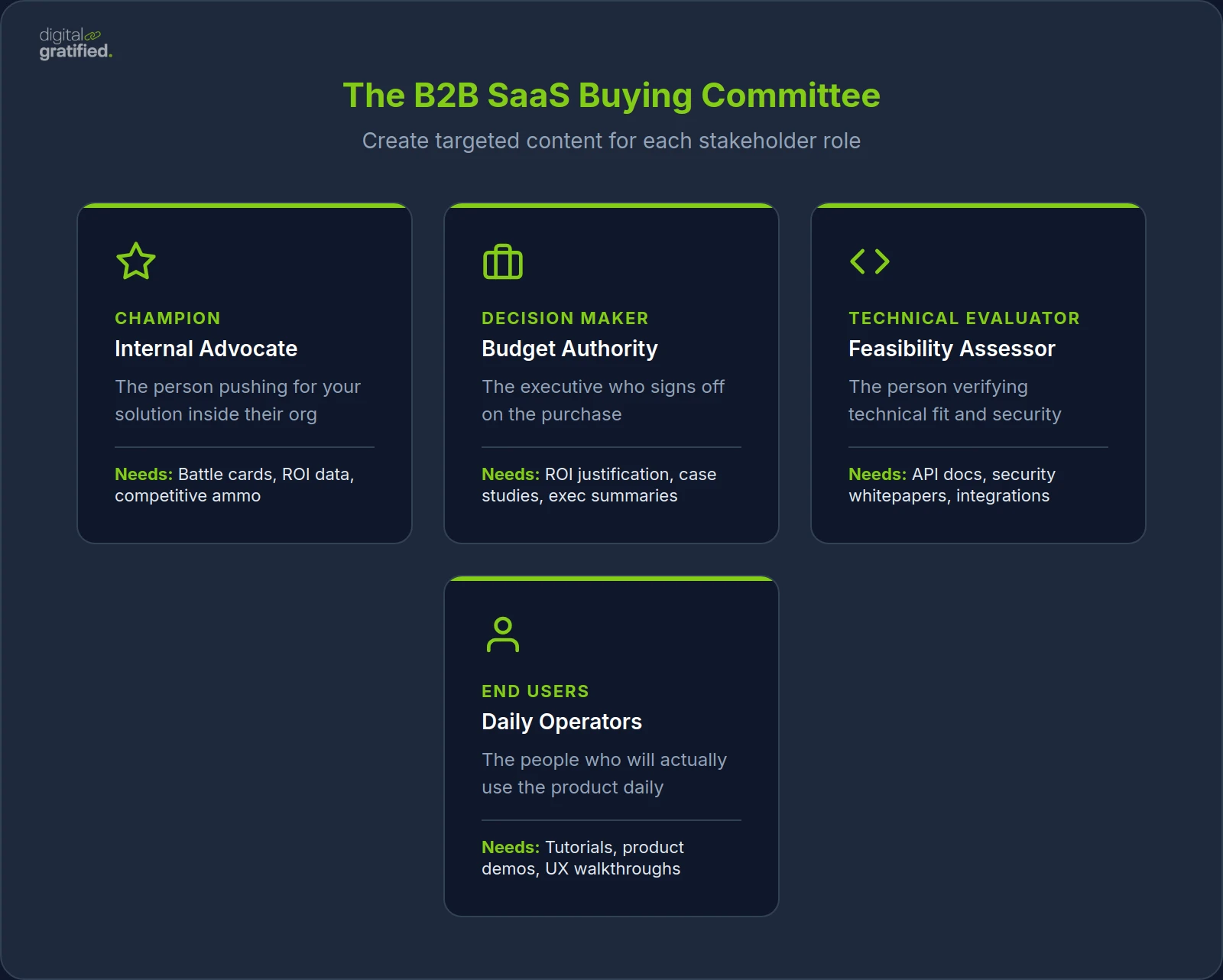
For B2B SaaS, you're rarely selling to one person. Map the typical buying committee:
- Champion: The internal advocate pushing for your solution
- Decision maker: The person with budget authority
- Technical evaluator: The person assessing feasibility
- End users: The people who'll actually use the product
Each needs different content. Your champion needs ammunition to sell internally. Your technical evaluator needs documentation and security details. Your decision maker needs ROI justification.
Step 4: Map Content to the Buyer Journey (BOFU-First)
Here's where most SaaS content strategies go wrong: they start at the top of the funnel and work down.
This is backwards.
Start at the bottom of the funnelwith content for prospects actively looking to buy. Then work your way up.
Bottom of Funnel (BOFU): Start Here
These prospects are comparing solutions and ready to buy:
- Comparison pages: "[Your Product] vs [Competitor]"
- Alternative pages: "Best [Competitor] Alternatives"
- Category pages: "Best [Category] Software for [Use Case]"
- Pricing pages: Transparent pricing with clear value propositions
BOFU content converts at 5-10x the rate of TOFU content. Yet most companies neglect it entirely.
Middle of Funnel (MOFU)
These prospects understand their problem and are evaluating solutions:
- Case studies: Real results from real customers
- Product tutorials: How to solve specific problems with your product
- Integration guides: How your product works with their existing stack
- ROI calculators: Interactive tools that quantify value
Top of Funnel (TOFU)
These prospects are researching their problem, but may not know solutions exist:
- Educational guides: "What is [Category]?"
- How-to content: "How to [Solve Problem]"
- Industry trends: "State of [Industry] Report"
- Thought leadership: Original perspectives on industry challenges
TOFU content builds awareness and authority, but only after you've captured demand at BOFU and MOFU.
Step 5: SaaS Keyword Research That Converts
Keyword research for SaaS isn't about finding high-volume terms. It's about finding terms that indicate buying intent.
High-Intent Keyword Patterns
Category keywords:
- "Best [category] software"
- "[Category] tools for [industry]"
- "[Category] platform for [use case]"
Comparison keywords:
- "[Competitor] alternatives"
- "[Competitor] vs [Competitor]"
- "[Competitor] pricing"
Solution keywords:
- "How to [solve problem] software"
- "[Problem] automation"
- "[Workflow] tools"
Keyword Prioritization Framework
Score each keyword opportunity on:
- Buying intent (1-5): How close is this searcher to making a purchase?
- Relevance (1-5): How well does your product solve their need?
- Competition (1-5): How difficult will it be to rank?
- Volume: How many people search for this monthly?
Prioritize high-intent, high-relevance keywords first, even if volume is lower. A keyword with 100 monthly searches and 10% conversion rate beats a keyword with 10,000 searches and 0.1% conversion rate.
Step 6: Content Types That Work for SaaS
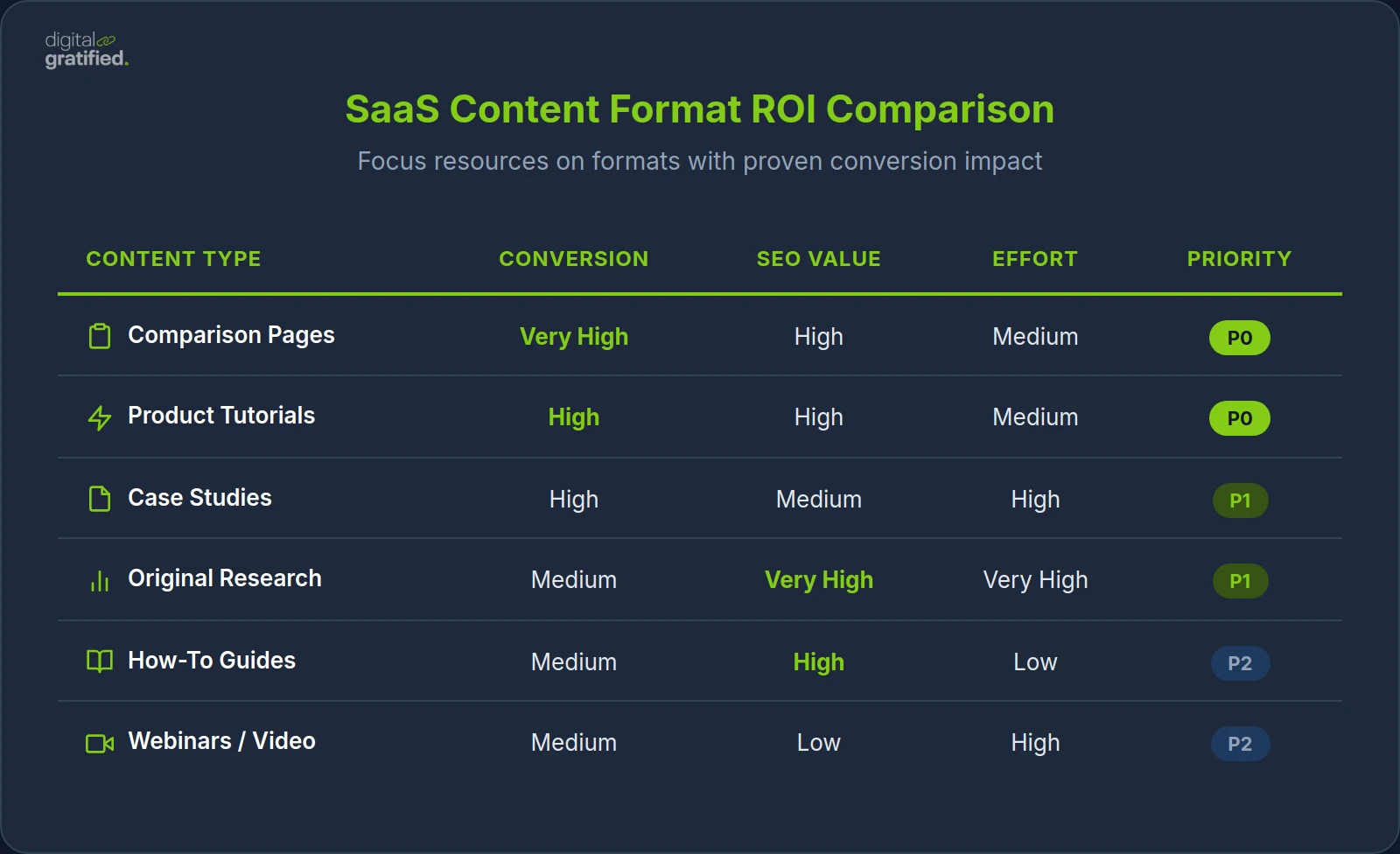
Not all content formats perform equally for SaaS companies. Focus your resources on formats with proven ROI:
High-ROI Content Formats
Comparison and alternative pages: The highest-converting content type for SaaS. These pages capture prospects actively evaluating options.
Product-led tutorials: Show how to solve specific problems using your product. These rank for long-tail keywords and convert warm leads.
Case studies: Social proof that demonstrates real results. Essential for enterprise sales cycles.
Original research: Data-driven content that earns links and establishes authority. Resource-intensive but compounds over time.
Supporting Content Formats
How-to guides: Educational content that builds topical authority
Glossary and definition pages: Capture informational searches and build internal linking structure
Webinars and video content: Engage visual learners and repurpose into multiple formats
Step 7: Build Your Content Calendar
A content calendar transforms strategy into execution. Without one, you'll publish reactively instead of strategically.
Monthly Publishing Cadence by Stage
| Company Stage | Monthly Content Volume | Mix |
|---|---|---|
| Bootstrapped | 4-6 pieces | 80% BOFU/MOFU, 20% TOFU |
| Seed/Series A | 8-12 pieces | 60% BOFU/MOFU, 40% TOFU |
| Series B+ | 15-20+ pieces | 50% BOFU/MOFU, 50% TOFU |
Content Calendar Components
Your calendar should track:
- Target keyword and search intent
- Content type and format
- Funnel stage (TOFU/MOFU/BOFU)
- Owner and due dates
- Status (ideation → writing → editing → published)
- Distribution plan for each piece
Step 8: Create Scalable Production Processes
Consistent output requires consistent processes. Document your content workflow:
Content Production Workflow
- Brief creation: Define target keyword, search intent, outline, and competitive gaps
- Research: Gather data, examples, and expert insights
- Writing: First draft following SEO and brand guidelines
- Editing: Substantive edit for accuracy, clarity, and engagement
- SEO optimization: On-page optimization, internal linking, meta data
- Design: Custom graphics, screenshots, and visual elements
- Publishing: Upload, format, and final QA
- Distribution: Promotion across owned and earned channels
Team Roles
Content strategist: Owns keyword research, editorial calendar, and performance
Writers: Create first drafts based on detailed briefs
Editor: Ensures quality, accuracy, and brand consistency
SEO specialist: Optimizes on-page elements and internal linking
Designer: Creates custom visuals and graphics
Early-stage companies often combine these roles. As you scale, specialize.
Step 9: The 50/50 Rule: Distribution Is Half the Battle
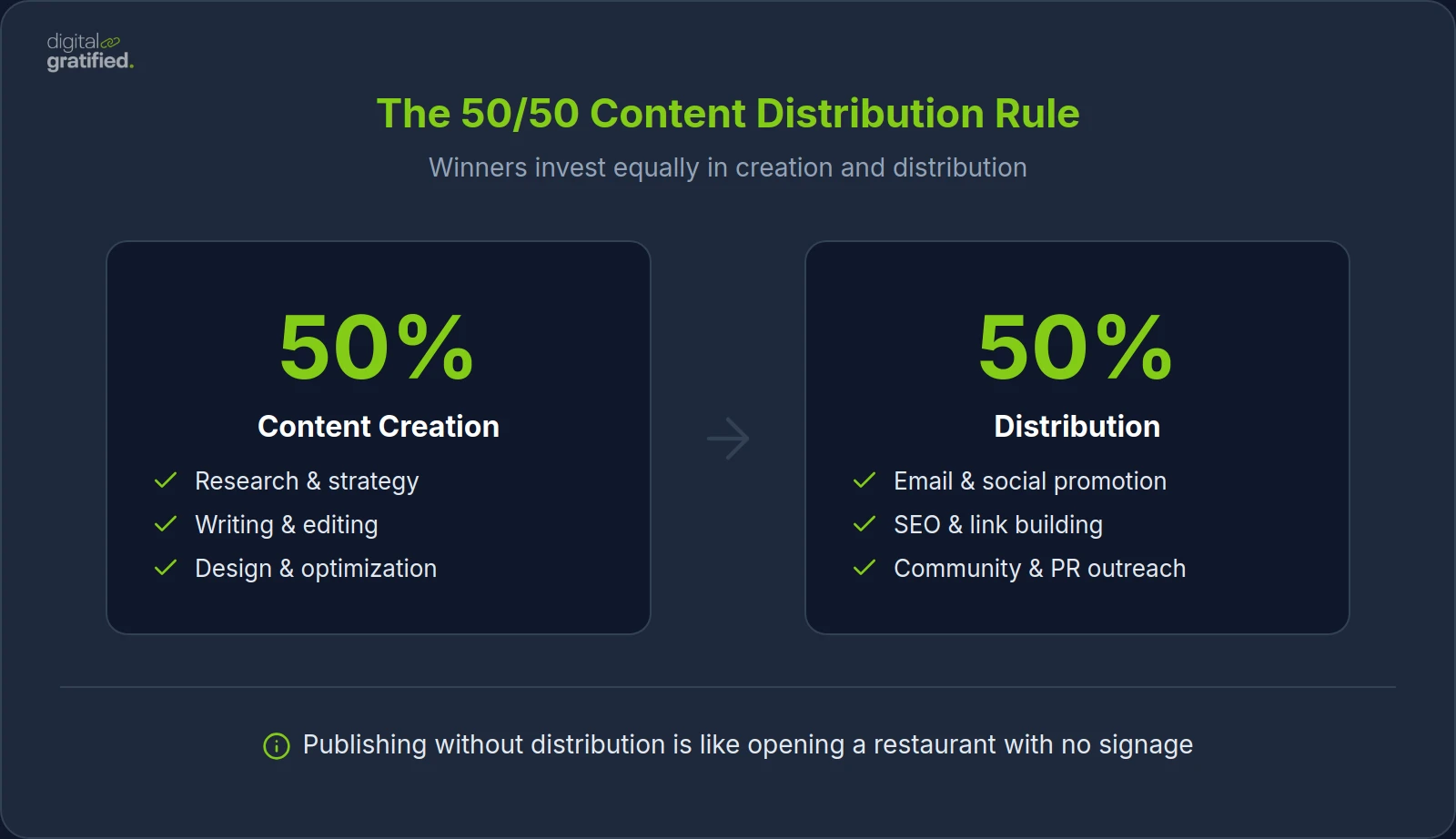
Here's what separates content marketing winners from the 80% who fail: they invest as much in distribution as creation.
Publishing content without a distribution plan is like opening a restaurant with no signage. The food might be great, but nobody will find it.
Owned Distribution Channels
Email newsletter: Your most valuable owned channel. Segment by persona and funnel stage.
Social media: Repurpose content for LinkedIn, Twitter, and relevant communities.
Product: Surface relevant content within your application.
Earned Distribution Channels
SEO: The long game. Invest in technical SEO, on-page optimization, and link building.
Digital PR: Pitch original research and data to industry publications.
Guest posting: Contribute thought leadership to publications your audience reads.
Community participation: Share insights in Slack groups, Discord servers, and Reddit communities.
The Distribution Checklist
For every piece of content you publish:
- Share to email list (segment appropriately)
- Post to company social channels
- Share in relevant communities (add value, don't spam)
- Identify link building opportunities
- Repurpose into social-native formats
- Add to sales enablement library
Step 10: Amplify with Strategic Link Building
This is the step most content strategies skip, and it's why most content never ranks.
Google uses backlinks as a primary ranking signal. Without links, even excellent content struggles to compete for competitive keywords.
Link Building for Content Amplification
Strategic link building isn't about manipulating rankings: it's about earning visibility for content that deserves to rank.
Create linkable assets: Original research, data studies, and comprehensive guides naturally attract links.
Digital PR: Pitch newsworthy findings to journalists and industry publications.
Guest contributions: Write for publications your audience reads, with links back to your cornerstone content.
Resource link building: Get your best content included in industry resource pages and roundups.
Integrating Link Building with Content Strategy
The best approach treats link building as a content amplification layer, not a separate initiative:
- Identify cornerstone content that deserves to rank for competitive keywords
- Build links strategically to those priority pages
- Let internal linking distribute that authority across your content cluster
- Monitor rankings and double down on what's working
For most SaaS companies, partnering with a specialized Digital Gratified makes sense. The expertise and relationships required take years to build in-house.
Measuring Content Marketing Success
Track metrics that matter for SaaS, not vanity metrics:
Leading Indicators
- Organic traffic growth: Is your content driving more visitors over time?
- Keyword rankings: Are you gaining visibility for target keywords?
- Engagement: Time on page, scroll depth, and content consumption
Lagging Indicators
- Leads generated: How many MQLs/SQLs does content contribute?
- Pipeline influenced: What percentage of pipeline touched content?
- Revenue attributed: What's the ROI of your content investment?
Realistic Timelines
Content marketing is a long game. Expect:
- Months 1-3: Foundation building, minimal organic traffic impact
- Months 4-6: Initial rankings and traffic growth
- Months 7-12: Compounding returns as content gains authority
- Year 2+: Content becomes a predictable, scalable growth channel
Putting It All Together
Building a SaaS content marketing strategy that works requires:
- Understanding why SaaS content is different
- Setting stage-appropriate goals
- Knowing your audience deeply
- Mapping content to the buyer journey (BOFU-first)
- Researching keywords that indicate buying intent
- Focusing on high-ROI content formats
- Building a strategic content calendar
- Creating scalable production processes
- Investing equally in distribution (the 50/50 rule)
- Amplifying with strategic link building
Most companies nail steps 1-8 and skip 9-10. That's why their content never gains traction.
The difference between content marketing that drives revenue and content that gathers dust isn't quality: it's distribution and amplification. Get those right, and your content becomes a sustainable competitive advantage.
Frequently Asked Questions
How much should we invest in SaaS content marketing?
Most SaaS companies invest 5-15% of revenue in content marketing, including creation, distribution, and amplification. Early-stage companies might start with $3,000-$5,000/month, scaling to $15,000-$30,000+/month at Series B and beyond. The key is balancing creation with distribution, if you're spending everything on writing and nothing on promotion, you're underinvesting in the wrong areas.
How long before we see results from content marketing?
Expect 4-6 months before content meaningfully impacts organic traffic and 6-12 months before it becomes a reliable lead generation channel. Content marketing compounds over time: the articles you publish today will drive traffic for years. Companies that quit after 3-4 months never see the payoff.
Should we build content in-house or work with an agency?
It depends on your stage and resources. Early-stage companies often benefit from agency partnerships for specialized skills (SEO, link building, content strategy). As you scale, building in-house capabilities gives you more control and institutional knowledge. Many successful SaaS companies use a hybrid model: in-house strategy and management with agency support for execution.
What's more important: content quality or quantity?
Quality wins, but consistency matters. Publishing 4 excellent pieces monthly beats 20 mediocre pieces. Focus on creating the best content for each target keyword: comprehensive, well-researched, and genuinely useful. Then invest in distribution to ensure that content gets found.
How do we measure content marketing ROI?
Track the full funnel: organic traffic → leads → opportunities → revenue. Most marketing automation platforms can attribute leads to content touchpoints. For SaaS, also measure content's influence on existing pipeline: prospects who engage with content typically close faster and at higher values.
Let's Scale Your SaaS Together
Get a custom SEO and link building strategy tailored for your SaaS business.
Get SEO insights that actually move rankings
Link building tactics, case studies, and SaaS SEO playbooks. No fluff, no spam.
You're subscribed!
SEO and link building insights, straight to your inbox.