Most companies hire an "SEO person" and hope for the best. The teams that actually move rankings are built differently: with clear roles, the right org placement, repeatable SOPs, and AI workflows that compound output. This guide covers how to design that team from scratch or restructure one that's stuck.

Digital Gratified
SaaS SEO Experts
Most companies hire "an SEO person" and expect a function. What they get is an output. SEO teams that actually move rankings, the ones whose work compounds year over year, are built deliberately: clear roles, deliberate org placement, repeatable SOPs, and a workflow stack (now AI-augmented) that scales output without scaling headcount one-for-one.
This guide is the structural playbook. It covers how to design an SEO team from scratch, restructure one that's stuck, and scale from a one-person function to a global hub-and-spoke operation: with concrete role definitions, placement frameworks, hiring sequences, SOP outlines, and the AI workflows that are quickly becoming the default for high-output teams.
What Does an SEO Team Actually Do?
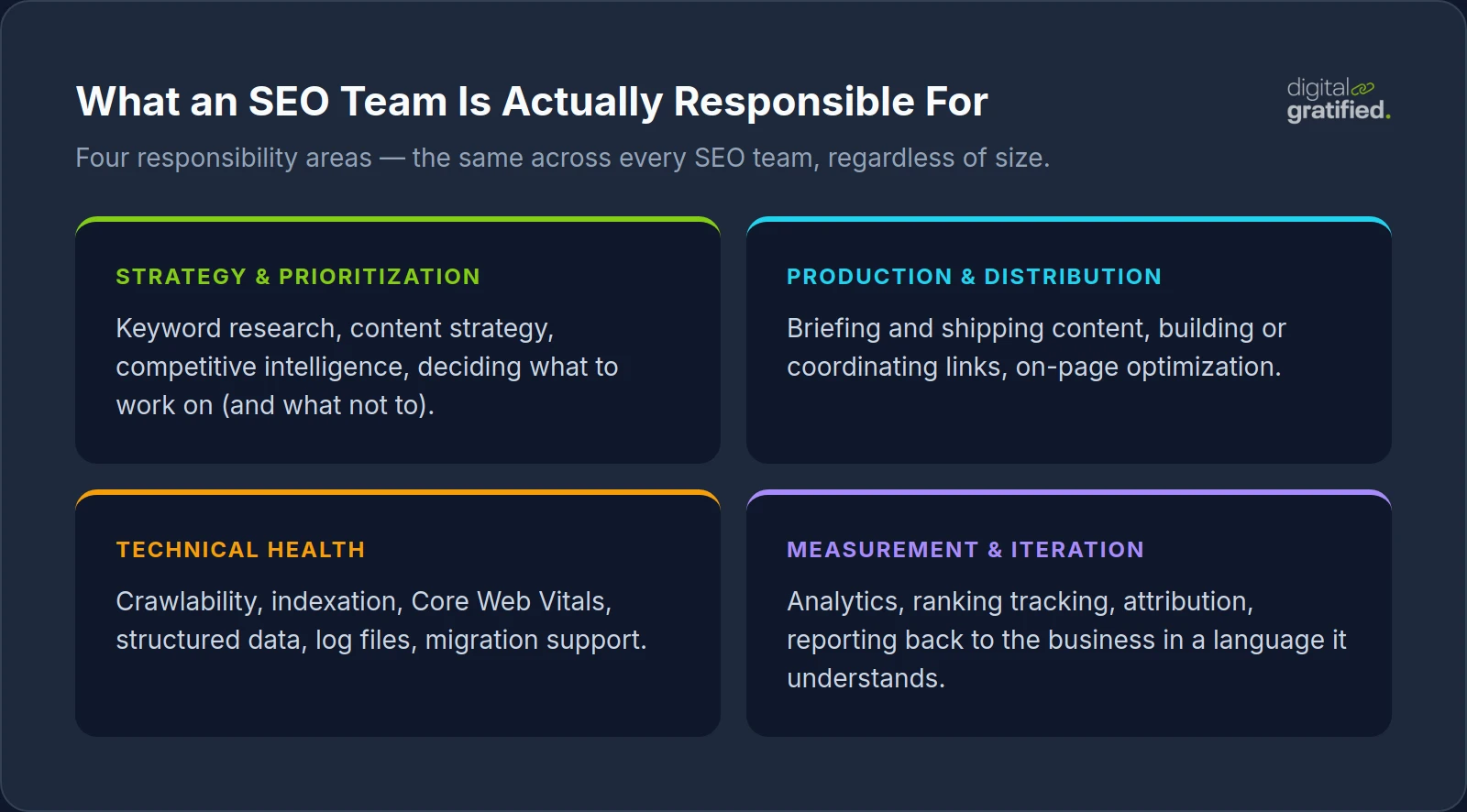
Strip the job titles away and an SEO team is responsible for four things: deciding what's worth working on, producing and distributing the work, keeping the site technically healthy enough that the work pays off, and measuring whether any of it is actually moving the business. Everything else in this guide is about who owns each of those and how they coordinate.
The size and shape of the team changes with the company, but the responsibility surface doesn't. A one-person SEO team and a fifty-person global SEO function are doing the same four things: the difference is how the work is split and where the bottlenecks sit.
- Strategy and prioritization : keyword research, content strategy, competitive intelligence, deciding what to work on and (more importantly) what not to.
- Production and distribution : briefing and shipping content, building or coordinating links, on-page optimization, and getting the work in front of the people it needs to reach.
- Technical health : crawlability, indexation, Core Web Vitals, structured data, log-file analysis, and supporting migrations without losing visibility.
- Measurement and iteration : analytics, ranking tracking, attribution, and feeding the results back into strategy in a way the rest of the business actually understands.
Once you can name who owns each of these on your team, you have a structure. If you can't, you have a wishlist.
The Core SEO Team Roles
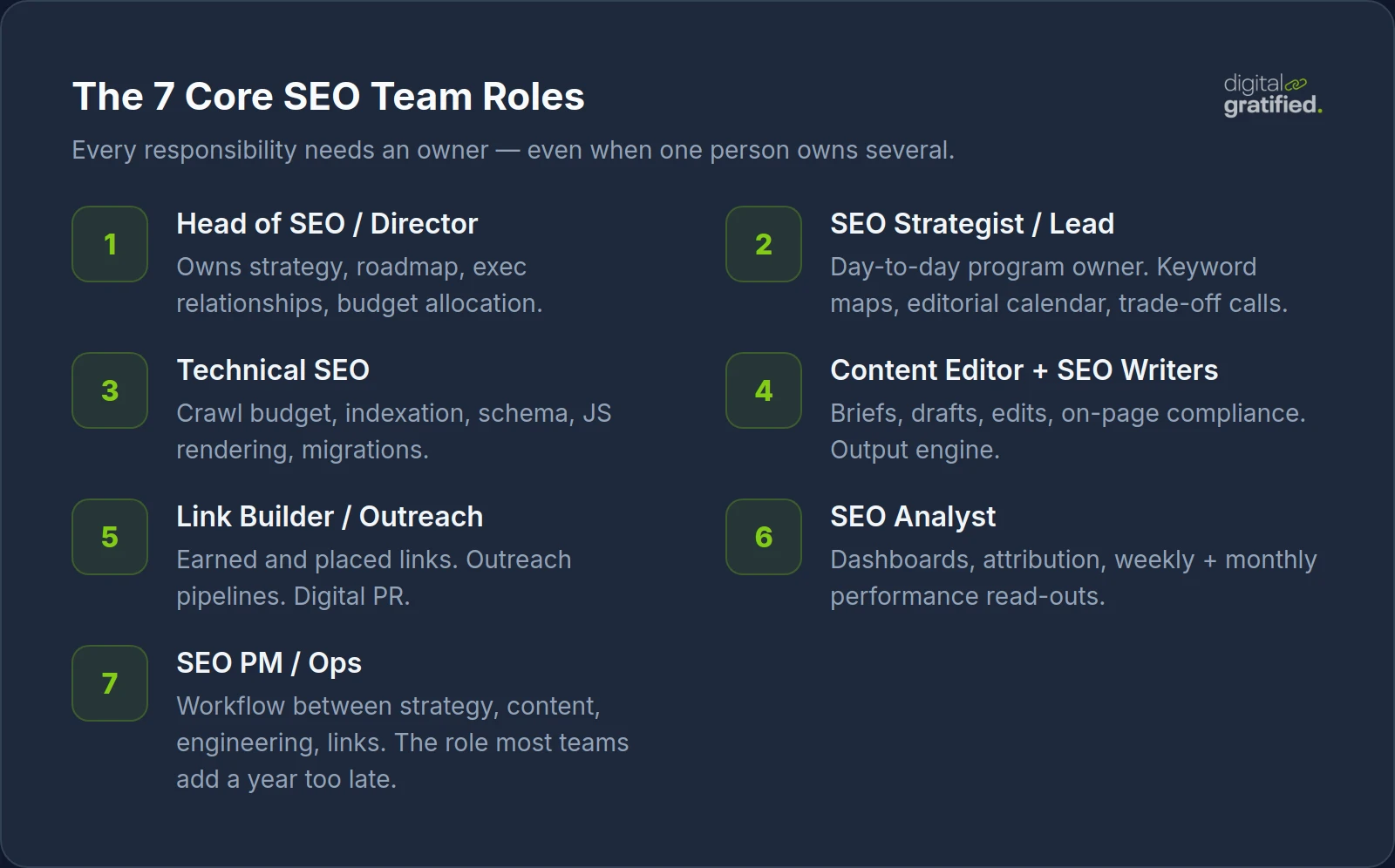
These are the seven roles a fully-built SEO team eventually has. Most teams won't have a dedicated person for every one (small teams collapse several into one role) but every responsibility needs an owner, even if that owner is shared or part-time.
Head of SEO / SEO Director
Owns the strategy, the roadmap, and the relationship with the rest of the business (product, growth, the exec team). Defines targets, allocates budget, decides what gets built in-house versus outsourced. Reports to a VP Marketing or CMO in most B2B orgs; sometimes to a CPO inside product-led companies where SEO is treated as a product growth lever. The Head of SEO's most important output isn't a campaign: it's a quarterly answer to "what is SEO going to deliver for this business, and what do we need to make that happen."
SEO Strategist / Lead
The day-to-day owner of the program. Builds keyword maps, defines topic clusters, sets the editorial calendar, briefs writers, and signs off on technical priorities. Most "SEO team lead" job descriptions describe this role. The Strategist owns the answer to "what should we work on this quarter, and why" and crucially, owns the trade-off conversation when product, brand, and demand gen want different things.
Technical SEO
Crawl budgets, indexation issues, Core Web Vitals, structured data, JavaScript rendering, migration plans, log-file analysis. In SaaS environments this person often sits closer to engineering than to marketing, and the most effective ones speak both languages fluently enough to translate. Technical SEO in a modern SaaS environment isn't an audit-once-a-year role, it's an embedded function with ongoing sprint capacity.
Content / SEO Writers
The team that produces the actual pages. Most modern setups have one editor plus a roster of freelance or in-house writers, briefed against keyword maps. The distinction that matters: SEO writers are not generalist content marketers. They brief and write to a strategy, against a defined target keyword and search intent, with on-page requirements as part of the deliverable. Mixing the two roles is how teams end up with beautiful prose that ranks for nothing.
Link Builder / Outreach Specialist
Owns earned and placed external links. Manages outreach pipelines, builds digital PR campaigns, and runs broken-link and unlinked-mention reclamation. This is the role that determines whether the rest of the team's work compounds: published content without external authority sits on page three forever. If you want a deeper background on what link building actually does for organic growth, that's the strategic case for funding this role. The mechanics of link building outreach are what this person executes every day.
SEO Analyst
Owns the dashboards, the attribution model, and the weekly and monthly performance read-outs. In smaller teams this is part of the Strategist's job; in mature teams it becomes a dedicated role, sometimes shared with the broader analytics function. An SEO Analyst that can connect rankings to pipeline (not just sessions) is one of the most leveraged hires a team can make, because that's the person who keeps SEO funded when the CFO starts asking hard questions.
SEO Project Manager / Ops
The role most teams discover they need a year too late. Owns the workflow between strategy, content, engineering, and link building. Keeps briefs moving, deadlines honest, and the team unblocked. Without this role, a five-person SEO team tends to operate at the output of a three-person team, not because anyone is underperforming, but because too much senior time gets spent chasing status updates instead of doing the work.
Designers, Developers, and PMs (shared resources)
Most SEO teams don't own dedicated design or dev: they depend on shared resources. The practical reality: a Head of SEO who can't get reliable engineering time will lose to one who can, regardless of strategy quality. Building working agreements with these teams (guaranteed sprint capacity, SEO requirements baked into PRDs, design support for content templates) is a structural decision, not an operational one. Treat it as part of the org design, not something to negotiate ticket-by-ticket.
SEO Team Roles by Company Stage
The role mix changes as the company grows. Most teams over-hire one role and under-hire another: usually too many strategists and not enough production or technical capacity. The table below maps the typical (and workable) role mix to each stage.
| Stage | Team size | Typical role mix |
|---|---|---|
| Founder-led / Pre-team | 0 in-house | Founder owns strategy. Outsourced content + technical audits. Optional agency partner for link building. |
| First hire | 1 | SEO Generalist (full-stack: strategy, briefs, on-page, analytics). Outsourced links and technical fixes. |
| Small team | 2–3 | SEO Lead + Content Manager + freelance technical and link building support. |
| Mid-stage | 4–7 | Head of SEO + Strategist + Technical SEO + Content Editor + Link Builder + freelance writers. |
| Mature / Multi-region | 8+ | Director + Regional SEO Leads + Technical SEO (often 2) + Content team (editor + writers) + Link Building team + SEO PM + Analyst. |
| Global | 15+ | Global Head of SEO + Regional Heads + central technical / analytics function + decentralized content. (See Section 7.) |
The order in which roles are added matters as much as which roles. Most teams scale in the wrong order: after the first generalist, they hire a second strategist or a junior specialist. The right second hire is almost always a Content Editor, because once strategy exists, the bottleneck is production. A second strategist just produces more briefs that nobody has the capacity to execute against.
Where Should the SEO Team Sit in the Org?
SEO team placement is one of those decisions that looks tactical and is actually structural. It determines what kind of work the team can ship, which adjacent teams will collaborate willingly, and how visible SEO is at the exec level. There are four common placements, each with a clear best-fit profile.
Inside Marketing
Default for most B2B and DTC companies. Pros: tight alignment with content, brand, and demand gen; shared editorial calendar; natural channel for funding. Cons: technical SEO often gets deprioritized because marketing leaders are weak on the engineering side, and SEO has to fight for engineering time against marketing's own platform asks.
Inside Growth
Common in product-led SaaS. Pros: SEO is treated as a growth channel with experiment cadence, clear KPIs, and a culture that values measurable outcomes. Cons: brand and content alignment can suffer because growth teams optimize for what's measurable in a short window, which is rarely how SEO compounds.
Inside Product / Engineering
Rare but powerful for product-led SEO: think Pinterest, Canva, Notion. Pros: technical SEO gets first-class engineering support; product templates and programmatic SEO become possible without months of negotiation. Cons: editorial and content strategy can drift unless paired with a strong marketing partner who owns brand voice and topic strategy.
Standalone Function Reporting to CMO or CPO
For organizations where SEO is a top-three growth channel. Pros: cross-functional authority, easier prioritization across marketing and product, the leadership visibility to actually move resources. Cons: requires a senior SEO leader comfortable advocating at the exec level, and an exec team willing to listen.
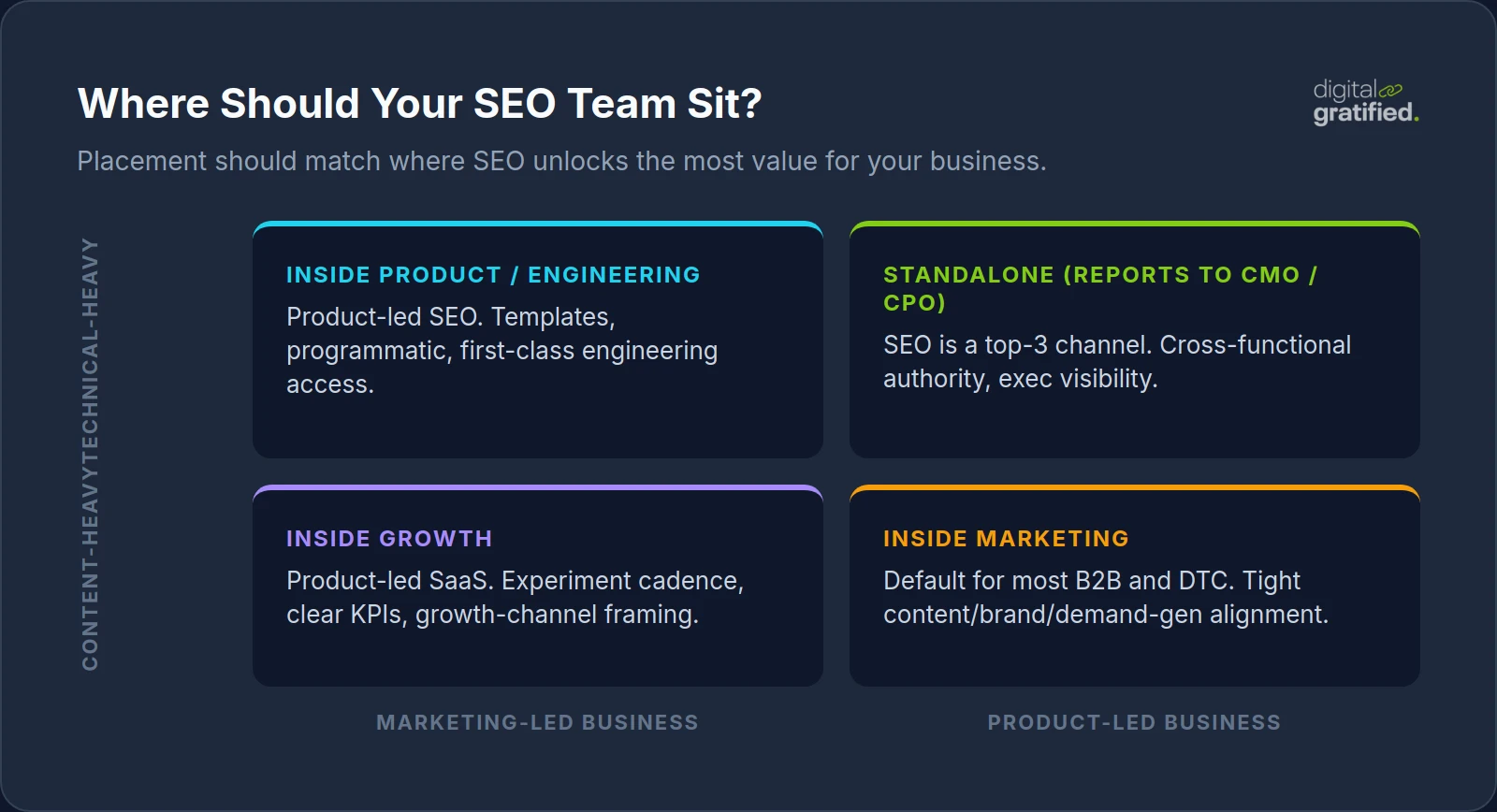
The practical rule: placement should match where SEO unlocks the most value for your business. If your wins are content-driven, sit in marketing. If they're product-driven, sit in growth or product. If both matter equally, the standalone model is worth the org weight: anything less and SEO ends up subordinated to whichever function it's nested under.
SEO Team Structure Models
Once a team grows past the small-team stage, the question stops being "what roles do we hire" and becomes "how do we organize them across business units or regions." There are three working models, and most mature organizations end up converging on the third.
Centralized Model
One central SEO team serves the entire business. Best for companies under roughly $100M ARR or with a single product line. Easy to coordinate, easy to align strategy, easy to maintain consistent quality, but harder to serve very different business units or markets well, because the central team becomes a queue everyone is waiting in.
Decentralized Model
Each business unit or region has its own SEO function. Best for multi-product holdcos or global brands with very different markets, customers, and competitive landscapes. The trade-off is significant: knowledge stays trapped inside each unit, work gets duplicated, and tooling and process consistency erode. Two SEO teams inside the same company often end up doing the same audit twice and reaching different conclusions.
Hub-and-Spoke (Center of Excellence) Model
A central SEO team owns standards, tooling, training, technical infrastructure, and (usually) link building partnerships. Embedded SEO leads sit within each business unit or region and execute against local strategy, drawing on the central team for specialist work. This is the structure most maturing global teams converge on, and it's also the model most large agencies are built around, which is not a coincidence.
| Model | Coordination cost | Knowledge sharing | Local responsiveness | Best for |
|---|---|---|---|---|
| Centralized | Low | High | Low | Single product, single market |
| Decentralized | High | Low | High | Multi-product, multi-region with very different needs |
| Hub-and-Spoke | Medium | High | Medium–High | Mature global orgs, large agencies |
Global SEO Team Management Structure
Global SEO teams almost always end up in some version of the hub-and-spoke model, for one simple reason: the trade-offs of the other two models compound badly at scale. A fully centralized global team becomes a bottleneck everyone in every region is queued behind. A fully decentralized one duplicates work and produces inconsistent quality across markets that share the same brand. Hub-and-spoke is the compromise that survives contact with reality.
The split that works: technical SEO, tooling, training, reporting standards, and high-leverage link building partnerships centralize. Keyword research, content production, on-page optimization, and local outreach decentralize. Centralizing the wrong things kills local responsiveness; decentralizing the wrong things destroys consistency. Get the split right and the model runs itself.
Time-zone and language considerations make async-first SOPs non-negotiable for global teams. If the only way the team coordinates is a weekly call that half the regions can't attend in business hours, the central team becomes a black box and the regions stop trusting it. Documented SOPs, written status updates, and a shared source of truth for strategy and standards are not nice-to-haves at this scale: they're the operating system.
The single most common failure mode for global SEO functions: centralizing strategy but forgetting to budget for local execution capacity. A brilliant global strategy with no one in-region to execute it produces nothing. The regional spokes need enough headcount and authority to actually ship work, not just receive instructions.
One practical note: the hub-and-spoke structure is also how most mature SEO agencies are organized internally: central specialists supporting embedded account leads. Which is part of why partnering with an agency is sometimes a faster on-ramp to a global SEO function than building one in-house from scratch.
In-House vs Agency vs Hybrid
The in-house versus agency debate gets framed as ideological. It shouldn't be. It's a resource allocation decision that depends on stage, channel importance, and which capabilities you can realistically hire for. Here's the honest framing.
The honest trade-offs
- In-house wins on: deep product knowledge, brand context, long-term institutional memory, control over strategy.
- Agency wins on: breadth of pattern recognition across many clients, faster ramp-up, access to specialists you couldn't justify hiring full-time (technical leads, digital PR, programmatic SEO).
- Hybrid wins on: combining the two: in-house owns strategy, brand, and analytics; an agency provides specialist execution capacity where it's hardest to hire.
When in-house makes more sense
- SEO is a top-three growth channel and you can fund three or more headcount without starving other functions.
- Your product changes frequently in ways that affect SEO (new templates, new app routes, frequent migrations).
- You have proprietary data, methodology, or expertise that requires deep internal context to translate into content.
When an agency makes more sense
- You're early-stage and need both strategy and execution capacity without committing to permanent headcount.
- You need specialist capability (digital PR, technical migrations, programmatic SEO) that's hard to hire for and hard to keep busy full-time.
- Your in-house team has bandwidth issues you can't solve by hiring fast enough, which is most of the time.
If you want the full breakdown of when and how to outsource SEO (including pricing models and contract structures) that's the deep-dive companion to this section.
The hybrid model in practice
Most mature programs end up hybrid. In-house owns strategy, editorial direction, analytics, and the cross-functional relationships. An agency partner handles specialist execution: most often link building, technical audits, surge content production, or digital PR. The split lets you have a small, senior in-house team backed by deep specialist capacity, without the headcount overhead of building each specialty internally. For more on how that SEO agency partnership model works in practice, the partnership-model breakdown covers the operating mechanics.
For agencies offering SEO as part of a broader retainer, white label link building partners can fill the link-acquisition gap without needing to staff a full outreach team, one of the most common applications of the hybrid model in the agency world itself.
How to Build an In-House SEO Team from Scratch
Building an in-house team is a sequence problem. Hire the right roles in the wrong order and the team stalls; hire them in the right order and each new role compounds the output of the previous one. Here's the sequence that works.
1. Define the SEO charter
Before hiring anyone, write a one-page document covering: what SEO is responsible for, what it explicitly isn't, what success looks like at 6, 12, and 24 months, and where SEO sits in the org. Without this, your first hire spends three months writing it themselves while everyone in adjacent teams has a different idea of what SEO is supposed to do. Most charter conversations get postponed; the teams that don't postpone them save themselves a year.
2. Make the first hire a senior generalist, not a junior specialist
Your first SEO hire needs to be able to own strategy and execute. A junior specialist who can only do one part of the job, a writer, an analyst, a technical SEO, will not move the program forward alone, because they have no one to hand off to. A senior generalist who can write a brief, ship a page, run an audit, and present results to the exec team can build the whole function from a standing start.
3. Build the brief, content, and review workflow before scaling production
A clear brief template, an editing standard, and a publish checklist will save you more time at scale than any tool or any additional hire. (Section 11 below has SOP outlines you can adapt.) Production capacity without process is just faster ways to ship bad work.
4. Add an editor and outsource writers
Output scales faster with one full-time editor and a freelance writer roster than with multiple in-house writers, until you're consistently publishing 15+ pieces per month. The editor owns brief quality, voice consistency, and SEO compliance; writers are interchangeable specialists. This split is significantly cheaper than two in-house writers and produces more output.
5. Solve the technical bottleneck
Once content is shipping reliably, technical SEO usually becomes the constraint: indexation issues, slow templates, broken migrations, schema gaps. Either hire a dedicated Technical SEO or build a working agreement with engineering that gets you reliable, predictable sprint capacity. Trying to "ask for" engineering time on a per-ticket basis is the slowest way to lose this fight.
6. Add link building capacity
In-house outreach is usually less efficient than an agency partner at this stage: building an outreach pipeline from scratch takes 6–12 months to produce reliable monthly volume. The pragmatic move is to either hire one in-house link builder plus use an agency for surge capacity, or outsource the whole function until you have clear signal that in-house pays off. At Digital Gratified, we work with B2B SaaS teams who are usually at step 3 or 4 of this sequence: the strategy exists but execution (especially link acquisition) is the bottleneck.
7. Add SEO Ops once the team is 4+
A part-time SEO PM or Ops role is the highest-ROI hire most mid-stage teams aren't making. Once you have a Strategist, a Technical SEO, a Content Editor, and a Link Builder all running parallel workstreams, someone needs to keep the workflow honest. Without that role, your most senior people spend their time chasing status instead of doing strategy.
How the SEO Team Works with Other Teams
An SEO team's effective capacity is largely determined by how well it interfaces with adjacent functions. A four-person team with great working agreements out-ships an eight-person team that lives in a silo. Here's how SEO connects to each adjacent function in practice.
Product / Engineering
SEO requirements need to be in PRDs from the start, not retrofitted after launch. Every URL or template change should pass through SEO review. There should be ongoing, predictable technical SEO sprint capacity: not ad-hoc tickets that compete with feature work. Tying any new template work into the broader internal linking strategy prevents the page from launching as an orphan with no equity flowing to it.
Content / Brand
A single editorial calendar, owned jointly. SEO briefs as inputs to brand-led content; brand review of SEO-led pieces to keep voice consistent. The teams that get this right treat SEO and brand as two inputs to one output: not two competing functions producing different content streams.
Demand Gen / Paid
Share keyword and conversion data both ways. SEO landing pages should be designed to be paid-friendly when needed, and vice versa. Most importantly, avoid cannibalization: paid and organic targeting the same query with different landing pages is a tax both teams pay. Quarterly alignment on which queries are paid-owned versus organic-owned solves most of this.
Sales
Sales surfaces buyer objections and the actual language prospects use. SEO uses that to brief bottom-of-funnel content. In return, SEO surfaces high-intent queries (competitor comparisons, integration searches, pricing) that sales can use in outbound. The exchange takes one recurring meeting to set up and pays back permanently.
Customer Success
CS surfaces feature gaps, common questions, and the queries that actually matter to existing customers. SEO surfaces queries that map to expansion or retention (usage patterns, integration questions, advanced use cases) that CS can use in onboarding and education.
The single most important point: the SEO team that gets the most done is the one with the most working agreements with adjacent teams, not the one with the largest headcount.
Example SOPs for an SEO Team
SOPs are the difference between an SEO team that produces consistent output and one that produces output that depends entirely on which senior person happens to be available. The three below are the minimum every SEO team should have written down: most teams already have all of this work happening, but undocumented, which is why output collapses every time a senior person leaves.
SOP: New Blog Post
- Strategist creates brief from the keyword map (target keyword, search intent, outline, internal link targets, reference URLs, on-page requirements).
- Editor reviews brief, refines if needed, and assigns to a writer.
- Writer drafts in the CMS, applies the on-page checklist, and submits for review.
- Editor reviews for quality, accuracy, and SEO compliance (target keyword usage, structure, internal links present).
- Technical SEO review (schema, internal links validated, image alt text, canonical tag correct).
- Publish + first-week monitoring (indexed, crawled, no rendering issues).
- 90-day performance review; refresh, expand, or sunset decision based on ranking and traffic.
SOP: Technical SEO Audit
- Crawl with Screaming Frog (or equivalent); export and categorize issues.
- Cross-check against Google Search Console coverage and log files for ground-truth indexation data.
- Prioritize by impact (organic traffic at risk or unlocked) × effort (engineering hours).
- Create engineering tickets with reproduction steps, expected behavior, and clear acceptance criteria.
- Weekly status sync with engineering until resolved; track in the same backlog they use for product work.
- Re-crawl and verify fixes are live in production, not just in staging.
- Quarterly full-audit cycle; ad-hoc audits triggered by major releases or traffic drops.
SOP: Link Building Campaign
- Strategy review: which money pages and pillar pages need authority this quarter, and what's the target volume.
- Asset selection: which existing pages support outreach (linkable assets, data studies, original research) and which need to be built.
- Prospect sourcing: build the target list from competitor backlink analysis, topical relevance filters, and prior relationships.
- Outreach sequence: personalized first touch + two follow-ups, tracked in a CRM or outreach tool.
- Placement review: every secured placement reviewed for quality (relevance, domain authority, do-follow, editorial context) before it counts toward the target.
- Internal link follow-up: ensure new equity flows from the linked page to money pages downstream: this is where the internal linking strategy and the link building strategy meet.
- Monthly reporting on placements, referring domains, anchor distribution, and resulting ranking changes for the targeted pages.
How to Improve SEO Team Productivity
SEO team productivity is almost never solved by hiring more people. It's solved by removing friction from the existing workflow. The teams that ship the most are usually the ones with the fewest meetings, the clearest briefs, and the shortest feedback loops.
- Cut the meeting load. One weekly team sync plus one async update is enough for most teams under 10 people. Anything more and you're paying for coordination overhead in lost execution time.
- Centralize the brief. Every piece of work (post, audit, outreach campaign) starts with a one-page brief; no work begins without it. The brief is the contract between strategy and execution.
- Track cycle time, not just output. Measure how long it takes a brief to go from assigned to published. That's the real bottleneck signal: output alone tells you nothing about where the friction sits.
- Run a single "what's blocked" channel. Anything blocking work goes here; reviewed daily by the Head of SEO or SEO PM. Most blockers get cleared in a 60-second message exchange if someone is actually watching.
- Quarterly retrospective on the workflow itself not just on results. What part of the process slowed us down? What should we automate, kill, or reassign?
- Invest in tooling before headcount. A $300/month SEO tool that saves the Strategist 10 hours a week is cheaper, faster, and more reversible than another hire.
SEO Team Training and Coaching
SEO changes fast enough that any team that isn't actively learning is decaying. Algorithm updates, AI search, evolving SERP features, new tooling: the surface area is too wide for any one person to keep up with passively. Training has to be a recurring practice baked into the team's calendar, not a one-off line item in the annual planning doc.
The teams that stay sharp tend to share a few practices: regular internal knowledge-sharing, real budget for external learning, a maintained internal playbook, and explicit growth plans for each role. None of this is expensive: it's just deliberate.
- Weekly 30-minute team learning session: each team member rotates presenting something new (a tool, an algorithm update, a case study, a tactic).
- A conference and course budget per person per year, with the default expectation that it gets used.
- Internal documentation maintained by the team as the canonical SEO playbook: onboarding new hires should be a matter of pointing them at it.
- Quarterly skills review tied to a role-specific growth plan, so career progression is visible.
- Pairing junior team members with seniors on real project work: this beats any course or certification.
External SEO team coaching is most valuable for SEO Leads and Heads of SEO, who often need a sounding board that their own team can't provide and a peer who's seen the same problems play out in other organizations.
The AI-Augmented SEO Team
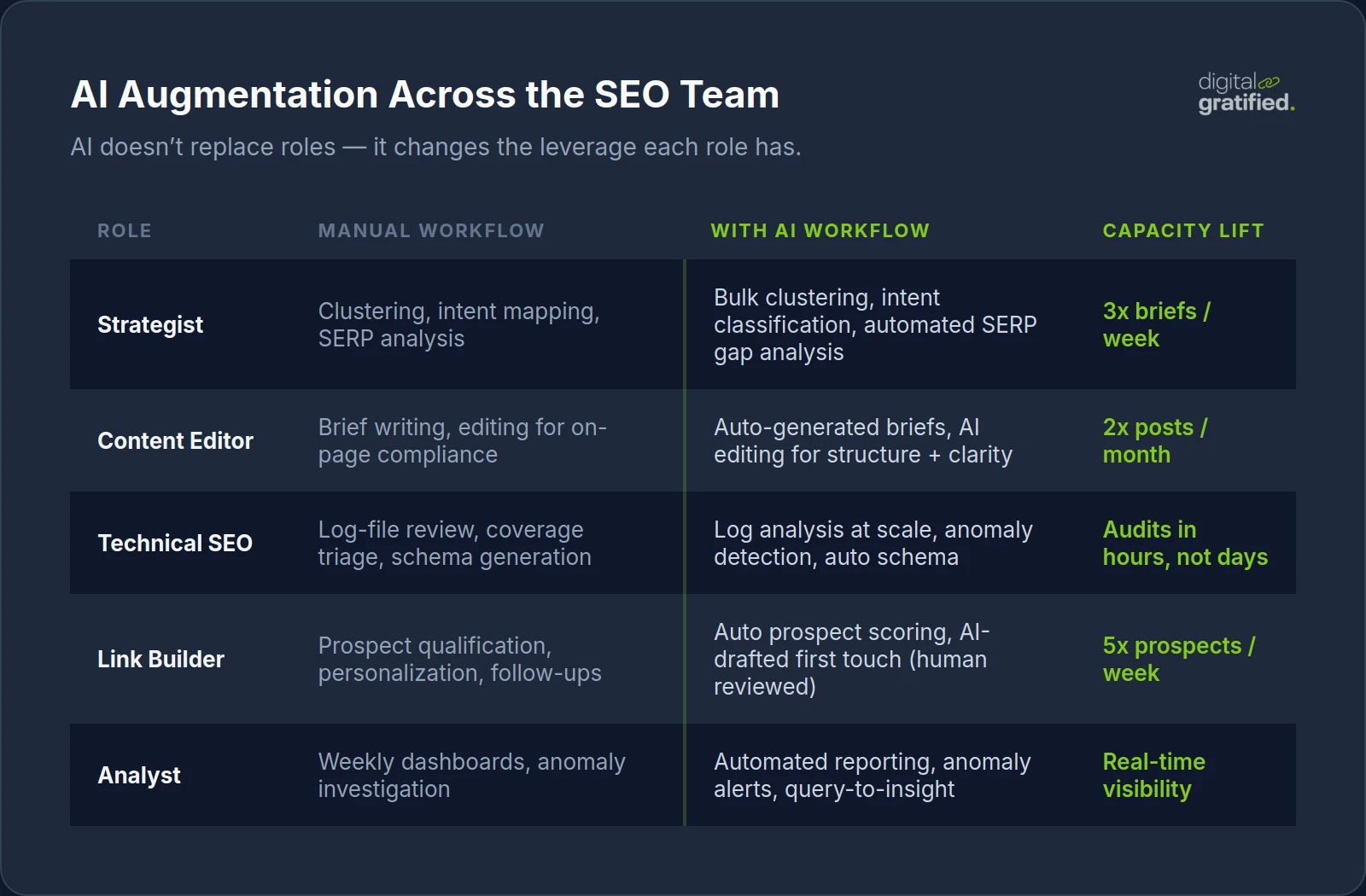
AI doesn't replace SEO roles. It changes the leverage each role has. A Strategist with AI workflows can brief three times as much content. A Technical SEO with AI workflows can audit a site in hours instead of days. A Link Builder with AI workflows can prospect and personalize at five times the rate. The teams that figure this out have an output advantage that doesn't show up as headcount on the org chart, which is what makes it structural.
AI in Strategy and Keyword Research
Clustering thousands of keywords by intent, classifying search intent at scale, automated SERP analysis to identify content gaps, competitor content extraction. Tools that help: Keyword Insights, ContentGecko, custom GPT workflows fed competitor data. The Strategist who used to spend a week clustering and prioritizing can now do it in an afternoon, and spend the rest of the week on the work that actually requires judgment.
AI in Content Production
Briefs generated (and pre-filled) from SERP analysis. First drafts AI-assisted but not AI-authored. AI editing for clarity, structure, and on-page compliance. The teams that ship the most use AI for the 80% of the work that's mechanical and keep humans on the 20% that's judgment (voice, accuracy, expertise, brand fit). AI SEO done well looks like a content team that's twice as productive without any drop in quality; done badly, it looks like a flood of generic content nobody reads.
AI in Technical SEO
Log-file analysis at scale (finding crawl waste, identifying indexation patterns), anomaly detection in coverage reports, automated schema generation, AI-assisted JavaScript rendering diagnostics. Most of the diagnostic work that used to consume a Technical SEO's week is now an automated workflow with a human reviewing the output.
AI in Link Building
Prospect qualification (does this domain actually rank for relevant terms? is it likely to respond?), personalization at scale (drafting first-touch emails grounded in the prospect's actual content), automated follow-up sequencing. The important caveat: AI helps the prep work, not the relationship work. Over-automating the actual outreach destroys reply rates: recipients can tell, and it burns your sender reputation faster than any volume gain is worth.
The New Role: AI Workflow Lead
A growing number of mature SEO teams have one person (often a senior Strategist or Ops lead) whose explicit responsibility is building, maintaining, and improving the team's AI workflows. This isn't a separate hire most of the time, but it is a separate responsibility that should be explicitly owned. Without it, AI workflows decay: prompts stop matching how the team actually works, tools get bought and forgotten, and the productivity gains evaporate.
The SEO team that consistently uses AI for the 80% of mechanical work has two to three times the effective capacity of the team that doesn't, without adding headcount. That capacity gap is the new structural advantage, and it's compounding fast.
Common SEO Team Structure Mistakes
- Hiring a junior specialist as the first SEO hire. They can't own strategy yet, and you'll spend a year hiring around them while the program doesn't move.
- Putting SEO inside a function that doesn't value technical work. If your placement doesn't give the team reliable engineering access, technical SEO will silently rot, and you won't know until traffic drops.
- Scaling content production before brief quality. More writers + bad briefs = more bad content. The bottleneck is upstream of the writers.
- No designated link building owner. Links become "everyone's job, no one's job" and stall. Outreach pipelines die fast when nobody owns the pipeline metrics.
- No SOPs. Every project becomes a custom workflow, new hires take three times longer to ramp, and quality varies wildly depending on who happens to be doing the work.
- Confusing output with progress. Publishing 20 posts a month means nothing if none of them target the right queries, earn the right links, or rank against the right competitors. Output is the easiest vanity metric in SEO.
Frequently Asked Questions
What does an SEO team do?
An SEO team is responsible for organic search visibility: strategy, content, technical health, link acquisition, and measurement. The exact responsibilities depend on the company's stage, business model, and where SEO sits in the org, but those five areas are constant across every SEO team that exists.
What are the core roles in an SEO team?
At minimum: a Head of SEO or SEO Lead (strategy), a Content Editor (production), a Technical SEO (site health), and a Link Builder (off-page). Mature teams add an SEO Analyst and an SEO PM / Ops role, and global teams add regional leads on top of that.
What does an SEO team lead do?
The SEO team lead owns the day-to-day program: keyword strategy, editorial calendar, briefing, technical prioritization, and team coordination. They're the layer between the Head of SEO (or CMO) and the executing roles, and they own the trade-off conversations when adjacent teams want competing things.
How big should an SEO team be?
For most B2B SaaS companies, 4–7 people is the sweet spot: Head of SEO, Strategist, Technical SEO, Content Editor, Link Builder, plus a shared analyst and freelance writers. Above roughly $100M ARR or in global organizations, the team typically grows to 10+ with a hub-and-spoke structure.
Should SEO be in marketing or product?
It depends on where SEO unlocks the most value. Content-driven SEO sits in marketing; product-led SEO sits in product or growth; if both matter equally, a standalone function reporting to the CMO or CPO is worth the org weight. Defaulting to marketing without checking is the most common mistake.
Is it better to build an in-house SEO team or hire an agency?
In-house wins on depth and institutional memory; agencies win on breadth and specialist capacity. Most mature programs end up hybrid: in-house owns strategy and direction, an agency partner provides specialist execution (typically link building, technical migrations, or digital PR).
How do you scale an SEO team effectively?
Scale in this order: senior generalist → content editor + freelance writers → technical SEO → link building capacity → SEO ops. Most teams scale in the wrong order and end up bottlenecked on either production capacity or technical engineering time, which slows the whole program regardless of how many people are hired.
What does "SEO team meaning" really come down to?
An SEO team is the group responsible for turning organic search into a predictable growth channel. The word "team" matters: a single SEO hire without a structure around them is an SEO function in name only, no matter how senior or skilled that person is.
Conclusion
SEO teams that consistently drive rankings are built deliberately. They aren't assembled by hiring "an SEO person" and waiting for results. They have a clear charter, an org placement that matches where their wins come from, the right first hire, SOPs that survive turnover, an honest read on in-house versus agency capacity, and AI workflows that turn one Strategist into the output of three.
The structural choices compound: the charter shapes the first hire; the first hire shapes the workflows; the workflows shape the SOPs; the SOPs shape how scalable the team is when growth comes. Most teams that feel stuck aren't stuck because of any single person: they're stuck because one or more of these structural choices was made by default rather than by design.
Whether you're building from scratch or restructuring a team that's plateaued, start with the charter and the org-placement decision. Everything else follows from those two. If you're building or restructuring an SEO function for a B2B SaaS company, Digital Gratified works with teams on exactly this: combining strategy, technical SaaS SEO, content, and link acquisition into a program that compounds.
Let's Scale Your SaaS Together
Get a custom SEO and link building strategy tailored for your SaaS business.
Get SEO insights that actually move rankings
Link building tactics, case studies, and SaaS SEO playbooks. No fluff, no spam.
You're subscribed!
SEO and link building insights, straight to your inbox.