Everyone gives the same answer: 'check your competitors and close the link gap.' That's correct but incomplete. The number of backlinks you need depends on three variables, and most people only calculate one. Here's how to find your actual number.

Founder, Digital Gratified
The honest answer to "how many backlinks do I need to rank?" is: it depends on three things, not one. Most guides tell you to check your competitors and close the link gap. That's correct, but it's only one of three variables that determine how many links your specific page needs.
The other two variables (your domain's authority position relative to competitors, and your content's ability to satisfy user intent) can either multiply or shrink the link count you're working toward. A page on a domain with strong topical authority can rank with a third of the links a newer domain needs for the same keyword. A page that genuinely outperforms competitors in content quality can rank above pages with 3× more backlinks.
For software companies trying to answer this question, the variables look slightly different. Our SaaS link building playbook covers how to set link velocity targets that match SaaS content strategies and typical DR trajectories in competitive software niches.
This guide walks through all three variables, shows you how to calculate your specific number, and explains why raw link counts mislead most people asking this question.
The Quick Answer: Benchmarks by Competition Level
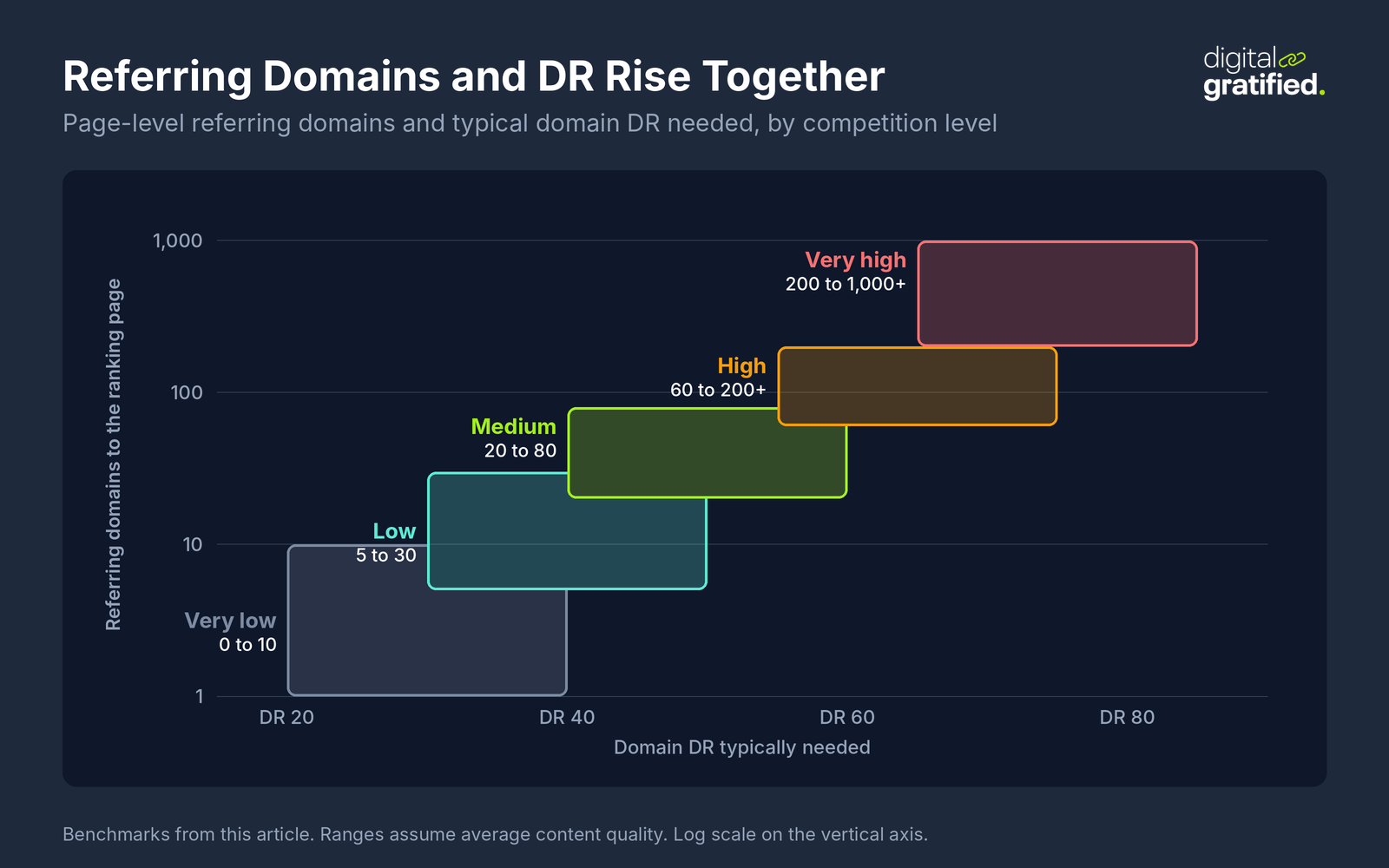
Before getting into the methodology, here are realistic benchmarks based on page-level analysis across competitive tiers. These are referring domain counts to the specific ranking page, not total backlinks to the domain.
| Competition Level | Example Keyword Type | Referring Domains to Rank Page | Domain DR Typically Needed |
|---|---|---|---|
| Very low | Local service + city, niche B2B | 0–10 | 20–40 |
| Low | Long-tail informational, niche commercial | 5–30 | 30–50 |
| Medium | Mid-tail SaaS, B2B service categories | 20–80 | 40–60 |
| High | Broad commercial, finance, insurance | 60–200+ | 55–75+ |
| Very high | Head terms: "CRM software", "project management" | 200–1,000+ | 65–85+ |
Two important caveats for this table. First, these are page-level referring domain counts: the number of unique domains linking to the specific URL you're trying to rank, not your entire domain. Second, these ranges assume average content quality. The content quality multiplier (covered below) can shift these numbers significantly in either direction.
Why Raw Competitor Link Counts Mislead You
Every guide on this topic tells you to look at what the top-ranking pages have and then match or beat that number. This is the right starting point, but it misses two important adjustments you need to make.
Problem 1: Domain vs. Page Level
When you look at a competitor's ranking page in your SEO tool, you'll see two different numbers: links pointing to the domain, and links pointing to that specific page. The page-level number is what actually matters for ranking that specific keyword.
A page on a DR70 domain with 8 referring domains can outrank a page on a DR45 domain with 40 referring domains, because the DR70 domain passes substantially more link equity through its internal linking structure to every page it publishes. The stronger domain's pages start with a significant base of authority before a single external link is built to them.
The mistake most people make: they see the competitor's domain has 500+ referring domains and panic, thinking they need to match that. They don't. They need to look at how many referring domains point to the specific ranking page, which is often far fewer.
Problem 2: Not All Referring Domains Are Equal
A referring domain count of 20 can mean very different things. If the 20 links come from DR80+ topically relevant sites with real traffic, that profile is worth more than 80 links from DR30 directories with no organic visitors. Raw counts are a proxy metric: useful for benchmarking, but not the full picture.
When doing your competitor analysis, filter for referring domains with meaningful traffic (most backlink tools show traffic for referring pages) and note how many of the links are topically relevant to the keyword you're targeting. The effective link strength of the competing page is what you're trying to estimate, not just its raw count.
The Three Variables That Determine Your Number
Variable 1: The Page-Level Link Gap
This is the number every guide covers. Pull the top 3–5 ranking pages for your target keyword in your SEO tool. Look at the referring domain count for each specific page (not the domain). Find the median (not the highest number, the median). That's your baseline target for page-level external links.
Use the process in the competitor backlink analysis guide to filter this correctly: looking at dofollow referring domains with at least some traffic, excluding obvious spam and directory links that aren't moving the needle for the ranking pages either.
Variable 2: Your Domain Authority Position
Your domain's DR or DA relative to the ranking competitors acts as a multiplier on the page-level link requirement. The adjustment works like this:
- If your domain DR is within 10 points of the median competing domain: your page-level link target is roughly the same as the median
- If your domain DR is 10–20 points below the median: add 30–50% to your page-level target to compensate for the authority deficit
- If your domain DR is 20+ points below the median: the link gap is real but secondary to the domain authority problem, you likely need to build domain-level authority in parallel rather than focusing exclusively on this one page
Variable 3: Content Quality (The One Most Guides Miss)
This is the variable that most guides skip entirely, and it's the one that most affects whether your real-world link requirement is at the top or bottom of the competitive range.
Google's ranking algorithm doesn't evaluate backlinks in isolation: it evaluates them alongside engagement signals. Dwell time, click-through rate from the SERP, pogo-sticking (users returning to search results after visiting your page), and scroll depth all tell Google how well your page actually satisfies the query.
A page that demonstrably satisfies user intent better than the competing pages (more comprehensive, better structured, more useful) will rank with fewer external links because the content quality signals partially substitute for link authority. Conversely, a thin page with weak content needs significantly more links to rank, and may fail to hold rankings even when it achieves them, because the engagement data pulls it back down.
The practical implication: before building any links to a page, make sure the page is the best available answer to the query it's targeting. If it isn't, your link building ROI will be substantially lower than the backlink count gap analysis suggests it should be.
How to Calculate Your Specific Number: Step by Step
Step 1: Pull the Page-Level Referring Domain Counts for the Top 5 Rankings
Open your SEO tool and search for your target keyword. For each of the top 5 organic results:
- Click through to the specific ranking URL
- Go to the Backlinks or Referring Domains report for that URL (not the domain)
- Filter for dofollow only
- Note the referring domain count
Calculate the median of the 5 numbers. This is your baseline page-level target.
Step 2: Compare Domain Authority Levels
Note the DR/DA of each ranking competitor. Calculate the average or median. Compare this to your own domain's DR/DA.
- If you're within 10 points: baseline target stands
- If you're 10–20 points below: multiply baseline by 1.3–1.5
- If you're 20+ below: consider whether this keyword is achievable now or whether domain authority building should come first
Step 3: Audit Your Content Quality
Before building any links, honestly assess whether your page is the best available answer to this query:
- Does it cover the topic more thoroughly than the ranking pages?
- Does it load quickly and provide a better UX?
- Does it include supporting elements (data, examples, visuals) that competing pages don't have?
- Is the answer to the searcher's intent clear and well-structured?
If yes: you may be able to rank at the lower end of the link target range. If no: fix the content before investing in links, or accept that you'll need more links to compensate.
Step 4: Set Your Link Velocity Target
Divide your target number by a realistic acquisition timeline. For most pages outside very competitive niches:
- 1–5 links/month: appropriate for low-competition keywords, new domains building naturally
- 5–15 links/month: appropriate for medium-competition targets on established domains
- 15–30+ links/month: competitive niches, usually requiring active outreach programmes or agency support
Sudden spikes in link acquisition (acquiring 50 links in a month on a domain that normally gets 5) can trigger manual review flags regardless of the quality of those links. Gradual, consistent link velocity is safer and more likely to produce stable rankings than burst campaigns.
The Content Quality Multiplier in Practice
This concept is worth spending more time on because it has the most practical impact on how you allocate link building budget.
Consider two pages targeting the same keyword with the same domain DR, facing the same competition. Page A is a well-structured, genuinely comprehensive piece that answers the query better than any of the competing pages: it includes original data, clear examples, strong UX, and a logical structure. Page B covers the same topic but doesn't clearly outperform the competition on any dimension.
Page A will typically rank with 30–50% fewer external links than Page B, because Google's engagement signals (lower bounce rate, higher dwell time, more return visitors) confirm its quality and partially substitute for link authority. Page B, despite identical link building, may achieve lower rankings or fail to hold position 1–3 even when it gets there, because user behaviour data pulls it back.
This is the reason experienced link builders always audit content before they build links. The Digital Gratified approach to link building starts with a content quality audit of the target page, because a link programme built on top of weak content is consistently less efficient than the same budget applied to strong content. The content multiplier affects your cost per ranking position more than most clients initially expect.
Practical Ways to Improve Your Content Quality Before Building Links
- Match search intent precisely. If the top results are all how-to guides and your page is a product landing page, no amount of links will bridge that structural mismatch.
- Go deeper than the competition on the things that matter. Not longer: deeper. Cover the specific nuances, edge cases, and follow-on questions that competing pages skip over.
- Add evidence and data. Original statistics, case studies, or proprietary data points make content more linkable and more trustworthy. Pages that cite credible external data also tend to earn more natural links over time, reducing how much active link building you need to sustain rankings.
- Improve page experience. Core Web Vitals, mobile usability, and clear content hierarchy all affect how long users stay on the page, which feeds back into the engagement signals that complement your link profile.
Link Quality: How to Count What You Have
Not all backlinks count equally in this analysis. When assessing your current link profile or counting what competitors have, think in terms of link tiers rather than raw numbers:
- Tier 1 (high weight): Dofollow links from topically relevant domains with DR 50+, real organic traffic, and genuine editorial context. One of these can be worth 10–20 lesser links for ranking purposes.
- Tier 2 (moderate weight): Dofollow links from legitimate sites (DR 30–50) with some relevance and modest traffic. These contribute meaningfully but require volume to compete with Tier 1 links.
- Tier 3 (low weight): Directory listings, low-traffic niche sites, nofollow links. These contribute marginally to link diversity signals but shouldn't anchor your link counting when assessing the gap.
Understanding anchor text distribution across your link profile also matters: a healthy link profile has a natural mix of brand anchors, partial matches, and naked URLs, with exact-match anchors making up only a small fraction. An over-optimised anchor profile is a risk signal regardless of how many links you have.
What Happens When You Skip the Analysis
The most common mistake: seeing a competitor has 200 backlinks to a page and starting to build links to your page without the domain authority or content quality foundation to support a ranking. The result is usually a page that ranks between positions 15 and 30, climbs slowly, and plateaus (despite consistent link building) because the authority deficit or the content quality gap is doing more damage than the links are fixing.
The second common mistake: building links to a domain-level target (homepage) when what needs links is a specific inner page. Homepage link building improves domain authority over time, which is valuable, but it doesn't directly move rankings for a specific keyword the way page-level links do.
For teams that don't want to run this analysis themselves, working with a specialist link building partner typically starts with exactly this kind of competitive gap analysis before any links are built. It's also the starting point for white-label link building programmes where agencies run this analysis for their clients on their behalf.
Frequently Asked Questions
How many backlinks do I need to rank on page 1?
It depends on competition level and your domain authority. For low-competition keywords, 5–30 referring domains to the specific page is often enough on an established domain. For medium-competition keywords, 20–80 referring domains is a more realistic range. For highly competitive terms, 100–500+ referring domains to the page is common among the top results. Check the page-level referring domain counts for the current top 5 results for your specific keyword: that's the most reliable benchmark.
Is it better to have 10 high-quality backlinks or 100 low-quality ones?
In almost all cases, 10 high-quality referring domains from topically relevant, high-authority sites with real traffic outperform 100 low-DR, low-traffic links. Low-quality links at scale can also create anchor text or link profile issues over time. Focus on quality first: use the competitive analysis to understand what "quality" means in your specific niche.
How many backlinks per month is safe to build?
There's no universal safe number, but sudden spikes are riskier than consistent velocity. For most sites, 5–15 new referring domains per month from active outreach is sustainable. Established domains in competitive niches can operate at higher velocity if the links are genuinely earned from quality sources.
Do nofollow backlinks count toward ranking?
Nofollow links don't pass PageRank directly, but Google has treated the nofollow attribute as a "hint" rather than an absolute directive since 2019. Nofollow links from high-authority sources contribute to brand visibility and referral traffic, which can indirectly support rankings. They shouldn't anchor your link building strategy, but they're not worthless.
Can I rank without any backlinks?
Yes, for very low-competition keywords where the ranking pages also have few or no backlinks. The determining factor is what the competition has. If the page ranking #1 for your target keyword has 0 referring domains, a well-optimised page on a domain with similar or better authority can compete without building links. Use the competitor analysis to check what's actually required.
How long does it take for backlinks to affect rankings?
A link from a frequently-crawled high-authority site can influence rankings within days. Links from lower-priority domains can take weeks to months to be fully processed. The cumulative ranking impact of a link building programme typically becomes measurable at 3–6 months for most keywords, with full impact visible at 6–12 months.
About the author
Let's Scale Your SaaS Together
Get a custom SEO and link building strategy tailored for your SaaS business.
Get SEO insights that actually move rankings
Link building tactics, case studies, and SaaS SEO playbooks. No fluff, no spam.
You're subscribed!
SEO and link building insights, straight to your inbox.