Most advice on startup SEO is either an agency pitch or a directory of agencies. Here's the budget-first version: what SEO help actually costs at the startup stage, when to do it yourself, when to hire a freelancer, and when a retainer is genuinely justified.

Digital Gratified
SaaS SEO Experts
Google "seo services for startups" and you'll find two things: agencies pitching you their own retainer, and directories ranking thirty agencies you've never heard of. What you won't find is anyone answering the question founders are actually asking, which isn't "who's the best agency?" It's "should I be paying anyone for this yet, and if so, how much?"
That's the question this post answers. No agency list, no pitch. Just a budget-first look at what SEO help costs at the startup stage, when doing it yourself is the right call, and when it stops being one.
What SEO Services for Startups Actually Cover (and What Can Wait)
Strip away the packaging and startup-stage SEO work falls into three buckets: technical setup (making sure Google can crawl, index, and render your site properly), content (pages that target what your buyers search for), and link building (earning the authority to rank for anything competitive). Every provider sells some mix of these three, whatever the service is called on the invoice.
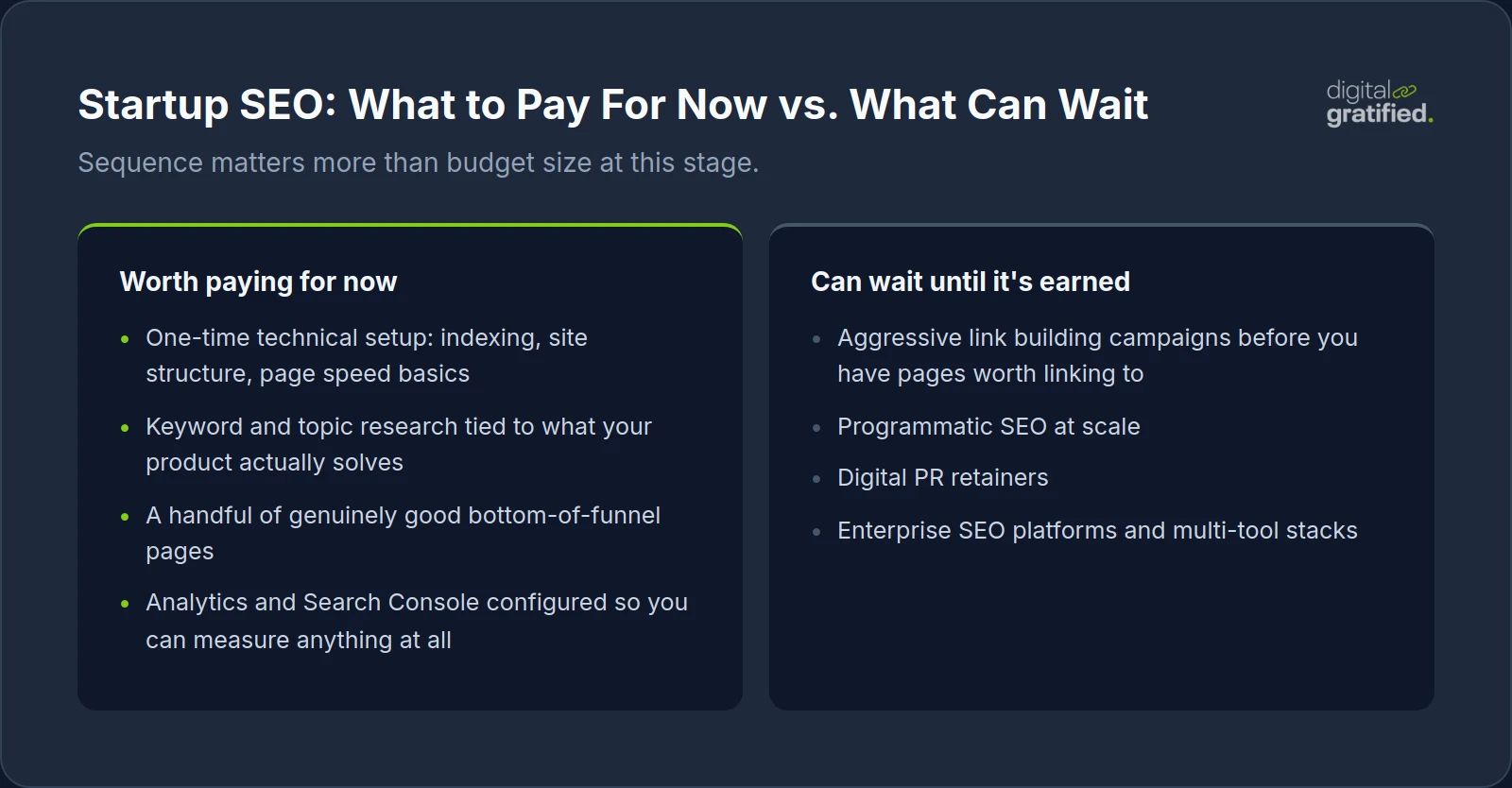
The startup-specific insight is about sequence, not selection. Early on, you don't need all three at full intensity. You need the technical foundation done once and done right, keyword research grounded in what your product actually solves, and a small set of genuinely useful bottom-of-funnel pages. Aggressive link building campaigns, programmatic SEO, and digital PR retainers can all wait until you have pages worth amplifying. Buying them first is like paying for billboards before the store is built.
If you want the full picture of how these pieces fit together for software companies specifically, our SaaS SEO guide covers the whole system. This post stays focused on the buying decision.
Does the 80/20 Rule Apply to Startup SEO? Yes, Ruthlessly
A quick answer to a question that comes up constantly: should early-stage teams apply an 80/20 approach to SEO? Absolutely, and more aggressively than most advice suggests. At the startup stage, roughly 80% of your organic results will come from a handful of moves: fixing the technical issues that block indexing, ranking a few high-intent pages that map directly to what you sell, and earning a modest number of real links to them. The remaining long tail of optimizations, schema tweaks, blog cadence for its own sake, chasing informational keywords with no buying intent, can safely wait. Prioritization is the whole game when you have one person and a few thousand dollars, not a department.
DIY, Freelancer, or Agency: The Actual Decision
Here's the framework nobody in the search results will give you, because most of them are selling one of the three options.
Do it yourself when you're pre-seed or bootstrapped, someone on the founding team can genuinely commit five or more hours a week, and your site is small enough that mistakes are cheap. SEO fundamentals aren't mysterious; Google's own SEO starter guide covers most of what a small site needs, free. The honest constraint isn't difficulty, it's time. Founder hours have a real price, and past twenty or so pages and a competitive keyword set, DIY tends to become quiet neglect. You'll know that's happening when "work on SEO" has sat in the backlog for a month.
Hire a freelancer or consultant when you know roughly what's broken and need specific skills to fix it: a technical audit, a batch of well-researched pages, a cleanup after a rebuild. Expect $500 to $3,000 a month depending on scope and seniority. The tradeoff is that you're still the project manager. A good freelancer executes brilliantly inside their lane; very few will own your strategy end to end, and it's unfair to expect them to at this price.
Bring in an agency only when three things are true: you've validated that organic search actually drives signups for your product, you have at least twelve months of runway to let a retainer compound, and nobody in-house can own the channel. An agency retainer is a bet on consistency over quarters, not a growth hack. Signing one while hoping for results in eight weeks is the most common way startups turn $15,000 into a lesson.
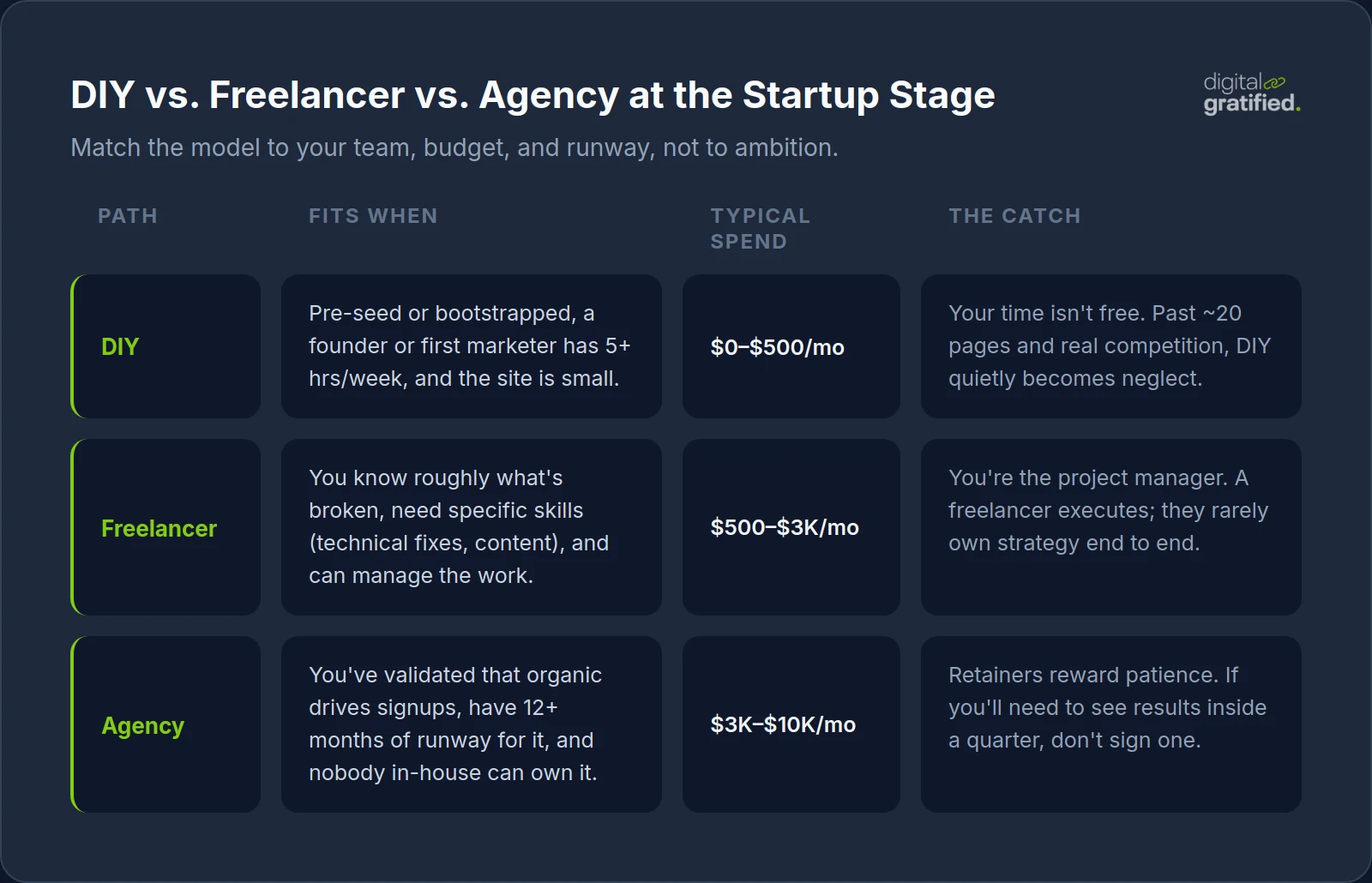
Notice what's not in this framework: your ambition, your competitor's agency, or what a sales call told you. Team capacity, budget, and runway decide this. Everything else is noise.
How Much Should SEO Services Cost a Startup?
The question everyone asks and nobody answers with numbers. Here are real ranges for competent work in 2026. You can find cheaper on every line; at this stage, cheap SEO is usually a liability you pay to acquire.
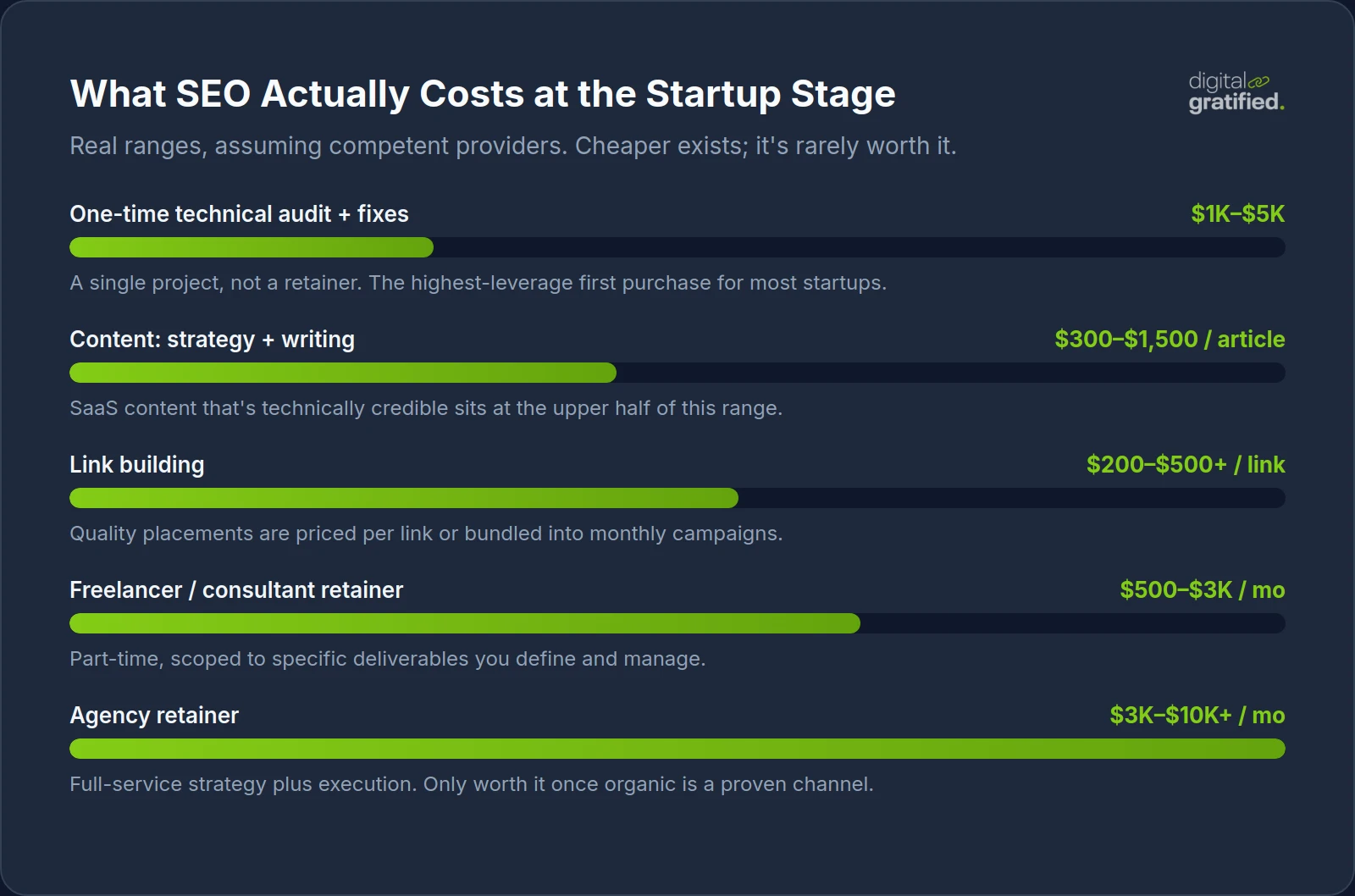
One-time technical audit and fixes: $1,000 to $5,000. A project, not a retainer, and the highest-leverage first purchase for most startups. Done properly, it shouldn't need repeating for a year or more.
Content strategy and writing: $300 to $1,500 per article. SaaS content that's technically credible, written by someone who understands the product, sits in the upper half of that range. Two excellent pages beat ten mediocre ones, every time.
Link building: $200 to $500+ per quality placement. Pricing models vary enough here that we've broken them down separately in our link building pricing guide, including what the suspiciously cheap end of the market actually delivers.
Freelancer retainer: $500 to $3,000 a month. Part-time and scoped. You define the deliverables.
Agency retainer: $3,000 to $10,000+ a month. Strategy plus execution. Below roughly $2,000 a month, "full-service SEO" is almost always templated work spread across too many clients.
For calibration: early-stage companies typically put somewhere around 10 to 20 percent of their overall budget into marketing as a whole. SEO should be a slice of that, sized to how central organic is to your motion, not a number copied from a pricing page.
The Two Budget Mistakes Almost Every Startup Makes
After enough startup engagements, you see the same two failure patterns on repeat, and they're opposites.
Overspending too early. A seed-stage company signs a $6,000-a-month retainer before a single page ranks, burns four months of it while the agency "builds foundations," then kills the channel right as it might've started working. The money wasn't wasted on bad work; it was wasted on the wrong sequence. If you can't fund a retainer for a year, fund projects instead: an audit, a content sprint, a small link campaign, each with a defined end.
Underspending on the foundation. The mirror image: a team publishes forty blog posts on a site with broken canonicals, an incoherent structure, and three-second render delays, then concludes SEO doesn't work. Foundational technical work is boring and it's invisible in a demo, which is exactly why it gets skipped. It's also the cheapest thing on this list to get right once.
Both mistakes come from treating SEO spend as a dial (more money, more results) instead of a sequence (this, then that). Sequence is what the whole decision framework above protects.
When Outsourcing Actually Makes Sense (and When You've Outgrown This Post)
The signal that it's time to pay for outside help isn't a revenue number. It's when the work you know needs doing consistently doesn't get done, or when you keep hitting problems nobody in-house can diagnose. If flagged technical issues sit unfixed for a quarter, or your content ships but never ranks and you can't say why, you're past the DIY stage regardless of headcount. We've written a fuller decision framework in our guide to outsourcing SEO, including what to hand off first and how to structure the engagement so you keep the strategic knowledge in-house.
And there's a version of this decision that isn't really "startup SEO" anymore. Once you have product-market fit, a marketing team, and organic search as a proven pipeline contributor, you're no longer buying startup SEO services; you're choosing a long-term partner for a working channel. That's a different evaluation with different stakes, and it's the territory of our SaaS SEO agency guide. The short version of the difference: startups are buying their first traction and should optimize for sequence and capital efficiency; scaled companies are buying leverage on something that already works.
The Bottom Line
The honest answer to "what SEO services should my startup buy?" is: fewer than the market wants to sell you, in a stricter order than the listicles suggest. Get the technical foundation fixed as a one-time project. Build a small set of pages that map to buying intent. Add links once there's something worth linking to. Do it yourself while founder hours are your cheapest currency, hire a freelancer when specific skills become the bottleneck, and sign an agency retainer only when organic is proven and funded for a year. That sequence, not any particular vendor, is what separates startups that compound organic growth from the ones that churn through providers.
SEO Services for Startups: Frequently Asked Questions
How much should SEO services cost for a startup?
Realistic 2026 ranges: $1,000 to $5,000 for a one-time technical audit and fixes, $300 to $1,500 per well-researched article, $200 to $500+ per quality link placement, $500 to $3,000 a month for a freelancer, and $3,000 to $10,000+ a month for an agency retainer. Prices meaningfully below these ranges usually mean templated, low-impact work.
Should a startup do SEO in-house or hire an agency?
It depends on team capacity, budget, and runway rather than ambition. DIY works pre-seed when a founder can commit five or more hours weekly. A freelancer fits when you need specific skills and can manage the work. An agency only makes sense once organic search is a validated channel and you can fund a retainer for at least twelve months.
What's the best SEO agency for startups?
There's no universal answer, and most "best agency" lists are paid directories. The better question is whether you're ready for an agency at all. If you are, evaluate for SaaS or startup-specific experience, transparent deliverables, and pricing your runway can sustain for a year, rather than picking from a listicle.
What is the 80/20 rule for startup SEO?
Roughly 80% of early results come from about 20% of possible SEO activities: fixing technical issues that block indexing, ranking a few high-intent pages tied directly to your product, and earning a modest number of real links to them. Everything else, from schema fine-tuning to high-volume blogging, can wait until those are working.
How long does SEO take to work for a startup?
With a sound technical foundation and genuinely useful pages, startups typically see early movement in three to six months and meaningful pipeline contribution in six to twelve. Any provider promising first-page rankings in weeks is describing either a keyword nobody searches or a tactic you'll regret.
Let's Scale Your SaaS Together
Get a custom SEO and link building strategy tailored for your SaaS business.
Get SEO insights that actually move rankings
Link building tactics, case studies, and SaaS SEO playbooks. No fluff, no spam.
You're subscribed!
SEO and link building insights, straight to your inbox.