Every off-page SEO checklist lists the same ten tactics as if they're equal. They're not. Here's the prioritized version for SaaS teams: what moves rankings, what supports it, what to skip, and a monthly cadence a lean team can actually keep.

Digital Gratified
SaaS SEO Experts
Search "off page seo checklist" and every result hands you the same flat list: build backlinks, do guest posting, get brand mentions, post on social media. There's a Reddit thread ranking on page one where people ask, almost word for word, "okay, but what do I actually do beyond 'get backlinks'?" The checklists exist. What's missing is an order.
That's what this one adds. It's written for SaaS teams with limited hours and budget, and it's organized by priority: what to do first because it moves rankings, what supports that work, and what you can skip without losing anything. If you only have six hours a month for off-page SEO, this tells you where they go.
What Counts as Off-Page SEO
Off-page SEO is everything that builds your site's authority and reputation from outside it: links other sites give you, mentions of your brand, reviews, and the coverage you earn. On-page SEO is what's on your pages (content, titles, internal links), and technical SEO is whether search engines can crawl and render the site at all. Google's own documentation on how ranking works is blunt about the external part: one signal of quality is whether other prominent sites link to or reference your content.
One rule before the checklist: off-page work amplifies pages, it doesn't rescue them. If your important pages are thin or your site has crawl problems, fix that first. Links pointed at weak pages are budget spent on amplifying a whisper.
The Off-Page SEO Checklist, Ordered by Priority
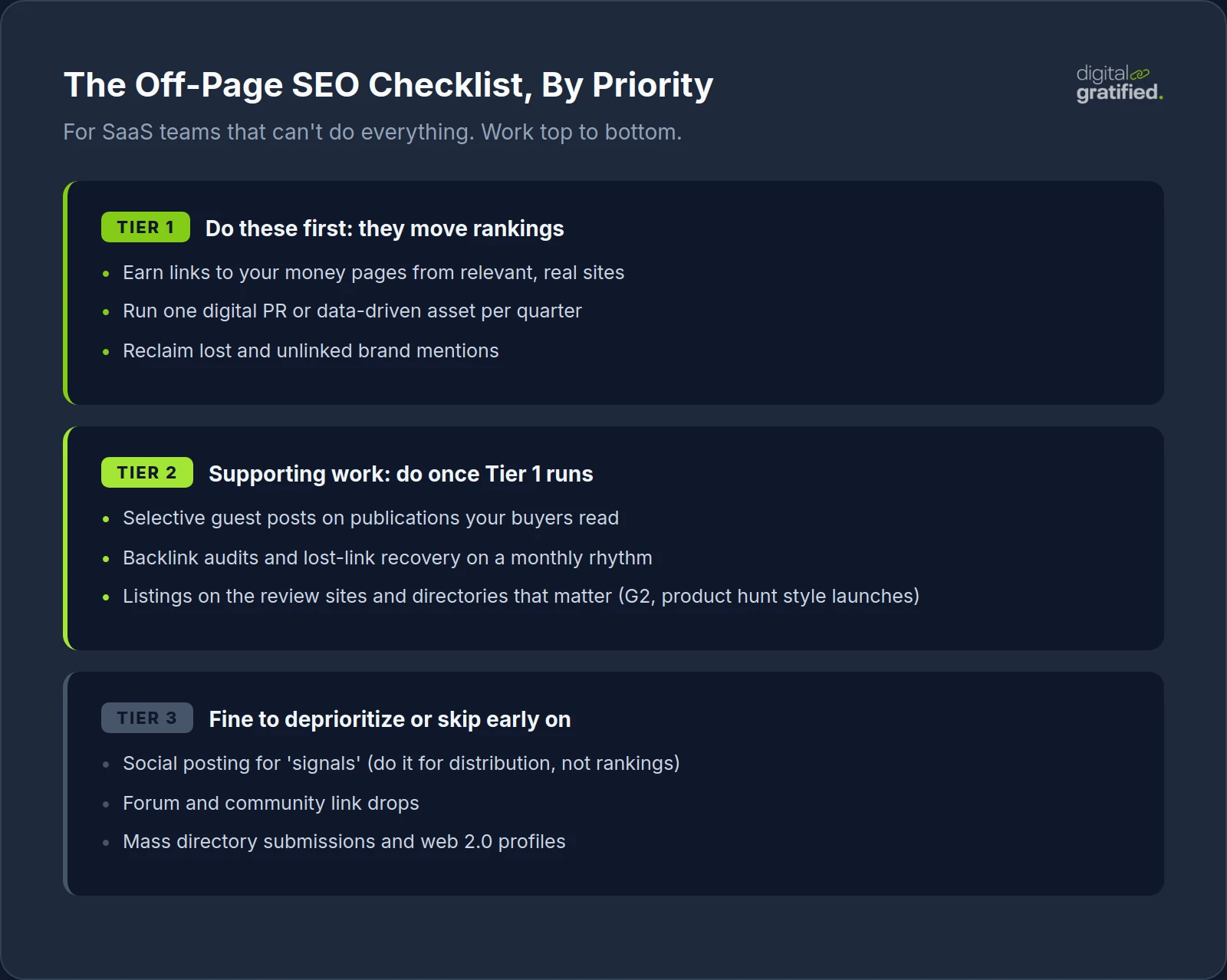
Most checklists present ten tactics as if they're equally weighted. They're not. Here's the same territory, split into three tiers by what actually moves rankings for a SaaS site.
Tier 1: Backlink acquisition and digital PR
This is the work that changes where you rank, and it comes in three parts.
Earn editorial links to the pages that make you money. Not your homepage by default, and not whatever page happens to be "linkable." Pick the two or three product, comparison, or bottom-of-funnel pages where ranking higher directly produces signups, and point your acquisition effort there. Keep that acquisition aligned with white hat link building principles, where publishers choose links for reader value rather than guaranteed ranking credit. The mechanics of finding prospects, writing pitches that get answered, and following up without being annoying are a discipline of their own; done well, link building outreach turns that whole process into a repeatable system instead of a numbers game.
Run digital PR around something only you can say. For SaaS companies this usually means original data: a benchmark report from anonymized product usage, a survey of your users, an analysis of your market. One genuinely citable asset per quarter routinely outperforms months of cold guest post outreach, because journalists and bloggers link to sources, not to vendors.
Reclaim what you've already earned. Set up brand monitoring and convert unlinked mentions into links; a site that already wrote about you says yes at a rate cold outreach never touches. Do the same for links that disappear when pages get deleted or redesigned. It's the cheapest link acquisition that exists.
Tier 2: Supporting tactics that earn their slot
Selective guest posting. Guest posts still work when the publication is one your actual buyers read and the article says something real. They stop working the moment they become a volume play across random blogs that exist to sell placements. A useful test: would you write this article if there were no link in it? If no, skip it.
Ongoing backlink audits. A link profile isn't a trophy shelf, it's an asset that decays. Links get dropped, anchor distributions drift, and the occasional spam cluster shows up uninvited. A monthly scan plus a quarterly deep review keeps the profile healthy, and the audit output feeds acquisition: lost links become your warmest prospect list. That ongoing practice is backlink management, and part of it is knowing when disavowing is and isn't worth the effort.
Reviews and the directories that matter. For SaaS that means G2, Capterra, and the handful of comparison sites your buyers actually check, not five hundred generic web directories. These links matter less for rankings than for the brand searches and AI-generated answers where those platforms get cited.
Tier 3: Fine to deprioritize or skip
Social signals. Post on social because it distributes your content and keeps the brand visible, both of which indirectly earn links. But social activity itself is not a meaningful direct ranking input, and treating it as an SEO task leads teams to measure exactly the wrong things.
Forum and community links. Participate in Reddit, Slack groups, and niche communities where your buyers hang out, for the customers. The links are nofollowed or ignored. If your motivation for a comment is the backlink, the community will smell it and so will Google.
Mass directory submissions and web 2.0 profiles. These filled out checklists in 2012. Today they're noise at best. Skip them without guilt.
Why Link Building Gets the Top Slot
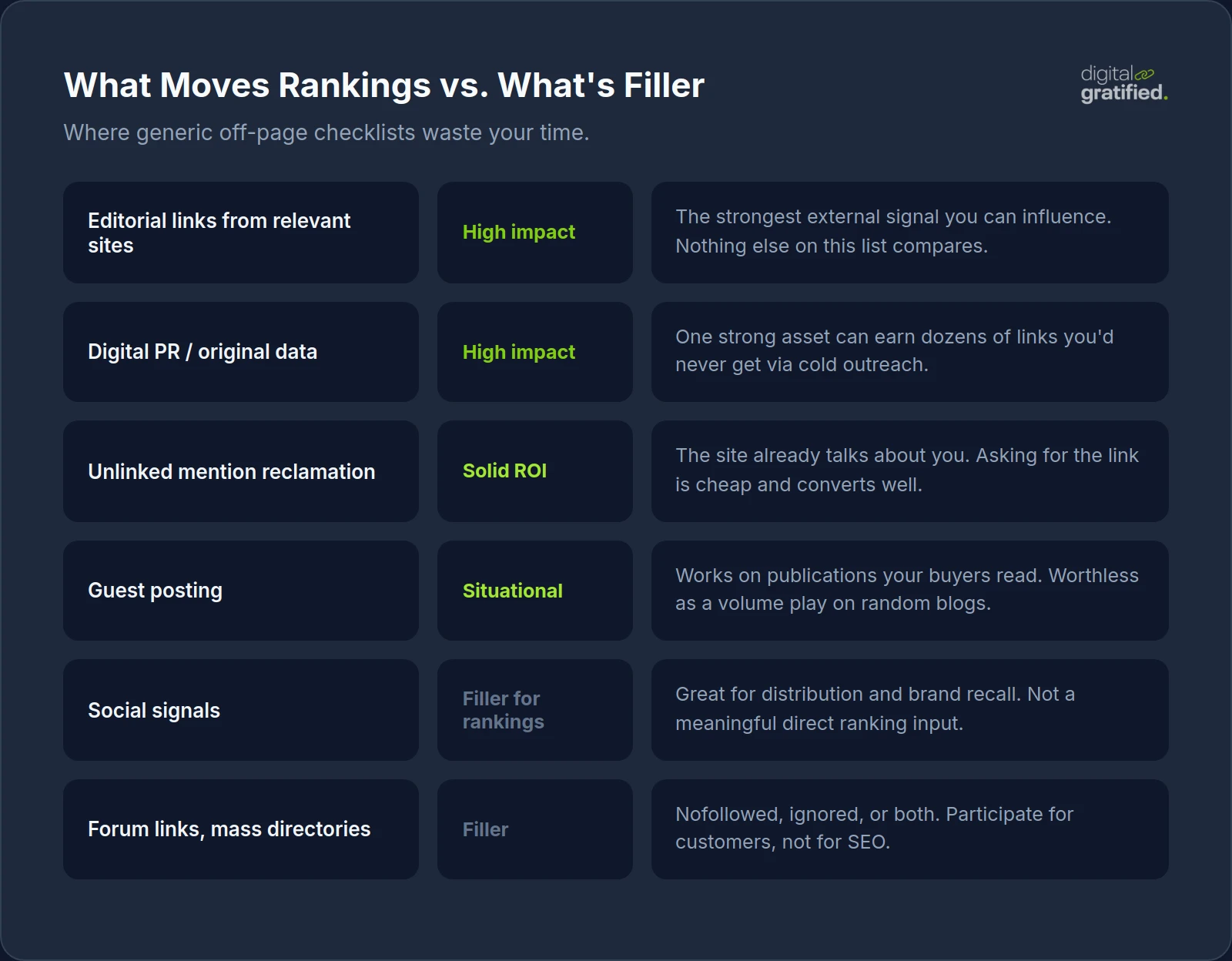
Every tactic above is "off-page SEO," but they're nowhere near equal. Links from real, relevant sites remain the strongest external signal you can influence, and for SaaS specifically, the competitive math makes them decisive: you're usually up against well-funded incumbents whose domains have years of accumulated authority. Content quality gets you into the game; links decide the tiebreaks on every keyword worth having.
That's also why the top tier deserves most of your hours even though it's the hardest work on the list. Everything else here is either maintenance of links (audits, reclamation) or indirect support for earning them (social, community). The full strategy for doing this in a SaaS context, from picking target pages to the in-house versus agency decision, is really the territory of SaaS link building as a discipline, and this checklist hangs off that bigger picture.
The Mistakes That Waste Off-Page Budgets
Spreading effort across every tactic. The most common failure isn't picking a bad tactic, it's doing all of them a little. A team that spends two hours each on eight tactics ships nothing that compounds. The same sixteen hours concentrated on one outreach campaign and one linkable asset produces links you can point to.
Measuring activity instead of authority. Directory submissions and forum posts feel productive because they're countable. Track referring domains to your money pages instead; it's the only off-page number that predicts anything.
Buying volume because it's cheap. Fifty $30 links cost more than they seem: they do nothing, and cleaning up the pattern later costs real money. If you're weighing doing this work yourself against paying someone, knowing what a manual link building service should include tells you what legitimate execution looks like and which red flags should end a sales call.
Stopping after a campaign. Competitors acquire links continuously. Off-page SEO run as a one-quarter project produces a bump, then a slow slide back.
Is Off-Page SEO Still Relevant in 2026?
Yes, and it's worth answering directly since most checklists dodge it. Search is changing shape: AI overviews answer more queries, and language models increasingly mediate discovery. But those systems lean on the same underlying question off-page SEO has always answered, which is "who does the rest of the web trust on this topic?" Links and brand mentions are how that trust gets counted. What has genuinely died is the junk end of the checklist: spam links, directory blasts, and manufactured signals get discounted faster than ever. Off-page SEO isn't less relevant; it's less forgiving.
A Cadence a Lean Team Can Actually Keep
The checklist only works if it survives contact with a real calendar. Here's a rhythm that costs a lean SaaS marketing team roughly six to eight hours a month.
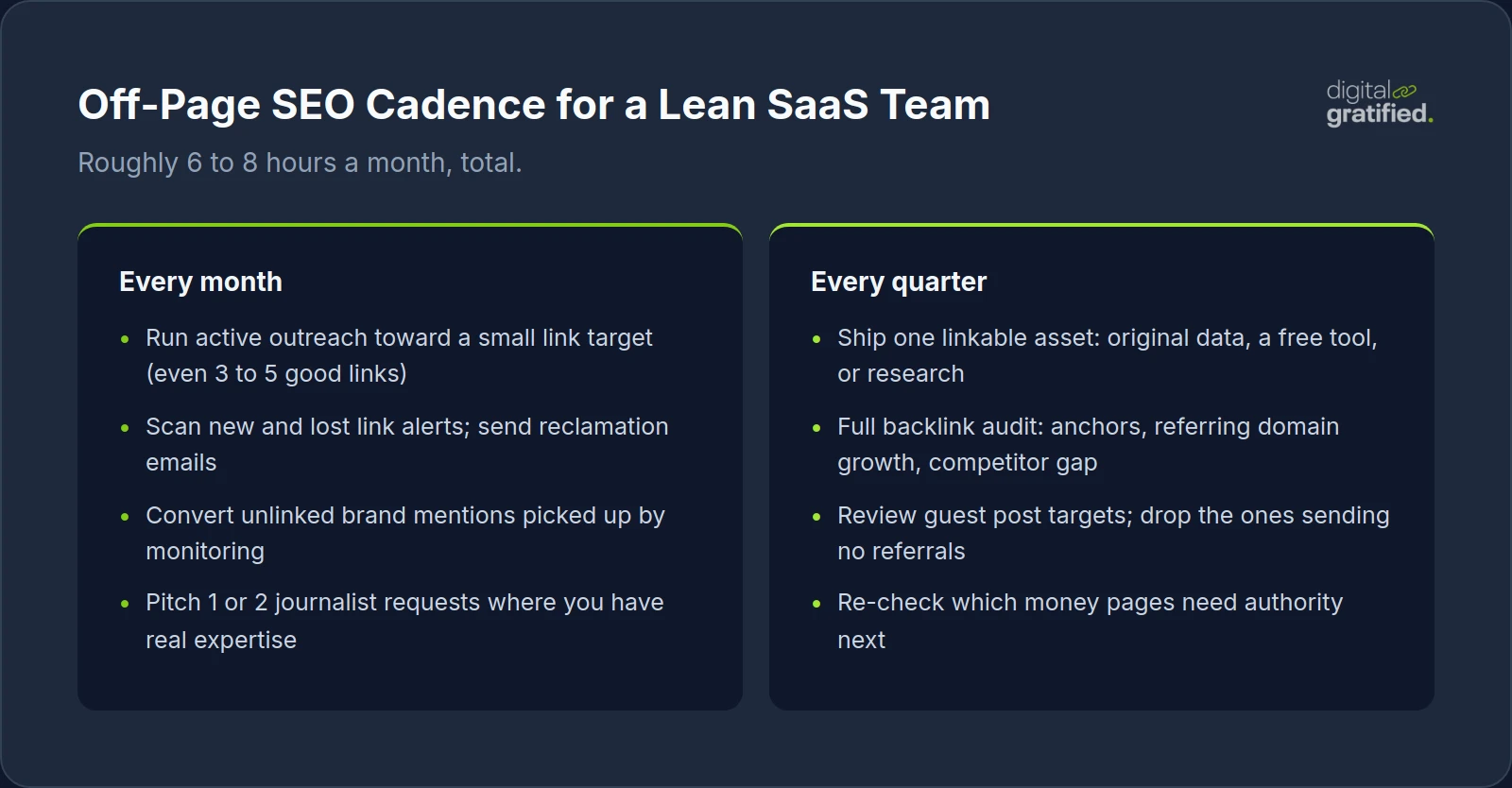
Monthly: keep one small outreach effort running (three to five good links a month compounds faster than most teams expect), scan your new-and-lost link alerts, send reclamation emails for anything worth recovering, convert fresh unlinked mentions, and answer one or two journalist requests where you have genuine expertise.
Quarterly: ship one linkable asset, run the full backlink audit including a competitor gap check, prune guest post targets that send neither links nor referrals, and revisit which pages need authority next quarter. The quarterly review is also where Tier 3 temptations go to be politely declined again.
Tools That Make the Checklist Easier
You need three capabilities, not thirty subscriptions: a backlink index with alerting for new and lost links (Ahrefs or Semrush covers it), brand mention monitoring so reclamation opportunities find you (Google Alerts is the free floor, Brand24 the paid version), and something to manage outreach once you're sending more than a handful of emails a month. Beyond that, tooling is a rounding error next to consistency. The best tools for link building come down to a small stack organized by workflow stage, and a perfectly functional setup can run under $50 a month.
The Bottom Line
An off page seo checklist is only useful if it admits that you can't do everything, because you can't. Point real links at the pages that make you money, earn coverage with things only you can say, and reclaim what you've already won. Support that with selective guest posting and a boring, recurring audit. Let social and community work serve customers instead of rankings, and skip the directory-blast tier entirely. Prioritization, not tactic count, is what separates SaaS teams that compound authority from the ones with very complete, very useless checklists.
Off-Page SEO Checklist: Frequently Asked Questions
What is included in off-page SEO?
Off-page SEO covers everything that builds your site's authority from outside it: earning backlinks, digital PR, reclaiming unlinked brand mentions, reviews on platforms like G2, guest contributions, and community presence. For SaaS teams, backlink acquisition and digital PR carry most of the ranking impact; the rest is supporting work.
What should a SaaS company do first on an off-page SEO checklist?
Start with links to your money pages: run focused outreach toward two or three bottom-of-funnel pages, set up brand monitoring to reclaim unlinked mentions, and plan one citable asset (original data or research) for the quarter. Those three items outperform everything else on a generic checklist combined.
Do social signals help SEO rankings?
Not directly. Google has repeatedly indicated social activity isn't a meaningful direct ranking input. Social matters as distribution: it puts content in front of people who can link to it and builds the brand searches that do influence visibility. Do it for reach, not as a rankings checkbox.
Is off-page SEO still relevant in 2026?
Yes. AI-driven search still leans on links and brand mentions to judge which sources the web trusts, so authority signals remain decisive. What's changed is tolerance for junk: spam links, directory blasts, and manufactured signals get discounted faster than ever, which makes prioritizing quality work more important, not less.
How many hours a month does off-page SEO take?
A lean SaaS team can run an effective program in six to eight hours a month: ongoing outreach toward a small link target, weekly alert scans with reclamation emails, plus a quarterly block for one linkable asset and a full backlink audit. Consistency at that scale beats sporadic bursts of activity.
Let's Scale Your SaaS Together
Get a custom SEO and link building strategy tailored for your SaaS business.
Get SEO insights that actually move rankings
Link building tactics, case studies, and SaaS SEO playbooks. No fluff, no spam.
You're subscribed!
SEO and link building insights, straight to your inbox.