Backlinks remain one of Google's most powerful ranking signals, but most B2B teams have no way to measure what a link is actually worth. This guide breaks down the real value of backlinks and gives you a repeatable framework to measure backlink ROI for any B2B website.

Digital Gratified
SaaS SEO Experts
B2B marketing teams routinely spend anywhere from $1,000 to $15,000 per editorial backlink, yet very few can answer a basic CFO question: "what was that link actually worth?" The conversation usually stops at domain rating, a screenshot of a referring page, and a vague promise that rankings will improve over the next two quarters.
That answer is not good enough in 2026. Backlinks remain one of Google's most influential ranking signals, confirmed publicly by Google's Andrey Lipattsev as one of the top three factors and reaffirmed by every credible industry study since.
But the value of a backlink to a B2B website is not just an SEO line item. It is a compound asset that influences pipeline, shortens sales cycles, builds brand trust across a buying committee, and creates a defensive moat that competitors cannot replicate in a quarter.
This guide covers two things in depth. First, the real value backlinks deliver in 2026 across five dimensions most B2B teams measure poorly or not at all. Second, a step-by-step framework to measure that value for any B2B website, with the formulas, metrics, and tooling needed to tie individual placements and entire campaigns back to revenue. By the end you will have a defensible answer to "what is this backlink worth to our business?"
What Is a Backlink, Really? (Quick Refresher)
A backlink is any hyperlink from another website that points to a page on yours. The mechanic is simple, but the variations matter when you start valuing them.
- Dofollow vs. nofollow: A dofollow link passes ranking signals (commonly called link equity) from the referring page. A nofollow link tells search engines not to pass equity, though Google now treats nofollow as a hint rather than a directive, meaning it can still influence rankings in some cases.
- Editorial vs. non-editorial: Editorial links are placed by a writer or editor inside the body of a piece of content because they genuinely reference your work. Non-editorial links sit in author bios, sidebars, footers, sponsored sections, or directory listings. Editorial links carry significantly more weight, both algorithmically and in terms of human trust.
- UGC and sponsored: User-generated content links (forum posts, blog comments) and sponsored links carry their own rel attributes and are weighted differently.
If you are new to this discipline, our primer on what link building actually involves covers the mechanics, the history, and the difference between earning and acquiring links. The rest of this article assumes you understand the basics and want to make smart decisions about value.
The Value of Backlinks in 2026: Five Dimensions Most B2B Teams Miss
Most articles on this topic stop at one or two dimensions. SEO authority and maybe referral traffic. That is a fraction of what a well-placed B2B backlink actually delivers. Below are the five dimensions worth measuring, in the order they typically compound for a B2B brand.
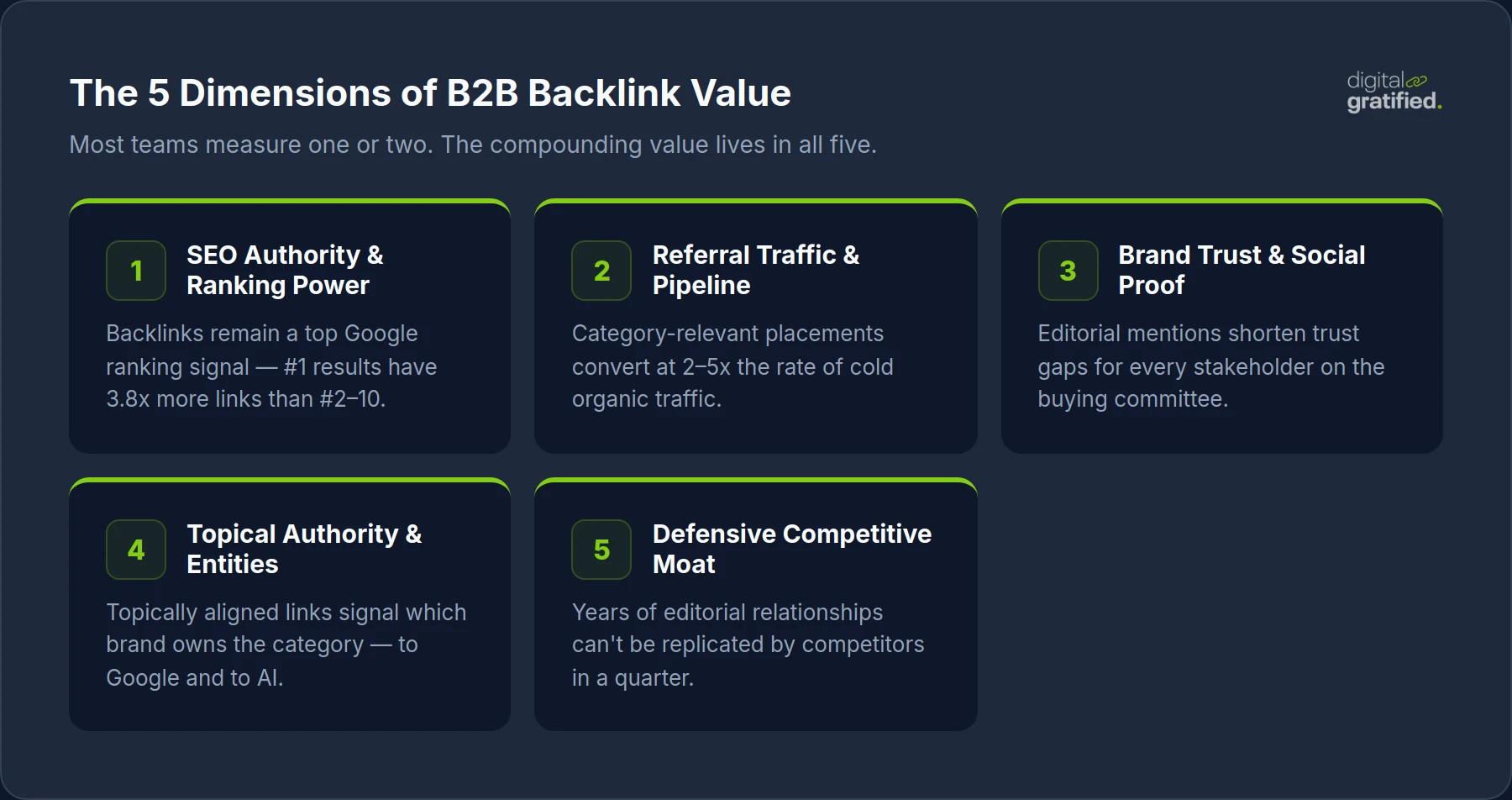
1. SEO Authority and Ranking Power
This is the dimension everyone knows. Backlinks remain a top ranking signal. Studies from Backlinko, Ahrefs, and Semrush consistently show a strong positive correlation between the number of unique referring domains a page has and its ranking position. Backlinko's frequently cited analysis of one million Google search results found that the number one ranking page has, on average, 3.8 times more backlinks than positions two through ten combined.
Conceptually, the value here flows from PageRank. Google still uses a derivative of PageRank to model how authority flows through the link graph. Pages on domains that receive many high-quality links accumulate authority, and that authority makes it easier for any new page on the domain to rank.
For B2B, the implication is straightforward. If you sell a product with a six-month sales cycle, every page that ranks in the top three for a relevant query becomes a compounding asset that produces qualified pipeline for years. The backlinks that helped that page rank are not a marketing expense, they are infrastructure.
2. Referral Traffic and Pipeline Influence
Many high-value B2B backlinks send qualified referral traffic directly. A sales operations leader reading a G2 comparison article does not arrive on the page by accident. A product marketing director who clicks a citation in a Gartner blog post is, by definition, deep in research mode. Referral traffic from category-relevant sites converts at two to five times the rate of cold organic traffic in most B2B verticals we have measured.
The value here is direct and measurable. A single editorial mention in a publication your buyers actually read can produce more pipeline in a quarter than a dozen tangential placements that exist purely for SEO. The trick is to track it, which we will cover in the framework below.
3. Brand Trust and Social Proof
B2B buying is a trust exercise. Buyers in long sales cycles run "trust verification" searches at multiple points in the journey. They search your brand name. They search "your brand vs. competitor." They search "is your brand legitimate." Every editorial mention they find on a publication they recognize shortens the trust gap.
The effect compounds across a buying committee. Forrester's research on B2B buying behavior shows that the average enterprise purchase now involves more than ten stakeholders. When a champion advocates internally for your product, the skeptics on the committee do their own searches.
If they keep finding you cited in publications they read, you become safer to recommend. That is a value dimension that never shows up in an SEO report, but it shortens deal cycles and lifts close rates in ways finance can model.
4. Topical Authority and Entity Recognition
Google's understanding of the web is increasingly entity-based. The search engine, and now AI-powered surfaces like AI Overviews, Perplexity, and ChatGPT search, are trying to understand which brands are the authoritative entities for which topics. Backlinks from topically aligned sites are one of the strongest signals that you belong in the conversation for a given topic.
For B2B, this matters more than ever because AI-driven surfaces are increasingly the first place buyers go to ask category-level questions. The brands that get cited in those answers are the brands that have spent years earning topically relevant links from the publications that AI systems were trained on.
Our analysis of SaaS backlink data found that the strongest correlator with ranking dominance in software categories was the share of links from topically aligned domains, not raw link count.
5. Defensive Moat Against Competitors
This is the dimension that gets discussed least and matters most over a three-year horizon. A strong backlink profile is genuinely hard to replicate.
Once you have accumulated several hundred editorial links from credible publications in your category, a competitor cannot match that profile in twelve months no matter how aggressively they spend. Editorial relationships take time. Earned mentions from major publications take case studies, original research, and named experts.
That structural advantage compounds into a defensive moat. Your pages rank above competitors not because your content is better in any given month, but because Google trusts your domain more, and Google trusts your domain more because the broader web has been telling Google to for years. For B2B categories with a small number of viable competitors, this moat is one of the highest-ROI investments a marketing team can make.
How Much Is a Single Backlink Actually Worth?
Searchers asking this question want a number. The honest answer is that there is no fixed dollar value, but there is a defensible valuation method that produces a range you can actually use in a budget conversation.
Four factors determine the value of any individual backlink.
Referring Domain Authority
Ahrefs Domain Rating (DR), Moz Domain Authority (DA), and Semrush Authority Score are the most cited proxies. They are useful, but they are proxies, not truth. A DR 70 domain that has been bought out by a private network and now sells links on a price list is worth a fraction of what a DR 45 niche trade publication with genuine editorial standards is worth to a B2B brand. Use DR as a filter, never as the deciding factor.
Topical Relevance to Your Business
A link from a site that is topically aligned with your category is worth substantially more than a generic link, regardless of DR. Google's entity-based model rewards relevance heavily. A DR 35 link from your category's leading trade publication will outperform a DR 75 link from a general business blog every time, both for rankings and for the brand and referral dimensions described above.
Organic Traffic of the Referring Page
The page that links to you, not just the domain it sits on, is what matters. A link from a page that gets 2,500 monthly organic visits passes meaningfully more equity and produces meaningfully more referral traffic than a link from a page that gets zero. Tools like Ahrefs report page-level traffic estimates that should be your primary signal here.
Link Placement and Editorial Context
An in-body editorial link surrounded by relevant context is the highest-value placement. An author bio link is mid-tier. A footer or sidebar link is low-tier. A link buried in a sponsored disclosure or directory listing is barely worth tracking. The link's prominence on the page, the relevance of the surrounding text, and the dofollow status all factor in.
As a sanity check, market pricing for editorial backlinks in 2026 from DR 50+ sites typically falls between $300 and $2,000, with niche-relevant placements at the top of that range. Premium digital PR placements in tier-one publications often exceed $5,000 when factoring in the agency or in-house resources required to earn them. Our deep-dive on what backlinks actually cost breaks down the market by tier.
Worked example: a DR 65 SaaS industry blog, 1,200 monthly organic visits to the linking page, in-body dofollow link with relevant anchor text, topical fit of 5/5 for your category.
Conservative valuation using a referral-only model (200 referral sessions per year, 3% conversion to demo, 25% demo-to-opportunity, $35,000 average deal size, 30% close rate) produces roughly $1,575 in directly attributable pipeline value over twelve months, before counting any SEO authority, brand, or topical benefit.
Once SEO contribution is layered in over a multi-year window, the same link can deliver many multiples of that figure.
| Factor | Low-Value Signal | High-Value Signal |
|---|---|---|
| Referring DR | Under 20, or inflated by spam tactics | 50+, with steady organic traffic trend |
| Topical relevance | General blog, unrelated industry | Your exact category or buyer audience |
| Page traffic | Zero or near-zero monthly visits | 500+ monthly organic visits |
| Placement | Footer, sidebar, author bio | In-body editorial with relevant anchor |
| Editorial context | Sponsored disclosure or paid post tag | Genuine editorial reference |
How to Measure Value of Backlinks for a B2B Website: The Framework
This is where most teams fall down. B2B link valuation must go beyond SEO metrics and tie back to pipeline, opportunities, and revenue. The framework below works for both individual link valuations and full-campaign ROI. It assumes you have Ahrefs or Semrush, GA4, Google Search Console, and a CRM with reasonable attribution hygiene.
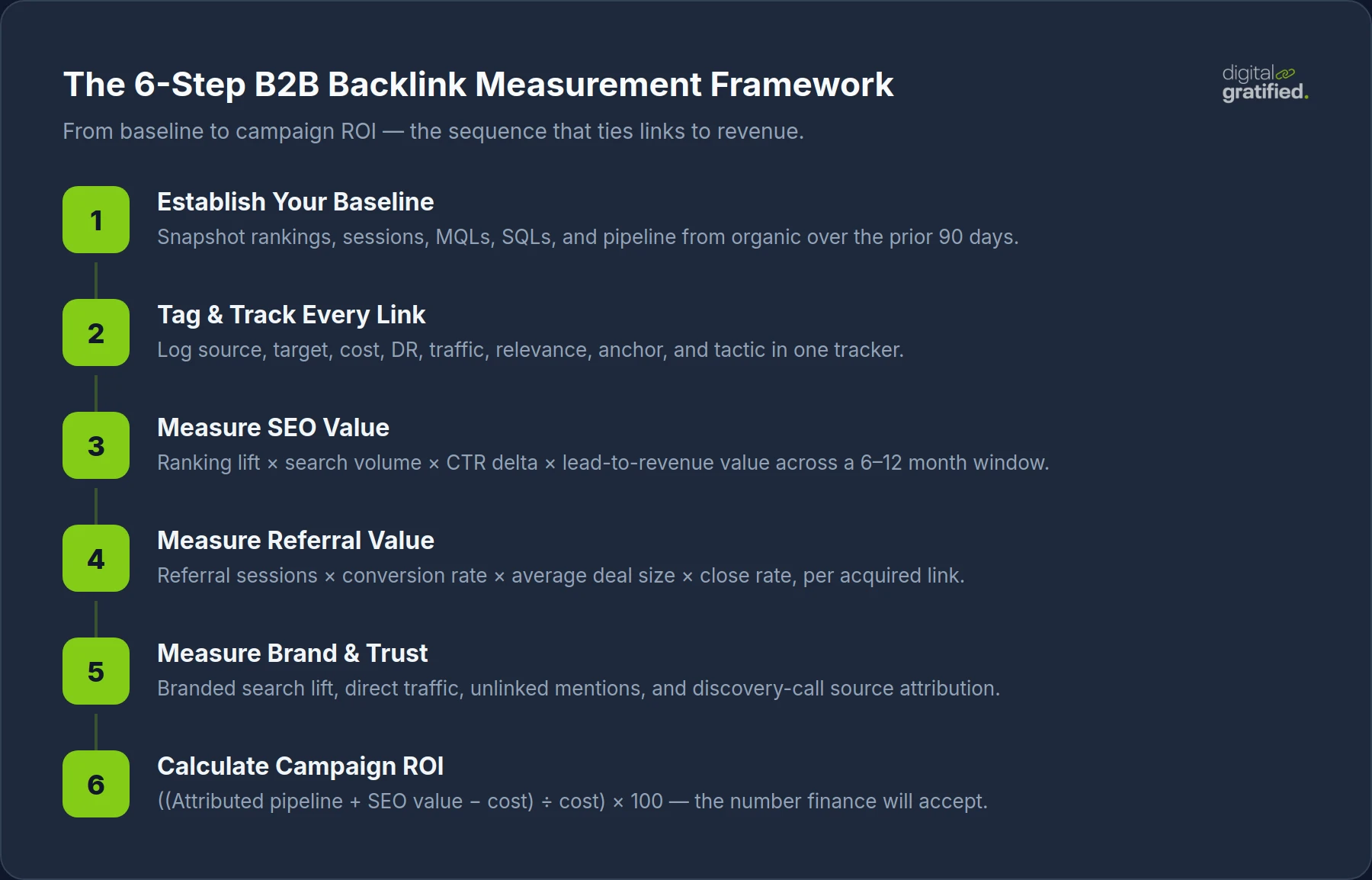
Step 1: Establish Your Baseline
Before any link building activity begins, snapshot the metrics you will be comparing against. Without a baseline, every result is anecdotal.
- Organic sessions to the target pages (GA4)
- Referring domains and DR for the target pages and the domain overall (Ahrefs/Semrush)
- Ranking positions for your top 20 target keywords (Ahrefs/Semrush/GSC)
- MQLs from organic over the prior 90 days (CRM)
- SQLs from organic over the prior 90 days (CRM)
- Pipeline contribution from organic over the prior 90 days (CRM)
- Branded search query impressions and clicks (GSC)
Save the snapshot as a fixed report in your dashboarding tool. You will reference it at month three, month six, and month twelve to quantify change.
Step 2: Tag and Track Every Acquired Link
Maintain a backlink tracker in Airtable, Google Sheets, or a dedicated tool. The columns that matter for valuation:
- Source URL and target URL
- Acquisition date
- Acquisition cost (including allocated time if produced in-house)
- Referring DR at acquisition
- Referring page organic traffic at acquisition
- Topical relevance score (1 to 5)
- Dofollow or nofollow
- Placement type (in-body, bio, sidebar)
- Anchor text
- Campaign or tactic source (HARO, guest post, broken link, digital PR, etc.)
This tracker becomes your attribution backbone. Without it, every downstream measurement is guesswork. If you also want to learn from competitors during this phase, our guide to studying your competitors' backlinks walks through the tooling.
Step 3: Measure SEO Value (Authority + Rankings)
Quantify the SEO contribution by tracking ranking lift attributable to the campaign window. The formula:
For each priority keyword, capture the starting position, the new position, the keyword search volume, and the estimated click-through rate for both positions (Advanced Web Ranking and Sistrix publish the most current CTR-by-position curves). Multiply through to get a session estimate, then multiply by your historical session-to-pipeline conversion rate. The result is a defensible SEO value figure that finance will accept.
Track DR and referring domain count over the same window. Correlation is not causation, but a clear upward trend across the link acquisition timeline is meaningful directional evidence. If you want a deeper dive on how link counts influence ranking positions, our analysis of how many backlinks you need to rank covers the math in detail.
Step 4: Measure Referral Traffic Value
For each acquired backlink, set up GA4 to track sessions from the referring domain. The metrics worth capturing per source:
- Sessions from the referring domain
- Engagement rate, pages per session, and average engagement time
- Conversions (demo requests, content downloads, free trial signups)
- Pipeline created from those sessions (use multi-touch attribution in your CRM)
The referral value formula:
This number tends to surprise B2B marketers the first time they run it. A single editorial mention in a publication your buyers read can produce more attributable pipeline in twelve months than ten link-only placements on tangentially relevant sites.
Step 5: Measure Brand and Trust Value
This dimension is harder to quantify but absolutely doable with proxies.
- Branded search volume lift: Pull branded query impressions and clicks from GSC and Google Trends for the 90 days before and after a major link placement. Sustained lifts above your baseline volatility are meaningful.
- Direct traffic lift: In the same window, watch direct traffic. Mentions on prominent publications often drive a direct traffic bump as people remember the brand and search later.
- Mention-based citations: Track unlinked brand mentions using Brand24, Mention, or Ahrefs Alerts. Unlinked mentions are still trust signals and often convert to linked mentions when you reach out to the author.
- Sales-cycle attribution: Add a question to your discovery call template: "Where did you first hear about us?" Track responses that name publications you have earned links from. Over a few quarters this produces meaningful data on which placements influence pipeline that organic attribution misses.
Step 6: Calculate Total Backlink Campaign ROI
Pull it all together with a single formula:
Worked B2B example. A $12,000 quarterly campaign produces 8 editorial links across DR 45–70 publications. Over twelve months, GA4 plus CRM attribution shows $48,000 in directly attributable pipeline from referral sessions on those links.
Rankings on 6 priority keywords improve by an average of 4 positions, producing an estimated $36,000 in incremental organic pipeline value over the same window.
Total attributed pipeline: $84,000. Total estimated SEO value rolled in: included above. Campaign ROI = (($84,000 − $12,000) ÷ $12,000) × 100 = 600%.
The numbers will vary by industry, deal size, and sales cycle length. The methodology will not. Here is the metrics summary table to pin above the dashboard.
| Value Dimension | Metric | Tool | Frequency |
|---|---|---|---|
| SEO authority | DR/DA, referring domains | Ahrefs/Moz | Monthly |
| Rankings | Position changes for target keywords | Ahrefs/Semrush/GSC | Weekly |
| Referral traffic | Sessions from referring domain | GA4 | Monthly |
| Pipeline | Influenced opportunities | CRM | Monthly |
| Brand | Branded search lift | Google Trends + GSC | Quarterly |
B2B-Specific Considerations When Valuing Backlinks
B2B is not B2C and it is not e-commerce. The valuation framework above works in any context, but four B2B-specific realities change how you weight the inputs.
- Long sales cycles: B2B deals typically close over 3 to 18 months. Attribution windows must match. A backlink acquired in January may not show its pipeline impact until Q4. Short windows undervalue every link you earn.
- Buying committees: A single link influencing one stakeholder may indirectly influence a committee of ten. Account-based attribution that rolls up touchpoints across an account is more accurate than per-lead attribution.
- Higher deal sizes: When average deal size is $40,000 to $400,000, even a handful of pipeline-influencing links deliver outsized ROI. The math always favors a smaller number of high-quality placements.
- Niche relevance trumps DR: A DR 30 link from your category's top trade publication will almost always outperform a DR 70 generic placement. In niche B2B verticals the "DR-first" mindset is genuinely counterproductive.
For software teams specifically, the patterns get even more pronounced. Our SaaS link building playbook covers the vertical-specific tactics and benchmarks that actually move pipeline for software companies.
How Digital Gratified Thinks About Backlink Value
A quick word on philosophy, written as context rather than a pitch.
At Digital Gratified we value relevance and editorial integrity over raw DR. We have walked clients away from DR 80 placements on irrelevant sites and recommended DR 40 placements in their exact category, because we measure success by pipeline impact, not link count.
Every placement is treated as a long-term asset to be defended and maintained, not a transaction to be closed and forgotten. The framework above is the same framework we use internally to evaluate every placement we recommend.
Agencies that resell B2B SEO services to their clients often look for a white label link building partner that thinks about value the same way. The principles do not change whether the work is direct or white-labeled.
Common Mistakes B2B Teams Make When Valuing Backlinks
The patterns that repeat across teams that struggle to prove backlink ROI.
- Over-indexing on DR alone. DR is a proxy, not value. A high-DR link from an irrelevant or spammy domain is worth less than a mid-DR link from your category's leading publication.
- Ignoring referral pipeline. Treating backlinks as an SEO-only line item misses one of the largest value dimensions, especially for high-ACV B2B brands.
- Attribution windows that are too short. B2B closes over months, not weeks. A 30-day attribution window will systematically undervalue every link you earn.
- Confusing link volume with link value. Fifty weak links can be worth less than five strong ones. The math is almost always non-linear in favor of quality.
- Not tracking acquisition cost. Without an honest cost figure that includes internal time, you cannot compute ROI. "Free" links produced by a salaried content lead are not free.
- Treating nofollow links as worthless. They still drive referral traffic, build brand mentions, and increasingly carry some algorithmic weight under Google's "hint" treatment.
If you want concrete numbers behind several of these claims, our roundup of link building statistics catalogs the most current published data.
Tools to Help You Measure Backlink Value
None of these are theoretical. Every tool below is in active use at credible B2B marketing teams in 2026.
- Ahrefs: referring domains, page-level traffic, anchor distribution, and historical backlink data
- Semrush: backlink audit, ranking tracking, and position change attribution
- Moz: Domain Authority tracking and link explorer with spam score
- Google Search Console: query-level ranking data, impression and click trends, branded query lift
- Google Analytics 4: referral session and conversion tracking, including custom events for high-intent actions
- Your CRM (HubSpot, Salesforce, Pipedrive): pipeline attribution and opportunity tracking
- Brand24 or Mention: brand mention tracking, including unlinked mentions worth converting
- Looker Studio or Tableau: dashboarding all of the above into a single weekly view leadership will actually read
For a broader look at the tooling landscape, including the lesser-known options worth considering, see our roundup of the best tools for link building.
FAQ: Value of Backlinks for B2B
How much is a single backlink worth in 2026?
There is no fixed dollar figure, but the methodology above produces a defensible range. For an editorial in-body link from a DR 50+ topically relevant publication driving 500+ monthly visits to the linking page, conservative pipeline-attributed value over twelve months for a mid-market B2B brand typically falls between $1,500 and $8,000, before counting SEO authority compound effects.
The same link viewed only as a market-priced placement costs between $300 and $2,000 to acquire. The gap between cost and value is what makes well-targeted link building one of the highest-ROI B2B marketing investments.
How do I measure the ROI of backlinks for a B2B website?
Use the six-step framework above. Establish a baseline. Tag every acquired link with cost, DR, relevance, and traffic data. Measure SEO value through ranking lift attributable to the campaign window.
Measure referral value through GA4 sessions and CRM-attributed pipeline. Measure brand value through branded search lift and direct traffic. Calculate ROI as ((attributed pipeline + estimated SEO value − total campaign cost) ÷ total campaign cost) × 100. The first time you run this, run it across at least a six-month window or the numbers will mislead.
Are nofollow links worth anything for B2B?
Yes. The "nofollow links are worthless" framing is outdated. Google now treats nofollow as a hint rather than a strict directive, meaning nofollow links can still pass some signal in some cases.
More importantly, nofollow links from publications your buyers read still drive referral traffic, build brand mentions, contribute to topical authority, and influence trust during buying-committee research. For B2B specifically, a nofollow editorial mention in a publication your buyers trust is often more valuable than a dofollow link on an obscure site.
How long until a new backlink shows measurable value?
Referral traffic and direct conversion value show up within days to weeks. SEO value is slower. Ranking improvements attributable to new links typically begin to show in 6 to 12 weeks, with the full ranking impact unfolding over 6 to 12 months as Google reprocesses the link and the page's authority compounds.
For B2B with long sales cycles, pipeline impact takes another 3 to 9 months on top of that. Plan your measurement windows accordingly. Anything shorter than six months will mislead you on either side of the value equation.
Is DR or relevance more important when valuing a backlink?
For B2B, relevance wins almost every time. A DR 30 link from your category's top trade publication will outperform a DR 70 link from a general business blog on every dimension that matters: SEO authority within your topical cluster, referral traffic from qualified buyers, brand trust with your buying committee, and topical authority signals to Google.
Use DR as a filter to weed out obviously low-quality domains, then prioritize relevance ruthlessly above the filter line.
How many backlinks does a B2B website need to see meaningful results?
It depends on the competitive context, not on an absolute number. The honest answer requires a competitive gap analysis. Count the referring domains of the pages currently ranking in the top three for your priority keywords, then count yours.
The gap is your target. For most mid-market B2B categories, meaningful ranking movement on commercial-intent keywords starts after closing roughly 30% to 50% of the gap. Our detailed walkthrough on how many backlinks you need to rank covers the methodology.
The Bottom Line on Backlink Value in 2026
The value of a backlink to a B2B website in 2026 is not a single number, and anyone who tells you it is should be ignored.
It is the sum of five dimensions that compound over time: SEO authority that lifts ranking position and unlocks compounding organic pipeline, referral traffic that converts at multiples of cold organic, brand trust that shortens sales cycles across a buying committee, topical authority that increasingly determines whether you show up in AI-driven answers, and a defensive moat that competitors cannot replicate in a quarter.
Measuring that value requires the six-step framework above. Baseline before you start. Tag every acquired link. Quantify SEO impact through ranking lift math. Quantify referral value through GA4 and CRM attribution. Quantify brand value through proxies that finance will accept. Roll it all into a single ROI formula that ties every campaign back to revenue.
Teams that do this well stop arguing about whether link building is worth it and start arguing about how aggressively to fund the next campaign. If you want to think through how this looks for your specific B2B context, Digital Gratified works with B2B brands on exactly this kind of measurement-grounded, relevance-first link building approach.
Let's Scale Your SaaS Together
Get a custom SEO and link building strategy tailored for your SaaS business.
Get SEO insights that actually move rankings
Link building tactics, case studies, and SaaS SEO playbooks. No fluff, no spam.
You're subscribed!
SEO and link building insights, straight to your inbox.