Anchor text is the clickable text in a hyperlink. This guide covers all 8 types, the internal vs. external strategy difference, how long anchor text should be, variation ratios, and whether nofollow anchor text carries any weight.
Digital Gratified
SaaS SEO Experts
Anchor text is the visible, clickable text inside a hyperlink. It's the part users see and click, not the URL itself.
In HTML, every link has two components:
Anchor text strategy becomes especially nuanced in a SaaS link building context, where branded, naked URL, and long-tail keyword anchors each play a different role in a diversified profile.
<a href="https://example.com/page">anchor text goes here</a>The URL tells the browser where to go. The anchor text tells readers and search engines what they'll find when they get there. That distinction matters a great deal for SEO, more than most guides explain.
Why Anchor Text Matters for SEO
Anchor text influences rankings through three distinct mechanisms. Understanding each one changes how you write links.
1. Relevance Signals
When Google crawls a link, it reads the anchor text as a description of the destination page. If ten different sites link to a page using the phrase "content marketing strategy," Google takes that as strong evidence the page covers that topic, even if the page title says something slightly different.
This is how anchor text shapes the complete internal linking guide. It's not just about one link in isolation; it's about the cumulative pattern of what language people use to reference your pages.
2. Link Equity Distribution
Links pass authority (often called PageRank or link equity) from one page to another. Anchor text influences how that equity gets attributed. A descriptive, relevant anchor text sends a cleaner signal than a naked URL or "click here." Google can contextualise the equity it's passing alongside the words that describe the destination.
3. User Experience
Good anchor text sets expectations before the click. Users who know what they're clicking on are more likely to follow through and stay engaged with what they find. High engagement signals (low bounce rate, time on page) correlate with better rankings, so the UX benefit feeds back into SEO.
The 8 Types of Anchor Text (With Examples)
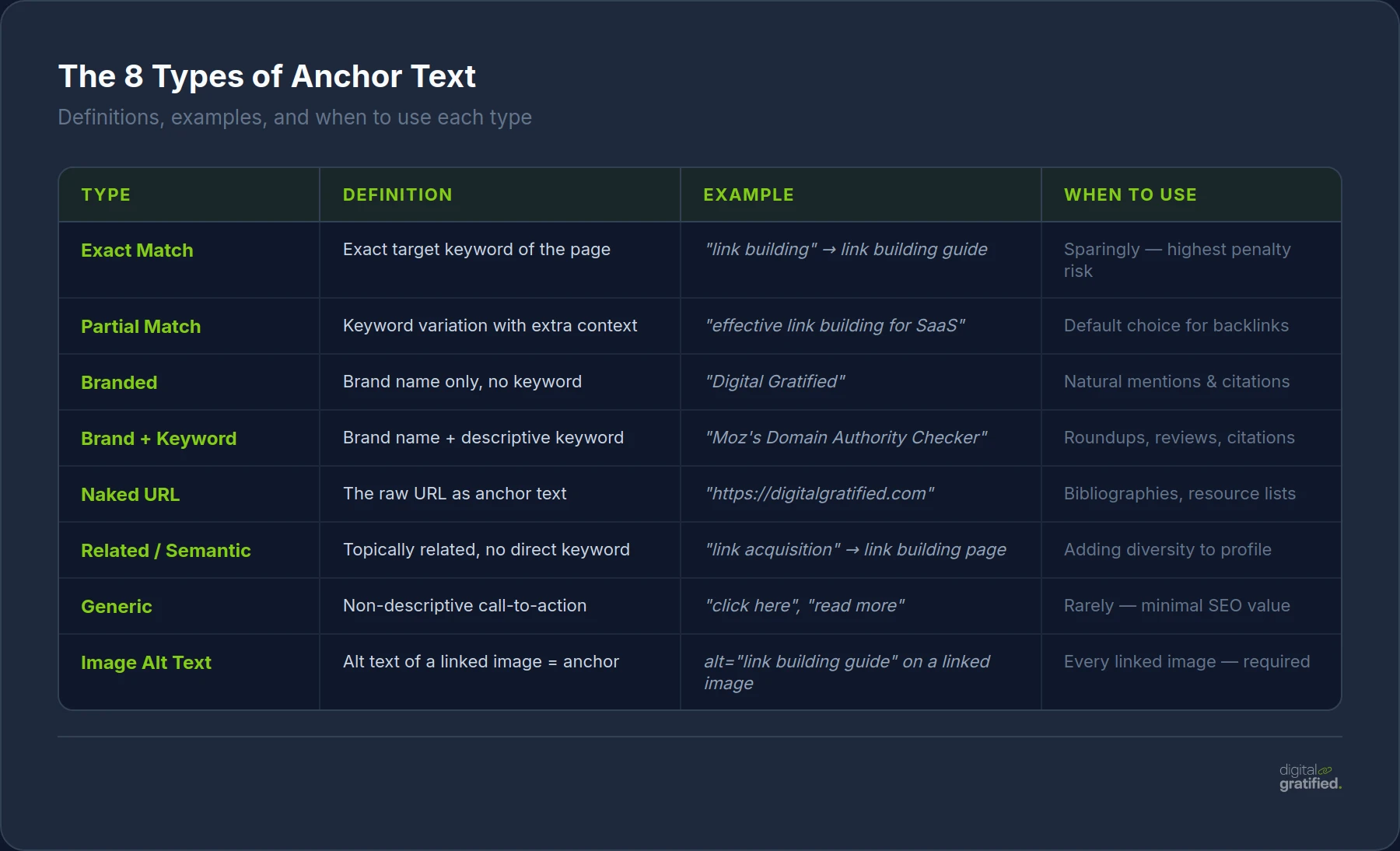
Anchor text isn't a single category: there are eight common types, each with a different purpose and SEO profile. Here's how each one works, when to use it, and what to avoid.
1. Exact Match
The anchor text exactly matches the target keyword of the linked page. Example: linking to a guide on "link building" using the text link building.
This sends the strongest topical signal to Google, but it also carries the highest over-optimisation risk. Used naturally by editorial writers, but heavily abused in link schemes. Keep exact-match anchors to a small share of your backlink profile.
2. Partial Match
A variation of the target keyword, with additional words providing context. Example: "effective link building strategies for SaaS companies" for a page targeting "link building strategies".
Partial match anchors are the workhorses of a healthy backlink profile. They read naturally in sentences, carry strong keyword signals, and are less likely to trigger over-optimisation flags.
3. Branded
The brand name alone, without any keyword. Example: Digital Gratified linking to the Digital Gratified homepage.
Branded anchors are a natural part of any established site's backlink profile, especially as you earn more editorial mentions. A high proportion of branded anchors is a sign of an authoritative domain.
4. Brand + Keyword (Compound)
The brand name combined with a descriptive keyword. Example: "Moz's guide to keyword research" or "Semrush link building tools".
This type is common in citations and roundup articles. It carries both brand equity and topical relevance, a useful combination.
5. Naked URL
The raw URL as the clickable text. Example: https://digitalgratified.com rather than "Digital Gratified".
Common in bibliography sections, resource lists, and formal citations. Provides no direct keyword signal to Google, but appears in natural link profiles and signals a direct reference.
6. Related / Semantic
A phrase that's topically connected to the target keyword without containing it directly. Example: using "link acquisition" as anchor text for a page that targets "link building".
Semantic anchors add topical diversity to a link profile. Google's understanding of related terms means these links still reinforce the right topic associations.
7. Generic
Non-descriptive phrases that give no information about the destination. Examples: "click here," "read more," "this article," "visit website."
Generic anchors carry near-zero keyword signal. They have their place (sometimes a call-to-action genuinely needs to say "learn more"), but they should be used sparingly and never as a deliberate SEO choice.
8. Image Alt Text (as Anchor)
When a linked image has no visible text, Google uses the image's alt text as the effective anchor text. This means alt text on linked images functions as anchor text from an SEO perspective.
Always write descriptive alt text on linked images, treating it as you would written anchor text for any other link.
Internal vs. External Anchor Text: Why the Strategy Is Different
Every guide on anchor text treats internal and external links the same way. They shouldn't. The strategy for each is fundamentally different.
Internal Anchor Text
For internal links (links between your own pages) you have full control. You choose every anchor every time. This means you can and should be deliberate about it.
For internal linking, use descriptive, keyword-rich anchors most of the time. Since you're not trying to build a "natural" backlink profile (there's no penalty risk from your own site), the goal is clarity: for users and for Google's crawlers. Link to "our link building case studies" rather than "click here to see results." The anchor text helps Googlebot understand which page covers what topic.
Watch for internal anchor text conflicts: if you link to two different pages using the same anchor text, you create ambiguity about which page should rank for that phrase. Keep each key anchor text associated with one page.
External / Backlink Anchor Text
For external links (backlinks from other websites) you rarely control the anchor text. When you do influence it (through guest posts, outreach, or partnerships), the goal shifts.
Here, diversity is critical. A backlink profile where 80% of anchors are your exact-match keyword is a manipulation signal. Google's Penguin algorithm (2012) targeted exactly this pattern. The goal is a mixed profile that looks like what you'd expect from genuine editorial links: mostly branded and natural, with some keyword anchors mixed in.
When you do have influence over external anchor text (for example, in a guest post author bio or a link building campaign) lean toward branded and partial-match over exact-match. Agencies managing this at scale often include anchor text diversification as a core component of their link building outreach strategy, ensuring no single anchor type dominates the profile.
How to Choose Anchor Text: A Practical Decision Framework
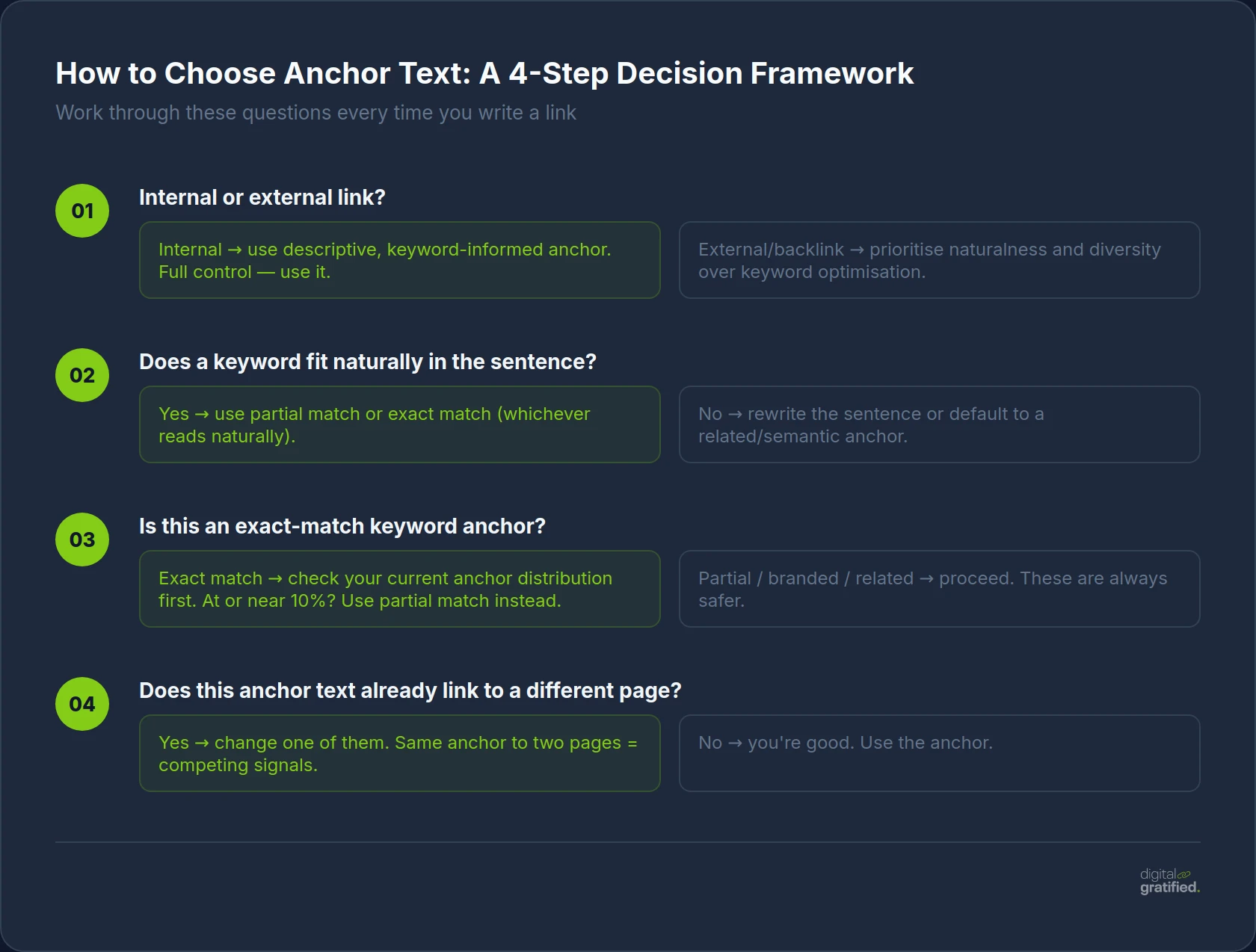
Most guides say "use descriptive anchor text" and leave it there. That's not enough guidance for anyone actually writing links. Here's a four-step framework for deciding what anchor text to use in any situation.
Step 1: Is this an internal or external link?
If internal: anchor text should be descriptive and keyword-informed. You have full control. Use it. If external (backlink): anchor text should prioritise naturalness and diversity above keyword optimisation.
Step 2: Does a keyword fit naturally in this sentence?
Read the sentence aloud. If the anchor text sounds like a normal phrase a writer would choose, it's fine. If it sounds like it was wedged in because it's a keyword, rewrite the sentence or use a partial match instead. Natural language always wins over manufactured keyword placement.
Step 3: Is this a sensitive (exact-match) keyword?
If you're linking to a core money page using its primary keyword (for example, "link building services" linking to your services page) ask: how many times have I already used this anchor text pointing to this page? If your backlink profile already has significant exact-match coverage for this page, use a partial match or branded variant instead.
Step 4: Does this anchor text already point to a different page?
For internal links especially: if you've already used a particular anchor text to link to another page, don't reuse it for a different destination. This creates competing signals. Either change one anchor text or consolidate the two pages.
Anchor Text Optimisation: Length, Variety, and Ratios
This is where every competitor guide goes vague. Here are specific, actionable answers to the questions they skip.
How Long Should Anchor Text Be?
For internal links, aim for 2–5 words. Short enough to be scannable; long enough to be descriptive. "content marketing guide" is better than "guide" (too short) and better than "our complete guide to content marketing for B2B SaaS companies in 2025" (too long).
For backlinks, the natural range is wider: anywhere from one word (a brand name) to a full phrase of 7–8 words. Since these are set by other writers, variation is expected. When you do control the anchor text (guest posts, resource pages), stick to 2–6 words.
Avoid anchors under one word (meaningless) or over ten words (dilutes the signal and reads unnaturally).
How Much Should You Vary Anchor Text?
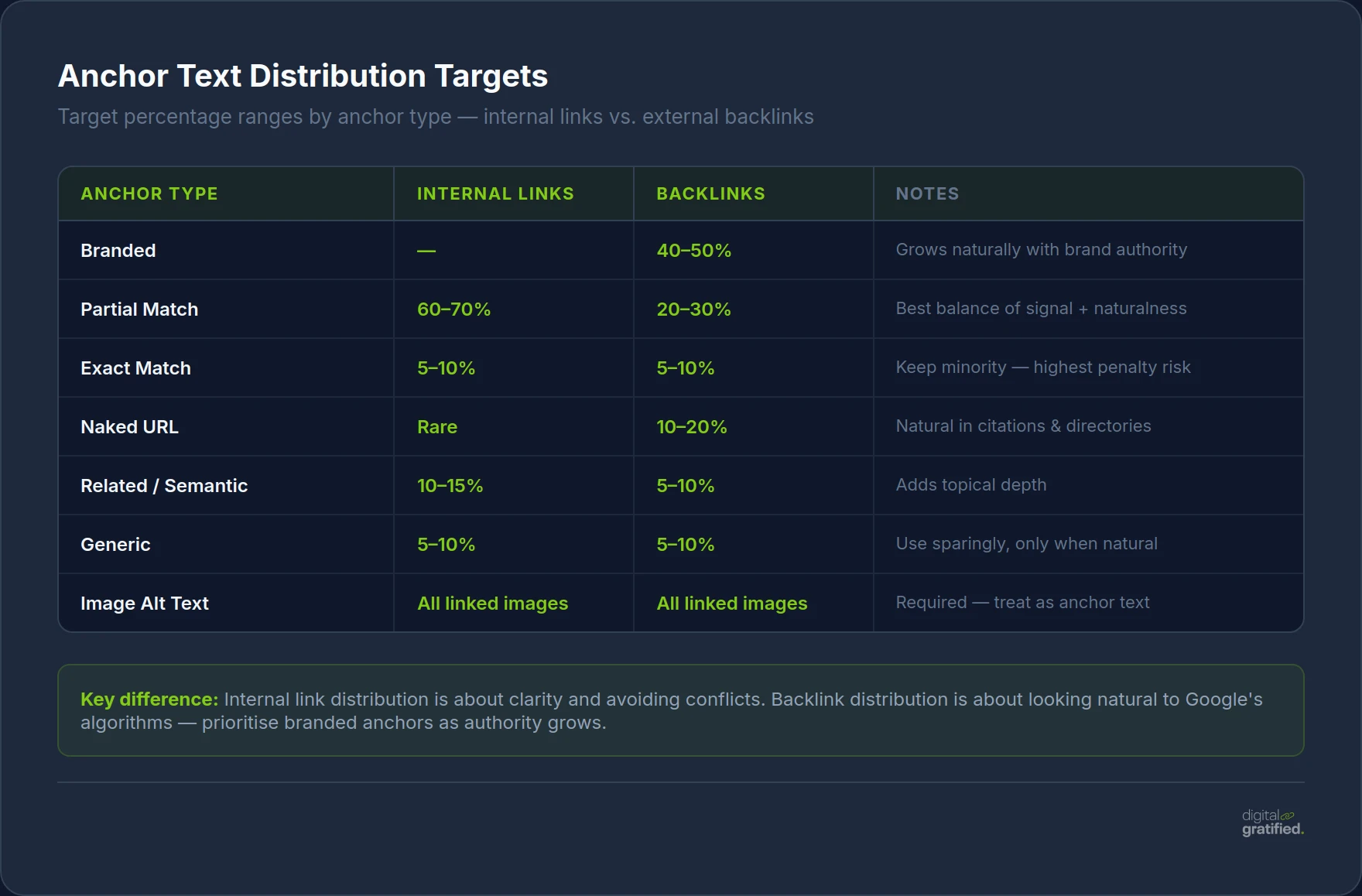
For backlink profiles, a healthy distribution looks roughly like this:
- Branded anchors: 40–50% (your brand name, brand + domain, brand variations)
- Partial-match and related: 20–30% (keyword variants, semantic phrases)
- Naked URLs: 10–20% (raw URLs, natural in citations and directories)
- Exact-match: 5–10% (the target keyword, exact, keep this a minority)
- Generic: 5–10% (click here, learn more, this article)
These are guidelines, not hard rules. New sites naturally have lower branded percentages: the brand isn't yet known, so fewer people cite it by name. Older, more established domains tend toward higher branded ratios as editorial mentions accumulate. What matters most is that no single non-branded anchor type dominates. The link building statistics on what healthy profiles look like across industries give useful benchmarks here.
For internal links, the distribution looks different: mostly descriptive (partial-match style), some generic where natural, and very few exact-match repetitions pointing to the same page.
How Much Exact-Match Is Too Much?
There's no universal threshold: Google's Penguin assessment is about patterns in context, not raw percentages. However, if more than 20–30% of your backlinks use the same exact-match anchor text for a single page, that's a pattern worth addressing, particularly if the site is new or the keyword is competitive.
The risk is highest for competitive keywords on new sites. For established brands with strong link profiles, higher exact-match ratios are less likely to trigger issues because the overall profile signals authenticity.
How Much Weight Does Nofollow Anchor Text Carry?
This question comes up constantly and gets a vague answer everywhere. Here's the direct version:
PageRank (link equity): A nofollow link passes zero PageRank. Google's documentation is explicit: the nofollow attribute tells Google not to pass ranking credit through that link.
Topical understanding: This is where it gets more nuanced. Research (including independent SEO experiments and analysis of Google's patents) suggests Google still reads nofollow links and may use surrounding context and anchor text for topical understanding, even when it doesn't pass equity. In other words, nofollow links from relevant, high-authority sites may still contribute to how Google understands what your page is about, even if they don't move your PageRank needle.
Practical implication: Don't actively pursue nofollow links purely for anchor text benefits. But don't dismiss high-quality nofollow mentions either, especially from major publications. The brand signal, potential referral traffic, and possible soft topical benefit all have real value.
Common Anchor Text Mistakes to Avoid
Over-optimising backlink anchor text
Using your exact target keyword as anchor text across all or most of your backlinks. Google flagged this pattern with Penguin and continues to watch for it. A natural link profile has variety. If you're running active outreach campaigns, build anchor text diversity in from the start.
Generic anchors everywhere on internal links
"Click here," "read more," "this post": these are wasted opportunities on your own site. You choose every internal anchor. Make them descriptive. Your users and Google both benefit.
Competing internal anchors
Using the same anchor text to link to two different internal pages creates ambiguity about which page should rank for that phrase. Audit your internal links periodically to catch this. The fundamentals of link building apply internally too: every link is a signal worth thinking through.
Mismatched anchor and destination
Anchor text that doesn't reflect what the linked page is actually about. This damages trust with users and sends a confusing signal to search engines. Always match the anchor to the content.
Ignoring image alt text as anchor text
If an image is a link and has no alt text, Google sees an empty anchor. That's a missed signal. Write descriptive alt text for every linked image.
Frequently Asked Questions
What is anchor text in SEO?
Anchor text in SEO is the clickable text of a hyperlink. It provides context to both users and search engines about the content of the linked page, influencing how Google ranks that page for related queries.
What is anchor text with an example?
If you write: "Here's our guide to what is link building in SEO" : the phrase "what is link building in SEO" is the anchor text. It's what a user sees and clicks, and it tells Google the linked page covers that topic.
What is branded anchor text?
Branded anchor text uses your brand name as the clickable text without any additional keywords. Example: "Digital Gratified" linking to the homepage. It's a natural, expected part of any authoritative site's backlink profile.
What is exact match anchor text?
Exact match anchor text uses the precise target keyword of the destination page: nothing more, nothing less. If a page targets "link building outreach," using that phrase verbatim as anchor text is an exact match. Effective in small doses; risky in large quantities.
What are the benefits of good anchor text?
Good anchor text: (1) helps Google understand what your linked page is about, increasing its chances of ranking for the right queries; (2) helps users decide whether a link is worth clicking, improving engagement; (3) distributes authority more efficiently through your site; and (4) contributes to a natural-looking backlink profile that avoids algorithmic penalties.
What is anchor text optimization?
Anchor text optimisation is the process of choosing and managing link text (both on your own site and in external backlinks) to send clear topical signals to Google without over-optimising. It involves using descriptive internal anchors, maintaining a varied backlink anchor profile, avoiding exact-match dominance, and auditing existing links for conflicts or wasted opportunities.
How do you optimize anchor text for SEO?
For internal links: use descriptive, keyword-informed anchor text that accurately describes the destination. For backlinks: pursue diversity: branded, partial-match, naked URL, and semantic anchors should all appear. Limit exact-match anchors to a small percentage of your total backlink profile. Audit quarterly using tools like Ahrefs, Semrush, or Moz Link Explorer to spot over-concentration in any one anchor type.
How do I create anchor text?
In HTML: <a href="URL">your anchor text here</a>. In most CMS editors (WordPress, Webflow, etc.), highlight the text you want to link, then use the link button to attach the URL. The highlighted text becomes the anchor text automatically.
How to anchor text in Word?
In Microsoft Word: select the text you want to make a link, right-click and choose "Link" (or press Ctrl+K / Cmd+K on Mac), then enter the URL. The selected text becomes the anchor text. When the document is exported to HTML or PDF, the link is preserved with that anchor text.
What is the anchor text of a link?
The anchor text of a link is the visible, human-readable text that users see and click. In <a href="https://example.com">example site</a>, "example site" is the anchor text of that link.
Let's Scale Your SaaS Together
Get a custom SEO and link building strategy tailored for your SaaS business.
Get SEO insights that actually move rankings
Link building tactics, case studies, and SaaS SEO playbooks. No fluff, no spam.
You're subscribed!
SEO and link building insights, straight to your inbox.