Tool pages and ten-step checklists dominate this topic, but nobody explains the actual ongoing workflow. Here's what to track, how often to audit, when to disavow, and how a lean SaaS team keeps a link profile healthy in half a day a month.

Founder, Digital Gratified
You've earned the links. Now what? Most SaaS teams put serious effort into acquiring backlinks and almost none into keeping them, which is how hard-won placements quietly disappear without anyone noticing. Good backlink management is knowing exactly what to do on a random Tuesday in month seven, when a journalist's article linking to you got deleted and your anchor text report looks slightly off.
This post is about that Tuesday. It's for SaaS teams that already have links coming in, whether from in-house outreach, an agency, or a broader SaaS link building strategy, and now need a system for keeping that profile healthy over time.
Backlink Management Is a Practice, Not a Project
Link building is acquisition: prospecting, pitching, earning placements. Backlink management is everything that happens after the link goes live. Tracking what you've earned, noticing what you've lost, watching the shape of the overall profile, and occasionally cleaning up.
Most teams do the first and skip the second entirely. That's how you end up paying for the same link twice: the placement you earned in January quietly 404s in June, nobody notices, and the budget goes toward new outreach instead of a two-line reclamation email that would've taken ten minutes.
The good news is that management is much cheaper than acquisition. Done sanely, the whole system described below costs a lean team about half a day per month.
Are Backlinks Still Relevant in 2026? (Short Answer: Yes)
Worth addressing head-on, since the question shows up every time an algorithm update or an AI search feature ships. Links remain one of the stronger external signals Google has for whether a site is trusted by the rest of the web, and every serious correlation study still shows referring domains tracking closely with rankings and organic traffic. What has changed is the tolerance for junk: low-quality links do less than ever, and manufactured patterns are easier for search engines to discount.
So the honest 2026 answer is: backlinks matter, but only the ones from real sites, which is exactly why managing the profile you've built is worth a slot on the calendar. We've laid out the fuller evidence in our post on the value of backlinks if you want the numbers.
What to Actually Track (and What to Ignore)
An ongoing audit watches four signals. Everything else is dashboard decoration.
Lost links. Pages get deleted, sites get redesigned, links get stripped in content refreshes. Lost links are the highest-ROI item in this whole discipline because recovery is cheap: you already earned the placement once, and a short, polite email to the site owner recovers a meaningful share of them.
Toxic and spammy links. Every site accumulates junk: scraper sites, weird directories, off-language blogs. Most of it is harmless and Google ignores it. What you are watching for is patterns, like a sudden cluster of links from one network, all pointing at your money pages with commercial anchors. Comparing acquisition against white hat link building principles helps separate harmless noise from manipulative patterns your team or vendor actually created.
Anchor text distribution. A natural profile is heavy on branded and URL anchors, with keyword anchors as a minority. If the mix drifts toward exact-match commercial anchors, either a vendor is cutting corners or someone is building links you didn't ask for. Both are worth knowing about early.
Referring domain growth vs. link velocity. Two hundred new links from three domains is very different from thirty links from thirty domains. Track unique referring domains against your historical pace. Steady growth is the goal; a spike or a stall is a prompt to investigate, not a verdict.
A Cadence a Lean Team Can Actually Keep
Enterprise SEO teams audit continuously because they have someone whose job that is. You probably don't, and pretending otherwise is how backlink management becomes another abandoned process doc. Here's a schedule that survives contact with a real SaaS marketing calendar:
Weekly, 10 minutes: scan the new-and-lost link alerts from your tracking tool. You're triaging, not acting. Flag anything that looks off and move on.
Monthly, an hour or two: work the flags. Send reclamation emails for lost links worth recovering, log notable new referring domains, and glance at the anchor mix on your most important pages.
Quarterly, two to three hours: the full review. Anchor distribution across the whole profile, referring domain growth against the last four quarters, a competitor check (more on that below), and a decision on whether anything actually merits a disavow.
Yearly, half a day: zoom out. Does the link profile match where the business is headed? Are you tracking pages that no longer matter? Reset the targets and clean out the spreadsheet.
If a step consistently gets skipped, shrink it rather than abandoning the cadence. A ten-minute weekly check that happens beats a perfect quarterly audit that doesn't.
Disavowing: Rarely, Reluctantly, and With a Paper Trail
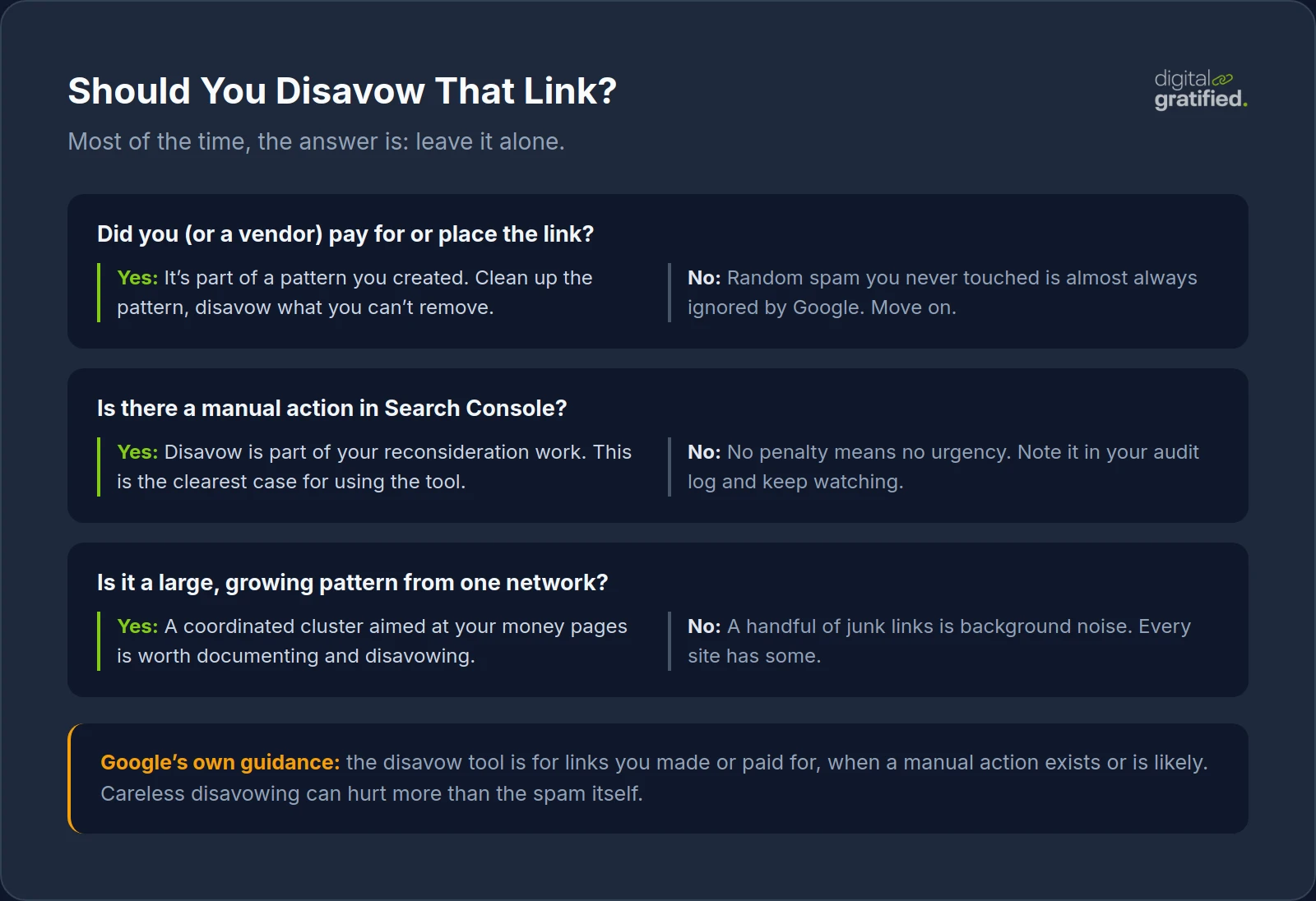
The disavow file is the most overused tool in backlink management, mostly because it feels productive. Google's disavow guidance is unusually blunt about this: the tool is meant for cases where you have a manual action (or reasonably expect one) because of links you or a vendor built, and careless use can hurt your site's performance.
So the decision framework is short. Disavow when there's a manual action in Search Console, or when you're cleaning up a paid-link pattern you created and can't get removed at the source. Consider it when a large, coordinated spam pattern keeps growing and targets your commercial pages. Skip it for everything else. The random junk every site accumulates is already being ignored by Google's systems, and its spam policies are enforced algorithmically whether or not you file paperwork about it.
When you do disavow, keep a log: date, domains, reason. Six months later, when someone asks why traffic moved, you'll want the record.
The Tool Landscape, Without the Listicle
You need exactly two capabilities: an index that shows your backlink profile with history (every major SEO suite does this well), and alerting for new and lost links, which those same platforms include. A third category, dedicated link CRMs, adds workflow features for teams managing links across many clients; useful for agencies, usually overkill for a single SaaS site.
The honest take is that the tool matters far less than the cadence. One backlink tool subscription plus a documented monthly review beats a six-tool stack nobody opens. If you want tool-by-tool detail, we've covered the best tools for link building separately so this post doesn't have to become a comparison table.
Management Feeds Acquisition (It Doesn't Replace It)
A common failure mode is treating backlink management as an alternative to building links: audit everything, disavow enthusiastically, recover the odd lost placement, and call it a strategy. It isn't one. Management protects the asset; acquisition grows it. The two run in parallel, and the audit data should actively feed your outreach process: lost links become your warmest prospect list, and the referring domains your competitors have but you don't become the next campaign.
That competitor angle deserves a permanent slot in the quarterly review. You're not just watching your own profile, you're watching the gap. Pull your top three competitors' new referring domains each quarter and ask which of those sites should reasonably link to you too. The mechanics are covered in our guide to finding competitor backlinks.
And if you're setting up the acquisition side from scratch alongside this, our link building checklist covers that process. Keep the two lists separate, though: an acquisition checklist tells you how to earn a link, an audit tells you whether the profile you've earned is holding. And if your remit covers more than links, backlink work is just one of several off-page SEO signals that need the same kind of upkeep.
How Many Links Are Worth Tracking?
Fewer than your dashboard suggests. For a typical SaaS site, the links that deserve individual attention are the ones from real referring domains pointing at pages you care about: your homepage, product pages, and the content that drives signups. That's usually a few hundred links, not tens of thousands. The scraper noise below that line only matters in aggregate, as a pattern.
"Enough" is also more modest than most founders expect. Outranking a competitor on a specific keyword is about matching the referring domains of the pages that currently rank, not the whole site's profile. We've broken down the actual numbers in our post on how many backlinks you need to rank, but the management takeaway is simple: track deeply where money is made, track in aggregate everywhere else.
The Bottom Line
Backlink management isn't a tool you buy or a one-time audit you commission. It's a small, boring, recurring practice: watch lost links, anchors, and referring domain growth on a weekly-monthly-quarterly rhythm, recover what you've already earned, disavow almost never, and feed what you learn back into acquisition. Half a day a month protects an asset you're likely spending thousands a month to build. That's the whole pitch.
Backlink Management: Frequently Asked Questions
What is backlink management?
Backlink management is the ongoing practice of tracking, auditing, and maintaining a site's existing link profile: monitoring new and lost links, watching anchor text distribution and referring domain growth, recovering dropped placements, and occasionally disavowing harmful patterns. It complements link building rather than replacing it.
Are backlinks still relevant in 2026?
Yes. Links from real, relevant sites remain one of the stronger external trust signals in Google's systems, and referring domain counts still correlate closely with rankings and organic traffic. What's changed is that low-quality and manufactured links are discounted more aggressively than ever, so profile quality matters more than raw volume.
How often should I audit my backlinks?
For a lean SaaS team: a 10-minute weekly scan of new and lost link alerts, a monthly hour to recover lost links and check anchors on key pages, and a quarterly deep review of the full profile including competitor gaps. That cadence costs about half a day per month in total.
When should I disavow backlinks?
Only when you have a manual action in Search Console, or when you're cleaning up paid or vendor-built links you can't get removed at the source. Google ignores most random spam automatically, and its own guidance warns that careless disavowing can hurt your site's performance more than the spam would have.
What's the best backlink management tool?
Any major backlink index with history and alerting covers a single SaaS site. Dedicated link CRMs add multi-client workflow features that mainly benefit agencies. The documented review cadence matters far more than which platform you pick.
About the author
Let's Scale Your SaaS Together
Get a custom SEO and link building strategy tailored for your SaaS business.
Get SEO insights that actually move rankings
Link building tactics, case studies, and SaaS SEO playbooks. No fluff, no spam.
You're subscribed!
SEO and link building insights, straight to your inbox.