Most SaaS growth guides assume you have venture capital to burn. This one is for founders building with their own money: covering which growth channels to prioritize first, how to compete against funded competitors, and the specific strategies that work when outspending the competition is not an option.

Founder, Digital Gratified
Growing a SaaS business without venture capital means every dollar and every hour has to earn its place. This playbook shows bootstrapped founders how to grow a SaaS business one stage at a time, from choosing the first channel to competing against funded rivals and tracking the metrics that matter at each revenue milestone.
Why Most SaaS Growth Advice Does Not Apply to You
Most advice on how to grow a SaaS business follows the same playbook. Hire a sales team, run paid ads, build a content engine, launch a referral program, optimize your onboarding, expand globally, invest in customer success.
That advice is not wrong. But it assumes you have the resources to pursue all of those channels simultaneously. If you are building a bootstrapped SaaS business, or any SaaS company operating on limited capital, that assumption will lead you to spread resources too thin and make progress on nothing.
Understanding how to grow a bootstrapped SaaS business requires a fundamentally different approach than the funded playbook. You cannot outspend funded competitors, so you have to outthink them. You cannot hire a team of specialists for every growth channel, so you have to pick the right channels first and execute them better than anyone else.
The Two Growth Paths: Funded vs. Bootstrapped
Understanding the difference between funded and bootstrapped growth is not just academic. It changes every decision you make about where to invest your time and money.
The Funded SaaS Playbook
Venture-backed SaaS companies follow a well-documented pattern: raise capital, hire aggressively, spend heavily on customer acquisition, prioritize growth rate over profitability, and use the resulting metrics to raise the next round. The goal is to capture market share as fast as possible.
This model works because the company is trading equity for speed. It can afford to lose money on every customer for years because the math says those customers will eventually become profitable, and in the meantime, the company has locked out competitors who cannot match its spend.
The Bootstrapped SaaS Playbook
Bootstrapped growth flips this model. Every dollar you spend on acquisition has to come from revenue. You cannot afford unprofitable customer acquisition for years. You need to reach profitability early, or at least sustainability, and then compound from there.
This constraint is often described as a disadvantage, but it forces a set of decisions that frequently produce more durable businesses:
- Channel selection discipline: You pick two or three growth channels instead of ten, and you go deep on the ones that offer the best return per dollar spent.
- Faster path to product-market fit: Without a cash cushion, you cannot afford to build features speculatively. You build what paying customers need, which accelerates learning.
- Lower churn by design: Because acquisition is expensive relative to your resources, you invest earlier in retention, which turns out to be the right move anyway.
- Sustainable unit economics from day one: You cannot hide poor economics behind growth metrics. If CAC is too high or LTV is too low, you feel it immediately.
Stage 1: Getting to Your First $10K MRR
The first stage of SaaS growth is the hardest, and it has almost nothing to do with marketing channels. It is about finding the intersection of a real problem, a solution that people will pay for, and a distribution method you can execute affordably.
Nail the Problem Before You Scale the Solution
The most common mistake at this stage is trying to grow before you have validated that your product solves a problem worth paying for. You cannot market your way out of a product-market fit problem. Every dollar spent on acquisition before product-market fit is validated is largely wasted.
How do you know you have product-market fit? The clearest signals are:
- Customers use the product without being prompted or reminded
- They tell other people about it without being asked
- When you ask "How would you feel if you could no longer use this product?" a significant portion say "very disappointed"
- Your churn rate for customers past the first 90 days stabilizes at a healthy level
Until you see these signals, your job is not growth: it is learning. Talk to every customer. Watch how they use the product. Build only what they need to succeed. Everything else is a distraction.
Pick Your First Acquisition Channel
At this stage, you need exactly one acquisition channel that reliably produces paying customers. Not five channels. One. Here is how to choose:
If your product solves a problem people actively search for: Search engine optimization is your highest-leverage first channel. Create content that answers the specific questions your target customers type into Google. This is the slowest channel to produce results (3 to 6 months), but it is also the most durable: content continues generating leads long after you publish it.
If your product sells to a community you belong to: Community-driven growth works well when you have genuine credibility within a niche. Participate in forums, Slack groups, Reddit communities, and industry events where your target customers gather. This is not about spamming links: it is about being genuinely helpful and letting people discover your product through your expertise.
If your product has a short sales cycle and clear ROI: Direct outbound works when you can identify specific prospects and demonstrate value quickly. Cold email to a targeted list, personalized LinkedIn outreach, and direct conversations at industry events can produce paying customers within weeks.
If your product is naturally viral: Product-led growth works when using the product inherently exposes it to new prospects. Collaboration tools, document-sharing products, and communication platforms have this characteristic. If yours does, invest in making the sharing and invitation flows seamless.
Stage 2: Growing from $10K to $100K MRR
Once you have a channel that reliably produces customers and a product that retains them, the game shifts from validation to systematic growth. This is where most bootstrapped SaaS founders either break through or stall out.
Add Your Second Growth Channel
With your first channel producing consistently, add a second one that complements it. The best second channel usually addresses a different stage of the buyer journey:
- If your first channel is SEO (top-of-funnel awareness), add direct sales or partnerships (bottom-of-funnel conversion).
- If your first channel is outbound sales (bottom-of-funnel), add content marketing (top-of-funnel).
- If your first channel is community (mid-funnel), add SEO or paid search to capture demand you are creating through community presence.
The mistake at this stage is adding too many channels too fast. Every new channel requires learning, iteration, and dedicated attention to produce results. Two well-executed channels will outperform five poorly executed ones every time.
Build Your Organic Growth Moat
This is where bootstrapped SaaS companies can build an advantage that funded competitors struggle to replicate: a compounding organic presence that generates leads without ongoing spend.
Paid acquisition stops producing results the moment you stop spending. Organic growth through content marketing, SEO, and authority building compounds over time. A blog post you publish today can generate leads for years. A strong domain authority makes every subsequent piece of content rank faster and higher.
For SaaS companies, the organic growth moat has three components:
- Content that captures search demand: Create content targeting the specific problems, questions, and comparison queries your target customers search for. Focus on bottom-of-funnel content first (comparison pages, "best X for Y" posts, problem-specific guides) because it drives revenue faster than top-of-funnel educational content.
- Domain authority through strategic link building: Search rankings are not just about content quality. They depend heavily on the authority signals your domain sends to search engines. Building high-quality backlinks from relevant, authoritative sites is what separates SaaS companies that rank on page one from those buried on page five.
- Technical foundation: Site speed, mobile experience, crawlability, and structured data all impact how effectively search engines index and rank your content. Getting the technical basics right is a one-time investment that pays dividends on every piece of content you publish.
This organic approach is particularly powerful for bootstrapped SaaS businesses because it converts a time investment into a durable asset. Funded competitors can outspend you on paid channels, but they cannot outspend you on patience and consistency.
Optimize Pricing to Maximize Revenue Per Customer
Pricing is the highest-leverage growth tool that most SaaS founders underutilize. Changing your pricing can increase revenue faster than any acquisition channel because it applies to every customer, current and future.
Common pricing mistakes at this stage:
- Pricing too low: Bootstrapped founders are often afraid to charge what their product is worth. If nobody complains about your pricing, you are probably undercharging. A good heuristic: you should hear "that is too expensive" from roughly 20% of prospects. If nobody says it, raise prices.
- Single pricing tier: A single plan forces you to choose between underserving power users and overcharging light users. Introduce tiers that let customers self-select based on their needs and willingness to pay.
- Pricing based on costs instead of value: Your price should reflect the value you deliver to customers, not the cost of providing the service. If your product saves a customer 10 hours per month, and that time is worth $100 per hour, charging $49 per month leaves enormous value on the table.
Stage 3: Scaling Beyond $100K MRR
At this stage, you have a product people love, channels that produce customers reliably, and pricing that supports healthy margins. The challenge shifts from finding growth to sustaining and accelerating it without breaking what works.
Hire for Leverage, Not Coverage
The first hires in a bootstrapped SaaS company should create leverage, meaning each person should multiply the output of the founder, not just add capacity. The most common hiring sequence for bootstrapped SaaS at this stage:
- Customer support: Frees the founder to focus on growth instead of reactive support work. This hire often pays for itself immediately by reducing churn through faster response times.
- Marketing or content: Someone who can produce content, manage SEO, and run campaigns so the founder is not the bottleneck on every piece of marketing.
- Engineering: Additional development capacity to ship features faster and reduce the founder's time spent on bug fixes and maintenance.
A common alternative to hiring full-time staff is outsourcing specialized functions like link building, technical SEO, or content production to experienced providers. This gives you access to expert-level execution without the overhead and management burden of building an in-house team for every discipline.
Reduce Churn Before Adding More Acquisition
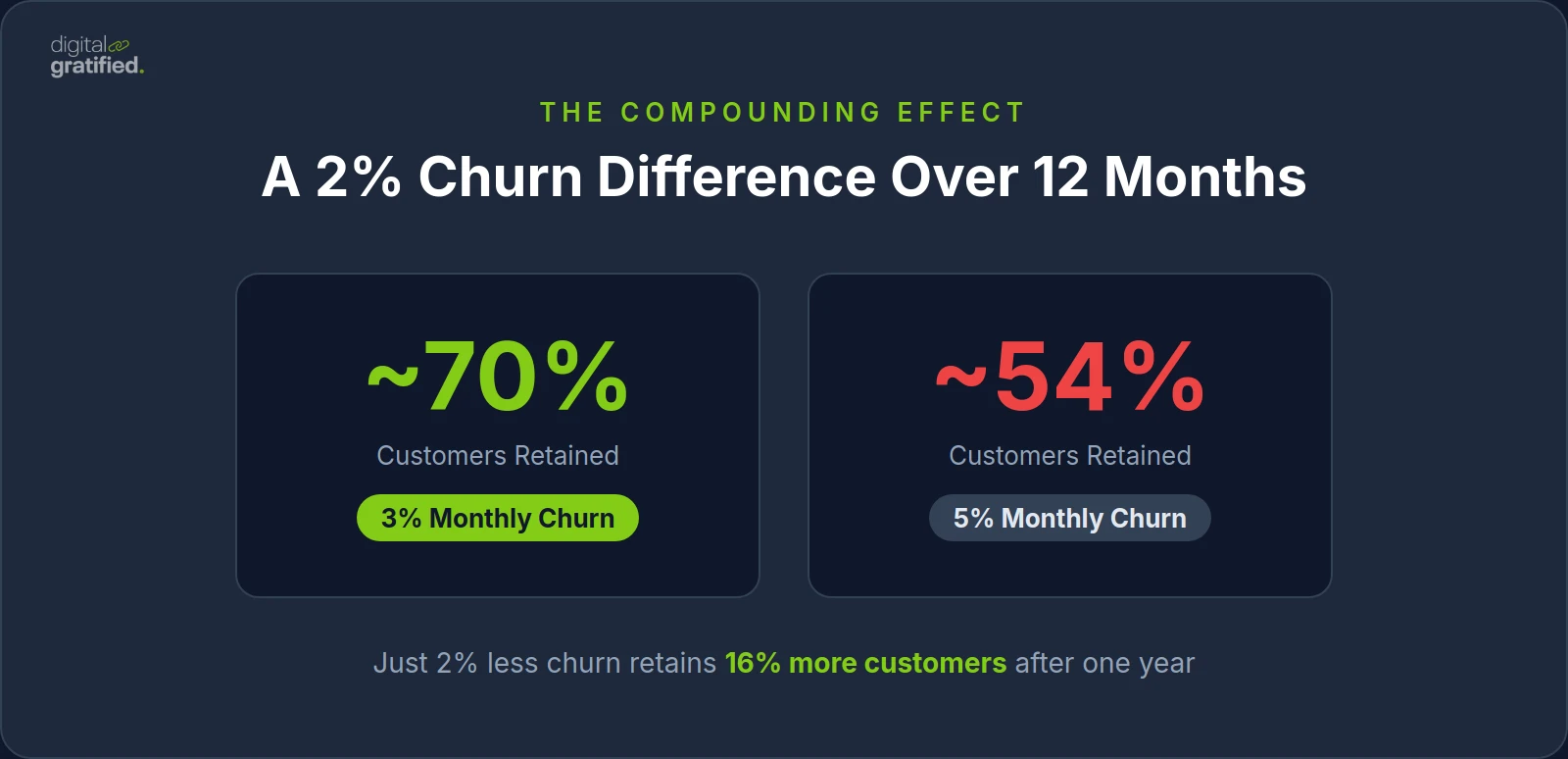
At every stage of SaaS growth, reducing churn is mathematically more efficient than increasing acquisition. A 1% improvement in monthly churn has a larger impact on long-term revenue than a 1% improvement in acquisition rate, because churn reductions compound across your entire customer base.
Effective churn reduction strategies for SaaS:
- Identify your "aha moment": What is the specific action that, once a new user completes it, dramatically reduces their likelihood of churning? Find this action through data analysis, then engineer your onboarding to get every user there as quickly as possible.
- Segment churn by cause: Not all churn is the same. Customers who leave because of price behave differently from customers who leave because they did not find value. Track the reason behind every cancellation and address the largest causes systematically.
- Invest in proactive customer success: Do not wait for customers to complain. Monitor usage patterns and reach out to customers showing signs of disengagement before they decide to cancel. A simple email asking "Is everything working well?" can save accounts that would otherwise churn silently.
- Build switching costs through integrations: The more your product integrates with the customer's existing tools and workflows, the harder it becomes to leave. This is not about trapping customers: it is about making your product more valuable by fitting deeply into how they work.
Competing Against Funded Competitors: The Bootstrapper's Advantages
One of the biggest fears for bootstrapped SaaS founders is competing against companies that have raised millions in venture capital. The fear is understandable: those companies can hire bigger teams, run expensive ad campaigns, and offer aggressive pricing that a bootstrapped business cannot match.
But bootstrapped companies have structural advantages that are easy to overlook:
Speed of Decision-Making
Funded companies have boards, investors, and management layers that slow down decisions. A bootstrapped founder can change pricing on Monday, launch a new feature on Wednesday, and pivot positioning by Friday. This speed is a meaningful competitive advantage in markets that are evolving rapidly.
Customer Intimacy
When you have 200 customers instead of 20,000, you can know every single one of them. You can respond to support tickets personally, hop on calls to understand feature requests, and build relationships that no enterprise sales team can replicate. This intimacy produces better products and lower churn.
Niche Dominance
Funded companies need large addressable markets to justify their valuations. That means they build broad products that serve many use cases adequately but few use cases excellently. A bootstrapped SaaS company can target a narrow niche and build the definitive product for that specific audience. The funded competitor cannot afford to focus that narrowly.
Profitability as a Moat
A profitable bootstrapped SaaS company can operate indefinitely without external validation. It does not need to hit growth metrics to raise the next round. It does not need to worry about runway. This stability allows you to make long-term decisions that a funded competitor (burning cash against an 18-month runway) simply cannot afford to make.
The Growth Channels That Work Best for Bootstrapped SaaS
Not all growth channels are created equal when resources are limited. Here is an honest assessment of the major channels, ranked by their suitability for bootstrapped SaaS businesses.
Tier 1: High Return, Low Ongoing Cost
SEO and content marketing: The best long-term investment for most SaaS companies. Requires significant upfront effort but produces compounding returns. Content published today continues generating leads for years. The key is focusing on high-intent keywords that attract potential buyers, not just traffic. Working with a specialized partner like Digital Gratified can accelerate the timeline to results, particularly for building the outreach infrastructure that drives domain authority.
Product-led growth: If your product naturally involves collaboration or sharing, this is your most capital-efficient channel. Every user becomes a distribution mechanism. The investment is in product engineering (making sharing, inviting, and collaboration seamless) rather than in marketing spend.
Integrations and partnerships: Building integrations with popular tools in your ecosystem puts your product in front of users who are already looking for solutions. App store listings (Shopify, Salesforce, HubSpot ecosystems) and integration directories drive qualified traffic with zero ongoing cost.
Tier 2: Moderate Return, Moderate Cost
Community and thought leadership: Building a genuine presence in communities where your target customers gather. This works well but requires consistent time investment. The return is both direct (leads) and indirect (brand authority that makes every other channel more effective).
Direct outbound: Email and LinkedIn outreach to targeted prospects. Effective when you can personalize at a meaningful level and when your product has a clear, immediate value proposition. Becomes less efficient as you scale because it requires proportionally more effort per lead.
Referral programs: Systematic programs that incentivize existing customers to bring in new ones. The challenge is that most referral programs produce modest results unless the product has strong word-of-mouth characteristics. They work best as an amplifier of existing satisfaction, not as a primary growth driver.
Tier 3: High Cost, Variable Return
Paid advertising (Google Ads, social): Can produce immediate results, but requires ongoing spend and careful optimization. Suitable for bootstrapped SaaS when you have validated your conversion funnel and can afford the CAC. Dangerous when used before product-market fit is established: you will burn cash learning lessons that could be learned more cheaply through other channels.
Events and conferences: Valuable for network building and brand awareness, but expensive relative to the number of leads produced. Consider attending rather than sponsoring in the early stages, and focus on events where your specific target customers gather.
The Metrics That Actually Matter at Each Stage
Tracking the right metrics at the right time prevents the common mistake of optimizing for vanity numbers while the business fundamentals deteriorate.
Pre-$10K MRR: Validation Metrics
- Activation rate: What percentage of signups reach the moment where they experience your product's core value?
- Week-1 retention: What percentage of activated users return after the first week?
- Qualitative feedback: What are customers saying about the product? What features are they requesting? Why are they leaving?
Revenue metrics matter less at this stage than engagement metrics. A product with 50 deeply engaged users is closer to growth than a product with 500 users who signed up and never came back.
$10K to $100K MRR: Growth Metrics
- MRR growth rate: Month-over-month growth should be 10 to 20% for a healthy bootstrapped SaaS at this stage. Anything above 15% compounding monthly is exceptional.
- Net revenue retention (NRR): Revenue from existing customers, including upgrades and churn. An NRR above 100% means your existing customer base is growing even without new acquisitions.
- CAC payback period: How many months of revenue from a new customer does it take to recover the cost of acquiring them? For bootstrapped SaaS, this should be under 6 months. Under 3 months is excellent.
- Channel-specific metrics: Conversion rate, cost per lead, and lead-to-customer rate for each active acquisition channel.
$100K+ MRR: Efficiency Metrics
- LTV:CAC ratio: The lifetime value of a customer divided by the cost of acquiring them. A ratio of 3:1 or higher indicates a healthy, scalable business. Below 3:1 suggests you are either spending too much on acquisition or not retaining customers long enough.
- Revenue per employee: How efficiently your team generates revenue. Bootstrapped SaaS companies often outperform funded ones on this metric because they hire more carefully.
- Gross margin: What percentage of revenue remains after the direct costs of delivering the service? Healthy SaaS gross margins are typically 70% or higher. If yours is significantly lower, your pricing or infrastructure costs need attention.
Common Growth Plateaus and How to Break Through Them
Every SaaS business hits growth plateaus: periods where the strategies that produced growth so far stop producing meaningful gains. Here are the most common plateaus and how to break through them.
The $10K MRR Plateau
Cause: Your initial customer base (usually from personal network and early community) is tapped out, and you have not yet built a scalable acquisition channel.
Solution: Invest seriously in one scalable channel. This usually means committing to content marketing and SEO, building a direct sales process, or launching a product-led growth loop. The key word is "invest": this means dedicating real time and potentially budget, not dabbling.
The $50K MRR Plateau
Cause: Your primary channel is maxed out at its current level of investment, and adding more budget to it produces diminishing returns.
Solution: Add a second channel or expand your market. If you have been focused on one customer segment, explore whether adjacent segments would benefit from your product. If you have been in one geography, consider whether international expansion is feasible. If content has been your primary channel, consider whether partnering with specialists to accelerate your SEO growth could break through the ceiling.
The $100K+ MRR Plateau
Cause: Churn is eating your growth. You are acquiring new customers, but losing existing ones at a rate that cancels out the gains.
Solution: Shift focus from acquisition to retention. Invest in customer success, improve onboarding, and build features that increase switching costs. At this revenue level, a 1% reduction in monthly churn has a larger revenue impact than most acquisition improvements.
Frequently Asked Questions
How do you grow a SaaS business from scratch?
Start by validating product-market fit with a small group of paying customers. Once you confirm that your product solves a real problem and retains users, choose one scalable acquisition channel and invest deeply in it. For most SaaS businesses, SEO and content marketing offer the best long-term return because they produce compounding results without ongoing spend. Add additional channels only after your first one is producing reliably.
How do you grow a bootstrapped SaaS business?
Bootstrapped SaaS growth requires ruthless prioritization. Focus on one or two high-return growth channels instead of spreading across many. Invest in organic growth (content, SEO, domain authority) that compounds over time rather than paid channels that stop producing when you stop spending. Optimize pricing early: it is the highest-leverage growth action because it applies to every customer. And reduce churn aggressively, because with limited acquisition budget, every lost customer hurts more.
What is the most important metric for SaaS growth?
Net revenue retention (NRR) is the single most important metric because it measures whether your existing customer base is growing or shrinking. An NRR above 100% means your business grows even without acquiring new customers. This metric captures product quality, pricing effectiveness, and customer satisfaction in a single number.
How long does it take to grow a SaaS business?
The timeline varies enormously based on market, product complexity, and resources. On average, reaching the first $1 million in annual recurring revenue takes about 3 years for bootstrapped SaaS companies. The timeline shortens significantly after product-market fit is established: a product with strong retention and a working acquisition channel can grow from $10K to $100K MRR within 12 to 18 months.
Can you grow a SaaS business without paid advertising?
Absolutely. Many of the most successful bootstrapped SaaS companies grew primarily through organic channels: SEO, content marketing, community participation, product-led growth, and strategic partnerships. Paid advertising can accelerate growth once you have validated your conversion funnel and unit economics, but it is not a prerequisite for building a substantial SaaS business.
What growth channels should a bootstrapped SaaS business focus on first?
Start with the channel that best matches your product's characteristics. If people search for solutions to the problem you solve, invest in SEO and content. If your product is inherently collaborative, invest in product-led growth. If you can identify specific prospects, invest in targeted outbound. The common thread is picking one channel, going deep on it, and only adding a second channel once the first is producing consistent results.
About the author
Let's Scale Your SaaS Together
Get a custom SEO and link building strategy tailored for your SaaS business.
Get SEO insights that actually move rankings
Link building tactics, case studies, and SaaS SEO playbooks. No fluff, no spam.
You're subscribed!
SEO and link building insights, straight to your inbox.