Most guides tell you to outsource SEO for "cost savings and expertise." This one tells you what to outsource first, how to vet providers without guessing, red flags that predict failure, and how to structure a relationship that actually delivers results.

Founder, Digital Gratified
Deciding to outsource SEO is one of the biggest calls a growing company makes about organic search. Get it right and you gain specialist expertise without the cost of building a full team. Get it wrong and you lose months of budget and momentum to a provider who was never a good fit.
This guide gives you a decision framework for outsourcing SEO well, covering what to hand off, what to keep in-house, how to choose a provider, and how to structure the engagement so it delivers results.
What Does It Actually Mean to Outsource SEO?
When you outsource SEO work such as link building, you hand some or all of your search engine optimization tasks to an external team, such as an agency, a freelancer, or a specialized provider, instead of doing them with internal staff.
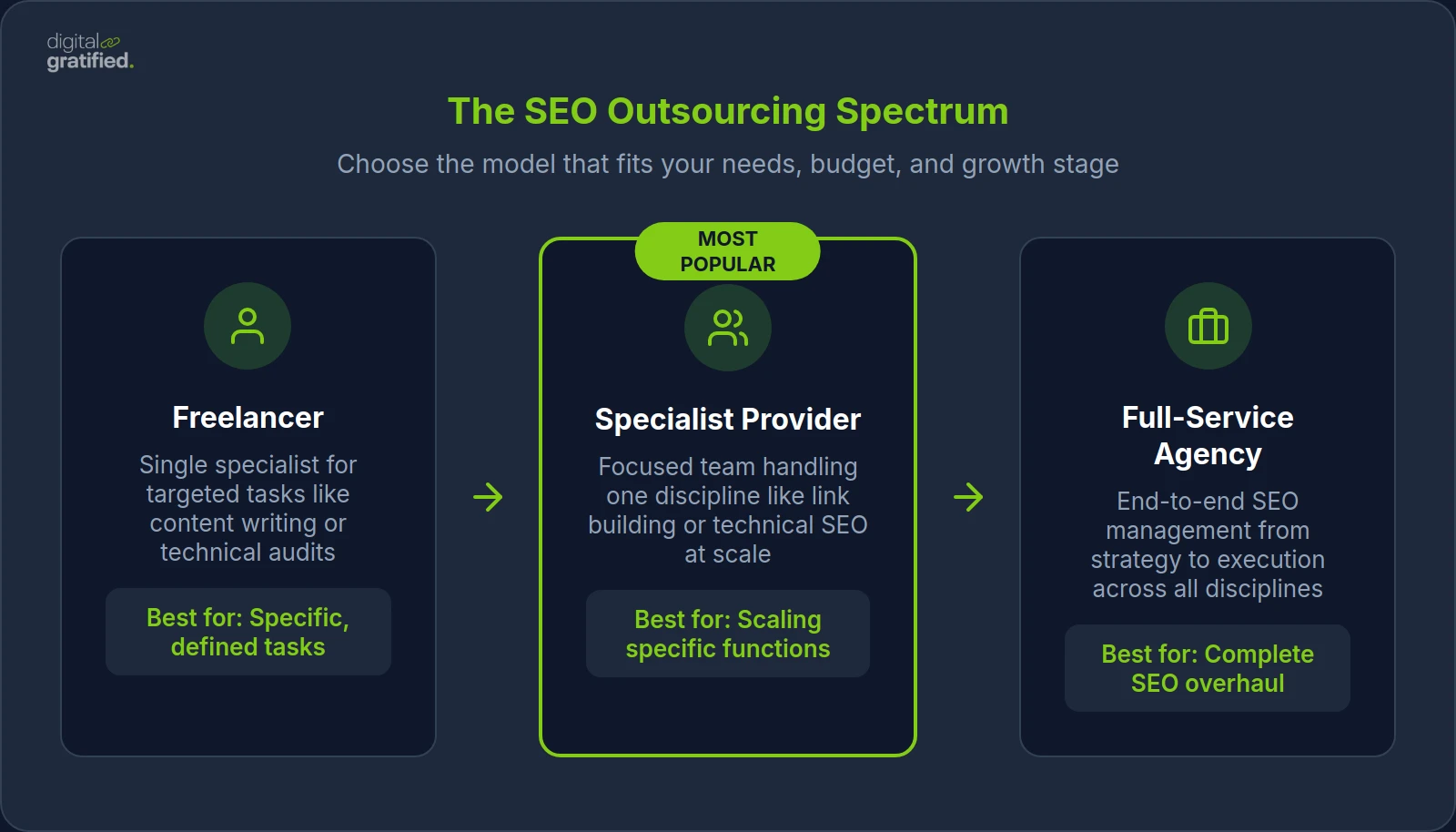
That sounds simple, but the range of what "outsource SEO" covers is enormous. It could mean hiring a freelance writer to produce blog posts. It could mean partnering with a full-service agency to manage your entire organic search strategy. It could mean working with a specialist provider to handle just your link building while your in-house team manages content and technical SEO.
The most important thing to understand upfront: outsourcing SEO is not a single decision. It is a series of decisions about which specific functions to hand off, to whom, and under what structure. Getting the structure right matters more than finding the cheapest quote.
The Real Reasons Companies Outsource SEO (Beyond the Generic Benefits)
Every article about outsourcing SEO leads with the same list: save money, access expertise, save time, focus on your core business. Those are all true. But they are also incomplete.
Here is what actually pushes companies to outsource SEO work (the specific situations where it makes strategic sense):
Your SEO Needs Outgrew Your Team Before Your Budget Caught Up
This is the most common trigger. A company starts seeing traction from organic search. They realize SEO is working and want to accelerate. But hiring a full-time SEO manager, a content writer, and a link builder, plus paying for all the tools they need (an SEO suite, an outreach platform, a site crawler), adds up to a significant annual commitment before you see a single additional ranking improvement.
Outsourcing lets you access that entire capability stack for a fraction of the cost. You pay for output, not headcount.
You Need Specialized Skills You Cannot Hire Locally
SEO is not one skill. It is a collection of specializations: technical SEO, content strategy, link building outreach, local SEO, international SEO, programmatic content. Finding one person who does all of these well is nearly impossible. Finding an agency or provider team that covers all of them is straightforward.
Your In-House Efforts Plateaued
Many companies have someone on the marketing team who "does SEO" alongside their other responsibilities. They handle the basics: title tags, some keyword research, occasional blog posts. But the results hit a ceiling because SEO at a competitive level requires dedicated, consistent effort across multiple fronts simultaneously.
Outsourcing to specialists breaks through plateaus because they bring proven playbooks, tested at scale across multiple clients, that a generalist marketer simply does not have access to.
You Are an Agency That Needs to Deliver SEO to Clients
This is the outsource SEO reseller model. Digital marketing agencies, web design firms, and PR agencies often sell SEO as part of their service offering but do not have the in-house capacity to fulfill it. They outsource the execution to a specialized provider who works behind the scenes, delivering results under the agency's brand.
This is not a weakness. It is how many agencies scale. The agencies that try to do everything in-house often deliver mediocre results across the board instead of excellent results in their actual areas of expertise.
What to Outsource First: A Practical Decision Framework
The biggest mistake companies make when outsourcing SEO is trying to outsource everything at once. This leads to loss of control, miscommunication, and disappointing results. Instead, use this framework to decide what to hand off first.
Outsource the Specialized, Keep the Strategic
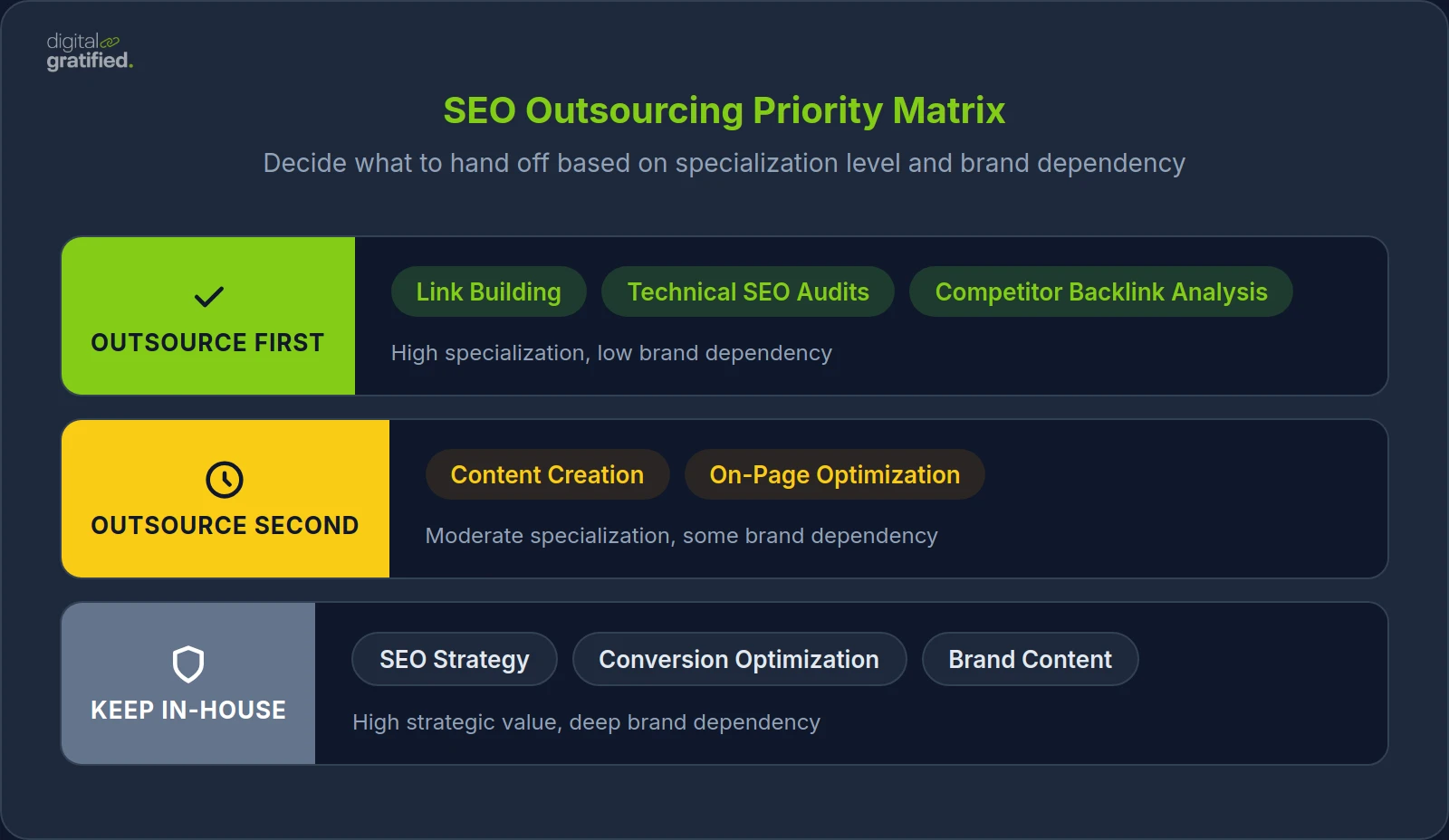
A useful rule: keep strategy and brand voice in-house, outsource specialized execution. Here is how that breaks down:
Outsource first (high specialization, low brand dependency):
- Link building: This is the most commonly outsourced SEO function, and for good reason. Effective link building requires dedicated outreach infrastructure, established relationships with publishers, and specialized tools. It is also the hardest SEO discipline to do well in-house without full-time staff. Understanding what link building costs helps set realistic expectations before you engage a provider.
- Technical SEO audits: Site crawls, Core Web Vitals optimization, schema markup, and indexation issues all require deep technical knowledge that does not need brand context. A specialist can audit your site, deliver recommendations, and your developer can implement them.
- Competitor backlink analysis: Identifying where competitors earn links and finding opportunities for your site is a research-intensive task that benefits from specialized tools and methodology.
Outsource second (moderate specialization, some brand dependency):
- Content creation: Blog posts, guides, and resource pages can be outsourced once you have clear brand guidelines and a content brief process in place. The provider needs to understand your voice, audience, and positioning, which takes a few iterations to calibrate.
- On-page optimization: Keyword mapping, title tag optimization, internal linking strategy. These require some understanding of your business priorities but are largely systematic once the keyword strategy is defined.
Keep in-house (high strategic value, deep brand dependency):
- Overall SEO strategy and prioritization: Which pages matter most, which markets to target, how SEO aligns with product launches and business goals.
- Conversion optimization: Landing page messaging, CTAs, and user experience decisions that directly impact revenue.
- Brand-sensitive content: Thought leadership pieces, product messaging, and anything that represents your company's unique perspective.
How to Outsource SEO Without Getting Burned: The Vetting Playbook
Choosing the wrong SEO provider is expensive: not just in wasted budget, but in lost time and potential damage to your site's authority. Here is how to vet providers systematically.
Red Flags That Predict Failure
Walk away from any provider that exhibits these warning signs:
- Guaranteed rankings: No legitimate provider can guarantee a #1 ranking. Search algorithms are controlled by Google, not by any agency you hire (see how to choose a SaaS SEO agency). Anyone making specific ranking promises is either lying or planning to use manipulative tactics that will eventually backfire.
- Unwillingness to explain their methods: If a provider cannot clearly articulate how they build links, what sites they target, and why their approach works, they are likely using tactics they know you would not approve of.
- Unusually low pricing: SEO delivered by experienced professionals with quality tools costs real money. If someone offers full-service SEO for $200 per month, they are either cutting corners (spammy links, AI-generated filler content) or running a volume operation where your campaign gets minimal attention.
- No case studies or verifiable references: Ask for specific examples of results they have achieved. Then verify independently: use an SEO tool to check whether the client's organic traffic actually grew during the period the provider claims to have worked with them.
- Long-term contracts with no performance clauses: Locking you into a 12-month contract with no exit clause based on performance suggests the provider is more concerned about securing revenue than delivering results.
Green Flags That Predict Success
- Transparent reporting with specific KPIs: Good providers define measurable deliverables upfront: number of links built per month, target domain authority ranges, content pieces delivered, keyword ranking improvements tracked monthly.
- Clear communication cadence: Monthly reports, regular check-in calls, and responsive communication between scheduled touchpoints. You should never wonder what your provider is doing.
- Willingness to start small: The best providers are confident enough to earn your trust on a smaller engagement before scaling up. A provider that pushes you into a maximum-budget package from day one is optimizing for their revenue, not your results.
- They ask hard questions: A good provider will want to understand your business model, competitive landscape, past SEO efforts, and realistic timelines before proposing a strategy. If they pitch a generic package without asking about your specific situation, they will deliver generic results.
Outsource SEO Projects: Structuring the Relationship
Finding the right provider is only half the equation. How you structure the working relationship determines whether the engagement succeeds or fails.
The First 30 Days: Foundation
The first month should be about alignment, not deliverables. A good outsourcing partner will:
- Conduct a comprehensive audit of your current SEO position
- Review your existing content, backlink profile, and technical health
- Identify quick wins and long-term opportunities
- Define specific, measurable goals for the first 90 days
- Establish reporting templates and communication schedules
Days 31-90: Execution and Calibration
This is where real work begins. The provider should be executing the agreed strategy while you monitor progress and provide feedback. Expect:
- Initial link placements and content pieces going live
- First technical improvements implemented
- Baseline metrics established for measuring future progress
- Regular check-ins to adjust approach based on early data
This period is critical for calibrating the relationship. If communication is poor, deliverables are late, or quality does not meet standards by day 90, these issues will not improve with time. Address them directly or consider a change.
Days 91 and Beyond: Optimization and Scale
By the end of the first quarter, you should have enough data to evaluate whether the outsourcing relationship is delivering value. At this stage:
- Review which activities are producing the strongest results
- Double down on what works, reduce or eliminate what does not
- Discuss scaling successful campaigns
- Set goals for the next quarter based on actual performance data, not projections
The Outsource SEO Reseller Model: How It Works for Agencies
For digital marketing agencies, the reseller model is one of the most efficient ways to outsource SEO. Here is how it works in practice.
An SEO reseller (also called a white-label provider) performs the actual SEO work (link building, content creation, technical audits) while the agency maintains the client relationship. All deliverables are branded with the agency's identity. The end client never knows that execution is handled by a third party. Our guide to white label SEO for agencies covers how to run that arrangement without putting the client relationship at risk.
This model is widespread for a reason: it lets agencies offer comprehensive SEO services without hiring specialists for every discipline. The agency focuses on client strategy, account management, and sales, while the reseller handles execution.
When the Reseller Model Makes Sense
- You sell SEO but your core expertise is elsewhere (web design, PPC, social media). Rather than building an SEO team from scratch, you partner with a provider who already has the infrastructure.
- You need to scale quickly. A new client signs a large SEO contract. Instead of hiring and training a team over months, you activate a reseller partnership and begin delivering within weeks.
- You want predictable margins. Reseller pricing is typically fixed per deliverable, which makes it easy to calculate your margin on every client engagement.
For agencies exploring this path, white-label link building is often the starting point: it is the most commonly outsourced SEO function and the one where specialized expertise makes the biggest difference. If you are still choosing between referral, white label and direct arrangements, our comparison of SEO agency partnership models lays out who owns the client and the margin in each.
Outsourcing SEO for Different Business Types
The right outsourcing approach varies significantly depending on your business model.
SaaS Companies
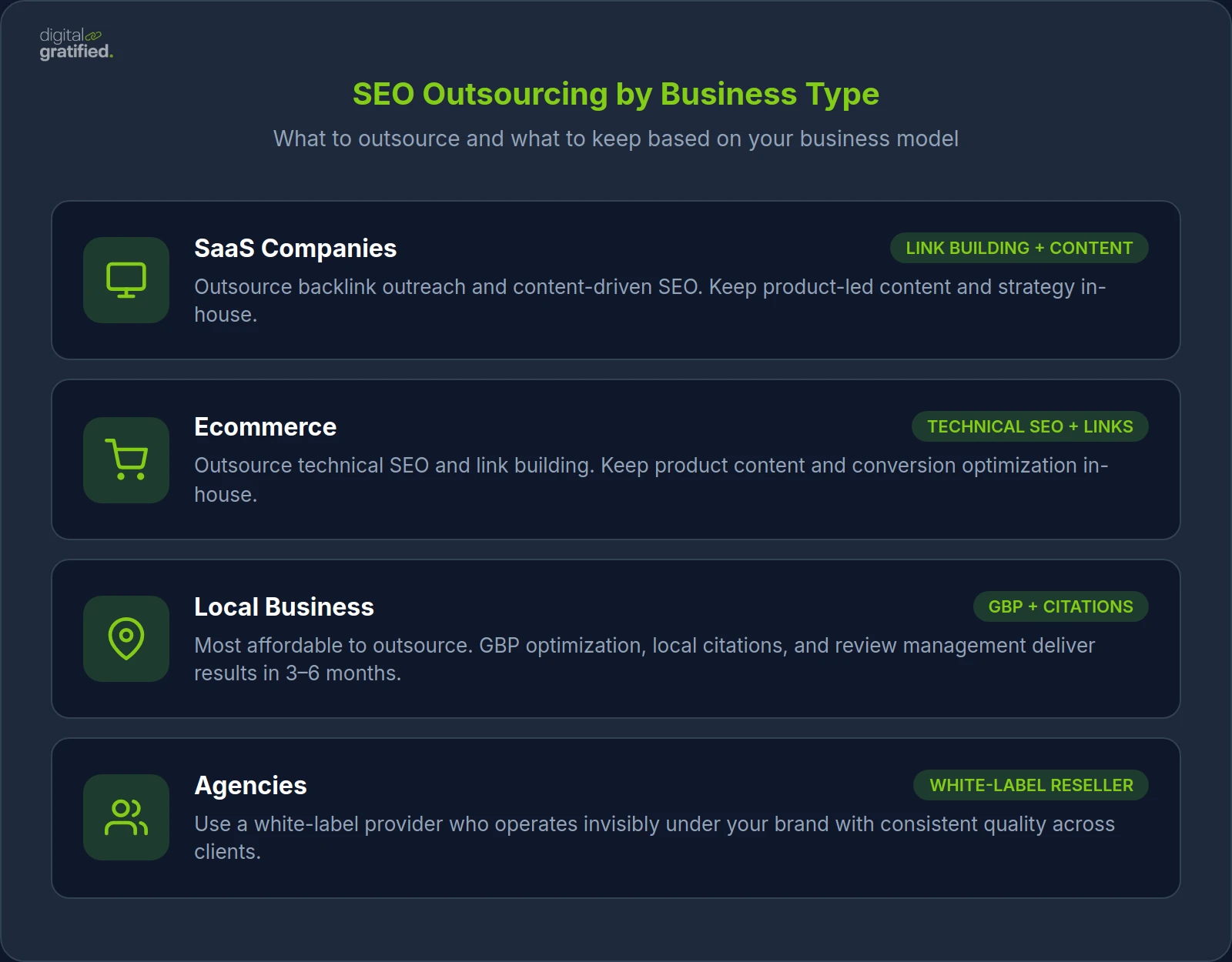
SaaS businesses typically need outsourced help with link building and content-driven SEO. The product itself often serves as a content asset (free tools, templates, data), but building the backlink authority to make that content rank requires dedicated outreach that most SaaS marketing teams do not have the bandwidth for.
When evaluating providers, SaaS companies should look for partners with specific B2B SaaS experience. The link building targets, content angles, and keyword strategies for SaaS differ materially from ecommerce or local business SEO. Early-stage companies weighing this decision can start with our breakdown of startup SEO services. A provider who understands what makes a good SaaS link building partner will deliver faster results than a generalist. If you would rather hire one person, our guide to finding a SaaS SEO expert worth the money covers how to vet them.
Ecommerce Businesses
Ecommerce SEO is heavily technical: faceted navigation, canonical issues, product schema, category page optimization, and managing thousands of product URLs. The content strategy is also distinct: product descriptions, buying guides, and comparison content need to balance SEO value with conversion optimization.
Outsource technical SEO and link building. Keep product content and conversion optimization in-house where your team understands customer behavior.
Local Businesses
Local SEO outsourcing is often the most affordable because the scope is narrower. Google Business Profile optimization, local citation building, review management, and locally-targeted content are the primary deliverables. A good local SEO provider can produce noticeable results within 3 to 6 months for businesses in moderately competitive markets.
Agencies
Agencies outsource SEO to fulfill client deliverables they cannot produce in-house. The key consideration is finding a provider who can operate invisibly under your brand. This means white-label reporting, no client-facing communication unless approved, and consistent quality across multiple client campaigns. We work with agencies in exactly this capacity through unbranded link building for agencies, handling the execution while the agency owns the client relationship.
How to Measure Whether Your SEO Outsourcing Is Working
Too many companies outsource SEO and then evaluate the relationship based on gut feeling. Here are the specific metrics you should track:
Leading Indicators (Months 1-3)
These show whether the work is being done correctly, even before ranking improvements appear:
- Deliverable completion rate: Are the agreed-upon number of links, content pieces, and technical fixes being delivered on time?
- Link quality metrics: Domain Rating of acquired links, topical relevance, and whether the linking sites have real traffic.
- Content quality: Are published pieces well-written, properly optimized, and aligned with your brand guidelines?
- Technical issues resolved: Are identified crawl errors, speed issues, and indexation problems being fixed?
Lagging Indicators (Months 3-6)
These show whether the work is translating into actual results:
- Keyword ranking improvements: Are target keywords moving up in search results? Track both target keywords and overall keyword visibility.
- Organic traffic growth: Is the site receiving more visitors from search engines? Compare month-over-month and year-over-year.
- Referring domain growth: Is the total number of unique domains linking to your site increasing at a steady pace?
- Page-level performance: Are the specific pages being optimized showing improved rankings and traffic?
Business Impact (Months 6+)
- Leads or revenue from organic search: Ultimately, SEO outsourcing should contribute to business results. Track conversions from organic traffic and calculate the cost per lead or cost per acquisition from your SEO investment.
- ROI comparison: Compare the total cost of outsourcing against the revenue generated from organic search growth. Well-executed SEO campaigns can deliver strong ROI over a 12-month period when measured against the total cost of the engagement.
Common Outsourcing Mistakes and How to Avoid Them
Outsourcing Strategy Along With Execution
The most damaging mistake is handing over both strategy and execution to an external provider without maintaining internal oversight. Your provider should execute, but someone inside your organization needs to own the SEO direction, approve priorities, and ensure that the work aligns with your business goals.
Choosing Based on Price Alone
The cheapest provider is almost never the best value. A provider charging $500 per month for "full-service SEO" is either spreading themselves across too many clients to give yours meaningful attention, or cutting corners on quality. Either way, you end up paying twice: once for the cheap service and again to fix the damage or restart with a legitimate provider.
Not Defining Success Upfront
If you and your provider do not agree on what success looks like before work begins, you will inevitably disagree about whether the engagement is working. Define specific, measurable goals tied to business outcomes, not vague objectives like "improve our SEO."
Disappearing After Signing the Contract
Outsourcing does not mean abdication. The best results come from a collaborative relationship where the client provides industry context, feedback on content, and strategic direction, while the provider brings specialized execution. Clients who "set it and forget it" consistently get worse results than those who stay engaged.
The Bottom Line
Outsourcing SEO works when you treat it as a set of decisions rather than one contract. Keep strategy, prioritization and brand-sensitive content in-house, hand off the specialized execution first (usually link building and technical audits), and pick providers who explain their methods and agree measurable goals before work starts.
Then judge the relationship in stages: deliverables in the first quarter, rankings and traffic by month six, and leads or revenue after that. If a provider cannot show progress on the leading indicators by day 90, change course before the lagging ones confirm it. For SaaS teams that want the link building piece handled, see how our SaaS link building works.
Frequently Asked Questions
How much does it cost to outsource SEO?
Costs vary widely based on scope and provider quality. Freelancers, agencies, and specialized service providers each operate at different price points, and the right budget depends on your competitive landscape and growth goals. For a detailed breakdown of what link building specifically costs, see our link building pricing guide.
How do I outsource SEO effectively?
Start by identifying which SEO functions to outsource first (typically link building and technical audits). Vet providers using verifiable case studies and references. Define clear deliverables, KPIs, and communication schedules before work begins. Monitor leading indicators monthly and evaluate business impact quarterly.
Should I outsource SEO or hire in-house?
If your SEO needs are broad but your budget is limited, outsourcing provides access to a full team of specialists for less than the cost of one senior hire. If SEO is central to your business model and you need daily strategic involvement, an in-house hire makes sense. But even then, most companies outsource specialized execution like link building while keeping strategy in-house.
What is an SEO reseller?
An SEO reseller is a provider that performs SEO work on behalf of another agency, under that agency's branding. The end client interacts with the agency, not the reseller. This model allows agencies to offer SEO services without building an in-house SEO team, and it is widely used by digital marketing agencies that sell SEO as part of their service offering.
Can I outsource just part of my SEO?
Yes, and this is often the best approach. Most companies start by outsourcing the most specialized, time-intensive functions (typically link building and technical audits) while keeping content strategy and on-page optimization in-house. This gives you the benefit of external expertise where it matters most while maintaining control over brand-sensitive work.
How long before I see results from outsourced SEO?
Leading indicators (deliverables completed, links placed, technical issues fixed) should be visible within the first month. Ranking improvements typically begin appearing in months 2 to 4. Meaningful organic traffic growth usually takes 4 to 6 months. Business impact (leads, revenue) from outsourced SEO generally materializes within 6 to 12 months of consistent effort.
About the author
Let's Scale Your SaaS Together
Get a custom SEO and link building strategy tailored for your SaaS business.
Get SEO insights that actually move rankings
Link building tactics, case studies, and SaaS SEO playbooks. No fluff, no spam.
You're subscribed!
SEO and link building insights, straight to your inbox.