Most link building outreach campaigns fail because they focus on volume over systems. Learn how to build a repeatable outreach operation: from prospecting and email infrastructure to follow-up sequences and outreach management at scale.

Founder, Digital Gratified
Link building outreach is how most high-quality backlinks get earned, and it rewards teams that treat it as a system rather than a numbers game. A good outreach process finds the right sites, pitches editors something genuinely useful, and follows up without becoming a nuisance.
This guide shows you how to build that system, from prospecting and personalization to follow-ups and measurement, so your emails actually get replies.
What Is Link Building Outreach?
Link building outreach is the process of contacting website owners, editors, and content managers to earn backlinks pointing to your site. It is the bridge between having great content and getting that content recognized by search engines through third-party endorsements.
Unlike paid ads or social media posts, a backlink earned through outreach is a lasting signal. Search engines treat it as a vote of credibility from one website to another. The more relevant, authoritative sites that link to you, the stronger your domain becomes in organic search.
Outreach is one component of a broader link building campaign, alongside planning, asset development, budgeting, and measurement. Within SaaS, it also fits with acquisition strategies like digital PR, broken link building, and competitor analysis in the SaaS link building framework. And outreach is only one piece of the wider set of off-page SEO priorities that decide how much authority a site actually builds.
But here is the part most guides skip: outreach is not a tactic you run once. It is an ongoing operation. The teams and agencies that consistently earn high-quality links, including Digital Gratified, treat outreach as a managed system, not a one-off email blast.
That distinction matters because the landscape has changed. Inboxes are flooded with generic pitches. Webmasters have seen every template. The only outreach that works now is outreach backed by a clear process, genuine relevance, and operational discipline.
Why Most Link Building Outreach Campaigns Fail
Before diving into strategies, it is worth understanding why the average outreach campaign produces dismal results. The typical response rate for cold link building emails sits between 1% and 5%. That means for every 100 emails sent, 95 to 99 get ignored.
The reasons are predictable:
The Template Trap
Most outreach emails read identically. "Hi [Name], I came across your article on [Topic] and loved it. I have a similar piece that would be a great fit..." Every editor has read this exact sentence hundreds of times. When your email sounds like everyone else's, it gets treated like everyone else's: deleted.
Wrong Targets, Wasted Effort
Sending outreach to irrelevant sites or the wrong contact person kills campaigns before they start. Emailing a site's general info address, reaching out to a developer instead of a content manager, or pitching a finance blog about your pet care article: these are systemic problems, not bad luck.
No Follow-Up System
Data from email outreach platforms consistently shows that follow-up emails generate more replies than initial sends. Yet most link builders send one email and move on. Without a structured follow-up cadence, you are leaving the majority of potential links on the table.
Ignoring Email Deliverability
This is the silent campaign killer. If your sending domain lacks proper SPF, DKIM, and DMARC records, or if you are sending high volumes from a cold domain, your emails land in spam. You could write the most compelling pitch in the industry and it would never be seen.
The Five Types of Link Building Outreach That Work
Not all outreach is created equal. Each method works best in different contexts, and the strongest campaigns combine multiple approaches. Here is how each one operates and when to use it.
1. Manual Outreach Link Building
Manual outreach link building is exactly what it sounds like: individually researched, personally written emails sent to carefully selected prospects. There is no automation, no mail merge at scale. Each message is crafted for a specific person at a specific site.
This is the highest-effort, highest-reward approach. When you reference a specific paragraph in someone's article, mention their recent podcast appearance, or connect your pitch to a gap you noticed in their content, the response rate jumps dramatically. Industry benchmarks suggest well-executed manual outreach can achieve 15% to 25% response rates.
When to use it: Targeting high-authority publications (DR 60+), building relationships with key industry voices, or pitching sites where a single link could meaningfully move your rankings. If you would rather have specialists run this process for you, our guide to what a manual link building service includes covers deliverables, pricing, and what to expect.
2. Email Outreach Link Building
Email outreach for link building at scale involves using outreach platforms (see the link building software stack) to manage prospect lists, send personalized email sequences, and track responses across campaigns.
The key difference from manual outreach is volume with structured personalization. You are not writing each email from scratch, but you are using dynamic fields, segmented prospect lists, and conditional follow-up sequences to maintain relevance at higher volume.
A well-structured email outreach campaign typically follows this cadence:
- Day 1: Initial pitch: personalized, value-first, under 150 words
- Day 4: Follow-up: add a new angle or data point, not just "checking in"
- Day 9: Final follow-up: shorter, direct, with a clear call to action
Each email in the sequence should add new information. Repeating "just wanted to follow up" signals that you have nothing of value to offer.
3. Content Outreach Link Building
Content outreach flips the traditional model. Instead of finding existing pages and asking for a link, you create a content asset specifically designed to attract links, then promote it to the people most likely to reference it.
The assets that consistently earn links through outreach include:
- Original research and data studies: Proprietary survey data, industry benchmarks, or analysis of public datasets. These become citeable sources.
- Interactive tools and calculators: ROI calculators, comparison tools, or assessment frameworks that solve a specific problem.
- Comprehensive guides: Definitive resources on a topic that genuinely outperform everything currently ranking.
The outreach angle is stronger here because you are offering something the prospect's audience would genuinely benefit from, not just asking for a favor.
4. Blogger Outreach Link Building
Blogger outreach for link building targets independent bloggers, niche publishers, and small media sites that actively publish content in your space. These are often more responsive than large publications because they have smaller teams, more editorial flexibility, and genuine interest in their niche.
Guest posting is the most common form of blogger outreach. It fits white hat link building when the publication serves a real audience, editors control the link, and the article is valuable without ranking credit. You offer to write a high-quality article for their site, including a natural, contextual link back to yours. The value exchange is straightforward: they get useful content, and you may earn a relevant backlink.
But guest posting is not the only play. You can also pitch:
- Expert quotes for articles they are already writing
- Resource additions to their existing listicles or guides
- Collaborative content like joint studies or co-authored pieces
The key with blogger outreach is selectivity. Focus on sites that have genuine readership, publish consistently, and are topically relevant to your business. A link from a niche blog with 5,000 engaged monthly readers is often more valuable than one from a generic "write for us" mill.
5. Digital PR Outreach
Digital PR outreach targets journalists, editors at online publications, and media outlets. The goal is to earn editorial links: the kind that appear naturally within news coverage, feature articles, or expert roundups.
This approach requires a fundamentally different pitch than traditional link building. Journalists do not care about your backlink goals. They care about stories, data, and expert sources that serve their readers.
Effective digital PR pitches lead with a newsworthy angle: a trend, a counter-intuitive finding, a timely dataset, or a genuine expert perspective on a current event. The link is a byproduct of the coverage, not the purpose of the conversation.
Building Your Outreach Process: Step by Step
Having the right strategy matters, but execution is where campaigns succeed or fail. Here is the operational framework that separates productive outreach from wasted effort.
Step 1: Build Your Prospect List With Precision
Prospecting is the foundation. The quality of your prospect list determines the ceiling of your campaign's results.
Start with competitor backlink analysis. Identify which sites link to your competitors but not to you: these are proven prospects because they have already demonstrated willingness to link within your niche.
Layer in these additional prospecting methods:
- Content gap analysis: Find topics where your content is stronger than what currently ranks, then identify sites linking to the weaker pieces.
- Resource page prospecting: Search for "[your niche] + resources" or "[your topic] + useful links" to find curated pages actively looking for good content to reference.
- Broken link prospecting: Use a backlink checker or site crawler to find dead links on relevant sites. Offering your content as a replacement for a 404 page is one of the strongest outreach angles because you are solving a problem, not just asking for a favor.
For each prospect, record the target URL, the contact person (ideally the author or content manager), their email address, the domain's authority metrics, and a brief note on why your content is relevant to their page.
Step 2: Set Up Your Email Infrastructure
This step is invisible to most link builders, but it makes or breaks deliverability.
Domain setup: Use a dedicated sending domain (e.g., outreach.yourdomain.com) to protect your primary domain's reputation. Configure SPF, DKIM, and DMARC records before sending a single email.
Warm-up: New sending domains need a warm-up period. Start by sending 5 to 10 emails per day to engaged contacts, gradually increasing volume over 2 to 4 weeks. Sending 200 cold emails from a fresh domain on day one is the fastest way to land in spam permanently.
Sending limits: Even after warm-up, keep daily sending volume reasonable. 50 to 80 emails per day per sending address is a safe ceiling for cold outreach. If you need higher volume, add additional sending addresses.
Step 3: Write Emails That Deserve a Response
The outreach email itself should be short, specific, and clearly explain what is in it for the recipient. Here is a framework that consistently outperforms generic templates:
Subject line: Reference something specific about their content. "Quick note about your [specific article title]" outperforms "Guest post opportunity" every time.
Opening line: Demonstrate that you have actually read their content. Mention a specific point, statistic, or argument from their article, not just "I love your blog."
The pitch: Clearly state what you are offering and why it benefits their readers. Whether it is a guest post, a resource suggestion, or a broken link replacement, make the value proposition obvious in one or two sentences.
The ask: Be direct about what you want. "Would you be open to adding this as a resource in your [specific section]?" is clearer than "Let me know your thoughts."
Length: Keep it under 150 words. Every word beyond that reduces your response rate.
Step 4: Execute a Structured Follow-Up Sequence
Follow-up is not optional. Multiple studies show that follow-up emails have higher response rates than initial outreach emails. The people who were interested but busy will often reply to the second or third touch.
But there is a right way to follow up:
- Each follow-up adds new value. Share a different piece of data, offer an alternative angle, or reference a recent development related to their content.
- Space them appropriately. 3 to 5 business days between emails gives recipients time to respond without feeling pressured.
- Know when to stop. Three emails total (one initial + two follow-ups) is the standard. Beyond that, you risk damaging your domain reputation and your professional reputation.
Step 5: Negotiate and Close
When a prospect responds positively, move efficiently. Provide exactly what they need to place your link: the target URL, suggested anchor text, and if it is a guest post, deliver the content quickly and to their editorial specifications.
Some negotiations involve link exchanges reciprocal or three-way arrangements where both parties benefit. These can be effective when handled transparently, but they require careful management to maintain a natural-looking backlink profile.
Link Building Outreach Management: Running Campaigns at Scale
Individual outreach skills get you links. Outreach management gets you consistent, predictable results month over month. This is where most guides stop, but it is where the real competitive advantage lives.
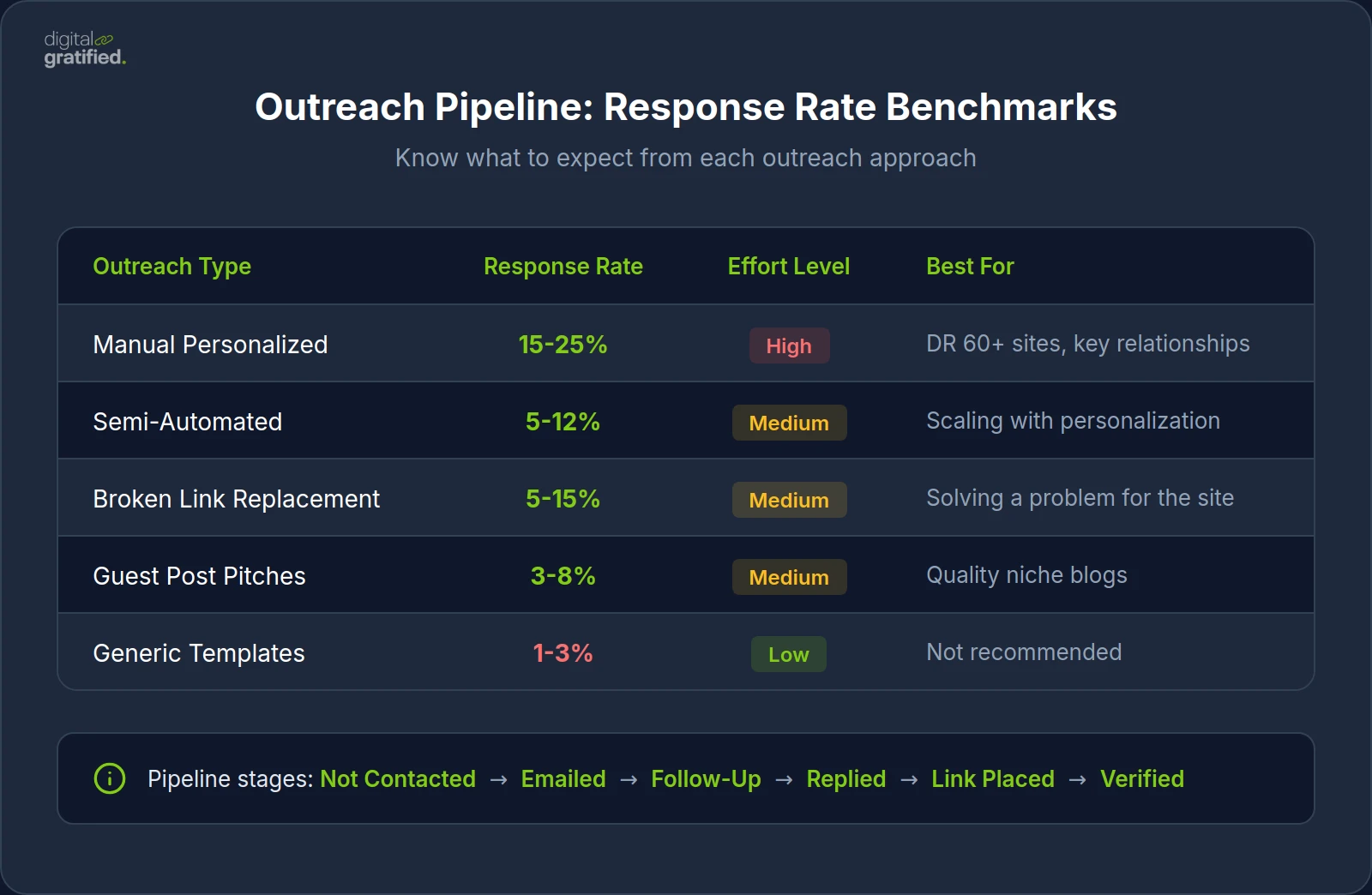
Tracking and Pipeline Management
Every outreach campaign needs a tracking system. At minimum, you should be monitoring:
- Prospect status: Not contacted → Emailed → Follow-up 1 → Follow-up 2 → Replied → Link placed → Link verified
- Response rates by campaign type: Guest post pitches vs. broken link vs. resource suggestions: knowing which approach performs best helps you allocate effort intelligently.
- Link placement verification: A "yes" reply does not mean a link is live. Build a verification step into your workflow to confirm placements, check for nofollow tags, and ensure the link points to the correct URL.
Tools like linkOreach, or even a well-structured spreadsheet, can serve as your outreach CRM. The tool matters less than the discipline of using it consistently.
Response Rate Benchmarks by Outreach Type
Understanding realistic benchmarks prevents you from abandoning campaigns too early or tolerating underperformance too long:
- Manual, highly personalized outreach: 15% to 25% response rate
- Semi-automated personalized campaigns: 5% to 12% response rate
- Broken link replacement pitches: 5% to 15% response rate
- Guest post pitches to quality sites: 3% to 8% response rate
- Generic template-based outreach: 1% to 3% response rate
If your campaigns consistently fall below these ranges, the issue is usually in prospect quality, email deliverability, or pitch relevance, not in volume.
When to Outsource Outreach
Managing link building outreach in-house works when you have the bandwidth for consistent effort. But outreach is operationally demanding: prospecting, email infrastructure management, content creation for guest posts, follow-up sequences, and link verification all compete for the same team's time.
For SaaS companies and growing businesses, outsourcing outreach to a specialized agency often makes sense. The economics are straightforward: an experienced agency brings established relationships, tested processes, and dedicated bandwidth that would take months to build internally. If you are evaluating this path, understanding what link building actually costs helps set realistic expectations.
For agencies looking to offer link building to their clients without building an in-house team, white-label link building provides a way to deliver results under your own brand while leveraging an established outreach operation.
Common Outreach Mistakes and How to Fix Them
Even experienced link builders make these errors. Recognizing them early saves months of wasted effort.
Prioritizing Volume Over Relevance
Sending 500 generic emails feels productive. Landing 3 links from irrelevant sites does not move your rankings. A smaller, targeted campaign of 50 well-researched pitches will almost always outperform a mass blast. Focus on sites where your content genuinely adds value to their audience.
Neglecting the Content Foundation
No amount of outreach skill can compensate for weak content. Before launching any outreach campaign, honestly assess whether your target page deserves links. Does it offer original insights, data, or utility that a webmaster would be proud to reference? If not, improve the content first.
Treating Outreach as Transactional
The best link builders think in relationships, not transactions. The editor who places your guest post today might become a regular publishing partner. The blogger who adds your resource link might invite you to co-author content. These compounding relationships are the real asset: the individual links are just the visible output.
Skipping Link Verification
A surprising number of outreach campaigns never verify whether promised links actually go live, stay live, or are configured correctly (dofollow vs. nofollow, correct target URL, appropriate anchor text). Build verification into your process as a non-negotiable final step.
Outreach for Link Building in Different Contexts
The principles of link building and outreach remain consistent, but the execution shifts depending on your business model and niche.
SaaS Link Building Outreach
SaaS companies have a unique advantage for outreach: their product is the content asset. Product-led content (like free tools, calculators, templates, or publicly available data from your platform) creates natural outreach angles that most industries cannot replicate.
For a deeper look at how SaaS link building leverages product features for link acquisition, the approach differs significantly from traditional content-based outreach.
B2B Services Outreach
B2B services companies often struggle with outreach because their content tends to be commercial. The fix is investing in educational, research-driven content that serves the broader industry, not just your sales funnel. Case studies with real data, industry surveys, and definitive guides on niche topics all create legitimate outreach angles.
Local Business Outreach
For local businesses, outreach targets shift to local media, community organizations, business directories, and regional industry associations. The personalization bar is lower because the local context is built in, but the prospect pool is also smaller, making each relationship more valuable. The same market-by-market prospecting logic scales up to international link building, where outreach lists are built country by country, often in the local language.
Frequently Asked Questions
What is outreach link building?
Outreach link building is the process of contacting website owners, editors, and bloggers to earn backlinks to your website. It involves identifying relevant prospects, crafting personalized pitches, and providing value (whether through guest content, resource suggestions, or broken link replacements) in exchange for a link.
How long does it take to see results from link building outreach?
Most outreach campaigns begin producing link placements within 2 to 4 weeks of launching. However, the SEO impact of those links typically takes 2 to 3 months to fully materialize in search rankings. Consistent monthly outreach produces compounding results over time.
What is a good response rate for outreach emails?
A realistic response rate for well-executed outreach is 5% to 15%. Highly personalized manual outreach can reach 15% to 25%. If your response rate is consistently below 3%, review your prospect targeting, email deliverability, and pitch quality.
Should I use outreach tools or send emails manually?
It depends on your scale. For campaigns targeting fewer than 50 prospects, manual emails work well and allow maximum personalization. For larger campaigns, outreach management tools help maintain personalization while managing volume, follow-ups, and tracking.
Is link building outreach still effective?
Yes. While the approach has evolved, outreach remains one of the most reliable ways to earn high-quality backlinks. The key shift is from volume-based template blasting to targeted, value-driven communication. Campaigns built on genuine relevance and relationship building continue to produce strong results.
How many follow-up emails should I send?
Two follow-ups after your initial email is the standard best practice (three total emails). Each follow-up should add new information or a different angle, not just repeat the original ask. Space them 3 to 5 business days apart.
About the author
Let's Scale Your SaaS Together
Get a custom SEO and link building strategy tailored for your SaaS business.
Get SEO insights that actually move rankings
Link building tactics, case studies, and SaaS SEO playbooks. No fluff, no spam.
You're subscribed!
SEO and link building insights, straight to your inbox.