94% of content earns zero backlinks. Top-ranking pages have 3.8x more referring domains. Digital PR now dominates tactics. Here's what 100+ studies and surveys reveal about link building in 2026, and what actually moves the needle.

Digital Gratified
SaaS SEO Experts
Every year, a wave of new statistics rolls in claiming to redefine what works in link building. Some are regurgitated from three years ago. Some are cherry-picked to sell a service. And a few (buried beneath the noise) actually tell you something useful.
This post cuts through that. We've compiled and cross-referenced link building statistics from over 100 studies, surveys, and industry reports, prioritising primary data over recycled claims. The goal isn't a long list of numbers: it's a clear picture of what the data actually says about link building in 2026.
If you're applying these statistics to a software product, our guide to SaaS link building translates the data into a concrete strategy, covering which link types, volumes, and sources matter most for B2B SaaS.
Key Link Building Statistics: Quick Snapshot
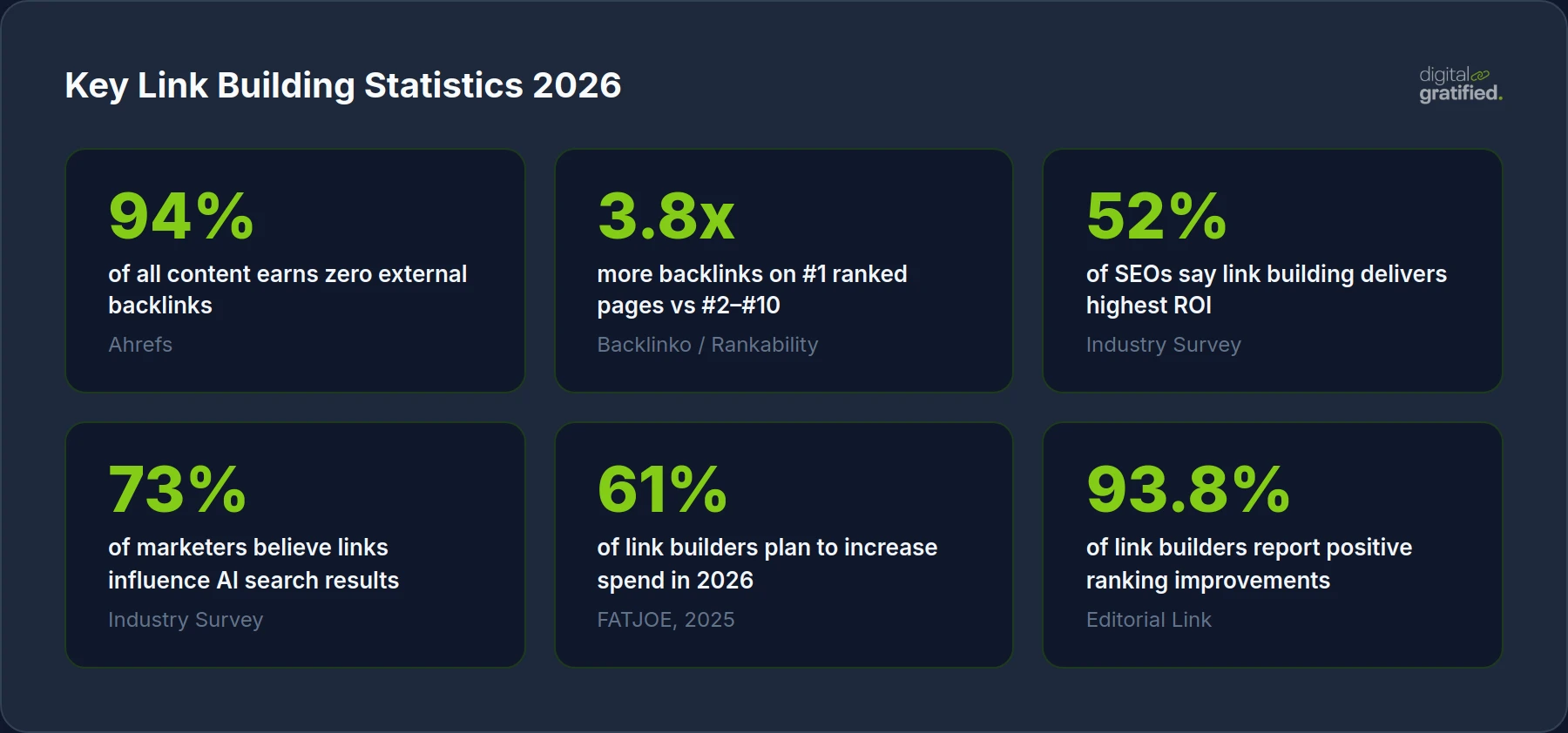
- 94% of all online content earns zero external backlinks
- 95% of web pages on the internet have no backlinks at all
- Google lists links among its top 3 search ranking factors
- Top-ranking pages have 3.8x more backlinks than pages ranked 2nd–10th
- 93.8% of link builders report positive ranking improvements from building links
- 52% of SEO professionals say link building delivers the highest ROI among all SEO activities
- Digital PR is now the #1 link building tactic, used by 67.3%–73% of marketers
- 61% of link builders expect to increase spending in 2025–2026
- 52.3% of digital marketers say link building is the hardest part of SEO
- 73.2% of marketers believe backlinks influence visibility in AI-powered search results
Links as a Ranking Factor: What the Data Actually Says
Google has publicly confirmed that backlinks are among its top three ranking signals (alongside content and RankBrain). Despite occasional statements from Google engineers downplaying individual link value, the correlation between backlinks and rankings remains one of the most consistently documented relationships in SEO research.
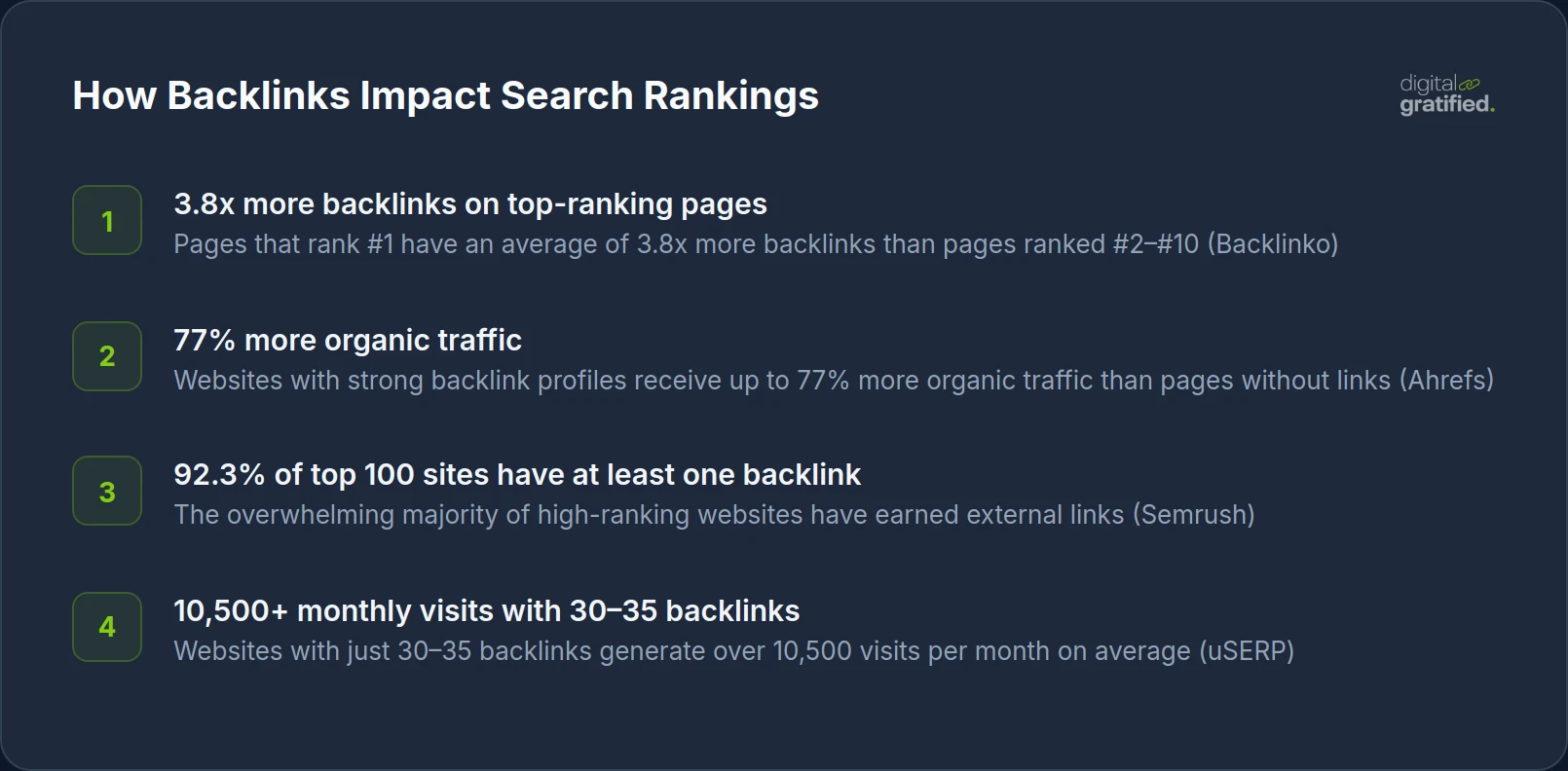
- Pages that rank #1 on Google have an average of 3.8x more backlinks than pages ranked #2–#10 (Backlinko / Rankability)
- 92.3% of the top 100 ranking websites have at least one backlink (Semrush)
- 85% of SEO experts believe link building has a significant impact on brand authority (uSERP)
- 59% of SEO professionals believe backlinks will carry even more weight in Google rankings in the next few years
- 94% of marketers believe links will impact Google rankings within 5 years
- 73% believe links will remain a ranking factor a decade from now
- Websites with strong backlink profiles receive up to 77% more organic traffic than pages without links (Ahrefs)
- Websites with 30–35 backlinks generate over 10,500 visits per month on average (uSERP)
- Service and product pages with diverse referring domains consistently outperform those with repeated links from the same domain (Moz)
The data is unambiguous: backlinks correlate with rankings, traffic, and authority. The debate isn't whether links matter: it's how to earn the right ones.
The Content Gap: Why 94% of Pages Never Earn a Single Link
Here's the most striking link building statistic of all: the overwhelming majority of content on the internet (94%) never earns a single external backlink.
- 94% of all online content fails to secure any external links (Ahrefs)
- Only 2.2% of pages successfully acquire external backlinks
- Approximately 95% of all pages on the internet have zero backlinks
- 29.79% of websites have fewer than three backlinks; 55.24% have none at all (Authority Hacker)
- About 63% of all backlinks point to homepages, with the remainder distributed across internal pages (SE Ranking)
This gap isn't a problem: it's an opportunity. In a landscape where most content is never linked to, building even a moderate backlink profile puts you ahead of the vast majority of competing pages. The caveat: backlinks amplify high-quality content. They don't rescue weak pages.
Link Building Budget and Spending Statistics 2026
Link building has moved firmly into the line item category for serious marketing teams. The data shows budgets are rising, and those who aren't allocating spend are losing ground.
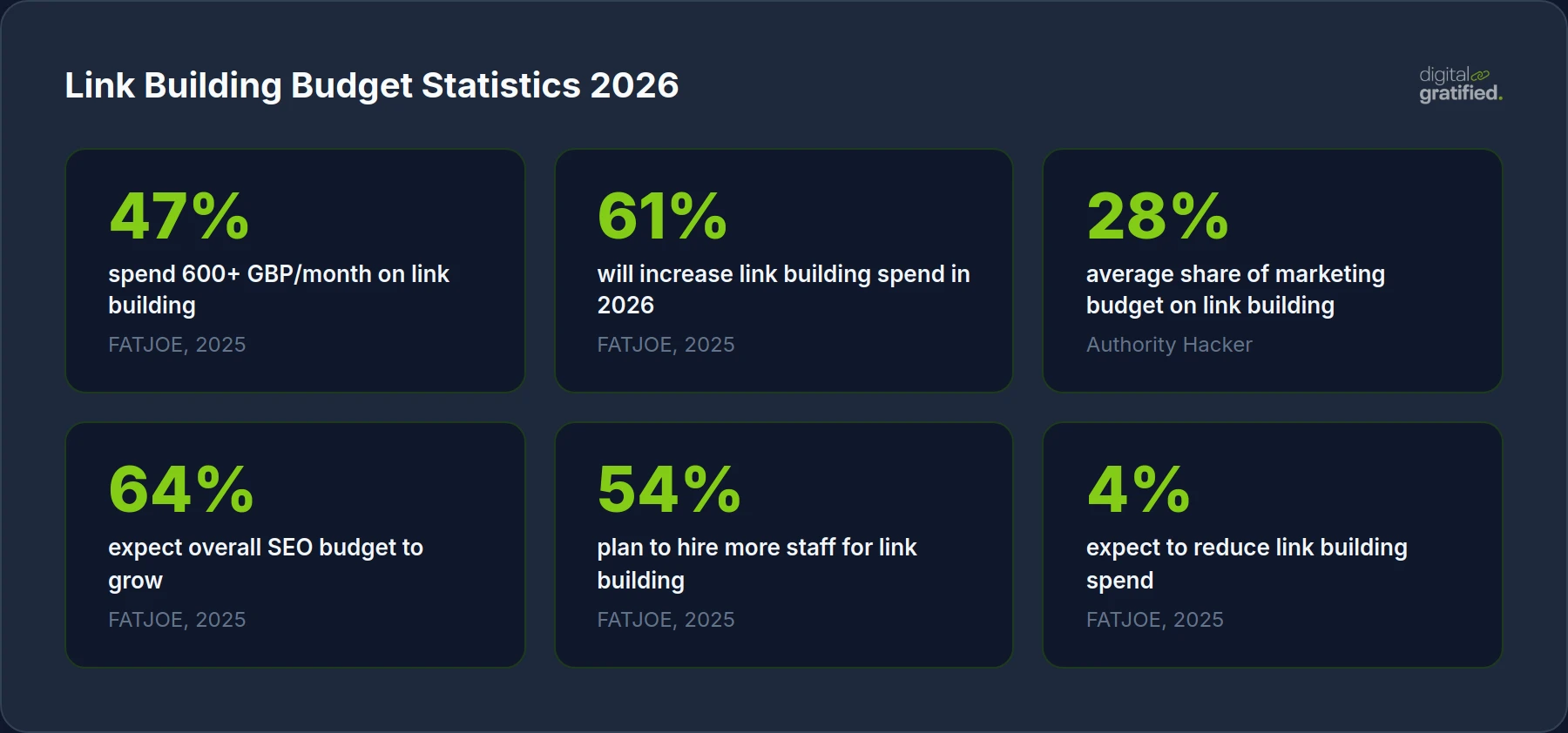
- 47% of link builders spend more than £600 (~$760 USD) per month on link building (FATJOE, 2025)
- A further 14% spend over £1,500 (~$1,900 USD) per month
- 61% of link builders say their spending on link building will increase in 2025–2026
- 64% of respondents expect their overall SEO budget to grow in 2025–2026
- 54% of link builders anticipate hiring additional staff to keep pace with demand
- Marketers spend on average 28% of their total marketing budget on link building or purchasing backlinks (Authority Hacker)
- Only 4% of link builders expect to reduce their link building spend
Whether in-house or through an agency, teams that treat link building as a core investment(rather than an afterthought) are the ones capturing compounding SEO returns.
The Most Effective Link Building Tactics in 2026
Strategy preferences have shifted considerably over the past few years. Content-led approaches and digital PR have risen sharply, while purely transactional tactics have lost ground.
Tactic Popularity Among Link Builders
- Digital PR: used by 67.3%–73% of marketers as a primary tactic
- Guest posting / blogger outreach: used by 68% of link builders
- Niche edits: favoured by 55% of respondents
- Content marketing (creating linkable assets): used by 40%+ of marketers
- Press releases: used by 52% of link builders
- Competitor backlink analysis and targeting: used by 54% of businesses
What SEOs Say Matters Most
- 51% of SEOs rate content quality and relevance as a top-three factor in link building success
- Only 28% say domain authority metrics will take precedence in future link building
- 93.8% of SEO experts emphasise quality over quantity in link acquisition
- ~3 in 10 backlinks are medium or high toxicity, making quality control non-negotiable
Guest Posting Statistics
Guest posting remains one of the most widely used link building methods, though the landscape has changed. Quality thresholds have risen, and the cost of placement on credible sites has increased accordingly.
- 85.3% of guest posting sites are low quality, defined as DR below 40 and fewer than 10,000 monthly organic visitors (BuzzStream, 2025)
- The average cost of a high-quality guest post ranges from $692 to $957; vendor prices can exceed $3,000
- Guest posting has seen the most significant increase in activity over recent months among all link building tactics
- 38.4% of SEOs use guest blogging as their primary link building tactic
- 50% of agencies list guest blogging as a core service offering
A handful of placements on genuinely authoritative, relevant sites outperforms a volume strategy on low-DR publications. The data makes this clear, and so does the cost difference.
Digital PR Statistics
Digital PR has become the link building strategy of choice for agencies and in-house teams, and the data makes it clear why.
- 48.6% of SEO professionals say digital PR is the single most effective link building tactic (Editorial Link)
- 87% of link builders say digital PR will be at least somewhat important in 2025 and beyond (FATJOE)
- 73% of link builders planned to use digital PR as their primary tactic in 2025
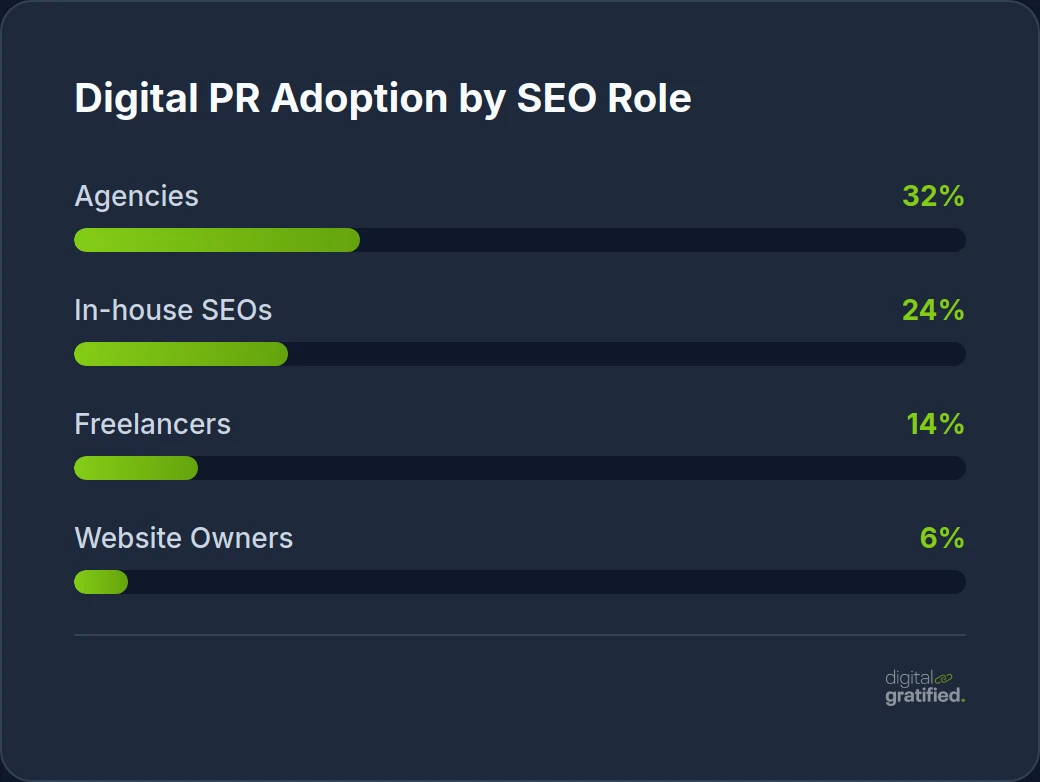
- Agencies and in-house SEOs are 3x more likely to use digital PR compared to freelancers and website owners
Adoption by background:
- Website owners: 6.02%
- Freelancers: 13.59%
- In-house SEOs: 23.78%
- Agencies: 31.95%
Digital PR earns links by creating genuinely newsworthy content, original research, and data-led stories. It's not cheap, but the quality and authority of the links it generates are consistently higher than most other methods.
Link Building Outreach Statistics
Even the best content needs a distribution engine. Outreach is where most link building campaigns succeed or fail, and the data reveals just how competitive it has become.
- The average outreach email response rate sits between 1% and 10%, depending on personalisation, relevance, and sender authority
- 82% of SEOs use backlink analysis tools like Ahrefs and Semrush to inform outreach strategy
- LinkedIn is the most effective platform for link building outreach in 2025, used by 17.3% of SEOs (AIOSEO)
- Experienced link builders (5+ years) generate an average of 25 links per month; beginners average only 7
- Experienced practitioners generate approximately 3.57x more backlinks than those newer to the discipline (Authority Hacker)
- 59.4% of link building agencies report having over 5 years of experience
For a closer look at building outreach systems that actually convert, see our guide on link building outreach.
How Long Does Link Building Take to Show Results?
On average, link building takes approximately 3.1 months to produce noticeable ranking improvements. Breakdown of when backlinks start influencing rankings:
- Less than 1 month: 7.5%
- 1–3 months: 46.6%
- 3–6 months: 35.2%
- 6–12 months: 7.3%
- Over 12 months: 3.3%
Over half of SEO professionals observe ranking improvements within 1–3 months. But the compounding returns from a sustained strategy take longer to fully materialise. Link building is a long game, and the data confirms it.
AI Search and Backlinks: The 2026 Dynamic
The rise of AI-powered search (Google AI Overviews, ChatGPT, Perplexity) has prompted a genuine question: do backlinks still matter in an AI-first world? The data says yes, with an important nuance.
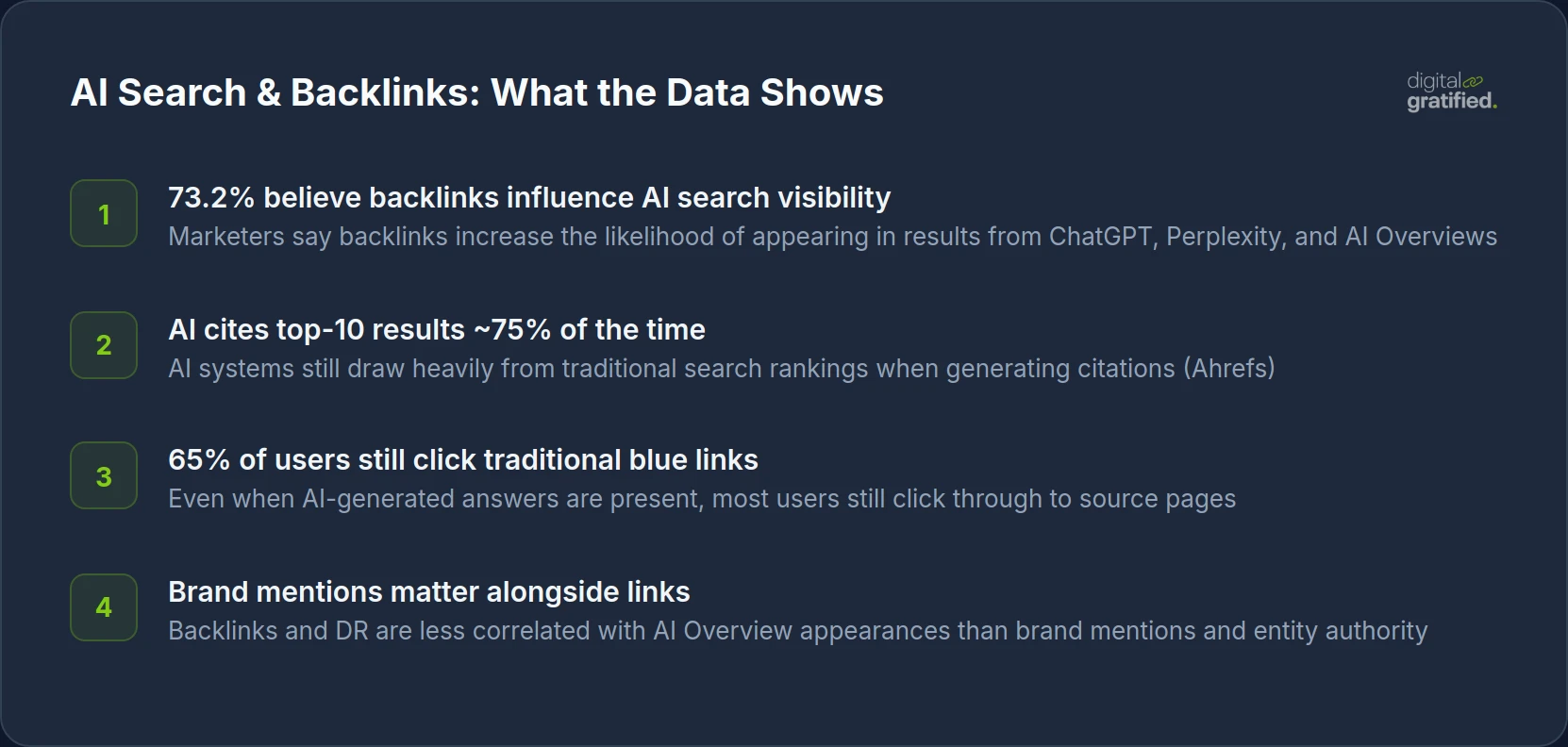
- 73.2% of marketers believe backlinks influence the likelihood of appearing in AI search results
- AI systems still pull citations from top 10 search results approximately 75% of the time (Ahrefs)
- Interest in link building reached an all-time high in Google Trends starting February 2025, correlated directly with rising AI search optimisation interest (BuzzStream)
- Backlinks and DR are less correlated with appearing in AI Overviews than brand mentions, signalling that entity authority matters alongside links
- 65% of users still click on traditional blue links even when AI-generated answers are present
Backlinks help pages rank in traditional search, which in turn influences what AI systems cite. It is not either/or: it's both. We've covered this shift in detail in our piece on the future of link building in the AI search era.
Link Quality vs. Quantity: What the Data Reveals
- 93.8% of SEO experts say link quality matters more than link quantity
- 47.5% of SEO experts believe backlinks are just as important as content for rankings (uSERP)
- Pages with diverse referring domains consistently outperform pages with many links from the same source (Moz)
- ~3 in 10 backlinks are medium or high toxicity, a meaningful portion of backlink profiles actively harm rather than help
- 54% of marketers consider no-follow links valuable for a balanced, natural backlink profile
- 86% of marketing professionals now use AI tools for SEO, with backlink auditing among their top three AI-assisted activities
Link Building for SaaS Companies
The broader statistics paint a general picture. But for B2B SaaS companies, the context is specific: longer sales cycles, technical buyers, niche publications, and a need for topical authority in competitive verticals.
The most effective approach for SaaS companies isn't mass guest posting or generic directories: it's building links from publications, tools, and communities that target buyers actually trust and read. That means industry-specific outlets, software review platforms, case study coverage, and partnerships with complementary tools.
At Digital Gratified, this is the model we've refined across 60+ SaaS clients: prioritising relevance and authority over raw link volume, building profiles that reflect genuine industry presence rather than manufactured backlink counts.
Link Building Challenges: What SEOs Struggle With Most
- 52.3% of digital marketers say link building is the most challenging aspect of SEO
- 85.3% of available guest posting sites fall below meaningful quality thresholds: finding genuinely valuable placements takes significant effort
- Longer content generates 77.2% more links than shorter posts, but producing that content at scale is resource-intensive
- What and Why posts generate approximately 25% more links than How To content
- Most large organisations (70+ employees) don't build links at all, either in-house or through outsourcing, suggesting link building consistently falls through the cracks without dedicated ownership
Key Takeaways
The link building statistics for 2026 tell a consistent story:
- Links still matteras a ranking factor, traffic driver, and authority signal in both traditional and AI-powered search
- Most content never earns any linkswhich means doing link building well is a genuine competitive advantage, not just table stakes
- Quality has won the quality vs. quantity debatea small number of highly relevant, authoritative links consistently outperforms a large volume of low-value placements
- Digital PR and content-led approaches dominatethey're more expensive and harder to execute, but the data consistently shows superior results
- Budgets are risingteams that invest in link building now are building compounding returns that are difficult for late starters to close
- AI search hasn't replaced the need for linksit has extended it, with backlinks influencing both traditional rankings and AI citation patterns
The data doesn't make link building easier. But it does make the path clearer: earn fewer, better links from genuinely relevant sources, invest in content worth linking to, and treat link building as a long-term programme rather than a one-off campaign.
Let's Scale Your SaaS Together
Get a custom SEO and link building strategy tailored for your SaaS business.
Get SEO insights that actually move rankings
Link building tactics, case studies, and SaaS SEO playbooks. No fluff, no spam.
You're subscribed!
SEO and link building insights, straight to your inbox.