Link building isn't dying: it's being redefined by how AI-driven search discovers, evaluates, and cites information. Learn how mentions, co-citations, digital PR, and Generative Engine Optimization are reshaping authority in 2026 and beyond.

Founder, Digital Gratified
The future of link building is being shaped by how AI-driven search discovers, evaluates and cites information. Visibility will no longer mean only ranking first. It will increasingly mean being a source AI systems trust enough to reference, and an entity mentioned repeatedly across the web, from Google AI Overviews and AI-driven SEO to Perplexity and Gemini.
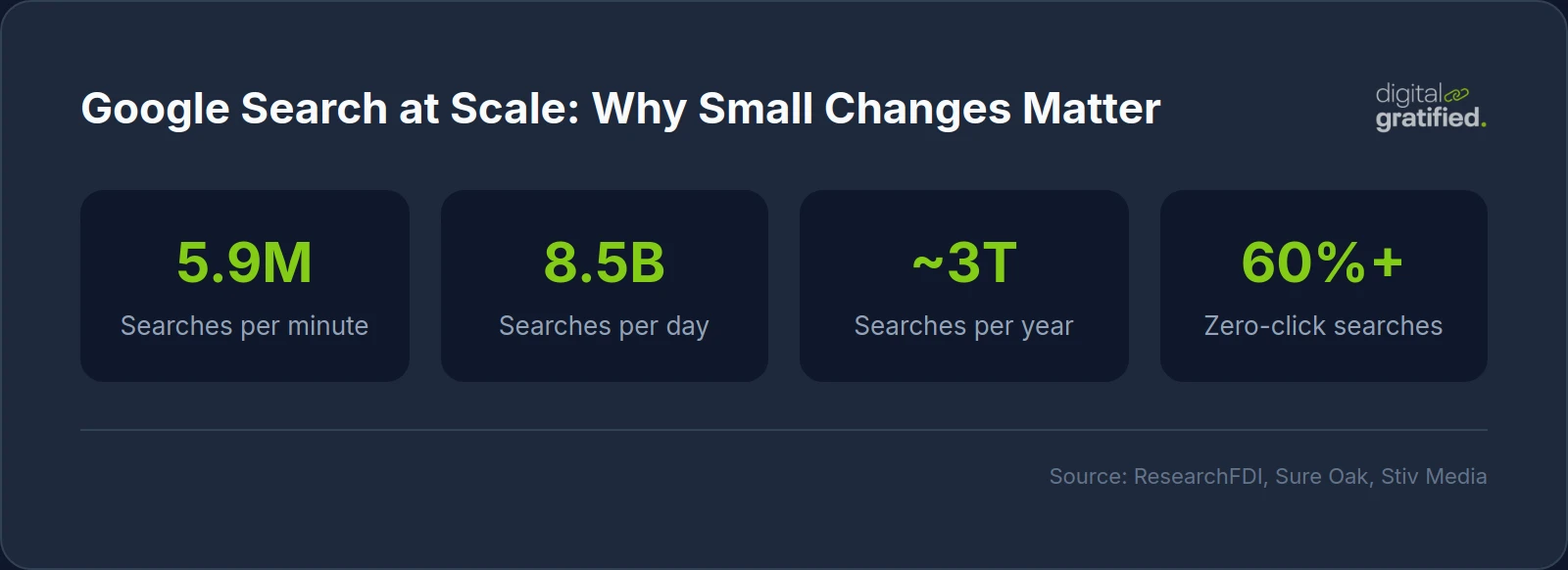
Backlinks still matter, but the win condition now includes mentions, co-citations, topical authority and digital PR, the signals that help AI systems decide who belongs in the answer. With Google processing billions of searches a day, even small changes in how results are displayed can reshape entire acquisition channels. If you're building a B2B SaaS marketing strategy, understanding this shift is essential.
What's Changing in Search (and Why Link Building Must Evolve)
From "10 Blue Links" to AI Answers and Multi-Platform Discovery
Search is no longer a simple "type query, click a result" flow. AI-driven experiences increasingly provide instant answers, reducing the need for users to open multiple tabs and compare sources themselves. AI-powered SERP experiences now deliver more immediate, relevant responses, and that changes everything about how your content gets discovered.
At the same time, discovery is fragmenting. Your audience might start in Google, continue in an AI tool like ChatGPT or Perplexity, validate via community discussion on Reddit or forums, and convert through marketplaces or review platforms. For link building, that means the goal isn't only "rank higher": it's to earn references in the places AI and humans repeatedly consult.
AI Systems Infer Authority Differently Than Classic Link Metrics
Classic SEO often reduced authority to link quantity and authority proxies like DR/DA. But AI-driven systems increasingly emphasize entity relationships, topical consistency, source credibility, and engagement, not just the existence of backlinks.
Modern systems like Google AI Overviews and LLM experiences evaluate semantic proximity, topical depth, and credibility. Authority is increasingly inferred from a broader set of signals than traditional link metrics. That's the heart of entity-based SEO: your brand needs to be understood as a "known thing" with consistent attributes and associations across the web.
The industry is also shifting toward predictive analytics and better intent understanding, moving strategies away from pure keyword matching and toward AI-informed optimization. The implication for link building is clear: authority must be demonstrated contextually, not manufactured mechanically. This is why a strong SaaS content marketing strategy becomes the foundation for earning the right signals.
Do Backlinks Still Matter? Yes. But Context Beats Count
Google Still Uses Links, but the Weighting Is Shifting
Backlinks remain a ranking factor. But the practical weighting is trending toward relevance and trust over raw volume, especially as search systems get better at detecting manipulation and evaluating context.
Google still uses backlinks, yet the value of a link increasingly depends on why it exists and how well it fits the topic, not just the linking domain's perceived strength.
The New Hierarchy: Relevance, Editorial Quality, Topical Alignment
In an AI-influenced landscape, "DR/DA chasing" becomes unreliable because it ignores the most important variable: topical alignment. A topically aligned link from a smaller industry site can outperform an off-topic link from a huge domain, for example, a contextually aligned DA40 industry blog can be stronger than a DR90 off-topic link. Understanding link building pricing helps you budget for quality over quantity.
What that means in practice:
- Prefer editorial links embedded naturally in relevant content over templated placements.
- Evaluate the surrounding page context (the paragraph, headings, and overall topic), not just the linking domain.
- Aim for links that are likely to remain live and useful (resources, guides, comparisons), not disposable posts.
Mentions, Co-Citations, and Entity Signals: The New Backlinks of AI Search
Why Mentions Can Matter Even Without Clickable Links
AI visibility increasingly depends on whether your brand appears often (and consistently) in the right contexts. That's because large language models learn patterns from enormous corpora. LLMs are trained on billions of indexed documents (including forums, directories, rankings, and editorial content) and operate through the statistical recurrence of terms, entities, and co-occurrences. In plain terms: the more your brand or entity shows up in credible contexts, the more likely an AI system is to "know about" and reference it.
To make this actionable, separate the signals:
- Brand mention: your brand name referenced (linked or unlinked).
- Co-citation: your brand referenced alongside other known entities (competitors, publications, standards bodies, recognized tools).
- Co-occurrence: your brand repeatedly appearing in semantically similar contexts (e.g., "technical SEO audits," "digital PR," "link reclamation") across multiple sources.
Systems like ChatGPT, Perplexity, and Google don't rely solely on backlinks; they also consider how often your brand is mentioned in high-trust contexts, even without links. The industry is shifting toward co-citation and co-occurrence rather than pure anchor-text games. Learning how to find competitor backlinks can reveal where your competitors are earning these mentions, and where you should be too.
Community-Driven Signals and Earned Conversation
Communities influence both perception and discoverability, especially for "best," "review," and "recommendation" queries. Brands frequently mentioned on Reddit can surface prominently for product review queries where Reddit threads appear in the SERP.
The lesson isn't "go spam Reddit." It's to build earned conversation:
- Publish resources people want to share (data, templates, unbiased comparisons).
- Participate as a helpful expert where your buyers actually ask questions.
- Encourage legitimate customer discussion (and be present to clarify, not control).
Digital PR Link Building: Same Goal, Smarter Signals
Why PR Placements Influence AI Visibility
Digital PR is back at the center because it produces the kinds of signals AI systems trust: editorial scrutiny, recognizable publishers, credible quotes, and consistent narrative. Google and LLMs care about what's been said about you, where, and by whom, which makes PR-driven placements a scalable way to earn authoritative mentions and links. A well-executed link building outreach strategy is the engine that powers these placements.
The Placements AI Loves: Lists, Comparisons, and "Best X" Pages
Being featured in ranking pages or comparison articles ("top 10 best tools") can be especially valuable because these formats are frequently reused in AI summaries, notably in Perplexity or Bing Chat-style experiences.
How to do this without becoming "listicle bait":
- Pitch inclusion in reputable comparison pages where evaluation criteria are explicit.
- Offer verifiable differentiators (benchmarks, certifications, customer counts, methodology).
- Avoid the trap of buying just any link or mention. Quality and thematic fit are non-negotiable: understanding the difference between good and bad practices is key, as we explore in our guide on link exchange.
Generative Engine Optimization (GEO): Optimize for AI Citations, Not Just Rankings
What Being Cited Requires (Content Assets That Earn References)
GEO is the practical discipline of making your content easy to reuse, cite, and trust in AI-mediated answers. The north star: build content that gets cited, not just indexed.
Cite-worthy assets tend to share two traits:
- They contain information that isn't easily rewritten from generic sources.
- They're structured so others can reference them quickly.
Visible Expertise and Trust Signals (Especially for YMYL)
Being correct isn't enough. You must be credibly attributable. The growing importance of visible expertise cannot be overstated: real authorship, real credentials, strong author bios, and structured data that clarifies provenance. Getting your technical SEO right ensures search engines and AI systems can properly attribute your expertise.
Practical implementation ideas:
- Create robust author pages (credentials, experience, links to publications).
- Add an editorial policy and citation standards.
- Use structured data where appropriate (Organization, Person, Article, Breadcrumb, FAQ when valid).
- Keep "reference URLs" stable: AI systems and humans cite what persists.
Tactical Link Building in 2026+: What to Do (and Stop Doing)
Build a Reference Footprint Across Trusted, Relevant Sources
Think less "link count" and more reference footprint: the total set of credible places your entity is discussed, compared, and recommended.
A future-proof mix:
- Digital PR for expert quotes and roundups: Become the person journalists quote with data-backed commentary. Provide short, publish-ready insights and (when possible) unique stats.
- Strategic guest contributions with real editorial standards: Prioritize publications with a clear audience and topical alignment. Write pieces that deserve to be referenced (original frameworks, examples, teardown analyses).
- Partnerships and co-marketing (entity association): Joint webinars, joint research, integration pages, and case studies create co-citation with adjacent trusted brands.
- Quality niche directories (especially for local trust): Vetted directories remain a clear local trust signal: use reputable associations and industry listings, not spam farms.
- Consistency across your knowledge ecosystem: Maintain consistent positioning, naming, and topical focus across owned content and external mentions to reduce entity confusion.
Strengthen Internal Linking to Reflect Topical Authority
Internal linking is where you prove topical depth. Structured internal linking that reflects topical authority (not just menu navigation) is essential. Our comprehensive guide on SaaS link building covers how to build these topical clusters effectively.
A simple cluster framework:
- Build a pillar page for the main topic.
- Create cluster pages for subtopics (each answering a distinct intent).
- Add contextual cross-links where concepts naturally overlap (not forced "SEO links").
- Use anchors that reflect meaning (varied, descriptive), not repeated exact matches.
Platform Reality Check: Google vs Bing vs LLM Interfaces
Why Bing Still Matters for AI Discovery
Bing is no longer an afterthought if you care about AI discovery. Many LLM browsing experiences use Bing for web indexing (for example, ChatGPT when connected to the internet).
"Bing-ready" best practices that also translate well to AI systems:
- Clear headings and clean markup
- Fast load times
- Original, useful content
- High-quality, diverse inbound links
Google AI Overviews: Prepare, but Don't Over-Optimize Prematurely
Google's AI Overview rollout and behavior remain uneven. Availability varies by country and is currently limited to relatively basic informational queries.
So don't build a strategy that only works if one feature triggers. Invest in fundamentals that translate across platforms: structured content, credible references, and entity clarity.
Measuring Link Building Success in an AI Era
Expand KPIs Beyond Rankings and Referral Traffic
If AI answers reduce clicks, you need metrics that capture "visibility without the click." Track:
- Unlinked brand mention growth (press, blogs, forums)
- Inclusion in "best X" / comparison pages (high GEO value for AI citations)
- Community share of voice (recommendation threads, problem-solving mentions)
- Citation pickup (how often your stats/frameworks get referenced)
- Branded search lift (a practical proxy for growing entity strength)
Monitor AI Visibility Directly
Treat AI visibility as a trend metric:
- Run the same prompts monthly in ChatGPT, Perplexity, and Gemini (e.g., "best tools for X," "top agencies for Y").
- Record whether you're mentioned, whether citations are shown, and which sources repeat.
- Track your presence in Bing and Google SERP features where AI summaries appear.
- Because outputs can be personalized and non-deterministic, measure directionally, not as a single source of truth.
Conclusion: Link Building Still Wins, If You Build for Citations and Mentions
The future of link building is still link building, just with a broader definition of "proof." Backlinks remain foundational, but AI-driven search increasingly rewards brands that become repeatedly referenced entities in the right contexts: credible publications, comparison pages, communities, quality directories, and well-structured sites with clear expertise signals.
A simple next-step plan:
- Create cite-worthy assets (first-party data, benchmarks, frameworks).
- Earn editorial references (digital PR plus reputable comparisons and roundups).
- Reinforce entity clarity (authorship, structured data, topical internal linking).
- Build for rankings and for inclusion in AI answersand your authority will compound no matter where discovery happens.
At Digital Gratified, we help B2B SaaS companies build the kind of link authority that works across traditional search and AI-driven discovery. Our approach combines strategic link building with entity optimization and digital PR to ensure your brand earns both rankings and citations. Whether you're looking to outsource SEO or find the best SaaS link building agency for your needs, we're here to help you navigate this evolving landscape.
About the author
Let's Scale Your SaaS Together
Get a custom SEO and link building strategy tailored for your SaaS business.
Get SEO insights that actually move rankings
Link building tactics, case studies, and SaaS SEO playbooks. No fluff, no spam.
You're subscribed!
SEO and link building insights, straight to your inbox.