Link earning and link building overlap, but they are not the same motion. Here is how SaaS teams should choose between compounding citations and controllable outreach.

Digital Gratified
SaaS SEO Experts
Link earning is what happens when another publisher chooses to reference your company, product, data, or content because it makes their own work better. You didn't negotiate the placement or control the anchor. The link exists because the source was useful enough to cite.
That sounds close to link building, and the two overlap. A team can publish original research, promote it to journalists, and later attract citations from writers it never contacted. The first links may come from active building. The later ones are earned. The useful distinction isn't “promotion versus no promotion.” It is who initiates the specific opportunity and how much control your team has over the result.
For SaaS companies, that difference matters when deciding where to invest. Link earning can create durable authority and qualified referral traffic, but it is slow and uneven. Active building creates more control, but it requires continuous execution. Most teams need both.
Link Earning vs. Link Building: The Practical Difference
The mechanical process is the same whether a backlink is earned or actively pursued, which is why link building in SEO is the umbrella category rather than a description of who initiated the opportunity.
Active link building starts with your team. You identify a relevant publication, resource page, contributor opportunity, or unlinked mention and make a specific request. The publisher still makes an editorial decision, but you created the opportunity. A structured link building outreach process lets you choose priority audiences, test angles, and forecast activity.
Link earning starts with the publisher. A writer searches for evidence, sees your product used by a peer, encounters your brand in another article, or remembers an expert from an earlier conversation. They choose your source without a pitch tied to that particular page.
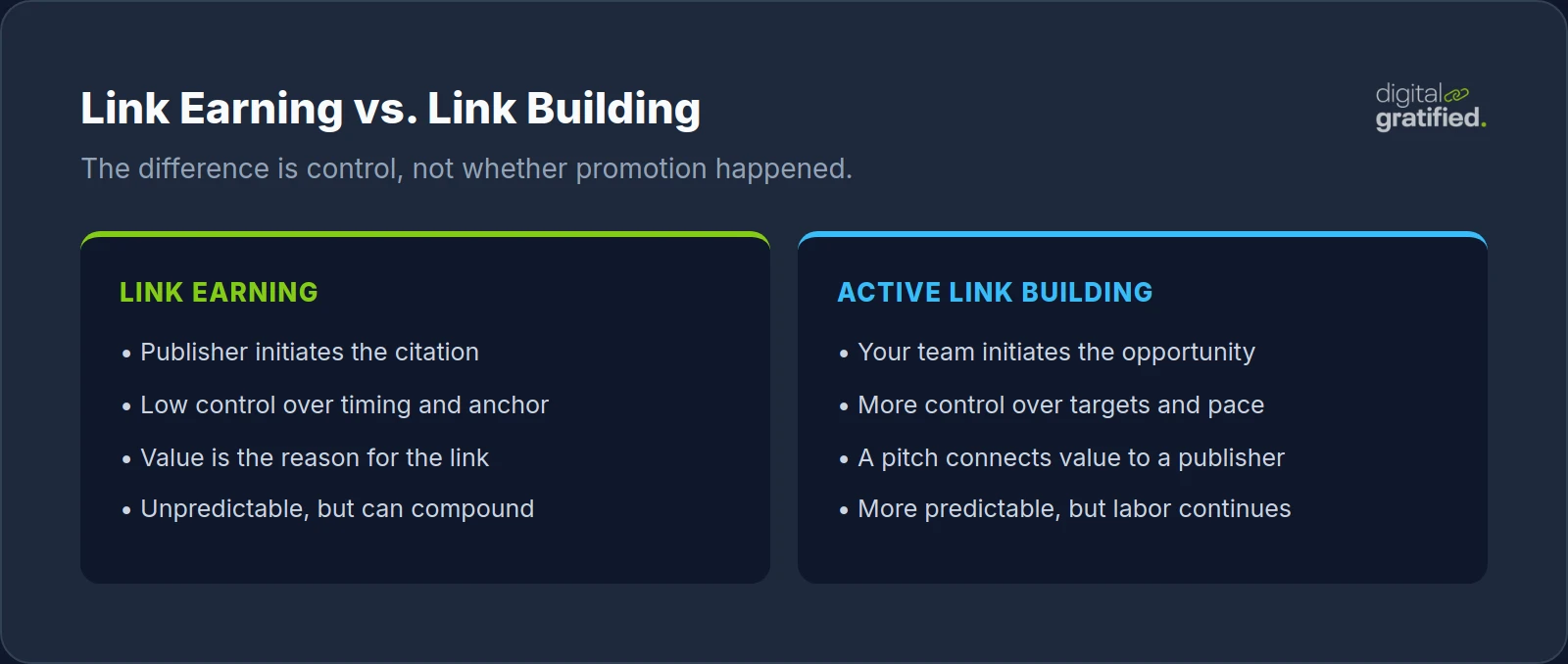
Neither label automatically tells you whether a backlink is valuable or safe. A built link can be a genuine editorial citation secured through an excellent pitch. An “earned” badge attached to a paid placement doesn't make the transaction independent. Google's link spam policies focus on manipulative arrangements, not marketing vocabulary.
The broader SaaS link building strategy should decide which topics, pages, and audiences matter. Earning and active building are two acquisition motions inside that strategy, not rival philosophies.
What Makes Something Worth Citing?
A page doesn't earn links because it is long, polished, or optimized. It earns links when it solves a publisher's evidence or explanation problem better than the alternatives.
Original research that answers a live question
SaaS companies often hold anonymized product data that nobody else can reproduce. A support platform can reveal response-time patterns. A security product can show where review cycles stall. A finance tool can quantify approval delays. The strongest research begins with a question the market already asks, then gives writers a specific finding they can verify and explain.
A survey can work too, but “we asked 100 people about the future of work” is not inherently citation-worthy. Publish the methodology, define the sample, expose useful segments, and make the underlying claim easy to quote. Refreshing a recognized benchmark can turn one launch into a recurring source of earned links.
Content that reduces explanation work
Definitions, diagrams, calculators, templates, and technical walkthroughs earn links when they help another writer explain something accurately. The bar is not comprehensiveness. It is usefulness at the moment of citation. A precise chart can outperform a 5,000-word guide if the chart resolves the reader's next question.
This is also why generic skyscraper content disappoints. Making an existing list longer rarely creates new evidence or a clearer model. Citation-worthiness usually comes from a defensible point of view, original material, or unusually good packaging.
Product-led mentions
A product can create its own reasons to be mentioned. Public templates, free utilities, integration directories, embeddable outputs, and genuinely useful community projects expose the brand while helping users complete a task. When writers recommend the tool because they have used it or repeatedly see peers use it, the mention begins with product value rather than an SEO request.
Keep the mechanics honest. A required keyword-rich link in every embed is not the same as a voluntary citation. The value of a backlink depends on editorial context, audience relevance, and the business it can influence, not simply whether a product generated the URL at scale.
Expert commentary and digital PR
Good digital PR gives a journalist evidence, access, or interpretation they could not easily get elsewhere. A founder reacting to every trending topic is noise. A product leader explaining a surprising pattern from thousands of customer workflows is useful.
Expertise compounds when the spokesperson is fast, specific, and willing to say something concrete. The first mention may follow a pitch. Later, a journalist may return directly because the source has proved reliable. That transition from outbound effort to inbound demand is one of the clearest signs that link earning is beginning to work.
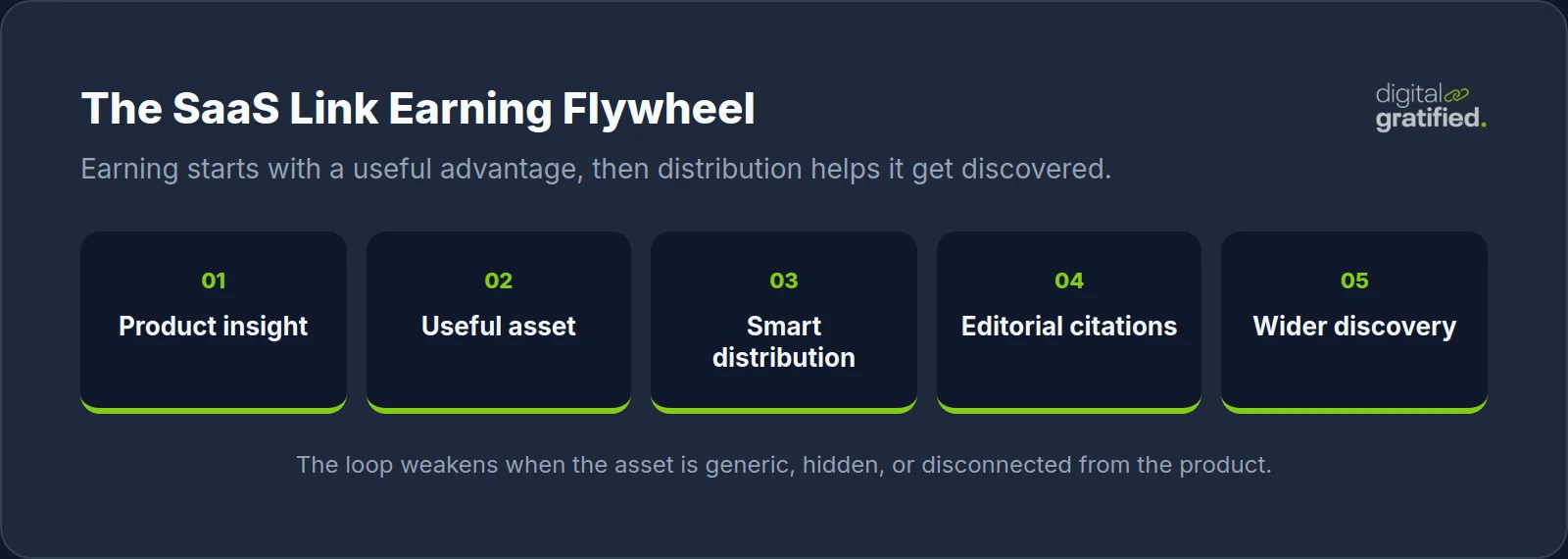
Why Earned Links Are Slow and Hard to Control
You can control whether a report is good. You cannot control whether an editor is working on a story that needs it this week. Publisher calendars, news cycles, search demand, brand recognition, and sheer luck all affect discovery.
You also give up control over the destination and anchor. A writer may link to your homepage instead of the report, mention the brand without a link, or cite a secondary source that cited you. That can frustrate a team judged on monthly link quotas, but editorial independence is part of what gives a genuine citation credibility.
The upside is leverage. One useful report can keep earning links after the launch ends. A trusted free tool can be recommended in communities your marketing team has never joined. A memorable framework can spread through newsletters, presentations, and sales conversations. Strong earned links often bring brand recognition and relevant visitors along with search authority.
Still, “publish and wait” is not a strategy. Great work can remain invisible. Distribution creates the initial surface area for earning without dictating every outcome.
When to Prioritize Link Earning
Lean harder into earning when your company has an unfair informational or product advantage. Proprietary data, recognizable experts, a widely used free product, an active customer community, or a distinctive category point of view can all produce assets competitors cannot cheaply copy.
Earning also makes sense when your brand already has enough awareness for people to search for it, discuss it, and revisit its resources. At that point, improving the citation layer can produce compounding returns. Invest in research operations, expert access, reusable visuals, clear methodologies, and pages that remain useful after a campaign ends.
Do not prioritize passive earning merely because outreach feels uncomfortable. If nobody knows the brand, even exceptional content may sit undiscovered. An early-stage SaaS company usually needs deliberate distribution before organic discovery has a chance to compound.
When Active Link Building Deserves More Budget
Prioritize active building when a commercially important topic lacks authority, the market has little awareness of your brand, or you need feedback inside a defined planning cycle. Outreach lets you choose publications that reach the right buyers instead of hoping the right audience finds you.
It is also the better motion when the opportunity is specific. Reclaiming an unlinked brand mention, suggesting a superior replacement for a dead resource, contributing expertise to a relevant publication, or introducing a new dataset to beat reporters all require an intentional ask.
The risk is substituting controllability for quality. Monthly targets can push teams toward easy inventory, irrelevant guest posts, and forced anchors. Active building works best when the pitch connects a strong source to a real editorial need. If the only reason to say yes is payment, exchange, or obligation, the link has not become earned simply because someone sent an email.
Why Most SaaS Companies Need Both
Earning without building can create excellent assets nobody sees. Building without earning can become an endless treadmill where every link needs another prospect, pitch, and follow-up. A combined system uses campaigns to launch and distribute citation-worthy work, then lets organic discovery extend its life.
For example, a SaaS team can publish a benchmark, pitch the most relevant findings to a small journalist list, give partners ready-to-use charts, and brief its executives for interviews. Those are active distribution choices. Months later, writers searching for the statistic find the original report and cite it without contact. The asset has crossed from built opportunities into earned demand.
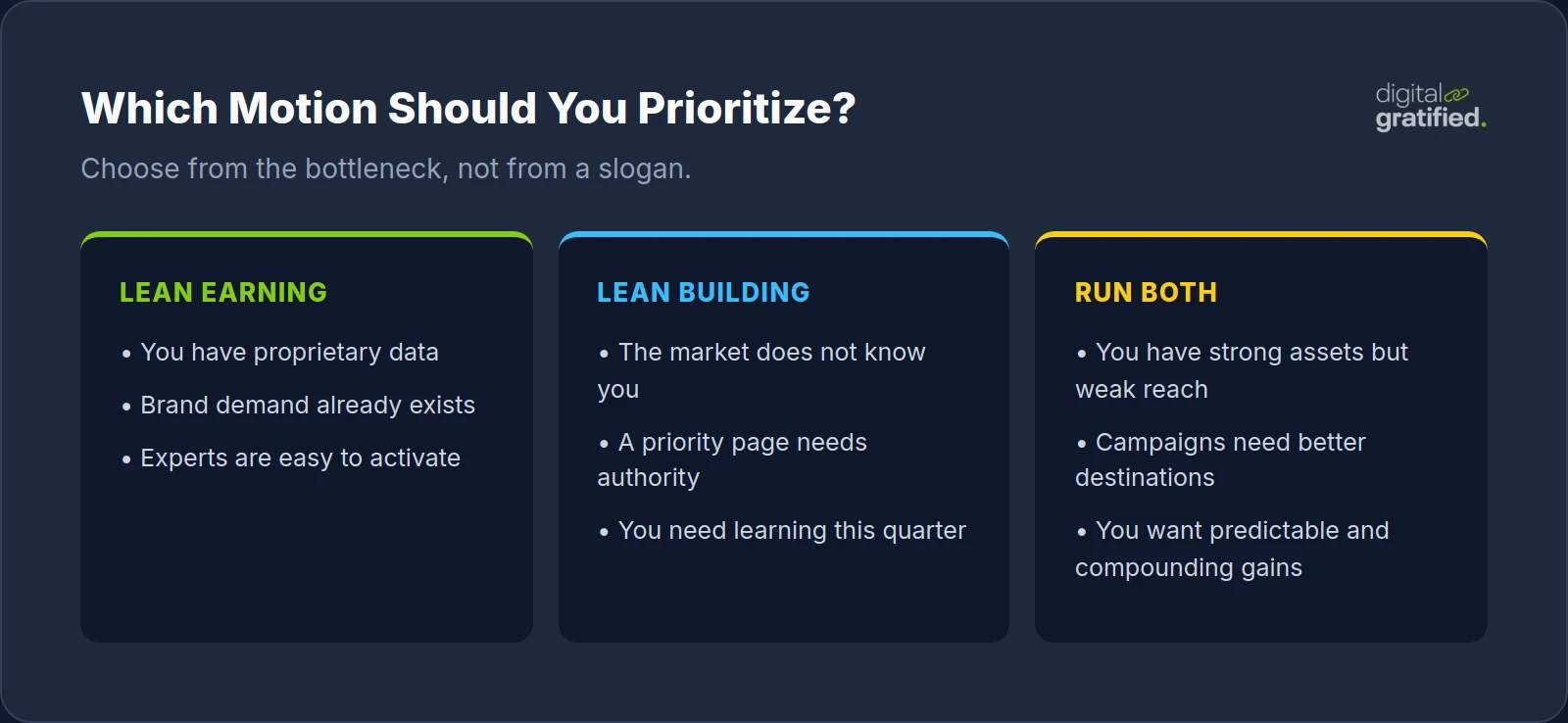
A practical quarterly portfolio might reserve one part of the budget for compounding assets, one part for targeted outreach around current priorities, and one part for maintaining relationships and refreshing proven sources. The exact split matters less than identifying the bottleneck. Strong assets with weak reach need distribution. Busy outreach with weak acceptance needs something better to offer.
The Earned-Link Gut-Check
Before calling an opportunity earned, ask five questions:
Would the publisher still link if ranking credit disappeared? Referral value, evidence, or reader utility should remain.
Could the publisher choose the page and wording? Genuine editorial control includes the ability to change or decline the link.
Did the source solve a real content problem? It should provide proof, context, explanation, or a useful next step.
Was payment or reciprocity required? If so, it is a commercial arrangement and should be treated and qualified accordingly.
Would you be comfortable explaining the process publicly? If the method relies on hiding how the link appeared, the label is doing reputational work the tactic cannot.
A link can pass this test even if outreach introduced the asset. Promotion does not cancel merit. The deciding factor is whether the publisher had an independent reason to include the source.
The Bottom Line
Link earning is not a hands-off alternative to link building. It is the result of becoming useful enough to cite, visible enough to discover, and trusted enough to remember. SaaS teams create those conditions through product value, original evidence, clear explanations, credible experts, and consistent distribution.
Use active building when you need control, learning, and targeted reach. Invest in earning when you have distinctive assets that can compound. Run both when you want a program that produces opportunities now without paying the full acquisition cost forever.
Link Earning: Frequently Asked Questions
What is link earning?
Link earning is the acquisition of backlinks that publishers choose to add because a source improves their content. The publisher initiates the specific citation and controls its context, destination, and wording.
What is the difference between link earning and link building?
Link earning begins with the publisher's decision to cite a useful source. Link building begins with your team's action to create a specific opportunity through outreach, contribution, reclamation, or another campaign. Both can produce legitimate editorial links.
Can outreach lead to earned links?
Yes. Outreach can introduce useful research or expertise while the publisher retains full editorial control. It is active link building at the opportunity level, but it can also generate later earned links as the source becomes known and discovered independently.
How long does link earning take?
There is no reliable deadline. Initial citations may appear during a launch, while organic links can build over months or years. The pace depends on source quality, demand for the topic, distribution, brand visibility, and whether the asset stays current.
Are earned links more valuable?
Often, but not automatically. Earned links tend to reflect stronger editorial intent and can bring referral traffic and trust. Their value still depends on the publication, page relevance, placement, audience, and the destination being cited.
Let's Scale Your SaaS Together
Get a custom SEO and link building strategy tailored for your SaaS business.
Get SEO insights that actually move rankings
Link building tactics, case studies, and SaaS SEO playbooks. No fluff, no spam.
You're subscribed!
SEO and link building insights, straight to your inbox.