How to set an SEO budget that fits your stage, what the money should actually cover, and how to tell if it's working. Real numbers, no agency fluff.

Founder, Digital Gratified
“How much should I spend on SEO?” The honest answer is “it depends,” but that shouldn't end the conversation. A useful SEO budget starts with the organic pipeline you need, then prices the work that might plausibly produce it. Copying another company's retainer tells you nothing about whether your site needs product pages, a developer, or simply a better way to measure demos.
For SaaS, the unit of planning is rarely a ranking. It's a qualified action, such as a demo request or activated trial. This article shows how to budget for SEO from that outcome backwards, including what to do when the math says the plan is too expensive.
Step 1: What an SEO budget actually pays for
Think in workstreams, not mysterious “SEO fees.” Content covers research, product input, writing, editing, design and updates to pages that help buyers decide. Technical work covers the developer and SEO time needed to make important pages discoverable, usable and measurable. Outreach covers creating something worth referencing and getting it in front of relevant editors or partners, not buying a promised number of links. Tools support crawling, search analysis and reporting. People coordinate all of this and decide what not to do.
Avoid double-counting: charge a staff lead's time once under people, not again under content or technical work. Split an agency invoice by deliverable or leave it as one agency line, not both.
This is a funding plan for a SaaS SEO strategy, not a shopping list. A site with broken indexing should not fund twenty articles before fixing its templates. A site with sound foundations and weak buyer pages probably needs the reverse.
Step 2: Build an SEO budget plan backwards from demos
Here is one entirely hypothetical example. None of its traffic estimates, conversion rates, hourly costs or salaries are market benchmarks or a forecast for your company.
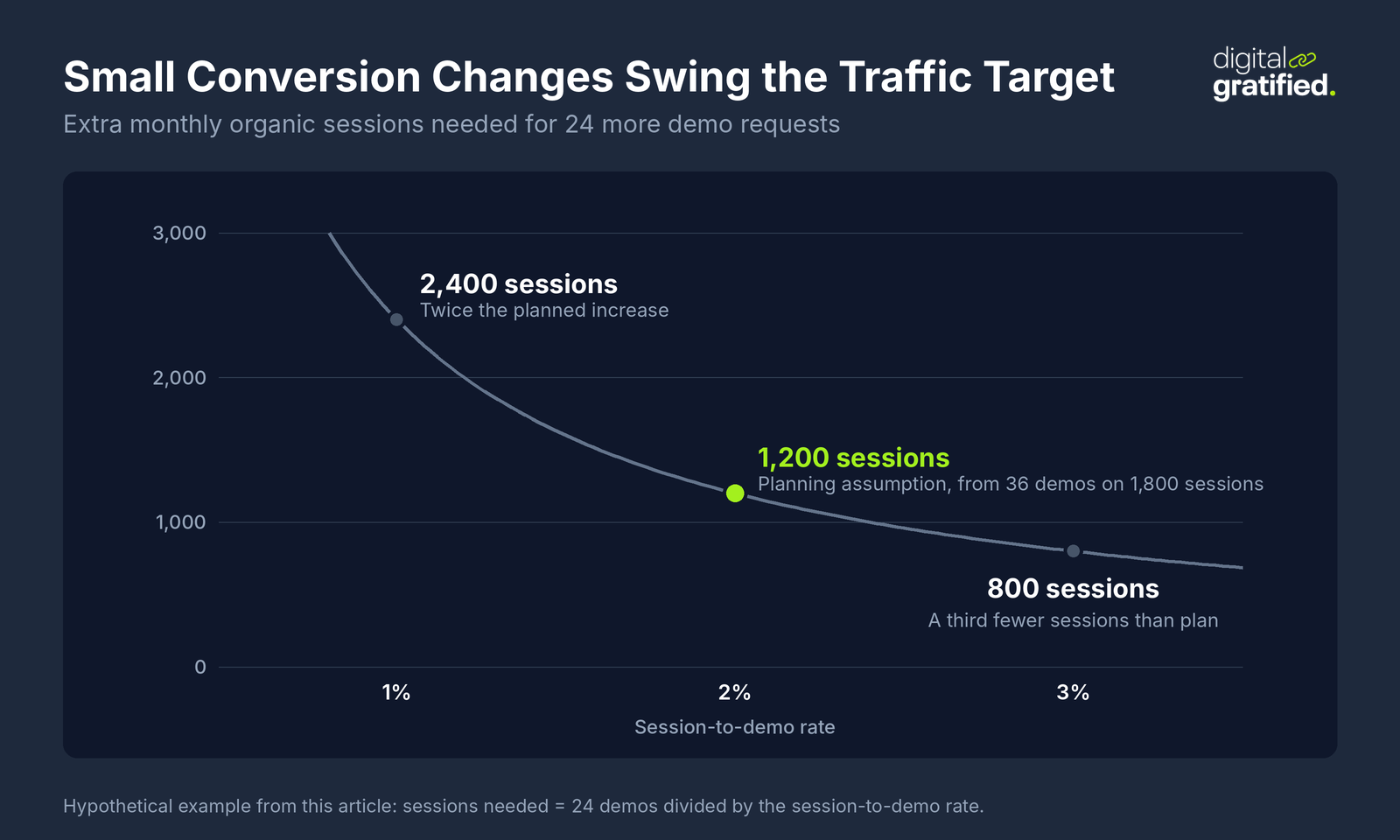
Suppose a SaaS team wants 24 additional organic demo requests per month by month 12, compared with today's run rate. Its current monthly organic baseline is 1,800 sessions and 36 demo requests, measured consistently in its analytics and CRM. That's 36 ÷ 1,800 = 2% of organic sessions ending in a demo request. The team uses 2% as a planning assumption, not a promise that every new page will convert equally.
At that rate, 24 ÷ 0.02 = 1,200 incremental organic sessions per month would be needed. Add the baseline and the planning target is 3,000 monthly organic sessions and 60 demo requests at month 12. Those are run-rate targets for a future month, not cumulative totals across the year. If qualified demos are the actual objective, substitute the observed session-to-qualified-demo rate; do not silently treat every form submission as qualified.
Now inspect the site and search demand before pricing content. In this example, the team reviews Search Console queries, existing landing pages, product use cases, buyer interviews and competing result types. It identifies six outdated pages with relevant impressions, twelve missing comparison or use-case pages with distinct intent, and six practical integration or implementation resources buyers keep asking for. Pages with no credible audience or unique product evidence get removed from the plan.
The team assigns scenario targets, not page-yield laws: six refreshed pages averaging 75 additional monthly sessions each (450); twelve new commercial pages averaging 50 each (600); and six useful resources averaging 25 each (150). 450 + 600 + 150 = 1,200. Search demand, SERP layout, indexing and time to rank can make the whole portfolio miss. The 2% sitewide demo rate may overstate what informational resources convert, so model a lower-rate case.
Outreach belongs in the work plan, but not in that traffic equation. The team can interview partners, offer original integration examples to relevant publishers and pitch resources to people who genuinely serve its buyers. An earned mention may help discovery or authority; no specific number of backlinks buys 1,200 sessions. Review the page portfolio and technical constraints first, then fund outreach where there is something useful to distribute.
Price the actual work, then test affordability
For this example, assume an SEO lead's allocated time costs $2,600 per month. Two new pages per month cost $800 each, including research, writing, editing and product review, and one refresh costs $350, for $1,950 in content. Assume 13 hours of technical implementation at $75 per hour = $975, 10 hours of editorial outreach at $78 per hour = $780, and $195 for tools. All these are invented planning inputs, not vendor quotes.
That makes $2,600 + $1,950 + $975 + $780 + $195 = $6,500 per month, or $78,000 for twelve months if that capacity is maintained. The SEO lead's $2,600 appears only once. Writing, developer work and outreach are separate purchased or allocated capacity, not a second charge for the lead's hours. The first six months at this rate cost $39,000, but six months only buys part of this illustrative portfolio.
At two new pages a month, the twelve commercial pages and six resources take nine months; the six refreshes take six. Replan the remaining months around improvements or consolidation, not unneeded pages.
Pressure-test the assumptions before approving $78,000. At a 1% session-to-demo rate, the same 24 incremental demos require 2,400 extra monthly sessions, twice the planned increase. At 3%, they require 800. Calculate whether the qualified demos and eventual customers plausibly justify the spend using your own close rates, gross margin and payback target. If the economics fail, narrow the goal, improve conversion, change the portfolio or don't buy the program.
Step 3: Set priorities by company stage, not somebody else's retainer
Bootstrapped or pre-seed: earn the right to scale
If positioning still changes every month and nobody knows which use case sells, a large content program is premature. Keep the SEO budget narrow: make core product and pricing pages understandable, fix obvious indexing problems, answer questions from real sales calls, and connect demo or trial events to organic landing pages. A founder or generalist can own the first pass, with a specialist brought in for a defined technical problem.
Skip an expensive reporting stack and a standing outreach retainer without anything useful to pitch. If SEO would displace product discovery, do less now, but record the internal time it consumes.
Seed to Series A: build repeatable production
Once the product has a clearer buyer and tracked conversions, fund a small portfolio of high-intent pages, refresh proven pages, resolve technical blockers and assign a single accountable owner. This is the stage where the hypothetical $6,500 plan might be worth testing, but only if your demand research and economics support it. It is not a recommended price for all seed-stage companies.
Don't commission near-identical “alternative to” pages without accurate product evidence, or start outreach just because a proposal has a links column.
Growth stage: remove bottlenecks
More products, markets and site sections create coordination work. Fund a clear owner, subject-matter review, technical prioritization, page maintenance and reporting by product line or audience. Explore localization or original research only if there is a real buyer need and someone can maintain the output. A larger team can spend more and still underfund SEO if engineering and product review queues keep completed work from going live.
Step 4: How should you split the budget?
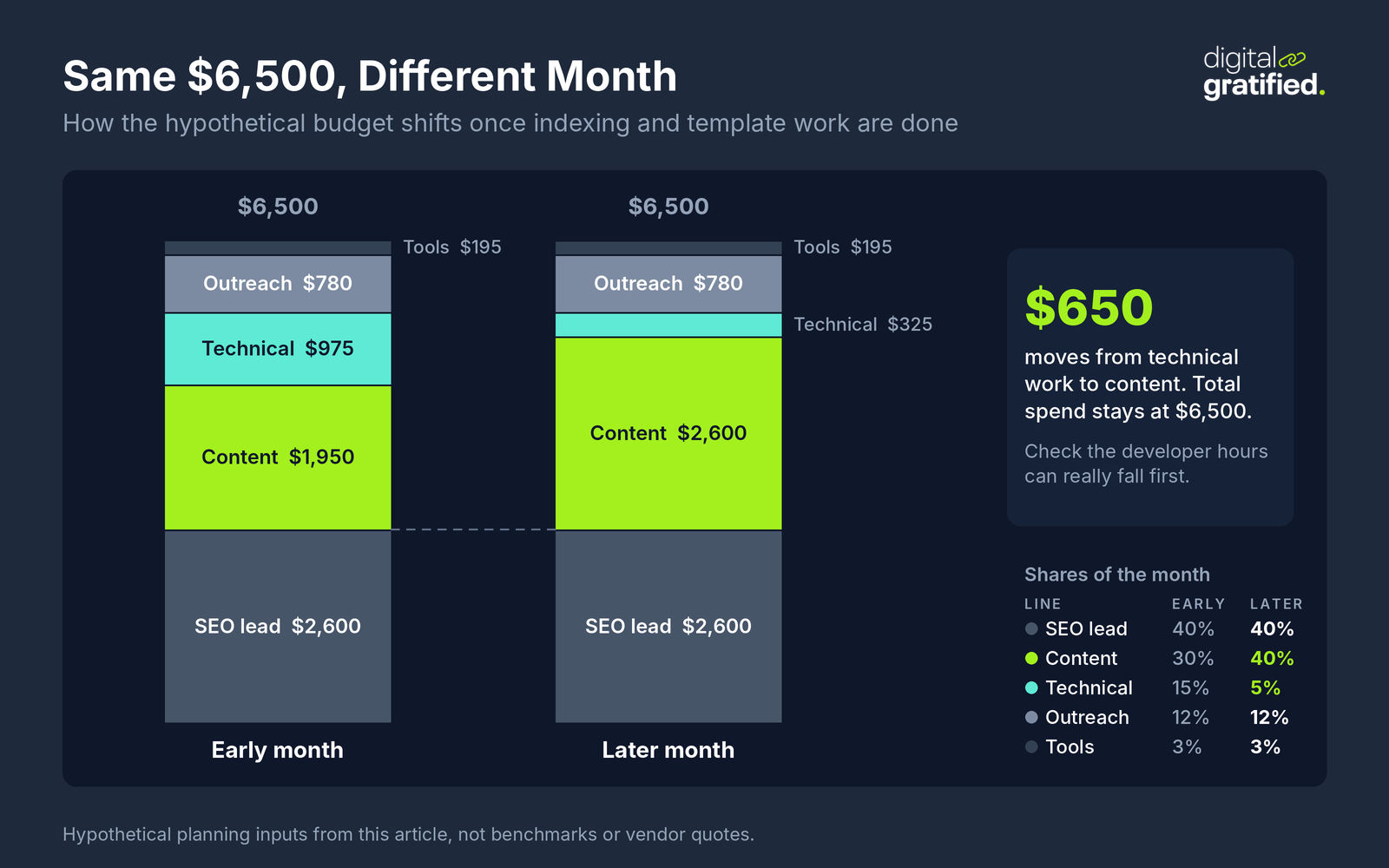
There is no universal percentage for content, technical SEO and links. In the hypothetical $6,500 month, $2,600 (40%) is the lead's allocated time, $1,950 (30%) content production, $975 (15%) technical implementation, $780 (12%) editorial outreach and $195 (3%) tools. These five amounts add to $6,500 and the shares add to 100%. They are a way to make ownership visible, not industry benchmarks.
After indexing and template work are addressed, a later hypothetical $6,500 month could keep the lead at $2,600 (40%), move content to $2,600 (40%), reduce technical maintenance to $325 (5%), and hold outreach at $780 (12%) and tools at $195 (3%). That's a reallocation of $650 from technical to content, not an extra $650 of spend. Check whether the developer hours can really fall before making the switch.
The technical SEO for SaaS line should be tied to named fixes and an owner, not a permanent audit subscription. For outreach, assess relevance, editorial standards and what is actually being delivered before comparing link-building prices. Treat a quote promising a fixed number of ranking gains as a warning, not a budget input.
Where does SEO fit in the broader plan? Decide how much the business can invest in marketing, then compare SEO's expected payback and risk with other channels. The question of how much SaaS companies spend on marketing is separate from the narrower decision about this SEO line item; don't take a generic marketing percentage and call it an SEO budget.
Step 5: In-house, freelancer or agency: buy the missing capability
An in-house lead knows the product and can build relationships with sales and engineering. They also need management time and specialist support; one hire is not automatically a writer, developer and outreach team. Define SEO team responsibilities before assuming a salary covers all production. In the example, the lead's allocated $2,600 is not a claim about market pay.
A freelancer fills a bounded gap, such as reviewing templates or editing comparison pages. You retain prioritization and quality control. Work moves quickly with a ready brief and product reviewer, slowly without an owner. Price deliverables and internal review time.
An agency can coordinate several skills sooner than you could hire them individually, but only if it has access to the product, can show who does the work and names the dependencies your team must supply. It cannot ship your engineering tickets by itself. When you outsource SEO, ask for a scope that separates strategy, production, technical implementation and outreach. Compare that scope with the in-house and freelancer plan, rather than comparing invoice totals while ignoring internal labor.
So what does SEO typically cost? There isn't a trustworthy universal answer for your site. The cost is the capacity and specialist work needed to address its particular constraints over a viable period. Ask for two or three proposals against the same prioritized scope, including who writes, approves, implements and measures each deliverable. Otherwise the cheapest quote may simply omit the hardest work.
Step 6: Give the budget a runway and milestones
Plan for six to twelve months of funding and decision points, not a promise that search will pay back on a fixed date. Google advises that when you're considering hiring an SEO, it can take several months to see the benefits of changes. Your market, site history and release pace may be faster or slower. If you cannot tolerate that uncertainty, don't approve a twelve-month plan on the assumption of month-three pipeline.
Months 1 to 3: establish conversion definitions and a baseline; inspect buyer demand; fix blocking technical issues; publish or update the first prioritized pages. Inspect whether those pages are live, indexable and reaching the intended audience. Don't call an increase in article count a business result.
Months 4 to 6: check query coverage, page engagement, demo quality and sales feedback. Refresh weak pages, improve product paths and retire ideas the evidence doesn't support. Some pages may gain traction; an absence of immediate demos doesn't by itself prove failure, but it should trigger diagnosis, not faith.
Months 6 to 12: compare the monthly demo run rate with the baseline, review qualified pipeline by cohort and revisit the conversion assumption. Continue, redirect or stop according to what you learn. A program cut at month three may still leave valuable pages and fixes, but it often has not had enough time or production to validate its commercial thesis. Plan that risk before signing, rather than using sunk cost to justify every later invoice.
Is SEO still worth it with AI search in 2026?
It can be, if buyers still search for problems, comparisons and implementation answers that your team can address credibly. But don't assume every search exposure becomes a click. Google's documentation on AI features in Search says the same foundational SEO practices apply and that traffic from those features is included in Search Console's overall Web search reporting. It does not promise an AI citation, click or demo for publishing more pages.
That makes the investment test stricter, not obsolete: prioritize pages that help a buyer evaluate or implement your product, measure on-site actions and keep a downside scenario for fewer visits than planned. A conversion improvement on existing pages may be a better use of this quarter's SEO money than another batch of broad glossary posts.
The 70/20/10 rule is sometimes used to allocate 70% of a marketing budget to proven work, 20% to related experiments and 10% to higher-risk new ideas. It isn't an SEO requirement. If it helps your team govern tests, define which work falls in each bucket and protect the essentials first; don't force a technical fix into an “experimental” bucket just to satisfy a ratio. The 80/20 rule is likewise a prioritization prompt, not evidence that exactly 20% of pages will generate 80% of results. Use your own landing-page and pipeline data to find where attention pays.
The final gut-check: too little, too much or misdirected?
Your budget is too low if it funds audits but never funds implementation, or commissions pages nobody has time to review. It may be too high if content production outruns demand research, engineering capacity or product expertise. It's misdirected if outreach buys irrelevant placements while buyer pages remain thin, or if dashboards count traffic without showing what visitors do.
Measure the plan against a consistent organic baseline: relevant landing-page sessions, demo requests, qualified opportunities and eventual customers, with conversion definitions and cohort lag stated. Separate branded demand from non-branded discovery where the data allows it. Keep SaaS content ROI measurement grounded in actual outcomes, not all the revenue from a multi-touch deal. Compare the spend with what else the business could fund. If the evidence changes, change the SEO budget plan. The number should be a decision you can explain, not a retainer you inherited.
About the author
Let's Scale Your SaaS Together
Get a custom SEO and link building strategy tailored for your SaaS business.
Get SEO insights that actually move rankings
Link building tactics, case studies, and SaaS SEO playbooks. No fluff, no spam.
You're subscribed!
SEO and link building insights, straight to your inbox.