Is link building still relevant to SEO in 2026? The evidence, the limits, and four signals to decide whether it deserves your SaaS budget.

Digital Gratified
SaaS SEO Experts
Yes, link building is still relevant to SEO in 2026. Google still uses link analysis, including PageRank, in its ranking systems. Earning useful editorial links remains a legitimate part of competing for organic visibility.
That doesn't mean links deserve your next marketing dollar.
For a SaaS company, the real question is whether stronger external references would help a page that already answers a buyer's question, or whether you're trying to promote a page, product, or offer that isn't ready. Those are different investments.
Here's the verdict: keep link building in your strategy, but make it earn its place in this quarter's budget. Neither “links are dead” nor “more links will fix it” is a useful operating rule.
What Google's comments actually mean
The debate didn't come from nowhere. In a November 2022 Search Off the Record Q&A, Google's John Mueller anticipated that the weight placed on links would decline as Google got better at understanding content. He framed that as an expectation, not a published percentage or an announcement that links had stopped counting.
Google's current ranking-systems documentation still identifies PageRank as part of its core systems. Its link-analysis systems help it understand what pages are about and which may be useful for a query.
Those positions aren't contradictory. A ranking signal can become less decisive without becoming irrelevant. Don't turn an older “top three factors” claim into a permanent rule, either: the documentation doesn't provide a universal weighting for your query.
The distinction matters when evaluating what link building does for SEO. Its role in discovery and ranking isn't a guarantee that another campaign will outperform fixing a weak comparison page. Relevance is the broad answer. Priority requires evidence about your site.
The evidence supports relevance, not guaranteed returns
There is measurable evidence, but it needs the right label.
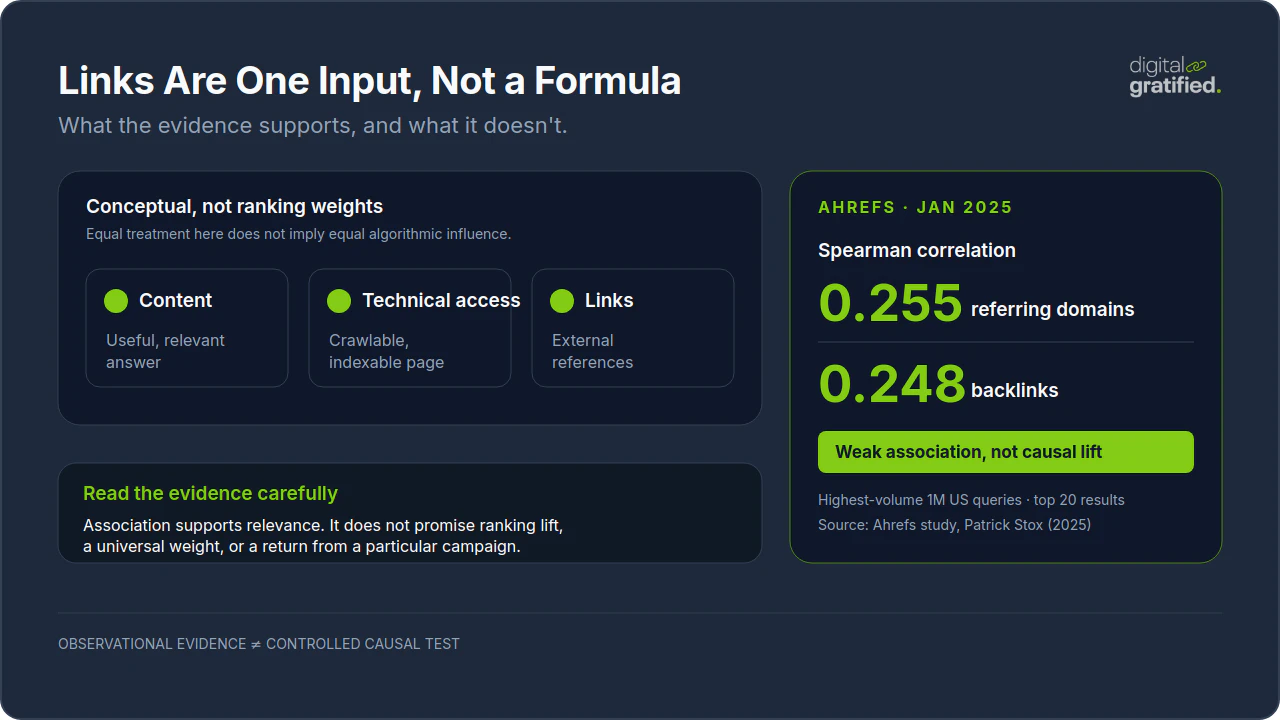
In a January 2025 study of one million search results pages, Ahrefs selected the highest-volume US keywords and examined their top 20 results. It reported a 0.255 Spearman correlation between referring domains and rankings, alongside 0.248 for backlink count. The researchers described the correlations as weak or very weak.
That's an association, not a promised lift. A coefficient of 0.255 doesn't mean links improve rankings by 25.5%, and the study didn't randomly assign backlinks to otherwise identical pages.
Popular brands may attract both links and strong rankings. Pages that already rank can also earn links because more people discover them. The high-volume US sample isn't a precise model for a niche B2B query with limited searches.
Still, the combination matters: Google confirms it uses link analysis, and a large observational study finds an association between link metrics and rankings. Neither supports declaring backlinks irrelevant. Neither proves that buying a particular number will produce pipeline.
For a marketing team, the value of backlinks needs a page-level business case, not just an industry statistic. Treat the study as a reason to investigate your opportunity, not permission to skip that investigation.
When links aren't the answer
Consider a hypothetical workflow SaaS targeting procurement teams. Its use-case page gets relevant impressions, but the copy never explains approval permissions or integrations. Prospects who reach a demo discover that the product doesn't support their required workflow.
A campaign might increase exposure. It won't create the missing capability or answer the missing question.
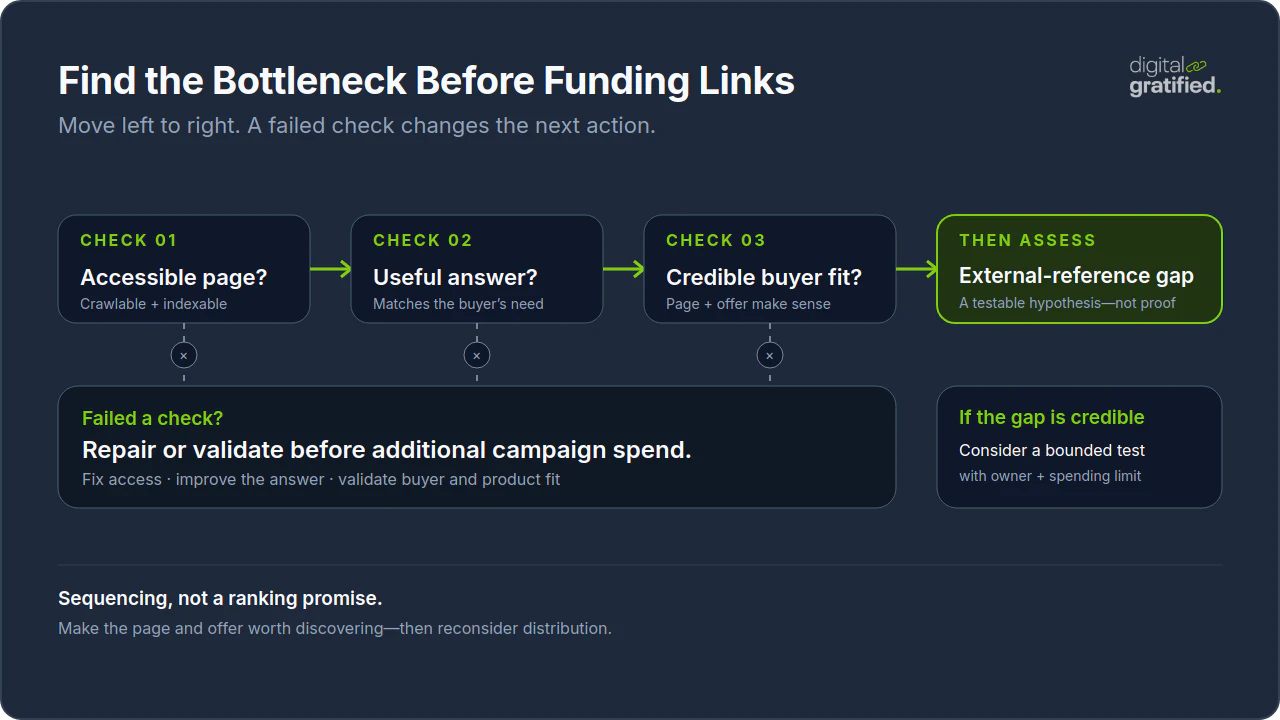
The same investment problem appears when an important page is accidentally excluded from indexing or when thin content doesn't match what buyers need. Fixing access or usefulness changes what you're promoting. More links don't perform that repair.
Product-market fit is a separate constraint: repeated wrong-fit demos, poor activation, or rejection of the core offer warrant customer and product work, not an automatic increase in acquisition spend.
Don't confuse “not the bottleneck today” with “never useful.” The decision is about sequencing. Make the page and offer worth discovering, then reconsider distribution.
AI citations change what you measure
AI Overviews make the relevance question more urgent, but they don't supply evidence that backlinks have become obsolete.
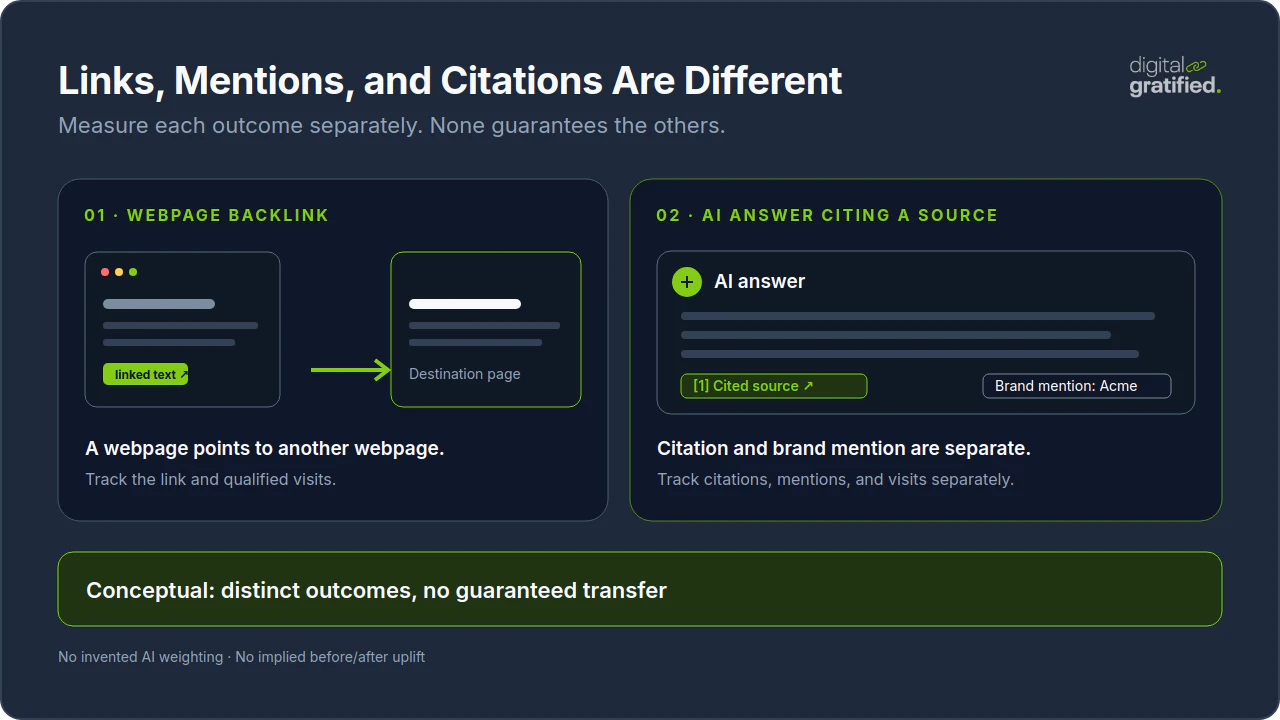
A backlink points from another webpage to yours. A brand mention names you. An AI citation identifies a source within an answer. A system may cite a page without recommending its publisher's product, and a brand mention may arrive without a citation or clickable link.
Google's guidance says a page must be indexed and eligible for a Search snippet to appear as a supporting link in AI Overviews or AI Mode. Eligibility isn't guaranteed selection, and Google's requirements shouldn't be generalized to every LLM.
That makes link building in AI search a broader measurement problem, not a reason to rename every mention a backlink. Track links, mentions, citations, and qualified visits separately.
Digital PR can create material worth referencing, such as original research or expert explanations. But a recognizable brand entity isn't a purchasable citation guarantee. Nor is E-E-A-T a numerical score you increase by adding links.
The bar rises for the campaign's usefulness: can it produce a credible source that someone would actually reference? Don't fund a link-count target and assume AI visibility will follow.
Four signals to check before investing this quarter
Use these as a decision sequence, not four reasons to approve a campaign regardless of what you find.
1. A specific page has a credible commercial job
Name the URL, the buyer it serves, and the next useful action. An integration page helping an operations lead evaluate compatibility has a clearer job than an article chasing loosely related traffic.
Check this week: Review the page with sales or product marketing. Inspect search-query relevance, demo feedback, and conversion paths. New pages won't have much data, so use customer interviews rather than pretending absence of data proves demand.
Decision: Fund promotion when there's credible buyer fit and a useful destination. If the offer or audience remains uncertain, validate that first. Good SaaS link building needs somewhere commercially relevant to send attention, even when the immediate landing page is educational.
2. The suspected link gap survives a fair comparison
Compare pages serving the same intent, not your startup's domain against a giant software brand. Look at the relevant editorial referring domains behind those pages, while checking differences in usefulness and page type.
Check this week: Inspect a small set of comparable pages and the sources linking to them. Ask whether those sources reference evidence, a tool, expertise, or something your page genuinely lacks.
Decision: A credible reference gap makes links a hypothesis worth testing, not a proven cause of the ranking gap. If the comparison exposes a better answer or better intent match, improve yours first. Third-party domain authority is a comparison metric, not Google's own score or a spending target.
3. You have a defensible reason to earn attention
“We need links” isn't a publisher's reason to reference you. Useful benchmark data, a genuinely helpful calculator, or a specialist explanation gives an editor something to work with.
Check this week: Write down the asset, the audience, and why a relevant publisher would cite it. Identify plausible publications and let someone outside the campaign challenge the pitch.
Decision: Proceed when the work has value beyond placing a URL. If the only plan is guaranteed ranking credit from interchangeable placements, stop and rethink it. Budget for research, production, outreach, and review; comparing link building pricing without those inputs can make an apparently cheap option misleading.
4. You can learn whether the investment helped
An increasing link count doesn't settle the budget question. You need a baseline and a decision rule before launch.
Check this week: Record target-page visibility, relevant visits, qualified conversions, campaign costs, and concurrent site changes. Choose a review window that fits your crawl activity and sales cycle, not a promised universal payback date.
Decision: Run a bounded test with an owner and a spending limit. Review placement quality alongside business signals. If results disappoint, inspect the page, audience, placements, and tracking before simply scaling volume.
Link building ROI remains uncertain when several changes happen together. Separate observed outcomes from the share you can reasonably attribute to the campaign.
The verdict for 2026
Backlinks still matter. Automatic budget approval doesn't follow.
If you can name a useful page, a plausible reference gap, a worthwhile asset, and a way to evaluate results, link building deserves a considered test. If you can't, the better decision may be to fix something else first.
That's not abandoning the tactic. It's refusing to let a general truth replace a specific investment decision.
Frequently asked questions
Does link building still work?
Yes. Links remain relevant to Google's ranking systems, and earning useful references can support visibility. But “works” should mean progress toward a defined outcome, not simply more backlinks. Content, technical access, demand, and acquisition quality all affect the case for investing.
Is link building dead?
No. Google's documentation still includes PageRank. What's indefensible is treating link volume as a complete SEO strategy or an assured return. A campaign needs a useful destination, editorially credible acquisition, and measurement, not nostalgia for an earlier algorithm.
Is link building still relevant?
Yes, including for SaaS and B2B teams. The narrower question is whether it's your next priority. When pages are usable, buyer fit is credible, and a reference gap is plausible, consider a bounded campaign. When those conditions aren't met, resolve the constraint first.
Let's Scale Your SaaS Together
Get a custom SEO and link building strategy tailored for your SaaS business.
Get SEO insights that actually move rankings
Link building tactics, case studies, and SaaS SEO playbooks. No fluff, no spam.
You're subscribed!
SEO and link building insights, straight to your inbox.