A comprehensive guide to link building costs in 2026, covering per-link pricing, agency retainers, in-house costs, and how to evaluate ROI. Includes pricing benchmarks, industry comparisons, and guidance on choosing the right approach for your business.

Founder, Digital Gratified
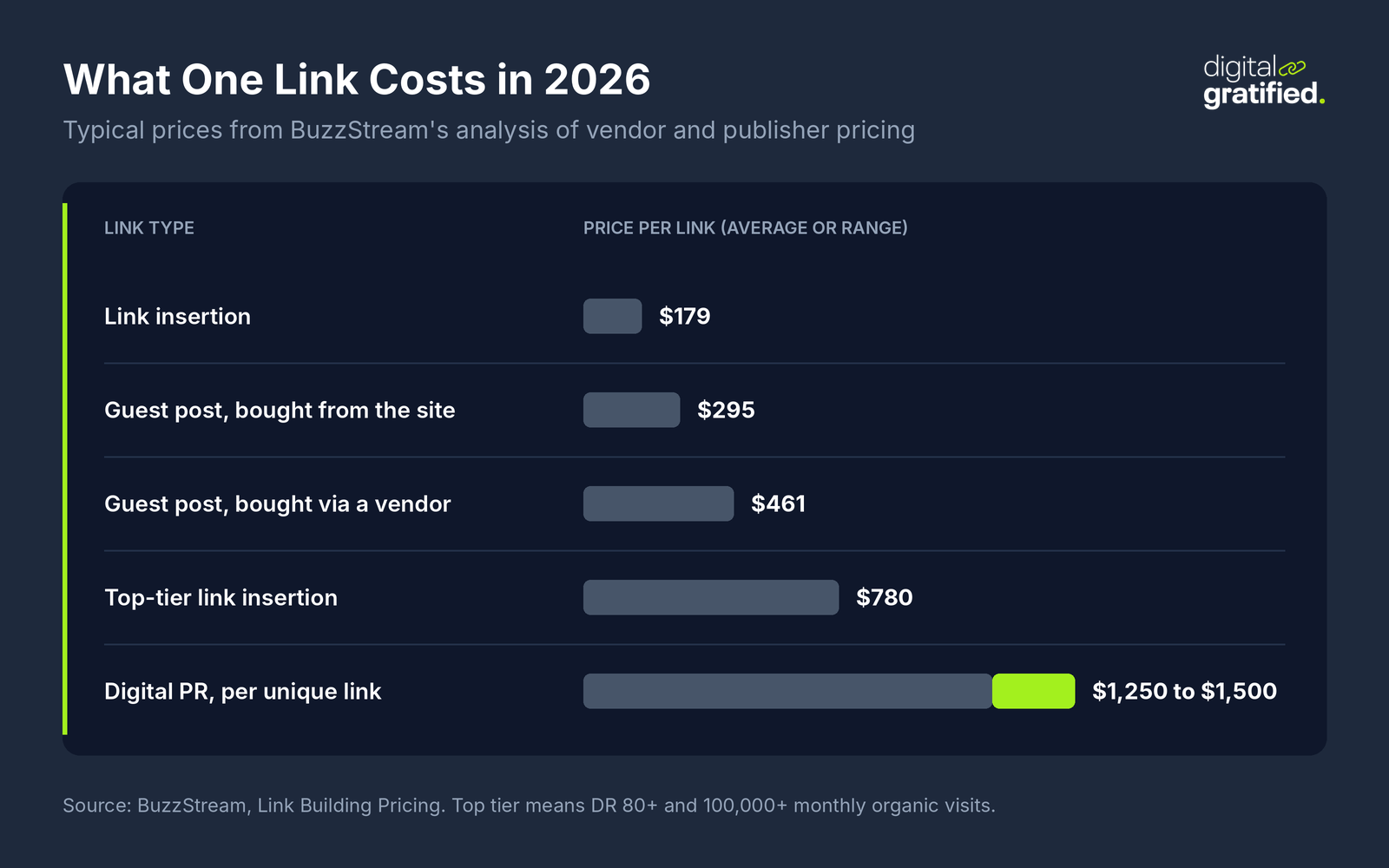
Link building in 2026 averages about $179 for a link insertion and $295 to $461 for a guest post, and costs $1,250 to $1,500 per unique link for digital PR, according to one published link building pricing analysis. What you pay matters far less than what you get: a relevant link that moves a commercial page is cheap at $1,000, and an irrelevant one is expensive at $100.
That spread is why quotes for link building services range from $50 a link to several thousand. This guide breaks down what each type of link costs, the pricing models agencies use, the in-house alternative, what drives price up or down, and how to judge whether your link building investment delivers results in pipeline rather than in link counts.
Link Building Pricing in 2026: Quick Overview
Here is what the market data says a single link costs, by link type:
| Link type | Typical price | What the figure covers |
|---|---|---|
| Link insertion | About $179 on average | A link added to an existing article; range $20 to $1,500 |
| Guest post, bought from the site | $295 on average | A new article placed directly with the publisher |
| Guest post, bought via a vendor | $461 on average | The same placement bought through a reseller's database |
| Top-tier link insertion | About $780 | Sites with DR above 80 and more than 100,000 monthly organic visits |
| Digital PR | $1,250 to $1,500 per unique link | Earned coverage; a $5,000 to $10,000 campaign typically nets 6 to 7 unique linking domains |
All figures come from that pricing analysis, which drew on a vendor database of more than 500,000 guest post sites. Two caveats matter. First, these are prices for placements, and Google's spam policies list "buying or selling links for ranking purposes" as link spam unless the link carries a nofollow or sponsored attribute. Second, the average hides the spread: a cheap placement on a site with no traffic and no relevance is not a bargain.
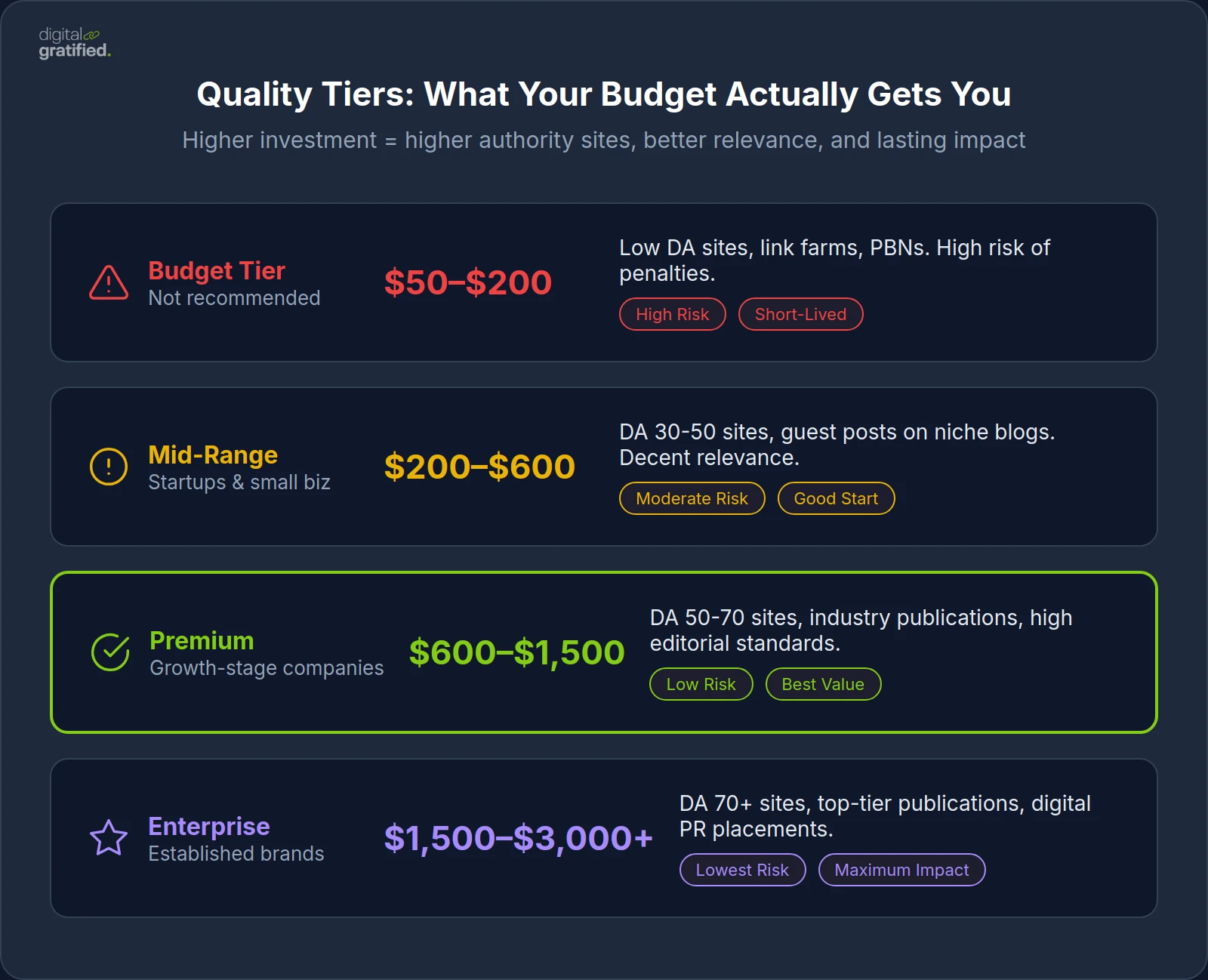
Agencies usually price by quality tier rather than by link type. This is how we see the tiers:
| Quality Tier | Price Per Link | What You Get | Best For |
|---|---|---|---|
| Budget | $50 to $200 | Low DA sites, often link farms or PBNs | Not recommended |
| Mid-Range | $200 to $600 | DA 30 to 50 sites, guest posts, niche blogs | Small businesses, startups |
| Premium | $600 to $1,500 | DA 50 to 70 sites, industry publications | Growth-stage companies |
| Enterprise | $1,500 to $3,000+ | DA 70+ sites, top-tier publications, digital PR | Established brands, competitive niches |
Note: DA (Domain Authority) and DR (Domain Rating) are third-party metrics from SEO tool vendors. While imperfect, they serve as useful benchmarks.
What's Changed in 2026?
Three developments shape what links cost and what they are worth this year:
- Google ran another spam update. The September 2026 spam update started on September 24 and finished rolling out on October 8, 2026. Every update of this kind raises the cost of cheap placements, because the links that stop counting still cost money.
- Good inventory is thin. In the same analysis's vendor data, only about 14% of sites offered link insertions at all, and only a small fraction of the guest post sites cleared a filter of DR 65+ and 10,000+ monthly organic visits. Sites that pass both relevance and traffic checks are scarce, and they charge for it.
- Editorial standards keep rising. In our experience, quality publications now vet contributors and content more closely, which raises the time and effort needed per placement.
The result: cheap links have become riskier, while relevant links on sites with real traffic have become more valuable.
Understanding Link Building Pricing Models
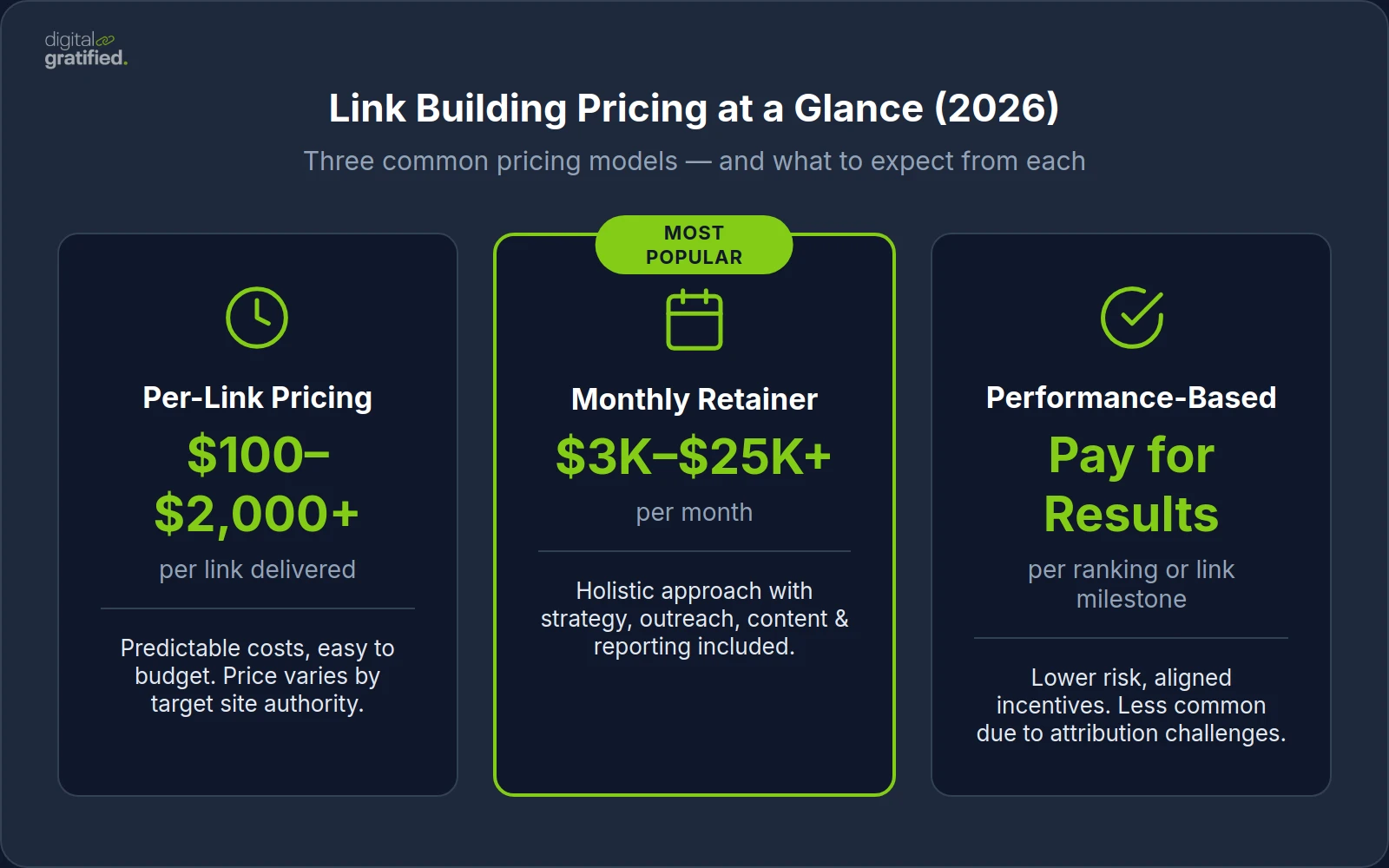
Agencies and services typically use one of these pricing structures:
1. Per-Link Pricing
You pay a fixed amount for each link delivered. Prices vary based on the target site's authority:
| Domain Rating (DR) | Typical Price Range |
|---|---|
| DR 20 to 30 | $100 to $200 |
| DR 30 to 50 | $200 to $400 |
| DR 50 to 70 | $400 to $800 |
| DR 70+ | $800 to $2,000+ |
Pros: Predictable costs, easy to budget
Cons: Incentivizes quantity over relevance, metrics can be manipulated
2. Monthly Retainer
You pay a fixed monthly fee for ongoing link building services. This typically includes:
- Strategy development
- Prospecting and outreach
- Content creation (guest posts)
- Reporting and analysis
Typical monthly retainers:
- Small campaigns: $3,000 to $5,000/month (5 to 10 links)
- Mid-size campaigns: $5,000 to $10,000/month (10 to 20 links)
- Enterprise campaigns: $10,000 to $25,000+/month (20+ links)
Pros: Holistic approach, ongoing relationship, strategic focus
Cons: Higher commitment, results vary month to month
3. Performance-Based Pricing
You pay based on results: either links delivered or ranking improvements achieved. Less common due to the difficulty in attribution.
Pros: Lower risk, aligned incentives
Cons: May encourage shortcuts, harder to find reputable providers
In-House vs. Agency: True Cost Comparison
Many companies consider building an in-house link building team. Here's what that actually costs.
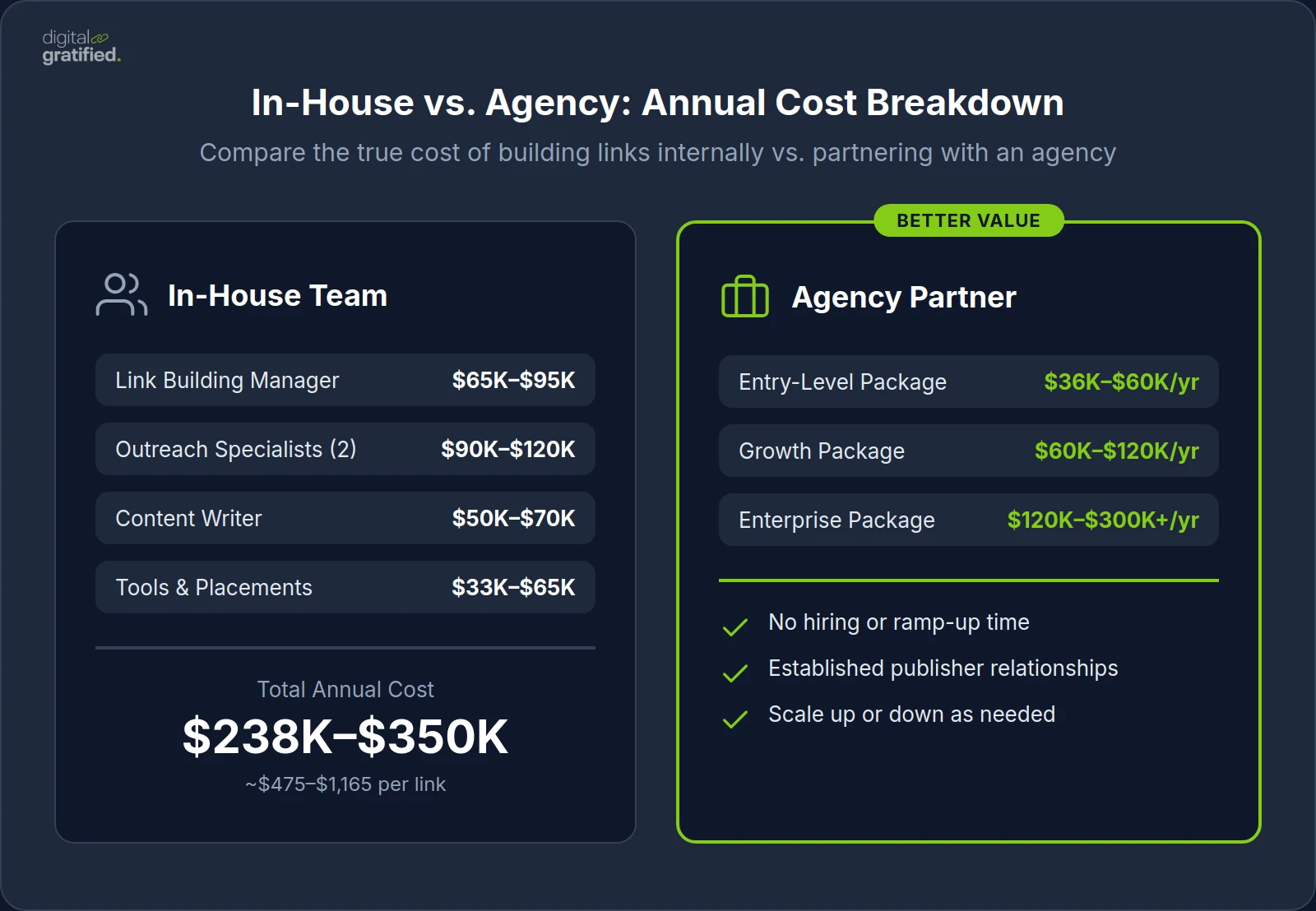
In-House Team Costs (Annual)
This is the cost model we use on our white label link building page:
| Resource | Cost |
|---|---|
| Link builder, writer and editorial fees | $100K to $180K a year |
| Benefits, taxes and overhead | About 40% on top |
| Tools and software | $5K to $12K a year |
| Total annual cost | $145K to $265K |
| Ramp-up before results | 3 to 6 months |
At 36 links a month, that works out to roughly $475 per link before management overhead, and the cost per link climbs fast if the team produces less.
Agency Costs (Annual)
Working with a specialized link building agency typically costs:
- Entry-level packages: $36,000 to $60,000/year ($3,000 to $5,000/month)
- Growth packages: $60,000 to $120,000/year ($5,000 to $10,000/month)
- Enterprise packages: $120,000 to $300,000+/year
If you are leaning toward an outside team, our guide to outsourcing link building without losing control covers contracts, reporting and how to manage the relationship.
When In-House Makes Sense
- You need 400+ links per year consistently
- You have the management capacity to oversee the team
- Your industry requires deep, specialized knowledge
- You're building a long-term content marketing engine
An in-house team also needs a tool stack; our workflow-based guide to link building tools covers what each stage of the work requires.
When Agency Makes Sense
- You need 100 to 300 links per year
- You want to scale quickly without hiring
- You lack internal expertise
- You prefer predictable costs and outsourced management
What Actually Drives Link Building Costs?
Understanding the factors that affect pricing helps you evaluate whether you're getting fair value:
1. Target Site Quality
The most significant factor. The pricing data shows the jump: an average link insertion costs about $179, while one on a site with DR above 80 and more than 100,000 monthly organic visits costs about $780. Top publications cost more not just because of their authority, but because:
- Editorial standards are higher
- Competition for placements is intense
- Relationship-building takes longer
- Content requirements are stricter
2. Your Industry
Some industries command premium pricing:
| Industry | Price Premium | Why |
|---|---|---|
| Finance/Fintech | +40 to 60% | YMYL requirements, stricter editorial policies |
| Healthcare | +50 to 70% | Medical accuracy requirements, liability concerns |
| Legal | +30 to 50% | Professional standards, limited relevant sites |
| Gambling/CBD | +100 to 200% | Policy restrictions, limited publishers willing to link |
| SaaS/Tech | +10 to 20% | Competitive space, technical content needs |
3. Content Requirements
Links that require content creation cost more. The same averages show the ladder:
- Link insertions (adding a link to existing content): about $179 on average
- Guest posts (new article placement): $295 bought directly, $461 through a vendor
- Digital PR (newsworthy content plus outreach): $1,250 to $1,500 per unique link
4. Your Brand Strength
Established brands with strong reputations get better response rates, reducing the cost per link. Startups and unknown brands pay more because:
- More outreach needed per placement
- Higher rejection rates
- Often need to pay for placements others get free
5. Linkable Assets
If you have valuable content (original research, useful tools, comprehensive guides), earning links costs less. Without linkable assets, you're paying for placements rather than earning them, which is why content strategy is inseparable from link building costs.
The Hidden Costs of Cheap Link Building
Before you opt for the lowest-priced option, consider what cheap link building often means:
Link Farms and PBNs
Sites that exist solely to sell links. They may show impressive metrics (DA 60+), but Google is increasingly effective at identifying and devaluing these networks. The result?
- Short-term gains, long-term penalties
- Wasted budget on links that stop working
- Potential manual actions requiring costly disavow efforts
Low-Quality Guest Posts
The $100 guest post from a link building marketplace often means:
- AI-generated content
- Irrelevant sites (your SaaS link on a lifestyle blog)
- Sites with no real traffic
- Spammy neighborhoods that hurt your profile
Manipulated Metrics
DA and DR can be artificially inflated through link schemes. A site showing DR 60 might have:
- Zero organic traffic
- No real audience
- A backlink profile full of spam
Always verify: Check organic traffic (in your SEO tool), review the site's content quality, and look at who else is linking to them.
How to Budget for Link Building
Your link building budget should match your competitive landscape, growth goals and the revenue a top ranking is worth to you:
Startup/Early Stage
- Monthly budget: $2,000 to $5,000
- Focus: Foundational links, niche-relevant sites, digital PR for brand awareness
- Expected output: 5 to 15 quality links/month
Growth Stage
- Monthly budget: $5,000 to $15,000
- Focus: Scaling link acquisition, targeting competitive keywords, building topical authority
- Expected output: 15 to 40 quality links/month
Enterprise
- Monthly budget: $15,000 to $50,000+
- Focus: High-authority placements, digital PR campaigns, brand building
- Expected output: 30 to 100+ quality links/month
Selling into several markets changes the math, because building links in each new market carries its own cost structure for each region.
Competitive Benchmark Method
A practical approach: analyze your top 3 to 5 competitors' backlink profiles using our complete guide to finding competitor backlinks. Calculate how many links they're building monthly and at what quality level. Budget to match or exceed their velocity in your target areas.
White-Label Link Building Pricing
If you're an agency looking to offer link building to your clients, white label pricing works on a wholesale model. On our wholesale link building program for agencies:
- Per-link pricing: $180 to $600 per good quality link
- Markup potential: wholesale pricing is set so agencies can mark up by 20% to 50% and still quote competitive rates
- Turnaround: placements are secured in 24 hours to 10 days
Key considerations for white-label partnerships:
- Reporting capabilities (branded reports for your clients)
- Communication protocols (direct vs. through you)
- Quality guarantees and replacement policies
- Turnaround times
Keep in mind that link building is usually just one line item in a broader reseller arrangement: our breakdown of SEO reseller services covers how agencies package and price the full stack of outsourced SEO.
Measuring ROI: Is Your Link Building Investment Working?
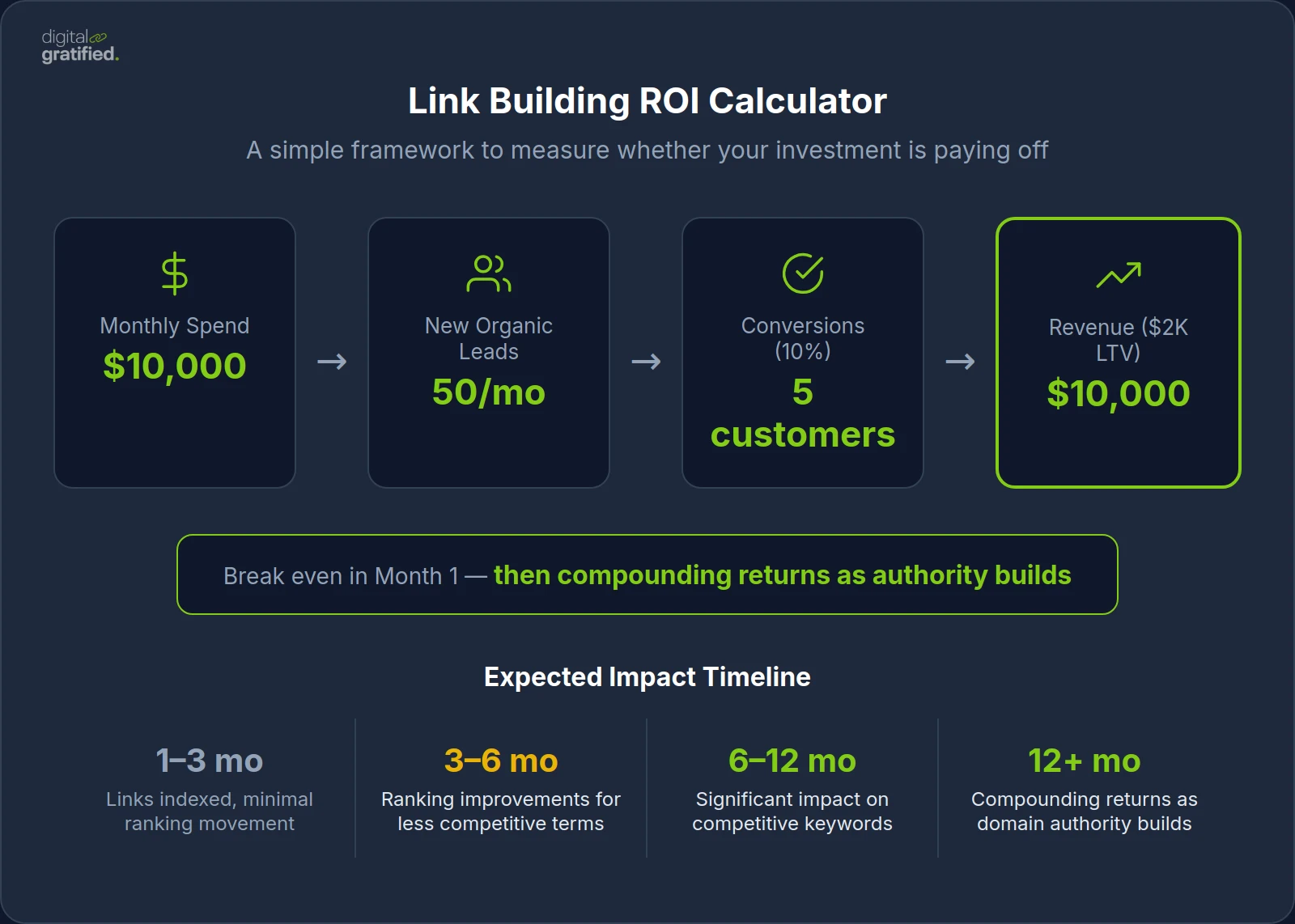
The true measure of link building pricing isn't cost per link: it's the pipeline the linked pages produce.
Metrics to Track
- Rankings for commercial terms: Are the pages that received links moving up for the searches buyers run?
- Organic traffic to those pages: Are target pages gaining visits?
- Referring domain growth: Is your backlink profile expanding with relevant sites?
- Conversions: Are demo requests and trials from those pages growing?
- Pipeline and ARR: Are qualified opportunities from organic search increasing?
Expected Timeline
Link building isn't instant. In our experience, expect:
- 1 to 3 months: Links indexed, minimal ranking movement
- 3 to 6 months: Noticeable ranking improvements for less competitive terms
- 6 to 12 months: Impact on competitive keywords
- 12+ months: Compounding returns as authority builds
Calculating Cost Per Acquisition
To understand true ROI:
- Record the organic landing page on every demo and trial form
- Track the qualified pipeline and closed ARR from pages that received links
- Compare it against your link building spend over the same window
Here is a worked example with hypothetical inputs; replace each with your own numbers. You spend $6,000 a month for six months, $36,000 in total, on links to three comparison pages. By month nine those pages bring 30 extra demo requests a month, 10 of them qualify, and you win 2 at $15,000 ARR each. That is $30,000 of new ARR a month from the linked pages, so the spend pays back in a little over a month of new bookings once the rankings hold. If the pages bring traffic but no demos, the problem is the page, not the links.
Red Flags: When Link Building Pricing Is Too Good to Be True
Be wary of providers offering:
- Guaranteed DA 60+ links for under $200: Almost certainly low-quality or manipulated sites
- "Unlimited links" packages: Quality always suffers at scale
- No site approval process: You should know where your links are going
- Instant delivery: Quality link building takes time
- No transparency on methods: If they won't explain how, assume it's risky
Choosing the Right Link Building Partner
When evaluating link building services, ask:
- Can you see examples of sites you've placed links on? Quality providers should show their work.
- What's your process for prospecting and outreach? Relationship-based outreach yields better results than mass emails.
- How do you measure and report success? Look for reporting tied to rankings and conversions, not just link counts.
- What happens if a link is removed? Reputable agencies offer replacement guarantees.
- Do you have experience in my industry? Niche expertise matters for relevance and relationships.
If human-driven outreach is a priority, see our breakdown of what a manual link building service includes and costs before comparing quotes, and our buyer's guide to SaaS link building agencies for a shortlist.
Final Thoughts
Link building pricing in 2026 has a clear floor and no ceiling. Ordinary placements average a few hundred dollars, digital PR runs $1,250 to $1,500 a link, and the cheapest options carry the most risk after another spam update. The price on the quote tells you little; the relevance and traffic of the linking site tell you most of what the link will be worth.
So set the budget from the revenue a ranking is worth, buy relevance over raw metrics, and judge every month of spend on the demos and pipeline the linked pages produce. If you want a team that earns those links for SaaS pages, talk to us about SaaS link building.
Frequently Asked Questions
How much does link building cost per link?
One published pricing analysis puts the average link insertion at about $179 and the average guest post at $295 bought directly or $461 through a vendor. Digital PR costs $1,250 to $1,500 per unique link. Relevant sites with real traffic sit at the top of those ranges.
How much do link building agencies charge per month?
Most agencies sell monthly retainers rather than single links. Small campaigns typically start around $3,000 to $5,000 a month, growth programs run $5,000 to $10,000, and enterprise programs go higher, depending on link volume, quality and how much content is included.
Is it cheaper to build links in-house?
Rarely at small volumes. Our cost model puts an in-house link builder, writer, editorial fees, overhead and tools at $145K to $265K a year, with three to six months of ramp-up. In-house makes sense when you need 400+ links a year and can manage the team.
Are cheap backlinks worth buying?
Usually not. Google's spam policies treat buying links for ranking purposes as link spam unless the link is marked nofollow or sponsored, and cheap placements tend to sit on sites with little traffic or relevance. Links that stop counting after a spam update still cost money.
What does white label link building cost?
On our white label program, good quality links cost $180 to $600 each, and wholesale pricing is set so agencies can mark up by 20% to 50% and still quote competitive rates.
How do I measure link building ROI?
Record the organic landing page on every demo and trial form, then compare the qualified pipeline and ARR from pages that received links with what you spent over the same window. Judge it over six to twelve months, not one.
About the author
Let's Scale Your SaaS Together
Get a custom SEO and link building strategy tailored for your SaaS business.
Get SEO insights that actually move rankings
Link building tactics, case studies, and SaaS SEO playbooks. No fluff, no spam.
You're subscribed!
SEO and link building insights, straight to your inbox.