White hat link building sounds simple until vendors start relabeling risky tactics. Here's where SaaS teams should draw the line, what Google actually penalizes, and how to vet a method before it reaches your domain.

Founder, Digital Gratified
White hat link building means earning links that publishers choose to give because the content genuinely helps their readers. The label sounds precise, yet it gets stretched constantly. Vendors call guest posts white hat because a human wrote them, marketplaces call placements editorial because someone approved the order, and scholarship campaigns look charitable while existing only to collect university links.
For SaaS teams, that ambiguity is expensive, because a risky link program can damage comparison pages, integrations, documentation and product content all at once. This guide draws a practical line between links that are truly earned and links that are merely made to look earned.
What Actually Makes Link Building White Hat?
Genuine white hat link building earns attention from relevant publishers without trying to deceive search engines about why the link exists. The publisher has editorial control, the link helps the reader, and the page would still be worth publishing if ranking credit disappeared tomorrow.
That standard is stricter than “a real person placed the link.” Humans can manually add links to private networks, paid articles, and thin guest posts. The labor is manual, but the outcome is still manufactured. The better question is whether an independent editor chose the link because it improved the page.
There are four useful tests: editorial choice, reader value, honest intent, and defensibility at scale. A tactic doesn't need to be passive. Outreach is allowed. Promotion is allowed. Even commercial relationships are allowed when they're disclosed properly. What crosses the line is arranging links primarily to manipulate rankings while presenting them as independent endorsements.
This is the risk-control layer inside a broader SaaS link building strategy. The pillar decides which pages need authority and how acquisition supports growth. The white hat standard decides which methods are safe enough to use while building it.
Is Link Building Illegal?
No. Link building itself isn't illegal. Asking a journalist to cite research, contributing an expert article, or suggesting a useful resource doesn't break the law. Google's policies are platform rules, not criminal law.
Breaking those rules can still carry serious business consequences. Google's link spam policies identify paid links that pass ranking credit, excessive link exchanges, automated link creation, and scaled article campaigns as spam. Google can ignore those links algorithmically or apply a manual action that suppresses some or all of a site's visibility.
The most common outcome isn't a dramatic overnight ban. Google often discounts manipulative links so they stop helping, which can look like a campaign that simply never produces results. Manual actions are more explicit and appear in Search Console, but they're less common. Either way, “we weren't penalized” doesn't prove a tactic worked. A company can spend heavily on links that Google quietly values at zero.
Payment isn't automatically forbidden either. Sponsorships, affiliate placements, and advertising are normal marketing. They should use the appropriate rel="sponsored" or nofollow qualification so the commercial relationship isn't disguised as an editorial vote. The problem is paying for ranking credit, not paying for exposure.
White Hat Link Building Strategies That Stay Safe
The safest strategies share one trait: the link is a byproduct of providing something useful to a publisher or its audience. We rank eight of them by effort and pipeline value in our guide to earning backlinks as a SaaS company.
Earned editorial links
A writer cites your benchmark, product data, definition, or original framework because it supports a claim. You can promote the asset, but the writer controls whether and how it's referenced. For SaaS companies, anonymized product data and technically credible explanations create an advantage that generic brands can't copy easily.
Digital PR built around evidence
Strong digital PR gives journalists a real story: original research, a timely dataset, or an expert who can explain a change in the market. The pitch leads with the finding, not a preferred anchor. Coverage might include a link, a brand mention, or neither, and that editorial uncertainty is part of what makes the result trustworthy.
Genuine guest contributions
Guest posting can be white hat when the publication serves your audience, the article would be commissioned on its own merit, and any link is relevant to the sentence around it. It becomes riskier when quotas replace editorial judgment. Good link building outreach builds repeat relationships with editors instead of treating every site as a one-time placement slot.
Resource pages and expert commentary
A resource-page link is safe when your tool or guide genuinely belongs in the collection and improves it. Expert-commentary platforms work on the same principle: answer a journalist's actual question with useful experience, then let the publisher decide what to quote and whether to cite you. Neither method needs an exact-match anchor or a promise of ranking credit.
“White Hat” Tactics That Turn Gray Fast
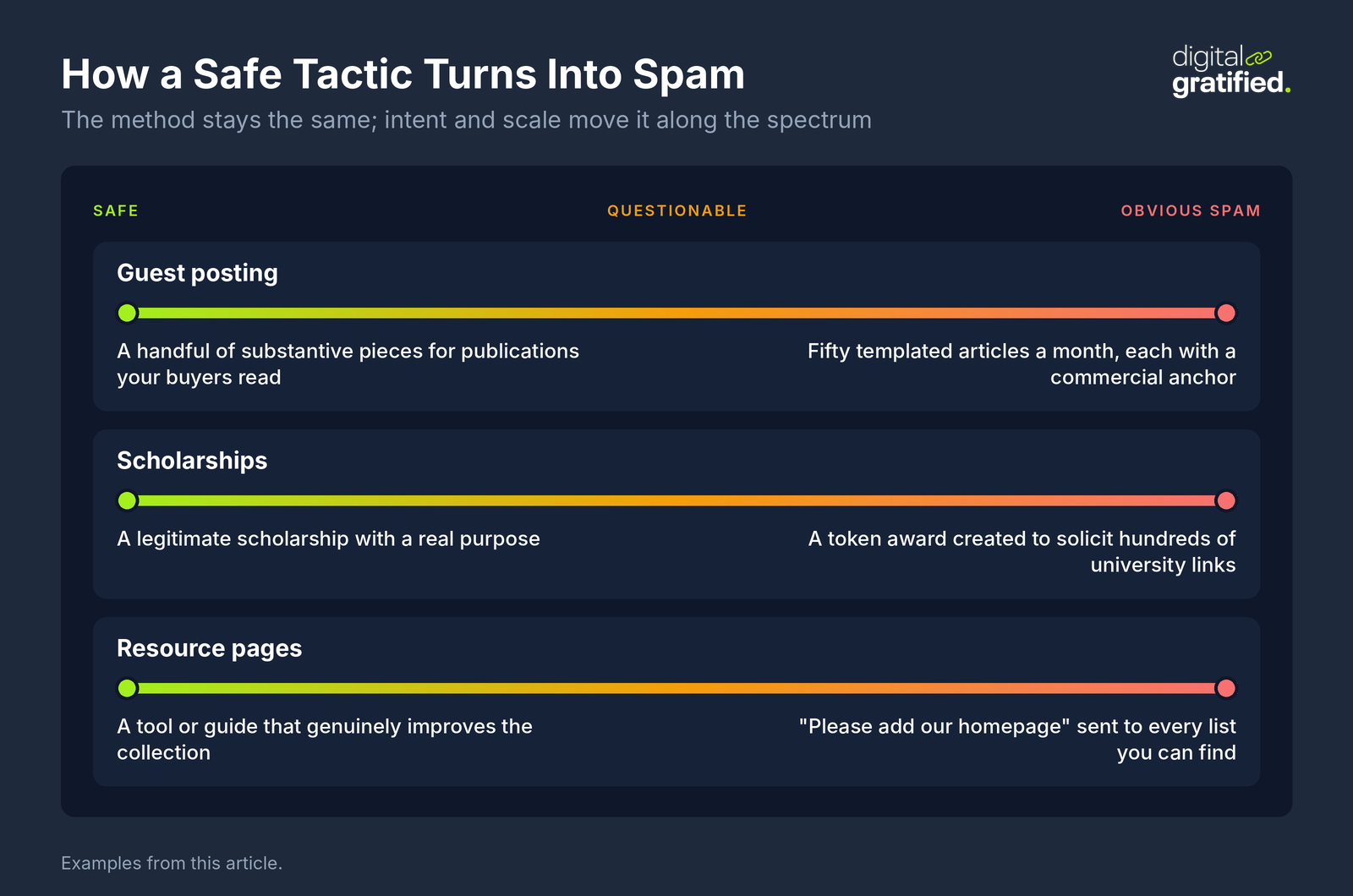
Mass guest posting. A handful of substantive contributions to publications your buyers read can be excellent marketing. Fifty articles a month built from interchangeable templates, each carrying a commercial anchor, look like a scaled link campaign because that's what they are. Adding human writers doesn't fix the footprint.
Scholarship link building. Offering a legitimate scholarship isn't the problem. Creating a token award mainly to solicit hundreds of links from university financial-aid pages is. The scholarship becomes a prop for the link scheme, and the unrelated .edu domain doesn't make the endorsement relevant to your SaaS product.
Low-effort resource outreach. “Your list is great, please add our homepage” is not value creation. Sending that pitch to thousands of loosely related pages turns a valid tactic into spam. A defensible resource pitch identifies a real gap and offers the strongest item for that specific audience.
Paid editorial placements presented as earned. If approval depends on a fee and the link passes ranking credit, the placement isn't independent. A polished site, named author, and decent traffic don't change the transaction underneath it.
The practical lesson is that tactics don't stay white hat because of their names. Intent, execution, and scale can move the same method from safe to questionable to obvious spam.
Why SaaS Companies Have More to Lose
A SaaS penalty doesn't just remove a few blog visits. It can push down comparison pages that capture evaluation-stage buyers, integration pages that support partner demand, and product pages that have accumulated authority for years. Because sales cycles are long, the pipeline impact may not appear until a quarter after visibility drops.
That lag makes recovery harder to manage. Paid acquisition has to cover the shortfall while the team audits links, removes placements, documents cleanup, and waits for systems to reassess the site. Investors see customer acquisition costs rise. Sales sees fewer organic opportunities. Customers researching the category see competitors instead.
This is why the value of a backlink can't be reduced to domain rating. A relevant editorial citation can assist rankings, referral traffic, and buyer trust for years. A risky placement can be worth less than zero once cleanup time and channel volatility are included.
How to Vet a Tactic or Vendor Before Spending
Ask questions that expose the process rather than accepting the label “white hat.”
Why would the publisher say yes? The answer should involve its readers, editorial needs, or a useful asset. “We have relationships” isn't enough if those relationships exist only to sell placements.
Who chooses the target page and anchor? Editors should retain meaningful control. A vendor guaranteeing exact-match anchors across every placement is manufacturing a pattern.
Can you show recent SaaS examples? Open the sites. Check whether they publish for a real audience, cover a coherent topic, and label sponsored content honestly.
What happens when a placement is rejected? Real outreach has rejection. A guaranteed monthly count usually means the vendor controls inventory somewhere.
How does the method behave at ten times the volume? If quality depends on nobody noticing repetition, it isn't a durable strategy.
A credible manual link building service can walk through prospecting, pitch creation, editorial discussion, and reporting for a real placement. It won't hide behind a domain-metric threshold or claim that “manual” alone makes every link safe.
White Hat Link Building Is an Ongoing Program
Safety isn't decided only on the day a link goes live. Links disappear, anchors drift, vendors change methods, and sites that once had standards can become placement farms. Ongoing backlink management catches those changes before they become a pattern.
That means a monthly review of new and lost referring domains, a quarterly look at anchor distribution and source quality, and a clear record of anything paid or sponsored. Acquisition and maintenance belong in the same operating rhythm. Link work also sits beside PR, mentions, reviews, and the other priorities in a practical off-page SEO program, not in a one-time tactic sprint.
The Bottom Line
White hat backlinks come from genuine editorial choice. You can create the asset, find the publisher, and make the pitch, but you can't manufacture independent endorsement and call it earned. For SaaS companies, the safest strategy is also the one most likely to compound: publish things worth citing, build real editorial relationships, accept rejection, and keep monitoring what you earn.
White Hat Link Building: Frequently Asked Questions
What is white hat link building?
White hat link building earns backlinks through useful content, credible expertise, digital PR, and genuine publisher relationships. An independent editor chooses the link because it helps readers, not because ranking credit was bought, automated, or exchanged at scale.
Is link building illegal?
No. Link building isn't illegal. Google's spam policies are platform rules rather than criminal law. Violating them can still lead to ignored links, ranking losses, or a manual action, which can create significant commercial damage.
What is black hat link building?
Black hat link building uses deceptive or manipulative methods such as private blog networks, automated placements, hidden paid links, and scaled campaigns designed mainly to pass ranking credit. The defining issue is manufactured endorsement rather than a particular tool or format.
Are guest posts considered white hat?
They can be. A substantive contribution to a relevant publication, written for its audience with editorially controlled links, is defensible. Repetitive articles published at scale mainly to insert commercial anchors move into gray or black hat territory.
Can Google penalize a site for bad backlinks?
Yes, especially when the site or its vendor created a manipulative pattern. Google may discount links algorithmically or issue a manual action. Random spam links that a site didn't build are usually ignored, so cleanup should focus on deliberate schemes rather than every low-quality backlink.
About the author
Let's Scale Your SaaS Together
Get a custom SEO and link building strategy tailored for your SaaS business.
Get SEO insights that actually move rankings
Link building tactics, case studies, and SaaS SEO playbooks. No fluff, no spam.
You're subscribed!
SEO and link building insights, straight to your inbox.