Every SaaS team asks the same question: how do we know if content marketing is working? This guide explains what to measure, what to ignore, how to calculate content ROI honestly, and how to build a measurement system that improves as your programme matures.

Founder, Digital Gratified
Measuring SaaS content marketing ROI answers the question every content team eventually faces, which is whether any of it is working. It's harder than it sounds, because content builds compounding assets. A post published today can drive traffic and leads for years, so judging it like a paid search campaign leads to the wrong conclusions.
Attribution adds another challenge, since tying a specific piece of content to a closed deal is difficult without enterprise analytics. This guide shows how to measure content ROI honestly, separate meaningful signals from noise, and build a measurement system that gets more accurate as your programme matures.
The Measurement Problem Nobody Admits
Before tracking metrics, it helps to understand why content marketing measurement is structurally different from other channels:
Content has a long and fragmented influence window. A prospect might read three blog posts over 90 days, never convert on any of them, receive a sales email, get a demo, and close. Which touchpoint drove the conversion? All of them. None of them. The attribution model you choose will give you completely different answers.
Organic content compounds over time. A paid ad generates results proportional to spend in a given period. A well-optimised blog post generates increasing traffic for years. Month 1 ROI looks terrible. Month 24 ROI looks extraordinary. Evaluating content by early-period results kills programmes that would have compounded.
Most SaaS companies lack the attribution infrastructure to prove content's contribution directly. Full multi-touch attribution requires clean CRM data, proper UTM tracking, closed-loop reporting between marketing and sales, and often an attribution platform layered on top. Most growing SaaS teams have some, but not all, of these in place.
Knowing this changes how you approach measurement: the goal isn't to prove content ROI with false precision. It's to build enough signal to know whether the programme is moving in the right direction and to identify what to improve.
The Metrics Hierarchy: Separating Signal from Noise
Not all content metrics are equally meaningful. Before defining which metrics to track, it helps to classify them by what they actually tell you:
Tier 1: Vanity Metrics (Monitor Internally, Don't Report Up)
These metrics feel good when they go up, but they have weak or no connection to revenue:
- Raw pageviews Volume without context. 10,000 pageviews from your target ICP is worth more than 100,000 from irrelevant audiences.
- Social shares and likes Shares rarely correlate with pipeline contribution. Some of the most commercially effective content gets low social engagement.
- Newsletter open rates Useful for content quality signals internally, but not a business outcome.
- Average time on page Directionally useful but easily misleading. A 30-second session on a well-designed piece might mean they got their answer fast; an 8-minute session might mean they were confused.
Tier 2: Engagement Signals (Internal Monitoring)
These indicate content is performing its job of engaging the right audience. They're worth monitoring because they inform content strategy, but they don't connect directly to revenue:
- Scroll depth What percentage of readers reach the bottom? Below 40% suggests significant drop-off problems worth fixing.
- Return visitor rate High return visit rates indicate that content is building genuine audience, not just capturing one-time searches.
- Content-specific CTR What percentage of readers click through to a product page, pricing page, or conversion point?
- Keyword ranking progress Are target keywords moving up in SERPs? Useful for evaluating SEO content strategy execution.
Tier 3: Pipeline Metrics (Report to Leadership)
These connect content activity to business outcomes and belong in your leadership reporting:
- Content-influenced pipeline Deals where a prospect engaged with at least one piece of content before closing.
- Content-sourced MQLs and trials Leads that came in specifically through a content conversion point (gated download, blog CTA, SEO landing page).
- Organic traffic to conversion rate What percentage of organic visitors convert to a measurable business action?
- Content channel CAC Customer acquisition cost attributable to the content/organic channel, compared to other acquisition channels.
Tier 4: Revenue Metrics (Full-Funnel Attribution)
These are the ultimate measurement targets but require infrastructure investment to track reliably:
- Content-attributed revenue Closed revenue in deals where content contributed to the buying journey.
- Organic channel LTV Whether customers acquired through organic/content have higher, lower, or equal lifetime value versus other channels.
- Content programme payback period How many months until cumulative content investment is recovered through attributable revenue.
The 5 Metrics That Actually Matter for SaaS Content
If you're in the early stages of building a measurement system, these five metrics provide the clearest view of content programme health without requiring sophisticated attribution infrastructure:
1. Organic Traffic from ICP-Match Segments
Not all organic traffic is equal. A SaaS company selling project management software to construction firms gets zero value from blog traffic generated by people searching for general productivity tips. The meaningful metric is organic traffic from visitors who match your ICP profile.
How to approximate it: segment organic traffic by the landing pages that represent ICP intent (solution pages, comparison pages, use-case content), and by geographic markets you actively sell into. Raw organic traffic growth is a vanity metric; ICP-segment organic growth is a signal.
Benchmark: Top-performing B2B SaaS content programmes grow ICP-segment organic traffic 30–60% year-over-year during their scaling phase. Early-stage programmes (months 1–12) should target any positive trend given the baseline-building nature of this period.
2. Content-to-Trial / Content-to-Demo Conversion Rate
This is the metric that connects the top of your content funnel to the beginning of your sales funnel. It measures what percentage of organic visitors initiate a trial, book a demo, or complete another designated first-touch conversion.
Median B2B SaaS content conversion rates (organic visitor to trial/demo request) typically fall in the 1–3% range for blog content, with high-intent bottom-of-funnel content (comparison pages, alternatives pages) often achieving 4–8%. If your overall conversion rate sits below 0.5%, the problem is usually one of three things: wrong traffic, conversion friction, or stage mismatch (content is attracting problem-aware readers but converting for purchase-ready intent).
3. Content-Influenced Pipeline
This is the metric that justifies content investment to leadership. It measures the total value of open and closed deals where at least one prospect touched a piece of content during their buying journey, tracked via CRM attribution and UTM tracking.
The important distinction here is influenced rather than attributed. Attribution (claiming content caused the deal) requires clean multi-touch attribution data that most SaaS teams don't have. Influence (content was in the journey) is measurable with good CRM hygiene and proper UTM tagging. Report influence; be honest about the limits of attribution.
4. Content Channel CAC vs. Other Channels
Customer Acquisition Cost from the content/organic channel is the single most compelling ROI argument for content investment, when the number is good. Calculate it by dividing total content programme costs (production, distribution, tooling, internal time) by the number of customers acquired primarily through organic/content channels in a given period.
The compounding effect means this number should improve significantly over time: Year 1 content channel CAC will look worse than paid. By Year 3, it typically looks dramatically better, because the asset base grows while marginal production costs don't scale proportionally.
5. Organic Keyword Coverage for Commercial Intent Terms
This is your leading indicator of future pipeline: are you appearing in the searches your buyers conduct when they're actively evaluating solutions? Track ranking positions for three specific keyword categories: problem-aware terms (how to solve X), solution-aware terms (best [category] software, [category] tools), and brand/competitor terms ([your competitor] alternative, [your brand] reviews).
Coverage across all three categories indicates a healthy content mix. Over-indexing on problem-aware terms with no presence in solution-aware searches is a common mistake: it generates traffic from audiences who aren't yet evaluating purchases.
Building this kind of keyword coverage is what the SaaS content marketing strategy work feeds into: content production and SEO infrastructure are the mechanism; keyword coverage and ICP-match traffic are the outcome.
How to Actually Calculate SaaS Content Marketing ROI
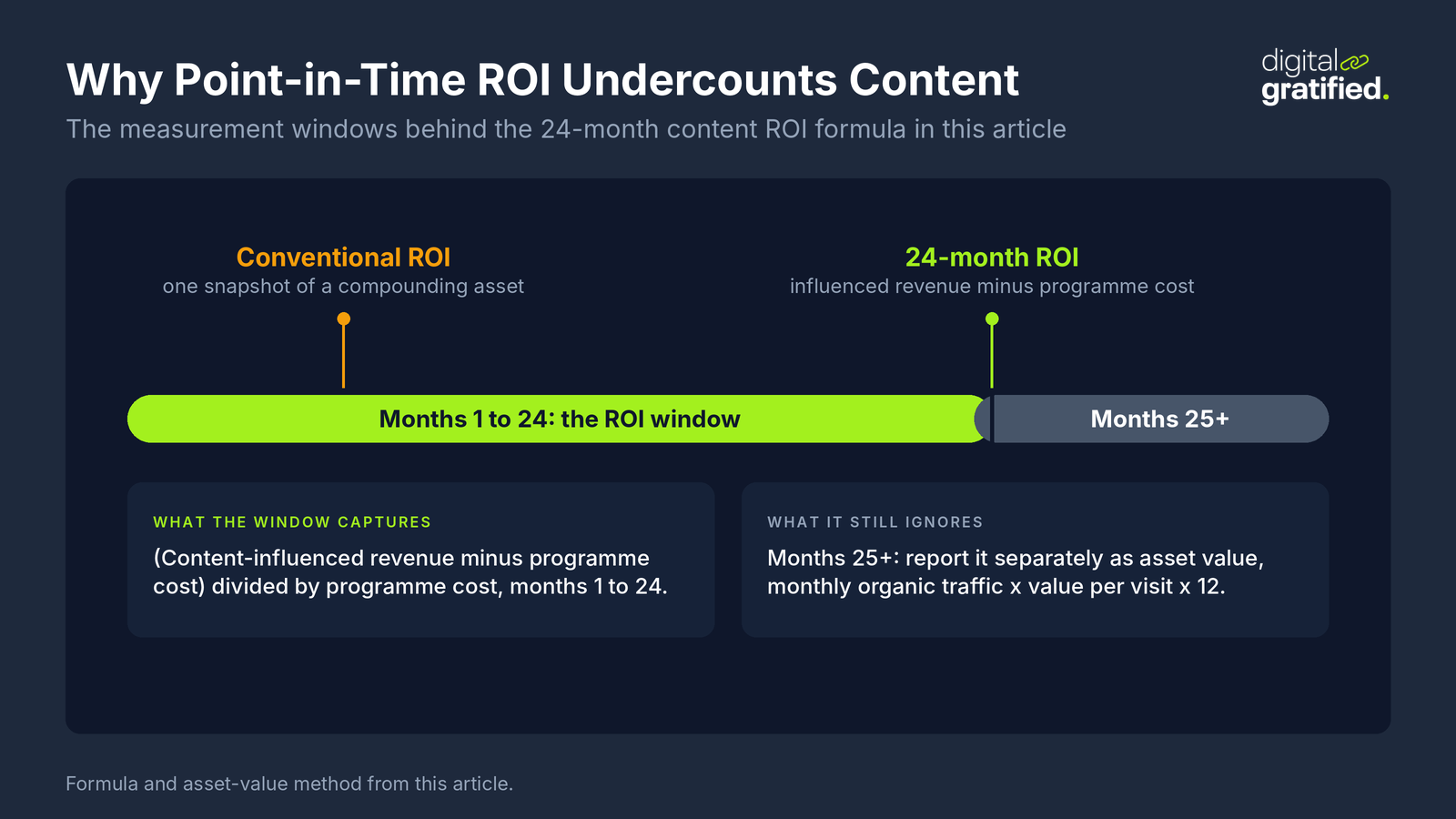
The conventional ROI formula (Revenue − Cost / Cost × 100) doesn't work well for content because it's a point-in-time calculation applied to a compounding asset. A better framework uses a 24-month horizon and accounts for the content asset's ongoing value:
Content ROI (24-month) =
(Total content-influenced revenue, months 1–24)
− (Total content programme cost, months 1–24)
÷ (Total content programme cost, months 1–24)
× 100
Even this calculation understates the return because it ignores months 25+, when content continues generating value without proportionally increasing cost. For leadership reporting, supplementing the ROI calculation with a separate "content asset value" estimate (current monthly organic traffic × estimated value per visit × 12) gives a sense of the ongoing asset value being built.
One important caveat: be transparent about the attribution assumptions your ROI calculation makes. Claiming full attribution for every deal where content appeared in the journey will produce inflated numbers that lose credibility when questioned. A more defensible approach is to apply a fractional attribution weight and document your methodology.
The Attribution Framework: What to Do When You Can't Track Everything
For most SaaS teams (those without enterprise attribution platforms or fully clean multi-touch CRM data) here's a practical three-level approach:
Level 1: Basic (Google Analytics + CRM)
Set up proper UTM parameters for all content distribution channels. Track organic traffic separately from other sources. Create goals in GA4 for all conversion events. In your CRM, add a "first content touch" field to record which content piece the contact engaged with first. This gives you first-touch attribution by content piece.
What you can report: Content-sourced leads, organic channel conversion rate, first-touch content attribution.
Level 2: Intermediate (GA4 + CRM + Content Engagement Tracking)
Add heatmap and scroll tracking. Implement lead scoring that includes content engagement signals. Tag leads in your CRM with all content they engaged with, not just the first. This enables approximate multi-touch attribution: which content pieces appear most frequently in the journeys of closed customers?
What you can report: Content-influenced pipeline (estimated), content pieces that appear most in closed-customer journeys, content contribution by funnel stage.
Level 3: Advanced (Full Attribution Platform)
Tools like HockeyStack, Dreamdata, or Factors.ai can connect anonymous content sessions to CRM contacts through probabilistic identity resolution, giving you true multi-touch attribution. This is the right investment for SaaS companies at $5M+ ARR where content is a meaningful acquisition channel and the ROI of better attribution visibility pays for the tooling.
What you can report: Revenue attribution by content piece, content channel ROI, LTV by acquisition channel.
What to Measure by Growth Stage
The right measurement focus shifts as your business grows. Tracking the wrong metrics for your stage wastes analytical capacity and leads to incorrect strategic decisions:
Pre-$1M ARR: Direction Over Precision
At this stage, your content programme is too early for meaningful pipeline attribution. The measurement job is validating that you're building an audience in the right segments: Are the right people finding your content? Are they engaging with it? Are any of them converting to trials or demos?
Focus metrics: organic traffic growth rate, content-to-trial conversion rate for your best-performing pieces, and keyword ranking progress for your 10–20 primary target terms.
$1M–$10M ARR: Build the Attribution Foundation
Now content is contributing meaningfully enough to measure. The priority is building the attribution infrastructure (CRM hygiene, UTM discipline, content engagement tracking) that will enable increasingly accurate reporting as the programme scales.
Focus metrics: content-influenced pipeline, content-sourced MQLs by channel, content channel CAC vs. paid channels, keyword coverage growth by intent category.
$10M+ ARR: Optimise and Defend
Content is an established channel. The measurement focus shifts to efficiency: which content types and topics produce the highest return? Where is content underperforming relative to its investment?
Focus metrics: content ROI by type, content-attributed revenue, LTV by acquisition channel, assisted conversion analysis (what content appears most in multi-touch journeys of high-LTV customers).
For SaaS companies at this stage evaluating how content and SEO investments connect to broader SaaS growth strategy, the measurement infrastructure built here is what enables confident reallocation of budget from lower-ROI channels to higher-ROI ones.
Building Your Measurement System: Step by Step
Step 1: Define What "Working" Means Before You Start Tracking
Before implementing any tracking, define the specific threshold that would mean content is "working" for your business at this stage. For a $2M ARR SaaS company, "working" might mean: organic traffic generates 20% of all demo requests within 18 months. For a $15M ARR company, it might mean: content channel CAC is within 2x of paid search CAC by end of year.
Having a pre-defined success threshold prevents two common failure modes: declaring success too early (when traffic grows but pipeline doesn't) and declaring failure too early (when early-period metrics look bad but the programme is building correctly).
Step 2: Set Up the Technical Foundation
Three requirements before you produce content at volume:
- UTM parameters Every content distribution channel should have clean, consistent UTM tagging so you can isolate organic from other sources.
- GA4 conversion events Define and implement tracking for every meaningful conversion action: demo request, trial sign-up, pricing page visit, newsletter sign-up.
- CRM first-touch field Add a field to your CRM that records which content piece or channel a contact first engaged with. This is the foundation of first-touch attribution.
Step 3: Identify Your Baseline
Document your baseline before the programme scales: current organic traffic by segment, current content-to-trial conversion rate, current content-influenced pipeline percentage, and current keyword rankings for 20–30 target terms. Without a baseline, you can't measure progress: you can only describe the current state.
Step 4: Build a Reporting Cadence
Different metrics operate on different timescales:
- Weekly: Technical issues, content publication status, new keyword rankings and ranking changes.
- Monthly: Organic traffic by segment, content conversion rates, new leads/trials from content, keyword coverage progress, domain authority progress.
- Quarterly: Content channel CAC vs. other channels, content-influenced pipeline, content ROI calculation, content type performance comparison, strategic decisions about which topics and formats to scale.
Step 5: Distinguish Programme Health from Individual Post Performance
One of the most common measurement mistakes in SaaS content marketing is evaluating individual pieces of content the same way you'd evaluate a paid ad. Content is a portfolio, not a campaign. Some pieces do SEO work (they rank for valuable terms and generate steady organic traffic for years). Some pieces do brand work (they get shared and attract backlinks). Some pieces do conversion work (they sit at the bottom of the funnel and convert evaluation-stage buyers).
Evaluate individual pieces against the job they were written to do, and evaluate the programme overall against pipeline and revenue metrics. Deleting "underperforming" content because individual post traffic is low is a common mistake that damages programmes doing exactly what they should.
The team at Digital Gratified works with SaaS companies on building content programmes that are measurable from the outset, with proper attribution setup, reporting cadences, and the SEO and link building infrastructure that connects content investment to organic pipeline. The measurement work and the programme work are designed together, not as an afterthought.
Frequently Asked Questions
How do you measure content marketing ROI for SaaS?
The most defensible approach uses a 24-month horizon, measures content-influenced pipeline rather than claiming full attribution, and accounts for the compounding nature of organic assets. Divide total 24-month content programme costs by total content-influenced revenue over the same period. Add a separate "content asset value" figure representing the ongoing monthly value of your organic traffic base to show what has been built, not just what was spent.
What are the most important metrics for SaaS content marketing?
The five that matter most: ICP-match organic traffic growth, content-to-trial/demo conversion rate, content-influenced pipeline value, content channel CAC compared to other acquisition channels, and commercial keyword coverage. These connect content activity to revenue outcomes and can be tracked without enterprise-level attribution infrastructure.
How long does it take to see ROI from SaaS content marketing?
Most B2B SaaS content programmes begin generating measurable pipeline contribution in months 9–18. Before that, the programme is building organic infrastructure (domain authority, indexed content, keyword rankings) that converts to attributable leads later. Companies that kill content programmes in months 3–6 are making decisions before the compound curve has started. Year 1 should be evaluated on leading indicators, not pipeline contribution. Understanding how SEO works for SaaS businesses and what realistic timelines look like helps set the right expectations for leadership before the programme starts.
What is a good conversion rate for SaaS content marketing?
Organic visitor to trial/demo conversion rates of 1–3% are typical for blog content targeting problem-aware audiences. High-intent bottom-of-funnel content can achieve 4–8%. If your overall content conversion rate is below 0.5%, prioritise conversion rate optimisation before producing more content.
How do you track content marketing attribution in SaaS?
Start with UTM parameters on all content distribution channels, CRM first-touch fields to record initial content engagement, and manual review of closed-customer journeys to identify which content pieces appear most frequently. As programme scale and revenue justify it, invest in a dedicated attribution platform that can stitch anonymous content sessions to CRM contacts through probabilistic identity resolution.
What content metrics should a SaaS marketer report to the CEO?
Three metrics belong in CEO-facing reporting: content-influenced pipeline (with a clear explanation of your attribution methodology), content channel CAC versus other acquisition channels, and organic keyword coverage progress for commercial-intent terms. Leave engagement metrics (time on page, social shares, newsletter open rates) in internal operational dashboards. If you're encountering common content marketing mistakes, confusing vanity metrics for business outcomes is consistently at the top of the list.
About the author
Let's Scale Your SaaS Together
Get a custom SEO and link building strategy tailored for your SaaS business.
Get SEO insights that actually move rankings
Link building tactics, case studies, and SaaS SEO playbooks. No fluff, no spam.
You're subscribed!
SEO and link building insights, straight to your inbox.