Most SaaS content fails not because it's poorly written, but because nobody sees it. Learn the complete content marketing framework including the distribution strategies that separate winners from the 80% of content that never ranks.

Founder, Digital Gratified
SaaS content marketing often fails for a reason that has nothing to do with writing quality. Around 80% of content published by B2B software companies never reaches the first page of Google, usually because it lacks the distribution strategy needed to compete.
Many companies spend $10,000+ per month creating content while investing almost nothing in getting it in front of anyone. The result is hundreds of posts with flat organic traffic and leaders convinced that content marketing doesn't work for them.
This guide focuses on the fix, the distribution and amplification strategies that separate the content that ranks from the content that doesn't. For the full 10-step framework from start to finish, see our SaaS content marketing strategy playbook.
What Is SaaS Content Marketing (Really)?
Most definitions frame SaaS content marketing as "creating valuable content to attract and convert prospects." That's technically accurate but dangerously incomplete.
A better definition: SaaS content marketing is the strategic creation and distribution of content that moves prospects through complex, multi-stakeholder buying decisions while building organic visibility that compounds over time.
The keywords are "distribution" and "compounds." Unlike paid advertising (which stops working the moment you stop paying), effective content marketing builds assets that continue delivering value for years. But only if those assets gain enough authority to rank and get discovered.
For B2B SaaS companies specifically, content marketing serves multiple functions:
Demand generation: Attracting prospects who don't yet know they need your solution
Demand capture: Ranking for high-intent keywords from buyers actively evaluating options
Sales enablement: Providing resources that help close deals faster
Customer success: Reducing churn through educational content
Brand building: Establishing thought leadership that differentiates from competitors
The challenge? Each function requires different content types, targeting different keywords, with different success metrics. A one-size-fits-all approach inevitably underdelivers across all objectives.
Why Most SaaS Content Marketing Fails (The "Publish and Pray" Trap)
Before diving into strategy, let's diagnose why most SaaS content marketing programs fail. Understanding these pitfalls helps you avoid them.
The Content-Link Disconnect
Here's the uncomfortable truth: content quality alone doesn't determine search rankings. Google's algorithm weighs backlinks heavily when deciding which content deserves top positions.
A mediocre article with 50 quality backlinks will outrank an exceptional article with zero backlinks, virtually every time. Yet most SaaS content marketing strategies treat content creation and link building as separate disciplines, often handled by different teams (or not handled at all).
The companies winning at content marketing understand that strategic link building isn't separate from content marketing: it's the distribution arm that makes content marketing work.
The "Publish and Pray" Workflow
The typical SaaS content marketing workflow looks like this:
Identify keywords
Create content
Publish
Share once on social media
Move on to the next piece
Wonder why traffic isn't growing
This "publish and pray" approach ignores a fundamental reality: organic social reach is essentially dead. Facebook Pages average 2-5% organic reach. LinkedIn company pages fare slightly better but still reach only a fraction of followers. Twitter/X? Negligible for most B2B brands.
Publishing content and sharing it once on social media is not a distribution strategy. It's wishful thinking.
The Wrong Content Prioritization
Many SaaS companies start content marketing by targeting high-volume, top-of-funnel keywords. It seems logical: more traffic means more opportunities, right?
In practice, this approach has serious flaws:
High-volume keywords are usually the most competitive
Top-of-funnel traffic converts at a fraction of bottom-of-funnel traffic
It can take years to rank for competitive terms without significant authority
ROI becomes impossible to demonstrate in reasonable timeframes
Smarter SaaS companies flip the funnel, starting with bottom-of-funnel content that converts, then working upward as they build authority and resources.
The SaaS Content Marketing Funnel: Strategy by Stage
Effective SaaS content marketing requires different approaches for different stages of the buyer journey. Here's how to think about content at each stage.
Bottom of Funnel (BOFU): Start Here
Counter-intuitively, the best place to start SaaS content marketing is at the bottom of the funnel, where buyers have the highest intent and content has the clearest ROI.
BOFU content types that work:
Comparison pages: "[Your Product] vs [Competitor]" or "[Competitor A] vs [Competitor B]"
Alternative pages: "[Competitor] Alternatives" for unhappy customers seeking options
Product pages: Optimized for category keywords ("project management software")
Use case pages: Targeting action-based searches ("how to track employee time")
Case studies: Proof that your product delivers results for companies like theirs
Why start here:
Lower competition (smaller search volumes mean fewer competitors)
Higher conversion rates (these searchers are actively evaluating)
Faster ROI demonstration (proving content marketing works builds internal support)
Foundation for internal linking (BOFU pages can be linked from future TOFU content)
A SaaS company creating five high-quality comparison pages will often generate more pipeline than one creating fifty generic blog posts.
Middle of Funnel (MOFU): Building the Business Case
Once BOFU content is covered, MOFU content helps prospects build internal consensus and justify the purchase decision.
MOFU content types that work:
ROI calculators and interactive tools: Let prospects quantify the value of switching
Industry benchmarks: Show how their performance compares to peers
Implementation guides: Reduce perceived switching costs
Feature deep-dives: Educate on capabilities they might not know they need
Buyer's guides: Position your criteria as the right criteria for evaluation
MOFU content serves a critical function: it gives your champion the ammunition to sell internally. The VP evaluating your tool needs content to share with their CFO, their team, and their leadership. Make that content easy to find and compelling to share.
Top of Funnel (TOFU): Building the Audience
TOFU content reaches prospects who don't yet know they need your solution, or that solutions like yours exist. This is where most companies start (mistakenly), but it's actually where you should expand once BOFU and MOFU are solid.
TOFU content types that work:
Industry trends and analysis: Establish thought leadership
Original research: Become a source that others cite (and link to)
How-to guides: Solve problems adjacent to your product's core value
Expert roundups: Borrow credibility while building relationships
Ultimate guides: Comprehensive resources that become bookmarked references
The TOFU trap to avoid: Don't create content that's too far removed from your product. If you sell accounting software, content about "best productivity apps" might drive traffic but won't drive qualified leads. Stay within one degree of separation from your core value proposition.
The Distribution Strategy Most Guides Skip
Here's where most SaaS content marketing advice falls short. Creating great content is only half the equation. Distribution is what determines whether anyone sees it.
The Distribution Budget Reality Check
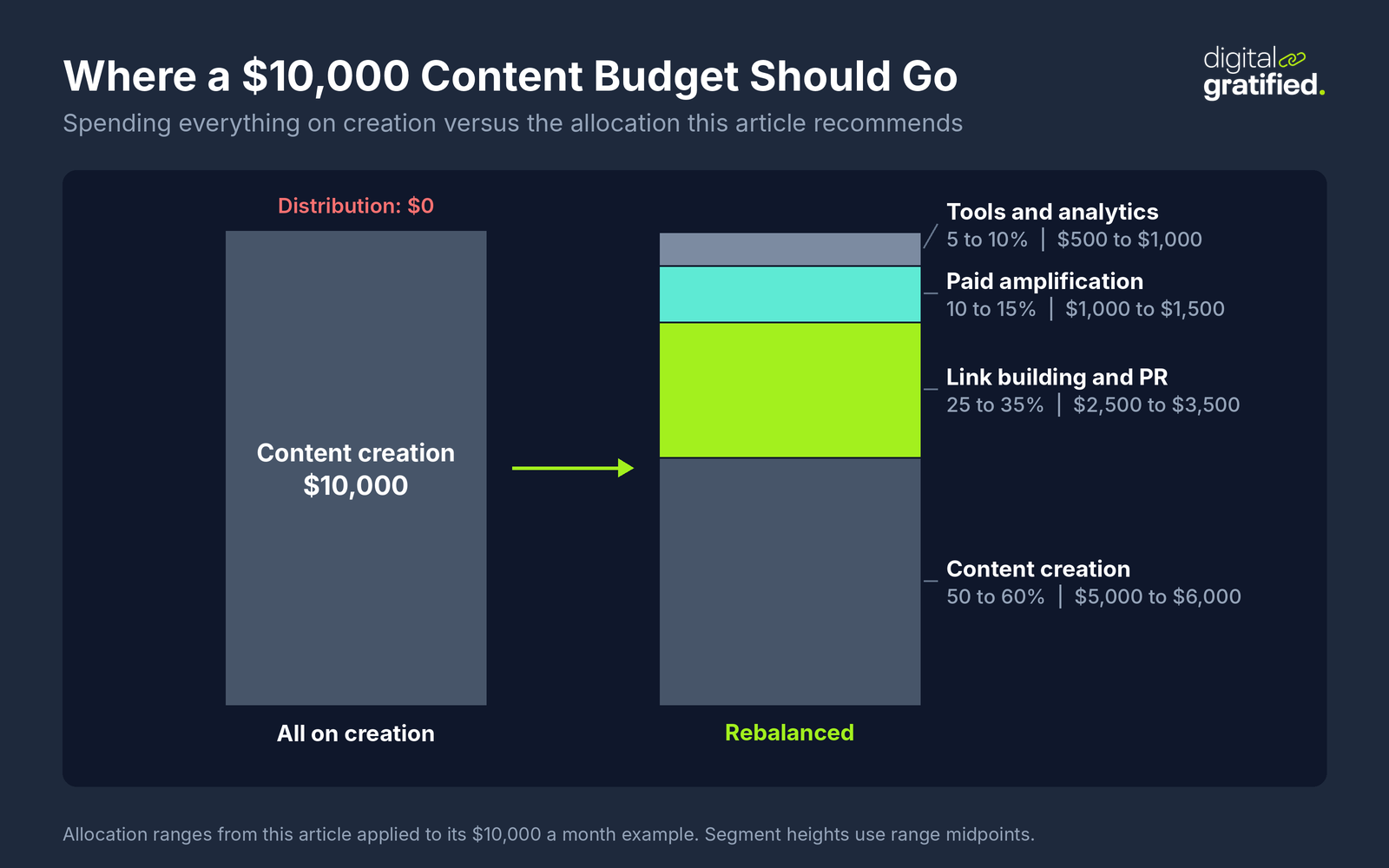
If you're spending $10,000/month on content creation and $0 on distribution, you're doing it wrong. A more realistic budget allocation:
ActivityRecommended AllocationWhat It CoversContent Creation50-60%Writers, editors, design, toolsLink Building/PR25-35%Outreach, placements, relationshipsPaid Amplification10-15%Content promotion, retargetingTools & Analytics5-10%SEO tools, analytics, optimization
Companies that allocate budget for link building and distribution consistently outperform those that pour everything into creation. For a detailed breakdown of what link building actually costs, see our complete link building pricing guide.
The Content-Link Connection
The most effective SaaS content marketers treat link building as integral to content strategy, not a separate SEO tactic. Here's how:
Before creating content:
Evaluate link-worthiness: Will journalists, bloggers, and industry sites want to reference this?
Identify outreach targets: Who would find this valuable enough to share?
Plan linkable assets: What data, tools, or unique insights can we include?
After publishing content:
Proactive outreach to relevant publications and journalists
Guest posting that references your new content
Broken link building to swap outdated resources for your fresh content
Unlinked mention conversion (find brand mentions without links and request addition)
This integrated approach means every piece of content has a distribution plan before it's written, not an afterthought once it's published.
Competitive Link Intelligence
Before creating content in competitive spaces, smart marketers analyze where competitors are getting their links. This reveals:
Which publications cover your space and what they link to
Content formats that earn links in your industry
Relationship opportunities (sites linking to competitors might link to you)
Content gaps where you can create superior link-worthy resources
Competitive backlink analysis isn't just about copying competitors: it's about understanding the landscape so you can create content with realistic ranking potential.
When Content Marketing ISN'T the Right Investment
Most guides won't tell you this, but content marketing isn't right for every SaaS company at every stage. Honest assessment prevents wasted resources.
Content Marketing May NOT Be Right If:
You don't have product-market fit yet: Content marketing amplifies what's working. If your product positioning is still evolving, you'll create content for the wrong audience or value props that change.
You can't commit for 6+ months: Content marketing compounds over time. Expecting results in 90 days is unrealistic. If budget or patience runs out at month 4, you'll abandon the strategy before it pays off.
Your buyers don't research online: Some enterprise sales are entirely relationship-driven. If your deals close through executive connections rather than inbound interest, content marketing ROI will be weak.
You have no distribution budget: As we've discussed, content without distribution is content nobody sees. If you can only afford creation without amplification, consider waiting until you can do both.
Your competition has insurmountable advantages: If you're entering a category dominated by $100M+ players with decade-old content libraries and DR 90+ domains, direct competition may be futile. Consider niche angles or alternative channels.
Better Alternatives When Content Marketing Doesn't Fit
If content marketing isn't right for your current situation, consider:
Outbound sales: Faster feedback loops, direct customer contact
Paid advertising: Immediate traffic (though not sustainable long-term)
Community building: Create audience through engagement rather than content
Partnership marketing: Leverage others' audiences through integrations and co-marketing
Product-led growth: Let the product market itself through freemium or viral mechanics
Recognizing when content marketing isn't the answer is as valuable as executing it well when it is.
Building Your SaaS Content Marketing Team
Successful SaaS content marketing requires specific capabilities. Here's how to think about team structure.
Core Roles You Need
RolePrimary ResponsibilityIn-House vs. OutsourceContent StrategistKeyword research, content planning, funnel mappingIn-house preferredContent WritersCreating the actual contentMix (in-house for core, freelance for scale)EditorQuality control, brand voice consistencyIn-house preferredSEO SpecialistTechnical optimization, keyword trackingCan be outsourcedLink Builder/OutreachDistribution, relationship buildingOften outsourced to specialistsDesignerVisual assets, infographicsShared resource or freelance
The In-House vs. Agency Decision
For link building specifically, many SaaS companies benefit from agency partnerships. Quality agencies bring:
Existing relationships with publications
Proven outreach processes refined across many clients
Capacity to scale without hiring
Specialized expertise that's expensive to develop internally
For companies considering this route, Digital Gratified specializes in SaaS link building with proven results for B2B software companies.
The hybrid model (internal content creation with agency-supported distribution) often delivers the best balance of quality, control, and results.
Top SaaS Content Marketing Agencies
If you decide to outsource content marketing, choosing the right agency is critical. Here is our own verified track record in SaaS content marketing:
AgencyClutch RatingNotable ClientsStarting PriceSpecialtyDigital Gratified4.9/5 (18 reviews)B2B SaaS companies$1,000+Content + Link Building integration
Data sourced from Clutch.co verified reviews and agency websites.
What to Look for in a SaaS Content Marketing Agency
When evaluating agencies, prioritize these factors:
SaaS-specific experience: They understand long sales cycles, technical audiences, and multi-stakeholder decisions
Integrated distribution: They don't just create content: they have a plan to get it seen
Transparent methodology: They can explain exactly how they'll drive results
Case studies with metrics: Traffic and rankings matter, but pipeline and revenue matter more
Realistic timelines: Any agency promising results in 30 days is selling snake oil
The best agencies function as extensions of your team, not vendors who disappear after delivering content. Look for partners who understand your business goals, not just your keyword targets.
Measuring SaaS Content Marketing Success
Content marketing ROI is notoriously difficult to measure. Here's a practical framework.
Leading Indicators (Track Monthly)
Organic traffic growth: Are more people finding your content?
Keyword rankings: Are target keywords moving up?
Backlink acquisition: Is your content earning links?
Time on page/engagement: Does your content hold attention?
Content production velocity: Are you hitting publishing targets?
Lagging Indicators (Track Quarterly)
Marketing qualified leads (MQLs): Are visitors converting?
Pipeline influenced: Which deals engaged with content?
Customer acquisition cost (CAC): Is organic reducing paid dependency?
Domain authority: Is your overall SEO strength growing?
Realistic Timeline Expectations
SaaS content marketing is a long game. Here's what realistic expectations look like:
TimelineRealistic ExpectationsMonth 1-3Foundation: Strategy, content production begins, minimal traffic impactMonth 4-6Early signals: Some keywords ranking, first organic leads, process refinementMonth 7-12Acceleration: Traffic growth visible, conversion optimization, expanding topicsYear 2+Compounding: Strong rankings, consistent lead flow, expanding market coverage
Companies expecting transformative results in 90 days will be disappointed. Those committed to 12-24 month horizons often achieve outsized returns as compounding effects kick in.
Putting It All Together: The Complete SaaS Content Marketing Checklist
Here's a practical checklist for building a SaaS content marketing engine that actually works:
Strategy Phase
Define ICP and understand their research behavior
Map content to funnel stages (prioritize BOFU first)
Conduct competitive content and backlink analysis
Allocate budget across creation AND distribution
Set realistic 12-month goals and milestones
Execution Phase
Create content calendar with clear ownership
Develop content briefs that include link-building angles
Build quality control processes (editing, SEO review)
Establish publishing workflow with optimization checklist
Create distribution playbook for each content type
Distribution Phase
Plan outreach targets before content creation
Execute link-building campaigns alongside publishing
Develop guest posting relationships with relevant publications
Monitor competitive link opportunities
Track and attribute results to specific efforts
Optimization Phase
Review performance monthly against leading indicators
Refresh underperforming content quarterly
Double down on topics and formats that work
Eliminate or pivot strategies that don't produce
Continuously build internal linking between content
Final Thoughts: Content Marketing as Competitive Moat
For SaaS companies willing to invest for the long term, content marketing creates one of the most defensible competitive advantages in business. Unlike paid advertising (which stops working the moment you stop paying) content assets compound. Unlike sales teams (which require linear investment for linear growth) organic traffic scales without proportional cost increases. (For actionable advice on this topic, see our guide on how to grow a SaaS business.)
But the key word is "invest." Half-measures don't work. Publishing content without distribution strategy doesn't work. Expecting results in 90 days doesn't work. Treating content and SEO as separate disciplines doesn't work.
The SaaS companies winning at content marketing understand that it's a system: strategy, creation, distribution, and optimization working together. They allocate resources across all components, not just the most visible one (creation). They commit to timelines measured in years, not quarters.
For those willing to make that commitment, the payoff is substantial: predictable organic traffic, lower customer acquisition costs, stronger brand positioning, and a competitive moat that's expensive and time-consuming for competitors to replicate.
Ready to build your content marketing engine? Start with the fundamentals: understand your audience, create content that serves their needs, and invest as much in distribution as you do in creation. The companies that master all three will own their markets.
About the author
Let's Scale Your SaaS Together
Get a custom SEO and link building strategy tailored for your SaaS business.
Get SEO insights that actually move rankings
Link building tactics, case studies, and SaaS SEO playbooks. No fluff, no spam.
You're subscribed!
SEO and link building insights, straight to your inbox.