The 8% of ARR benchmark is real, but it's also nearly useless for setting your actual marketing budget. This guide explains why, separates the two different budget figures most articles confuse, and gives you a framework to derive the right number from your own growth targets.

Founder, Digital Gratified
How much do SaaS companies spend on marketing? The most-cited benchmark is 8% of ARR, from SaaS Capital's annual survey of 1,000+ private B2B SaaS companies. It's real data, but on its own it won't tell you what your company should spend.
This guide covers the real benchmarks, including where the 8% figure comes from and who it represents, explains the most common source of confusion in SaaS marketing spend data, and gives you a framework for deriving the right budget from your own situation rather than an industry median.
The Two "How Much Do SaaS Companies Spend on Marketing" Numbers: And Why They're Different
Before citing any benchmark, it helps to understand that there are two completely different figures commonly reported under the same question:
Figure 1: Marketing department spend as a % of ARR. This is the figure behind the 8% benchmark. It's the budget allocated specifically to the marketing function: people, programs, tools, and content. The 2025 median for private B2B SaaS is 8% of ARR.
Figure 2: Combined Sales & Marketing as a % of revenue. This is what you see in public company S-1 filings and investor benchmarking reports. It bundles your entire revenue-generating cost centre together. The typical range for this figure across SaaS businesses is 30–50% of revenue at scale, with early-stage companies often exceeding that.
Most articles either use one or the other without distinguishing them, which is why you'll read "SaaS companies spend 8% on marketing" in one place and "SaaS companies spend 38–50% on sales and marketing" in another. Both numbers are correct. They're measuring completely different things. If you're confused about how much to budget, there's a good chance it's because you've been reading both figures as if they were comparable.
For the rest of this article, we'll focus on marketing-specific spend (the function budget, not the combined S&M income statement line), which is what most marketing leaders actually control.
2025 SaaS Marketing Spend: What the Data Actually Shows
The most comprehensive recent data comes from SaaS Capital's 2025 survey of 1,000+ private B2B SaaS companies, completed in March 2025. Here's what it shows:
The Headline Numbers
Median marketing spend (all companies): 8% of ARR, unchanged from the prior year
Median selling costs: 13% of ARR, up from 10.5% the prior year
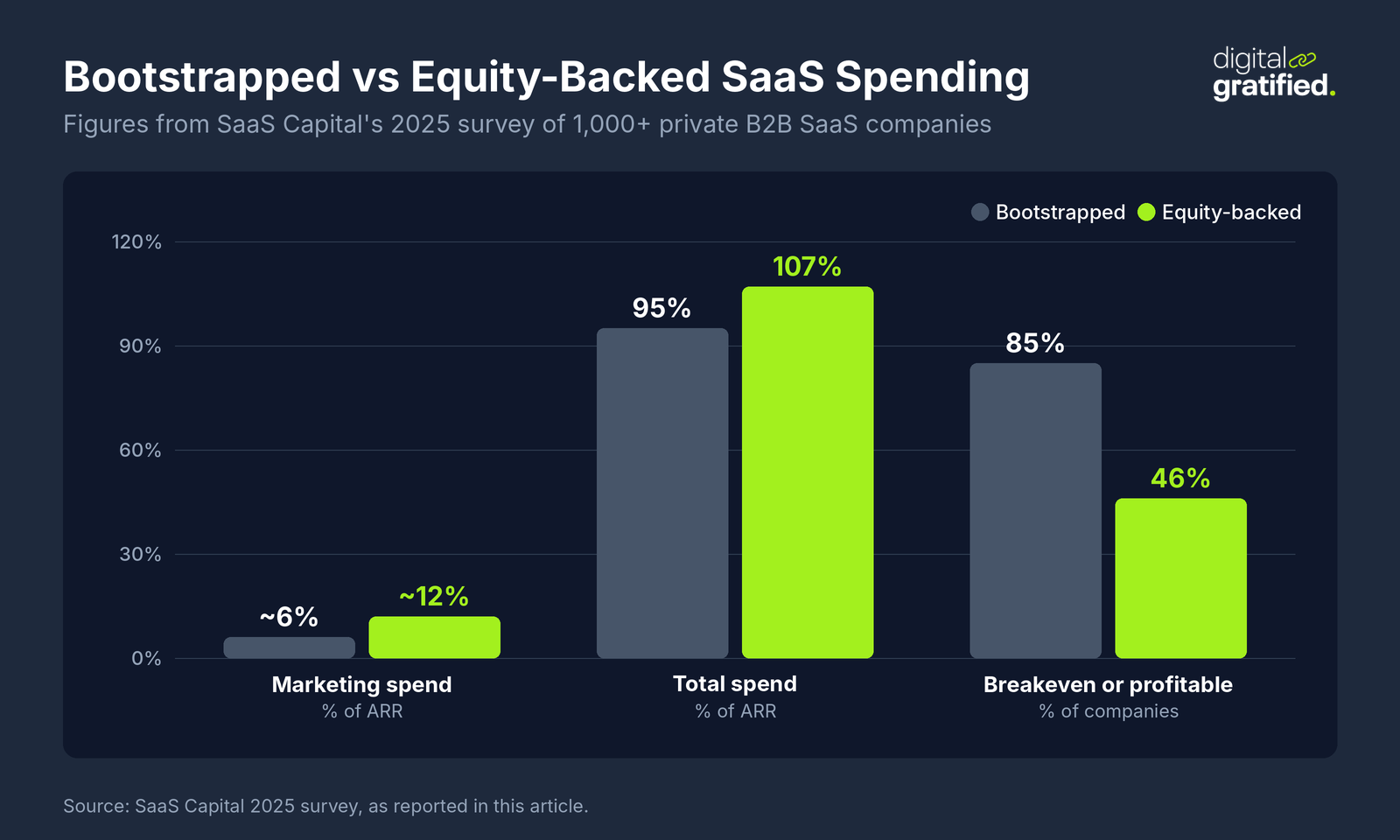
Median total spend (all categories): 95% of ARR for bootstrapped companies, 107% for equity-backed companies
% of bootstrapped companies at breakeven or profitable: 85%
% of equity-backed companies at breakeven or profitable: 46%
By Funding Type
The funding source variable produces the most dramatic differences in marketing spend:
Bootstrapped companies: approximately 6% of ARR on marketing
Equity-backed companies: approximately 12% of ARR on marketing
Equity-backed companies spend roughly 100% more on marketing than bootstrapped ones. This isn't just because venture-backed companies are more growth-minded; it's because their capital structure demands it. VC returns require category-defining growth rates, which typically require acquisition spend that bootstrapped P&Ls can't sustain. The 8% median is a blend of these two groups.
By Growth Rate
Splitting each funding type at its median growth rate shows another gap: higher-growth companies spend approximately 40% more on marketing than lower-growth counterparts, within both the bootstrapped and equity-backed cohorts. This is useful context: the companies growing fastest are not simply better at marketing; they're also outspending their lower-growth peers significantly.
By ARR Scale
Spending patterns shift meaningfully as companies grow:
$3M–$5M ARR: Median marketing spend ~7% of ARR; selling costs ~15%; R&D ~20%; G&A ~15%
Larger companies ($15M+ ARR): Marketing percentage tends to compress as the denominator grows and the brand does more of the work that paid acquisition previously had to do
The R&D figure is worth highlighting: at 22% of ARR (up from 18% the prior year), R&D is the single largest non-COGS spend category for most SaaS companies, dwarfing the marketing budget. This context matters when marketing teams are defending budget in planning cycles.
Why the 8% Benchmark Doesn't Tell You What to Spend
Here's the core problem with using the 8% figure as a budget target: it tells you what the median private B2B SaaS company spends. It doesn't tell you what the median company should spend, or what you should spend, given your specific growth targets, competitive environment, CAC dynamics, and channel mix.
The companies spending 6% of ARR on marketing and the companies spending 15% are not doing the same thing. They have different growth ambitions, different channel mixes, different competitive pressures, and different underlying unit economics. Averaging them together produces a number that accurately describes no individual company in the dataset.
There's also a selection bias in any survey of "what companies spend": it captures what companies did, not what drove the best outcomes. A company spending 12% on marketing and growing at 50% YoY is in the same dataset as a company spending 12% and shrinking. The spend figure alone tells you nothing about whether it was the right call.
The Right Starting Point: Work Backwards from Your Growth Target
Rather than starting with "what do other companies spend?", a more useful approach starts with your growth target and works backwards through your unit economics to determine what your marketing budget needs to be to achieve that target. This is the framework that finance teams in well-run SaaS companies actually use:
Step 1: Define Your Growth Target in Absolute Terms
Convert your growth target from a percentage into an ARR number. If you're at $2M ARR and targeting 60% growth, you need to add $1.2M in net new ARR this year.
Step 2: Account for Churn
If your annual logo churn is 15%, you need to replace $300K in lost ARR before generating any new growth. Your gross new ARR target is $1.5M.
Step 3: Calculate Required Leads from Your Funnel Conversion Rates
Work backwards through your funnel. If your average contract value is $15K ARR, you need 100 new customers. If your close rate (demo → closed-won) is 25%, you need 400 demos. If your lead-to-demo rate is 20%, you need 2,000 qualified leads.
Step 4: Determine Your Blended Channel CAC
Across your actual channel mix, what does it cost to acquire one customer? This is your customer acquisition cost (CAC). If your blended CAC is $8,000, acquiring 100 customers requires $800K in sales and marketing spend.
Step 5: Separate Sales and Marketing Components
Of that $800K, split it between sales-facing costs (sales compensation, commissions, tools) and marketing-facing costs (content, paid acquisition, events, tools, agency fees). The split varies by motion: product-led growth companies are often marketing-heavy; enterprise SaaS companies are often sales-heavy.
This backward calculation may produce a marketing budget that's 6% of ARR, or 14%, or 20%, depending entirely on your funnel economics. That's fine, and that's the point. The right budget is the one that funds your growth target at acceptable unit economics, not the one that matches the median of companies with completely different circumstances.
What SaaS Companies Spend on Marketing: By Stage
While the backward calculation is the right methodological approach, stage-based benchmarks are useful for a sanity check. Here's how spending tends to look across funding rounds:
Seed / Pre-Series A
Marketing spending is highly variable at this stage and often driven by the founding team's own skills rather than a deliberate channel strategy. Many pre-Series A SaaS companies rely primarily on founder-led outreach and early content, spending well below 8% of ARR on formal marketing programs while the CAC model is still being validated. Companies that raise seed rounds and move aggressively on customer acquisition might spend 15–30% of ARR on marketing at this stage.
Series A to Series B
This is typically when dedicated marketing teams form and systematic channel investment begins. Marketing budgets in the 10–25% of ARR range are common for companies that raised capital to grow, particularly if they're in competitive categories where brand-building and demand generation need to happen simultaneously. Companies at this stage spending below 8% are often either product-led (organic virality is doing the work) or capital-constrained.
Series B to Series C
Channel clarity tends to arrive by this point: teams know which two or three channels drive most of their pipeline. Marketing spend often lands in the 10–20% range, with more efficient allocation replacing the experimental scatter of earlier stages. The absolute budget grows significantly even if the percentage holds steady.
Series D and Beyond / Late-Stage
Marketing spend as a percentage of ARR typically compresses to 6–12% at this stage. The company's brand carries more of the acquisition load, the customer base generates referrals, and the absolute size of the denominator means even efficient marketing programs can seem small as a percentage. Enterprise SaaS at this stage tends to shift more budget from digital programs toward field marketing and events.
The Bootstrapped Track
Bootstrapped SaaS companies consistently spend less on marketing both in absolute terms and as a percentage of ARR. The median is approximately 6%, but the more important observation is that bootstrapped companies favour long-duration, compounding channels (content, SEO, community, referrals) over short-duration, paid channels. This isn't because they prefer efficiency in the abstract; it's because they can't sustain the cash flow profile of heavy paid acquisition. Content and SEO investments serve a strategic function here that goes beyond their individual ROI.
Where Does the Marketing Budget Go? Channel Allocation
Knowing the total budget matters less than knowing how to allocate it. Channel allocation varies significantly by stage and motion, but some patterns hold across the data:
Paid Search (SEM/PPC)
Historically the largest single line item in SaaS digital marketing budgets, and still dominant for companies in competitive categories with high-intent search volume. The challenge in 2025 is escalating CPCs for SaaS keywords: cost-per-click for competitive B2B SaaS terms has risen significantly, which has compressed the CAC advantage paid search once had over organic acquisition for many companies. Budget allocation here typically ranges from 20–40% of the digital marketing budget for demand-gen focused teams.
Content and SEO
The investment case for content and SEO has strengthened as paid search costs have risen. Unlike paid acquisition (which generates results proportional to current spend and stops when spend stops), content assets compound over time, generating increasing organic traffic and leads without proportional cost increases. For SaaS companies thinking seriously about how SEO works for SaaS businesses, this compounding dynamic is the central argument for allocating more budget to organic acquisition earlier.
Budget allocation for content and SEO typically ranges from 15–30% of digital marketing spend, with bootstrapped companies and later-stage companies often allocating more to this category relative to paid acquisition.
Events and Field Marketing
Trade shows, virtual summits, executive dinners, and co-marketing events take a larger share of budget at later stages and in more enterprise-oriented products. They're inefficient per lead but highly efficient at generating qualified pipeline from accounts that are already in evaluation mode. Many B2B SaaS marketing teams at Series C and beyond allocate 20–30% of total marketing budget to events.
Product Marketing and Brand
Often underfunded at early stages and corrected at later stages, product marketing and brand investment covers positioning, competitive intelligence, launch programmes, and brand campaigns. It's notoriously difficult to attribute directly to pipeline, which is why it gets cut in planning cycles, but underfunded product marketing shows up as messaging inconsistency, high sales cycle friction, and poor competitive win rates.
Tools and Marketing Operations
CRM, marketing automation, attribution platforms, SEO tools, analytics, and the people who run them. This category gets squeezed at early stages and tends to balloon at later stages as data infrastructure investments compound. The investment in attribution infrastructure specifically is worth making earlier than most teams do: it pays back in better channel allocation decisions across the life of the programme. This connects directly to the infrastructure needed to measure SaaS content marketing ROI accurately over time.
Link Building and Domain Authority
Often the most overlooked line item in SaaS marketing budgets, particularly for companies relying on organic search as a meaningful acquisition channel. Building domain authority through high-quality backlinks is what separates SaaS companies that rank for competitive commercial keywords from those that produce excellent content that nobody finds. Teams working with an agency like Digital Gratified on SEO and link building typically treat this as a consistent monthly investment rather than a periodic project, because authority compounds the same way content does.
The Efficiency Question: Spend vs. Outcome
The most important shift in how sophisticated SaaS finance teams evaluate marketing budgets is moving from "what percentage of ARR are we spending?" to "what is our marketing-sourced CAC and how does it compare to customer LTV?"
A company spending 12% of ARR on marketing with a blended CAC of $4,000 and average customer LTV of $40,000 is running a dramatically better programme than a company spending 8% of ARR with a CAC of $18,000 and LTV of $25,000. The percentage benchmark tells you nothing about which company is making a better investment.
The LTV/CAC ratio is the underlying metric that determines whether your marketing budget is appropriately sized:
LTV/CAC below 2x: Marketing budget is probably oversized relative to what the unit economics can support, or there are efficiency problems in the funnel that budget alone won't solve
LTV/CAC of 3–5x: The generally accepted healthy range for B2B SaaS, marketing and sales spend is generating sustainable returns
LTV/CAC above 5x: The counterintuitive signal: you might be under-investing in marketing. Companies with high LTV/CAC ratios can often profitably increase acquisition spend significantly
The payback period (how many months of gross margin it takes to recover CAC) is the companion metric. Investors in B2B SaaS typically look for payback periods under 18–24 months; sub-12-month payback indicates significant room to invest more aggressively.
The Five Most Common SaaS Marketing Budget Mistakes
Across the data and conversations with SaaS marketing teams at various stages, five mistakes show up repeatedly:
1. Using the industry median as the default target. As discussed above, the 8% figure is a description of what companies do, not a prescription for what you should do. Building a budget around matching the median rather than funding your growth target produces a number untethered to your actual situation.
2. Front-loading paid acquisition before organic infrastructure exists. Paid acquisition generates leads immediately, which makes it seductive for teams under pressure. But it also generates leads only for as long as you're paying. Companies that invest in content and SEO foundations before scaling paid spend end up with a more defensible, lower-CAC acquisition engine. Avoiding this is one of the most common pieces of advice in any honest SaaS content marketing mistakes breakdown.
3. Treating the marketing budget as a variable cost to cut in downturns. Marketing budgets are among the first to get cut when growth slows. This is often the wrong move, and it's particularly destructive for organic channels, where investment continuity is what generates compounding returns. Cutting content and SEO investment in Q3 produces compounding negative effects that show up as declining organic traffic in Q1 of the following year.
4. Conflating activity with investment. Producing more content, running more campaigns, and attending more events are activities. The budget funding those activities is an investment. Investments require ROI analysis; activities tend to accumulate. The best marketing budget reviews start by asking which investments produced measurable returns, not by asking what activities need to continue.
5. Under-investing in link building while expecting organic results. SaaS companies often invest in content and SEO copywriting while allocating nothing to off-page authority building. Content ranking for competitive commercial keywords requires domain authority that comes from earned backlinks, not from publishing volume alone. The most efficient approach is an integrated programme where link building investment runs alongside content production from the outset, not as an afterthought once rankings plateau.
Quick Reference: 2025 SaaS Marketing Spend Benchmarks
A summary of the data points covered in this article, for quick reference:
Median marketing spend, private B2B SaaS (2025): 8% of ARR (SaaS Capital, 1,000+ companies)
Bootstrapped companies: ~6% of ARR on marketing
Equity-backed companies: ~12% of ARR on marketing (100% more than bootstrapped)
Higher-growth companies vs. lower-growth (same funding type): ~40% more marketing spend
$3M–$5M ARR median marketing allocation: 7% of ARR
Seed to Series A typical range: 10–30% of revenue on marketing
Series B–C typical range: 10–20% of revenue
Series D+ / late-stage typical range: 6–12% of revenue
Combined S&M (income statement line, not just marketing): 30–50% of revenue at growth stage
Healthy LTV/CAC range: 3–5x
Target CAC payback period: under 18–24 months; sub-12 months indicates room to invest more
The Bottom Line
The answer to "how much do SaaS companies spend on marketing?" is 8% of ARR for the median private B2B SaaS company, and roughly double that for equity-backed, high-growth companies. But the more useful question is: "what budget does my specific growth target require, at my current unit economics?" That calculation starts with your ARR target and works backwards through CAC, conversion rates, and channel mix, not forwards from an industry average.
The companies that consistently build efficient acquisition engines don't benchmark their way to a marketing budget. They model their growth target, validate their funnel economics, choose channels that match their CAC tolerance, and then invest consistently in the compounding assets (content, SEO, domain authority) that make paid acquisition cheaper over time rather than more expensive.
Frequently Asked Questions
How much do SaaS companies spend on marketing on average?
The median for private B2B SaaS companies is 8% of Annual Recurring Revenue. Equity-backed companies spend approximately 12% of ARR; bootstrapped companies spend approximately 6%. These figures cover the marketing function budget only, not combined sales and marketing.
What percentage of revenue should a SaaS startup spend on marketing?
There's no universal answer, but early-stage SaaS companies that have raised capital to grow typically spend 10–25% of ARR on marketing while building channel clarity and customer acquisition infrastructure. The right number is derived from your growth target divided by your funnel conversion rates and CAC, not from the industry median.
What is a typical SaaS sales and marketing budget?
Combined sales and marketing as a percentage of revenue is a different (and larger) figure than marketing alone. Early-stage SaaS companies typically run combined S&M at 30–50% of revenue; mature, profitable SaaS companies often run it at 20–30%. Enterprise SaaS companies like DocuSign have run S&M as high as 37–40% of revenue while at significant scale, justified by strong LTV/CAC ratios.
How do bootstrapped SaaS companies approach marketing spend differently?
Bootstrapped companies spend less in absolute terms (roughly 6% of ARR vs 12% for equity-backed) and favour channels that compound over time (content, SEO, community, and referrals) over paid acquisition. This isn't purely a philosophical preference; it reflects the cash flow reality of funding growth from revenue rather than from investment capital. Understanding SaaS growth strategy for bootstrapped companies requires understanding that the channel mix question and the budget size question are intertwined in a way they aren't for VC-backed businesses.
When should a SaaS company increase its marketing budget?
The signal to increase marketing investment is an LTV/CAC ratio above 4–5x and a CAC payback period under 12 months. These metrics indicate that each marketing dollar is generating significantly more value than it costs, and that the business can profitably acquire customers faster than it currently is. Companies that cut marketing budgets when growth slows, and whose core problem is actually an underinvestment in acquisition, often compound their growth problem rather than solving it.
About the author
Let's Scale Your SaaS Together
Get a custom SEO and link building strategy tailored for your SaaS business.
Get SEO insights that actually move rankings
Link building tactics, case studies, and SaaS SEO playbooks. No fluff, no spam.
You're subscribed!
SEO and link building insights, straight to your inbox.