Most SaaS marketing advice teaches you to chase the same channels everyone else uses. This comprehensive guide reveals how to build marketing moats: compound authority through SEO, strategic link building, and thought leadership that makes every other channel work harder.

Founder, Digital Gratified
A strong B2B SaaS marketing strategy does more than copy the channels every competitor already uses. Blog posts, ads, LinkedIn and email all have a place, but when everyone runs the same playbook, nobody stands out and customer acquisition costs keep climbing.
The SaaS companies winning today build marketing moats, advantages that get stronger over time instead of weaker. Think of it like planting a tree instead of buying flowers. Flowers look great for a week, while a tree takes longer to grow but provides shade for decades.
This guide shows you how to build marketing that compounds, how it fits alongside a structured SaaS content marketing strategy, and how to make every dollar you spend today work harder tomorrow.
Why Most SaaS Marketing Doesn't Work
Before we talk solutions, let's be honest about the problems. Most SaaS marketing fails, and the data proves it:
Only 29% of SaaS companies say their content marketing actually works, even though almost all of them have blogs
It now costs $2.82 to bring in $1 of new revenue, up from $2 just two years ago
More than half of marketers admit their messaging is too complicated
Why is this happening? Five common mistakes:
1. Doing Random Tactics Without a Plan
Posting a blog here, running an ad there, hoping something works. Without a clear plan connecting your activities to actual sales, you're just throwing money at the wall.
2. Talking About Features Instead of Benefits
"AI-powered." "Cloud-native." "Scalable." These words are on every SaaS website. When you sound like everyone else, potential customers tune out. They want to know: what problem do you solve for them?
3. Chasing New Customers While Ignoring Current Ones
Most marketing teams obsess over getting new customers. But keeping your existing customers happy is 5-7x cheaper than finding new ones, and happy customers refer others.
4. Measuring the Wrong Things
Likes, followers, and page views feel good but often don't lead to sales. If you can't connect your marketing activities to actual revenue, you're probably tracking the wrong numbers.
5. No Long-Term Advantage
If your competitors can copy everything you're doing in a month, you don't have an advantage. The companies winning aren't just doing marketing better: they're building something their competitors can't easily replicate.
The Marketing Moat: What It Is and Why It Matters
A marketing moat is like a competitive advantage that grows stronger over time. Unlike paid ads (which stop working the moment you stop paying), a marketing moat builds on itself: each investment makes the next one more powerful.
Think of it like your credit score. A good credit score takes years to build, but once you have it, everything becomes easier: better loan rates, more options, less hassle. A marketing moat works the same way for your business.
There are three layers to building a marketing moat:
Layer 1: Your Foundation (Getting Found Online)
This is about making sure people can find you when they search for solutions you provide. The stronger your foundation, the more often you show up in search results, and the more people trust what they find.
Your foundation gets stronger when:
Other reputable websites link to your content
You consistently publish helpful, relevant information
People search for your company by name
Think of each quality link to your site as a vote of confidence. The more votes you have from respected sources, the more Google (and now AI tools like ChatGPT) trust and recommend you.
Layer 2: Your Reputation (Becoming the Go-To Expert)
Once people can find you, you want them to see you as the expert in your space, not just another option. This comes from:
Original insights: Sharing data or perspectives nobody else has
Helpful content: Answering the questions your customers actually ask
Visible experts: Having real people (founders, team members) who share their knowledge publicly
When you're seen as the expert, everything else becomes easier. Journalists quote you. Podcasts invite you. Customers seek you out instead of you chasing them.
Layer 3: Your Trust (Becoming the Obvious Choice)
The top layer is when your reputation becomes so strong that people choose you almost automatically. They search for you by name. Friends recommend you. Customers become fans who spread the word.
This takes years to build, which is exactly why it's valuable. A competitor can copy your website in a week. They can't copy a decade of trust-building.
Why SEO Is Your Most Important Investment
SEO (Search Engine Optimization) is often treated as just another marketing channel: something to "do" alongside ads and social media. But that misses the point.
SEO is really the foundation everything else sits on. When your website has a strong reputation with Google, everything you do works better:
Your content reaches more people because it ranks higher in search
Your ads cost less because you're not competing for every click
Journalists are more likely to quote you because they see you as credible
AI tools recommend you because they pull from authoritative sources
For the order to build pages in, starting with the searches buyers run while they shortlist vendors, see our B2B SEO playbook for SaaS teams.
A Simple Example of How This Compounds
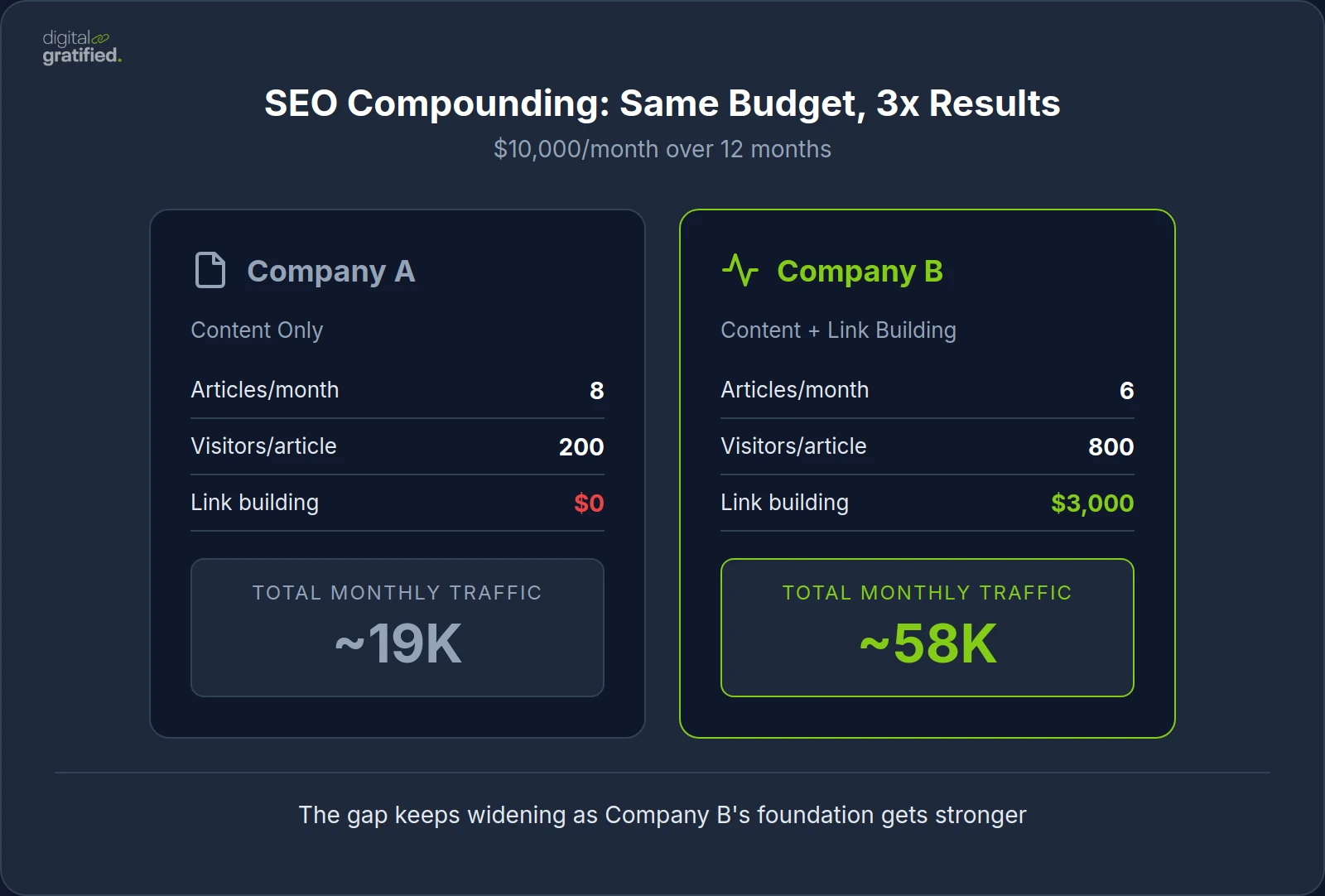
Imagine two similar companies, both spending $10,000/month on marketing:
Company A spends it all on content, publishing 8 articles per month. After a year, each article gets about 200 visitors monthly. Total: roughly 19,000 visitors/month.
Company B spends $7,000 on content (6 articles) and $3,000 building their site's reputation through editorial link building. After a year, their stronger foundation means each article gets 800 visitors monthly. Total: roughly 58,000 visitors/month.
Same budget, 3x the results. And the gap keeps widening because Company B's foundation keeps getting stronger.
Building Your Foundation Takes Time: That's the Point
Link building (getting other quality websites to link to yours) is the main way to strengthen your foundation. But it takes 12-24 months to see major results.
This is actually good news. Because it takes time, your competitors can't just throw money at it and catch up instantly. The companies that start building now will have an advantage for years.
For a realistic look at what this costs and what to expect, see our guide to link building pricing. For specific tactics that work for software companies, our SaaS link building guide breaks it all down.
What's Different About Marketing in 2026
The marketing landscape is shifting fast. Here's what matters now:
AI Is Changing How People Find Information
More than half of Google searches now end without anyone clicking a link. People get answers directly from AI summaries, featured snippets, or tools like ChatGPT.
The good news? AI tools pull their information from trustworthy, authoritative sources, exactly what you're building with a marketing moat. Companies with strong foundations get recommended by AI, not just found in search results.
There's Too Much Content (But Most of It Is Mediocre)
Over 30,000 SaaS companies are fighting for attention. AI has made it easy to pump out generic articles. The result? A flood of forgettable content.
The way to stand out isn't more content: it's better content with a real plan for avoiding the usual SaaS content mistakes that includes distribution:
Original data nobody else has
Strong opinions backed by evidence
Useful tools (calculators, templates, assessments)
Video and audio that builds personal connection
Attracting Customers Beats Chasing Them
The numbers are clear:
Content that attracts customers converts at 14.6%
Cold outreach converts at 1.7%
Attracting customers costs 80% less after 5 months
This doesn't mean outreach is dead: it's still useful for landing big accounts. But the smartest companies use outreach to accelerate while building content that attracts customers automatically.
What to Focus on at Each Stage of Growth
What works for a startup doesn't work for a larger company, and vice versa. Here's what to prioritize based on your size, and our guide to what works at each stage of SaaS growth goes deeper on channel choices.
Just Starting Out (Under $500K in Annual Revenue)
Your goal: Learn, don't scale
Right now, you need customers who will give you honest feedback, not thousands of leads. Spending big on marketing before you know what works is one of the most common startup mistakes. Our bootstrapper's playbook for growing a SaaS business covers this stage in detail.
What to do:
Talk directly to potential customers (founders should be selling)
Hang out where your ideal customers hang out online
Create content that tests whether your message resonates
Save your marketing budget for later
Early Growth ($500K - $3M in Annual Revenue)
Your goal: Find what works, then do more of it
You've got something people want. Now you need to find reliable ways to reach more of them.
What to do:
Test 2-3 marketing channels seriously (not 10 channels half-heartedly)
Start building your SEO foundation now, this is when working with a specialist SaaS link building team starts paying off
Create core content pieces for your most important topics
Set up basic tracking so you know what's actually working
Scaling Up ($3M - $20M in Annual Revenue)
Your goal: Double down on what works
You know which channels bring customers. Now it's about doing more of what works while keeping costs reasonable.
What to do:
Build a proper marketing team (content, demand generation, product marketing)
Scale your proven channels 3-5x
Add account-based marketing for bigger deals
Invest in original research and thought leadership
Market Leader ($20M+ in Annual Revenue)
Your goal: Build an unbeatable position
At this stage, you're competing with well-funded companies. Your marketing moat should be deep enough that competitors can't catch up.
What to do:
Full marketing organization covering the entire customer journey
Brand building alongside performance marketing
International expansion
Build an ecosystem (partners, integrations, community)
The Numbers That Actually Matter
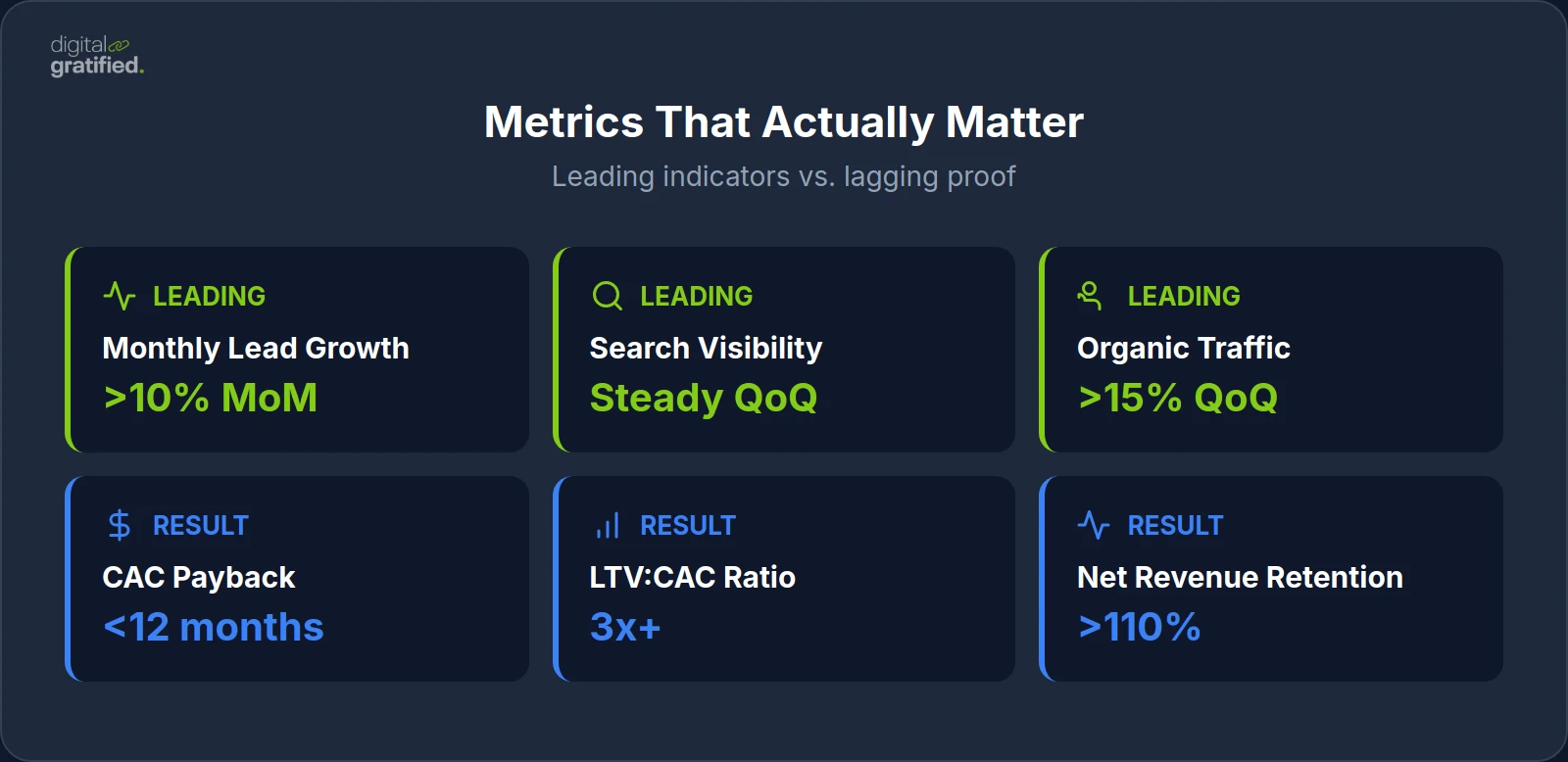
Most marketing dashboards are full of numbers that don't connect to business results. Here's what to actually track, and our SaaS marketing spend benchmarks by stage help size the budget behind it.
Signs You're on the Right Track
What to MeasureWhat It Tells YouWhat 'Good' Looks LikeMonthly Lead GrowthIs your pipeline growing?More than 10% growth month-over-monthSearch Visibility GrowthIs your foundation getting stronger?Steady improvement each quarterOrganic Traffic GrowthIs your content reaching more people?More than 15% growth each quarterPeople Searching Your NameIs brand awareness growing?More than 10% growth year-over-year
Results That Prove It's Working
What to MeasureWhat It Tells YouWhat 'Good' Looks LikeTime to Recover Customer CostsHow quickly do new customers pay for themselves?Less than 12 monthsCustomer Value vs. Acquisition CostIs each customer worth the cost to get them?Customer value is 3x+ acquisition costRevenue from MarketingHow much business does marketing actually bring in?More than 40% of new businessRevenue from Existing CustomersAre current customers growing their spending?More than 110% retention
Your 90-Day Action Plan
Here's exactly what to do in your first three months of building a marketing moat:
Month 1: Take Stock and Set Up
Weeks 1-2:
Assess where you stand: How visible are you in search? Who links to you? What keywords do you rank for?
Identify your top 10 competitors and see how they compare
List the searches your ideal customers are doing
Write down what makes your perspective unique
Weeks 3-4:
Fix any basic technical SEO issues on your website
Set up tracking so you can measure what matters
Decide: Will you build links in-house, hire an agency, or both?
Create one major piece of content for your most important topic
Month 2: Start Building
Weeks 5-6:
Publish 2-3 quality articles targeting your most important searches
Begin link building (either yourself or with a partner)
Have your founder or executives start sharing insights on LinkedIn
Weeks 7-8:
Promote your content through your existing channels
Write guest articles for industry publications
Participate in communities where your customers spend time, and pick one or two SEO and marketing conferences worth attending this year
Month 3: Measure and Adjust
Weeks 9-10:
Review what content is getting traction
Check if your search rankings are starting to improve
Count how many quality links you've earned
Weeks 11-12:
Do more of what's working
Adjust your link building targets based on results
Plan your content for the next quarter
Set goals for 6 months and 12 months out
The Bottom Line: Patience Is Your Advantage
Here's the uncomfortable truth: marketing moats take time. Real SEO results take 6-12 months. Building a strong reputation takes years. Trust develops gradually.
But this is exactly what makes moats valuable.
Your competitors are optimizing for this quarter. They're pouring money into ads because results show up fast. They're churning out AI-generated content because it's cheap.
Meanwhile, companies building moats are playing a longer game:
Investing in foundations that take time to build but compound forever
Creating original insights that require real expertise
Building relationships that can't be bought
Developing trust that takes years to establish
The companies that will dominate in 2026 and beyond aren't necessarily the ones with the biggest budgets. They're the ones that started building their moats early, and kept building while others chased shortcuts.
The best time to start building your marketing moat was two years ago. The second best time is today.
Ready to Start Building Your Marketing Moat?
Building a marketing moat is a strategic decision. It takes commitment and patience. But the payoff, a growing advantage that your competitors can't easily copy, is worth it.
Here's how to begin:
Know where you stand: How visible are you in search today? How much of your business comes from people finding you organically?
Find your unique angle: What do you know that your competitors don't? What data or perspective can only you share?
Make your first investment: For most SaaS companies, that means starting to build your foundation through strategic link building. Digital Gratified specializes in helping SaaS companies build these foundations.
Set realistic expectations: This is a 12-24 month investment. Make sure your team understands the timeline.
The SaaS companies that will own their categories in 2026 won't be the ones that chased every new tactic. They'll be the ones that built solid foundations while others looked for shortcuts.
Start building your moat today.
About the author
Let's Scale Your SaaS Together
Get a custom SEO and link building strategy tailored for your SaaS business.
Get SEO insights that actually move rankings
Link building tactics, case studies, and SaaS SEO playbooks. No fluff, no spam.
You're subscribed!
SEO and link building insights, straight to your inbox.