Broken link building has a 5–10% average response rate. Before you commit to it, you need to know when it's worth the effort, and when it isn't. This guide covers the full process, a prioritisation framework for vetting opportunities, and the outreach psychology that actually gets replies.

Digital Gratified
SaaS SEO Experts
Broken link building gets pitched as an easy win: find a dead link, offer your content as a replacement, earn a backlink. Simple enough. Except the average outreach response rate sits at 5–10%, and most guides skip that part entirely until after you've spent weeks building a prospect list.
This guide doesn't do that. You'll get the full picture: what broken link building actually is, how to find and filter the right opportunities, what separates an outreach email that gets a reply from one that gets ignored, and an honest look at when this tactic is worth your time versus when another approach would deliver better results.
Broken link building is one of several strategies covered in our broader guide to SaaS link building including how to prioritise it relative to outreach, data studies, and digital PR for SaaS companies specifically.
What Is Broken Link Building?
Broken link building is an off-page SEO tactic where you find links on other websites that point to dead or non-existent pages (typically returning a 404 error), then reach out to the site owner to suggest your own relevant content as a replacement.
It works because you're offering something genuinely useful. Website owners don't want broken links on their site: they damage user experience and can indirectly signal poor site maintenance to search engines. When you notify them of a broken link and provide a high-quality replacement, you're solving a real problem. That's what makes broken link building a white-hat tactic: the value exchange is mutual rather than one-sided.
Three things need to align for it to work:
- A broken link exists on a page with genuine authority and relevance to your niche
- You have (or can create) content that legitimately replaces what the dead link used to offer
- Your outreach email is framed as helpful rather than transactional
When all three conditions are met, broken link building can earn you high-quality editorial backlinks from authoritative pages. When one or more are missing, you're burning time on outreach that goes nowhere.
How Broken Link Building Works
At a mechanical level, every broken link represents an opportunity because someone already decided the content was worth linking to; they just can't access it anymore. The referring page has established authority and is already sending link equity somewhere; that equity is currently being wasted on a dead URL. Your goal is to offer a living, higher-quality version of what used to be there.
The tactic works particularly well on:
- Resource pages curated lists of links on a topic. These pages link out extensively, so the probability of finding at least one broken link is high.
- Older authoritative content posts from 5–10 years ago that cite sources which no longer exist. The page still ranks and gets traffic; its outbound links have simply aged poorly.
- Competitor dead pages pages on competitor sites that have been deleted or moved without a redirect, leaving their backlinks pointing to nothing.
Understanding the fundamentals of link building helps contextualise where broken link building fits: it's one of several tactics for earning editorial backlinks, each with different effort-to-reward profiles.
Is Broken Link Building Worth It? An Honest Assessment
Here's what most guides don't tell you until you're already deep in a campaign: the numbers aren't spectacular. A 5–10% response rate is considered excellent. Some practitioners report lower. That means for every 100 outreach emails you send, you might earn 5–10 links, if your targeting, content, and pitch are all solid.
That's not a reason to dismiss the tactic. It is a reason to be selective about when you use it.
When Broken Link Building Works Well
- You're targeting a niche with a lot of older, authoritative content that hasn't been maintained
- You have (or can quickly create) genuinely high-quality replacement content
- You have the bandwidth to run consistent outreach at scale over weeks or months
- You're targeting resource pages or link-heavy editorial content where broken links are more common
- Your domain has enough authority that your replacement page is a credible upgrade
When It's Probably Not Your Best Use of Time
- Your niche is newer and doesn't have much aging content with broken links
- You don't have content that legitimately replaces what the dead link offered
- You're expecting quick results: the campaign-to-link cycle is slow compared to some other tactics
- You're in a highly competitive niche where webmasters receive constant outreach and are desensitised to it
Our link building statistics round-up shows that broken link building ranks as the 5th most widely used tactic among SEO professionals: popular, but not dominant. It sits comfortably behind digital PR, guest posting, and content-driven link acquisition. The SEOs who get the best results from it treat it as one component of a broader link building system, not the entire strategy.
Step 1: Find Broken Link Opportunities
There are four main methods, each suited to different tools and situations. You don't need all four: pick the one or two that match your resources.
Method 1: Audit Your Own Broken Backlinks
Start here. These are links that previously pointed to your site but now land on a dead page (perhaps because you moved content, restructured URLs, or deleted pages without redirects). These are the easiest wins because the webmaster already chose to link to you once.
Use link building software stack (Site Explorer → Best by Links → filter 404), Semrush (Backlink Audit → Target URL Error filter), or Google Search Console (Coverage report → Not Found) to find them. For each one, either restore the original content at the old URL, add a 301 redirect, or reach out to update the link.
Method 2: Find Competitors' Dead Pages With Backlinks
Competitors frequently delete, move, or restructure content without setting up proper redirects, which leaves their backlinks pointing to nowhere. If you have content that covers the same topic, those referring domains are legitimate outreach targets.
In Ahrefs: Site Explorer → enter a competitor domain → Best by Links → filter for 404 → sort by Referring Domains. Look for dead pages about topics you already cover or can credibly write about.
Method 3: Search for Dead Pages on a Topic
Rather than starting from a competitor's domain, search by topic across the entire web. Ahrefs Content Explorer lets you search for broken pages about a keyword: filter for 404 pages with 20+ referring domains. This surfaces dead pages that used to rank and accumulated real backlinks before going offline.
This is the highest-upside method but requires paid Ahrefs access. The quality of opportunities depends heavily on how you filter.
Method 4: Scan Resource Pages Manually
Resource pages link out extensively, which makes them fertile ground for broken links. Find them using Google search operators:
"your keyword" + inurl:resources"your keyword" + intitle:links"your keyword" + "helpful resources""your keyword" + "useful links"
Then use a free Chrome extension like Check My Links to scan each page for broken links. It's manual but completely free, and resource pages tend to have the highest density of outbound links of any page type.
Step 2: Vet and Prioritise: Not All Opportunities Are Equal
Finding broken links is the easy part. Most people's broken link building campaigns fail not because they can't find opportunities, but because they pursue the wrong ones. Before adding any broken link to your outreach list, run it through a simple quality filter.
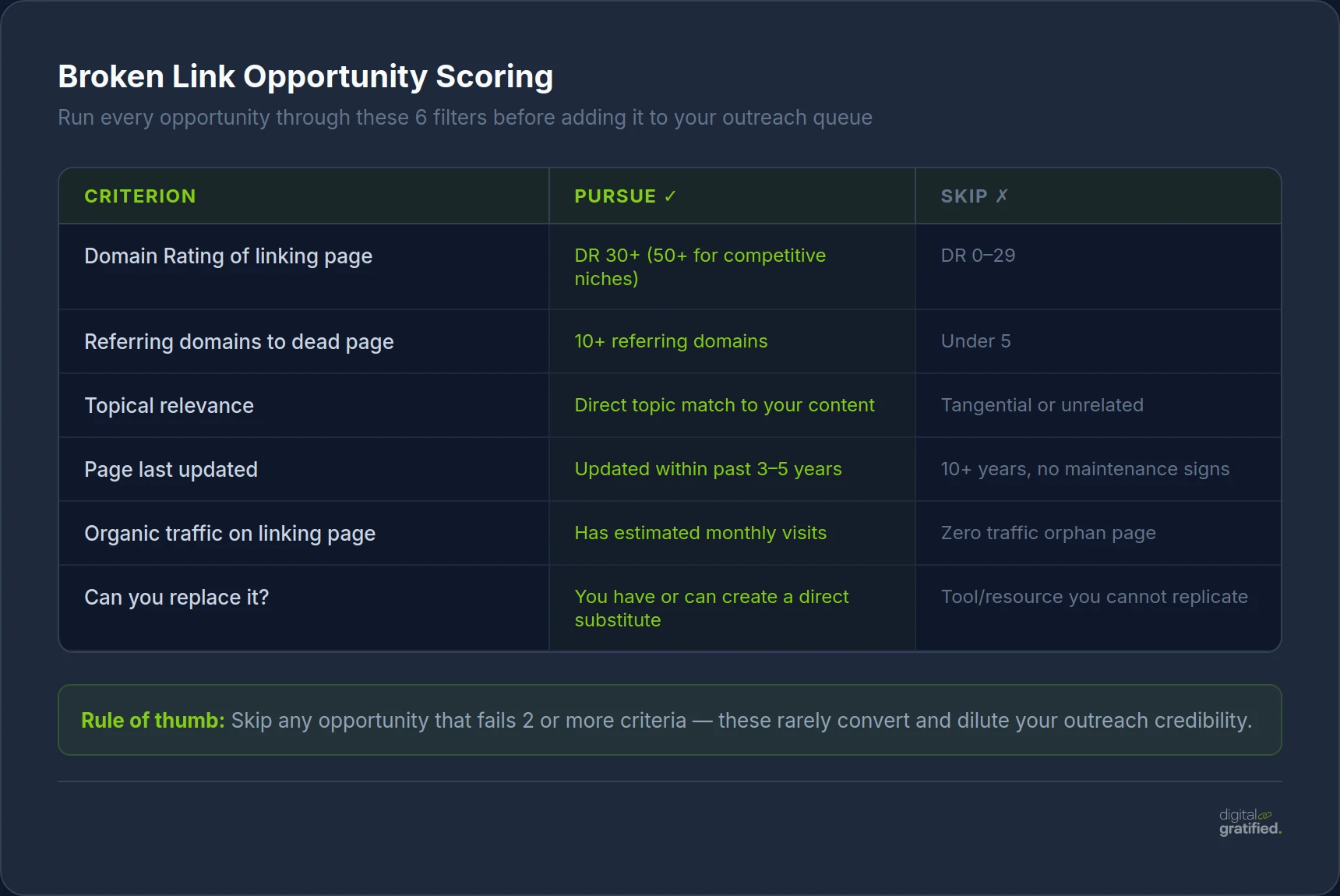
The criteria that matter most, in order of importance:
- Domain Rating / Authority of the linking page A broken link on a DR 10 blog is not worth your outreach effort. Set a minimum threshold (DR 30+ is a reasonable floor, DR 50+ for competitive niches).
- Number of referring domains to the broken page The more sites that link to the dead page, the more outreach targets you have from a single discovery. Prioritise broken pages with 10+ referring domains.
- Topical relevance The linking page should be genuinely relevant to the content you'd offer as a replacement. An exact-topic match converts far better than a tangential one.
- Recency of the page Very old pages (10+ years, minimal updates) may have webmasters who are no longer reachable or maintaining the site. Aim for pages that were updated in the past 3–5 years.
- Organic traffic of the linking page A link from a page with actual traffic is worth more than one from an orphaned page that nobody reads. Check estimated monthly visits in Ahrefs or Semrush.
- Can you actually replace it? The most important question. You need content that is a genuine, high-quality substitute for what the dead link offered. If the dead page was a tool or calculator you can't replicate, skip it.
Run these six checks before any outreach. Skip opportunities that fail on two or more criteria: they're unlikely to convert and will dilute your outreach credibility if you're sending low-relevance pitches.
Step 3: Build or Repurpose Your Replacement Content
You need something worth linking to before you start reaching out. This is where most broken link building campaigns underinvest: they send the outreach email pointing to a mediocre page and wonder why the response rate is low.
Your replacement content doesn't have to be brand new. Consider three scenarios:
You Already Have the Content
Ideal. Review your existing content against the dead page's topic: what did it cover? What was its format? If your content is genuinely stronger and covers the same ground, you have a ready-made replacement. Update it to be current if needed before outreaching.
You Need to Create It
Only invest in creating new content if the opportunity is substantial enough to justify the effort. A dead page with 50+ referring domains from high-DR sites is worth building a comprehensive resource for. A dead page with 5 referring domains from DR 20 sites is not.
When creating replacement content, don't just recreate what existed: make it demonstrably better. More current data, better structure, more depth, or a cleaner user experience all give the webmaster a genuine reason to prefer your version.
You Can Repurpose Existing Content
Sometimes a broken link points to a resource type you have in a different format: a blog post where a PDF used to live, or a comprehensive guide where a short article once existed. Repurposing and upgrading existing content into a better format can be faster than creating from scratch while still producing a high-quality replacement.
Step 4: Write Outreach That Actually Gets Replies
The email is where most broken link building campaigns break down. The pitch that works is not the pitch that most people send.
The Psychology Behind a Successful BLB Email
Most outreach emails lead with what they want. A broken link building email should lead with what you're offering: specifically, a helpful notification about a problem the webmaster may not know exists.
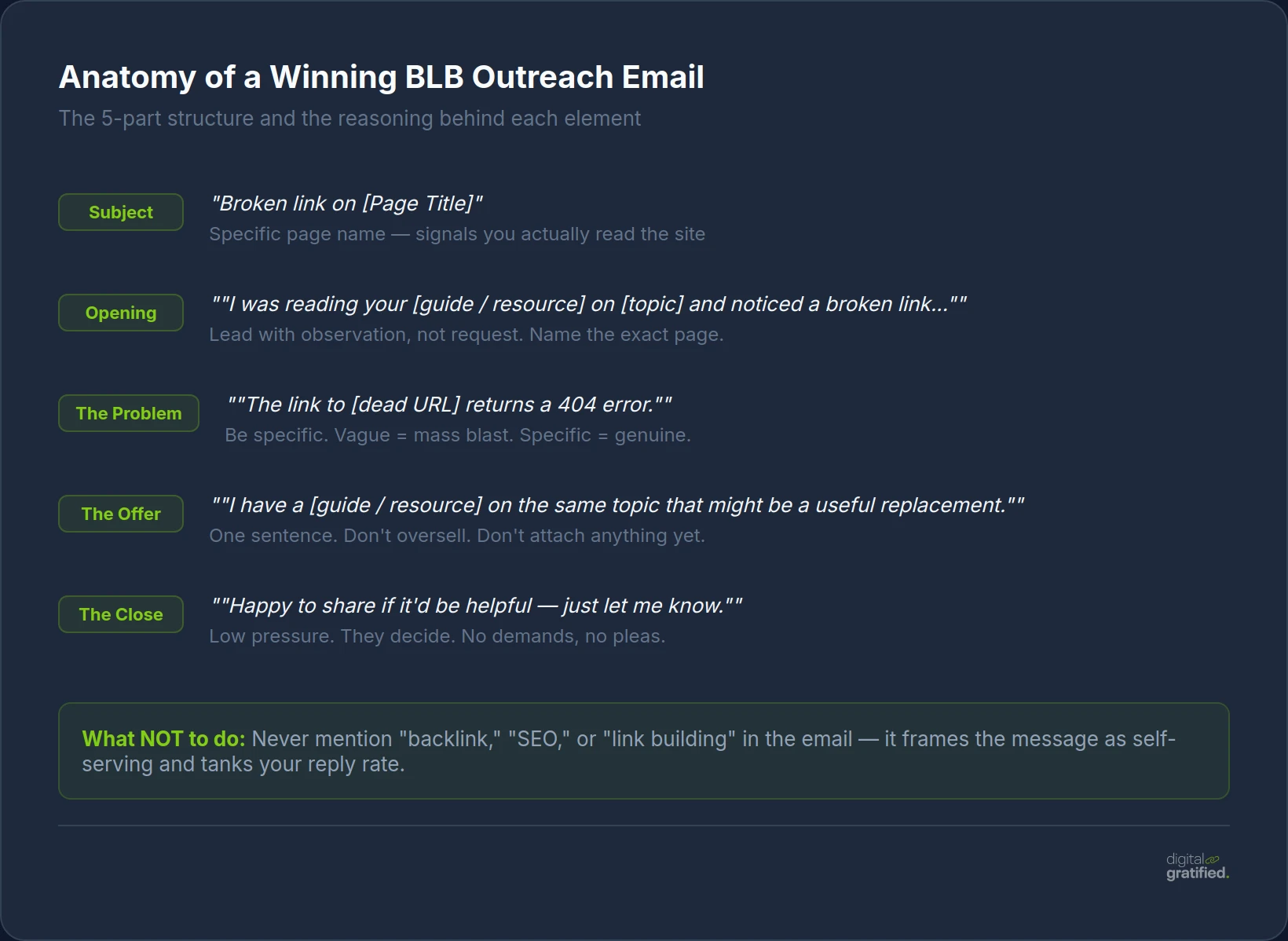
The psychological sequence that converts:
- Specific observation Name the exact page you're referencing and the exact broken link. Vagueness signals a mass-blast campaign; specificity signals you actually read their site.
- The problem, not the ask Lead with "I noticed a broken link on your page" not "I'd like a backlink." Frame this as a helpful heads-up, not a negotiation.
- The solution, briefly Mention that you have content that covers the same topic. One sentence. Don't over-explain or sell it.
- The low-pressure close Offer to share your content if they're interested. Not a demand. Not a plea. Just a clean offer.
For a systematic approach to outreach at scale (including follow-up sequences, personalisation at volume, and what to do when you don't hear back) our link building outreach guide covers how to build a system that consistently gets replies rather than running one-off campaigns.
What NOT to Do
- Don't send generic templates with obvious placeholder text
- Don't attach your content or include the link in the first email: offer to share it
- Don't mention SEO, backlinks, or "link building" in the pitch: it frames the email as self-serving
- Don't follow up more than twice: persistence crosses into spam territory quickly
- Don't pitch irrelevant content as a replacement: webmasters notice, and it damages your credibility for any future outreach
What Realistic Results Look Like
Setting accurate expectations before you invest in a broken link building campaign is important for evaluating whether it's actually working versus whether your process needs adjustment.
Typical benchmarks for a well-executed campaign:
- Response rate: 5–15% of outreach emails receive any reply
- Conversion rate (reply → link): 40–60% of replies result in an actual link update
- Effective link rate: 3–8% of outreach emails result in an earned backlink
- Time to link: 1–4 weeks from outreach to live link, assuming positive response
These numbers improve significantly with better targeting. A campaign focused exclusively on DR 50+ pages with high topical relevance will outperform a high-volume, lower-quality campaign. The quality filter in Step 2 is the single biggest lever you have on final link rate.
Volume expectations: to earn 10 quality backlinks per month from BLB, expect to process 300–500 broken link opportunities through your quality filter, qualify 100–150 for outreach, and send those emails over 2–4 weeks. It's a system, not a one-time effort.
Building a Scalable BLB System
Most broken link building guides treat the tactic as a one-off campaign. The practitioners who get consistently strong results run it as an ongoing system with defined workflows.
The components of a repeatable BLB system:
- A weekly prospecting routine : 30–60 minutes per week running the same searches and filters to add fresh opportunities to your pipeline, rather than doing a single big discovery sprint
- A quality filter checklist : a fixed set of criteria (as outlined in Step 2) applied consistently to every opportunity before it enters the outreach queue
- A CRM or tracking sheet : tracking which URLs you've pitched, to whom, on what date, and what response you received. Prevents duplicate outreach and lets you measure performance
- Templated but personalised emails : a base structure you customise with specific details about each target page, not a blanket copy-paste
- A content library : knowing exactly what replacement content you can offer for different topic areas, so you're not creating assets from scratch every time
At Digital Gratified, broken link building works best as one component in a layered link building strategy, combined with digital PR, guest posting, and content-driven acquisition. Running it in isolation tends to produce inconsistent results; running it as part of a systematic approach produces compounding ones.
BLB vs Other Link Building Tactics: When to Choose What
Broken link building is one tool. Understanding when it's the right tool, and when another approach would serve you better, saves significant time and budget.
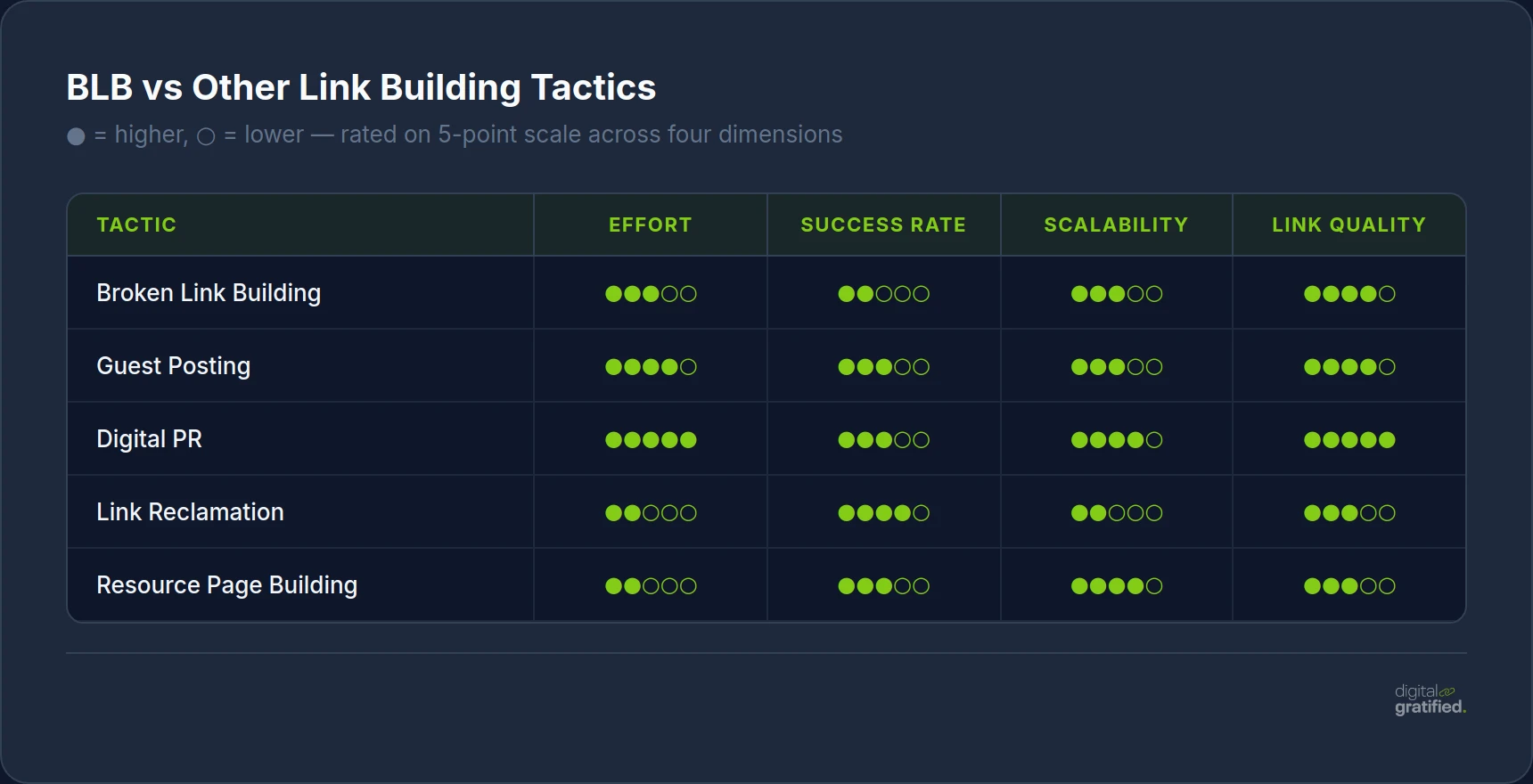
The decision framework:
- Choose BLB if you're in a niche with abundant aging content, you have relevant assets ready, and you have the bandwidth for sustained outreach
- Choose guest posting if you want more control over anchor text, topic, and placement, and if your domain authority is strong enough to get accepted
- Choose digital PR if you want the highest-authority links at scale and can invest in creating genuinely newsworthy content or research
- Choose link reclamation (recovering mentions without links) if it's faster, if your brand is mentioned without a link, converting that mention costs far less effort than finding and pitching broken link opportunities from scratch
- Choose resource page link building as a natural complement to BLB: you're already scanning resource pages for broken links; add a workflow to pitch your content for inclusion even when you don't find a broken link
For a full breakdown of what different link building approaches cost in time and money, our link building pricing guide compares agency, freelancer, and in-house models across tactics.
Frequently Asked Questions
What types of broken links should I target?
Prioritise broken links on pages with real authority (DR 30+), genuine topical relevance to your content, and actual organic traffic. The best targets are external links within the body copy of editorial content: not sidebar links, footer links, or low-traffic pages that haven't been updated in years.
Do I need expensive tools to do broken link building?
Not entirely. Method 4 (scanning resource pages with Check My Links) is completely free. Methods 1–3 work best with Ahrefs or Semrush, which require paid subscriptions. If you're budget-constrained, start with Google search operators to find resource pages and use Check My Links to scan them. It won't surface every opportunity, but it's a legitimate starting point.
How long does a broken link building campaign take?
The prospecting and filtering phase typically takes 2–4 hours per 50 qualified opportunities. Outreach and follow-up runs in parallel over 2–4 weeks. Expect 4–8 weeks from starting a campaign to seeing the first new backlinks appear in your profile. Building it as an ongoing system rather than a campaign reduces this ramp-up time considerably.
Is broken link building a white-hat tactic?
Yes. You're helping webmasters fix a real problem on their site and offering genuinely useful content in return. There's no link manipulation, no paid placement, and no attempt to deceive search engines. Google has never penalised broken link building when it's done legitimately: the value exchange is transparent and beneficial to both parties.
What's the difference between broken link building and link reclamation?
Broken link building involves finding dead links on external sites and offering your content as a replacement. Link reclamation involves finding mentions of your brand, content, or assets on external sites that don't currently include a link, and asking them to add one. Both are outreach-based tactics, but link reclamation tends to have a higher success rate because the site already referenced you; they just didn't link to you.
Should I build new content or use existing content as a replacement?
Use existing content wherever you legitimately can: it's faster and the quality bar is already met. Only invest in creating new content when the opportunity is large enough (high DR referring domains, significant link count on the dead page) to justify the effort. The replacement doesn't need to be identical to the dead page: it needs to be equally or more useful to the readers of the page that's linking out.
Let's Scale Your SaaS Together
Get a custom SEO and link building strategy tailored for your SaaS business.
Get SEO insights that actually move rankings
Link building tactics, case studies, and SaaS SEO playbooks. No fluff, no spam.
You're subscribed!
SEO and link building insights, straight to your inbox.