Forget the alphabetical tool dump. This is a workflow-based guide to the best link building tools, organized by where they fit in a real campaign, with honest takes from running outreach for B2B SaaS clients.

Founder, Digital Gratified
The best tools for link building are the ones that fit where you are in the workflow, not the ones with the longest feature list. A campaign needs different software for finding prospects, closing placements and tracking what lands, and every dollar of tool spend should justify itself in earned links.
This guide organizes the tools by workflow stage, with picks drawn from running link building campaigns for B2B SaaS clients. If you're new to the discipline, start with our primer on what link building in SEO actually is before picking tools, because buying software before understanding the workflow is the most common and expensive mistake.
The Five Stages of a Link Building Workflow
Every link building campaign (outreach, broken link building, digital PR, niche edits) follows the same five stages. Most tools specialize in one or two. A small number try to cover several, with mixed results.
- Competitor & backlink analysis what links does your competition have, and which are realistically replicable?
- Prospect discovery & outreach finding the sites worth pitching, then sending the emails and tracking replies. Modern prospecting platforms handle both.
- Email finding & verification getting valid contact addresses for the right person.
- Content support the linkable assets and ideas that earn placements in the first place.
- Tracking & reporting monitoring what landed, what got removed, and what's actually moving rankings.
This is roughly the same backbone we cover in our link building checklist. Pick a tool for each stage you actively work in. Skip the tools for stages you don't.
Stage 1: Competitor & Backlink Analysis Tools
Every campaign should start by analyzing what's already working. Before pitching a single email, you should know which links your top three competitors have earned in the last 12 months and which ones look replicable.
Ahrefs
Still the gold standard for backlink analysis, and the tool we open first on almost every project. Site Explorer, Link Intersect, and the Best by Links report are the three features worth the entire subscription. The crawler is genuinely the largest in the industry, which matters more than marketing copy suggests: finding niche, low-volume backlink opportunities lives or dies on index size.
- Best for: Backlink discovery, link gap analysis, monitoring competitor link velocity
- Pricing: Starts at $129/month (Lite plan)
- Honest limitation: The export caps on lower plans add up quickly for agencies running multiple campaigns
Semrush
Semrush has narrowed the gap with Ahrefs in recent years, especially on backlink data. The Backlink Analytics and Backlink Gap features are strong, and bundled keyword + traffic estimates make it useful when one person is wearing both the SEO and link building hats.
- Best for: All-in-one SEO + link building when you don't want two subscriptions
- Pricing: Pro plan starts at $139.95/month
- Honest limitation: Backlink index, while larger than Moz's, still trails Ahrefs for hard-to-find placements
SE Ranking
SE Ranking is the most credible mid-priced alternative to Ahrefs and Semrush, and it's the tool we recommend most often to in-house teams that find the bigger two cost-prohibitive. The Backlink Checker pulls from a respectable index, the Backlink Gap analyzer is genuinely useful for prospect discovery, and the bundled rank tracking is more accurate than the price suggests.
- Best for: In-house teams and small agencies wanting a full SEO + link analysis stack without enterprise pricing
- Pricing: Essential plan starts at $65/month
- Honest limitation: Index size doesn't quite match Ahrefs for the most niche placements, but it covers 90% of what most campaigns need
Pair any of these tools with the manual techniques in our guide on how to find competitor backlinks the tool gives you the data, the technique gives you the angle.
Stage 2: Prospect Discovery Tools
Once you know what kinds of links to chase, you need a clean list of sites to actually pitch. This is where most campaigns fall apart: bad prospect lists turn into low reply rates, low reply rates turn into low placement rates, and the team blames "outreach" when the real problem was upstream.
linkOreach
linkOreach is the prospecting workhorse we lean on most often. Its intelligent domain discovery pulls prospects directly from Google SERPs and the Ahrefs API based on your target keywords, then deduplicates the list against contacts your team has already pitched, so two outreach specialists never burn the same prospect twice. It also runs the outreach sequences and tracks responses from the same dashboard, which means you don't need a separate sending tool layered on top.
- Best for: Teams that want prospect discovery, sending, and reply tracking in one workflow
- Standout features: Google SERP + Ahrefs domain discovery, smart contact protection, automated multi-sequence follow-ups
- Why we use it: Built specifically for link building, not retrofitted from generic cold email
Pitchbox
Pitchbox is the enterprise option for prospecting and outreach combined. It pulls prospects from search operators, integrates with Ahrefs and Moz for live metrics, finds contact emails, and runs sequences inside the same platform. For an agency running 5+ active campaigns, the integrated workflow saves hours a day, but the pricing only makes sense above a certain campaign volume.
Respona
Respona is a solid Pitchbox alternative with a more modern interface and a more accessible price point. It's especially strong for digital PR campaigns where you're pitching journalists more than webmasters. The built-in AI personalization helps small teams keep emails from sounding templated.
Stage 3: Email Finding & Verification Tools
The cleanest prospect list in the world is useless if the emails bounce. Verification quality affects deliverability, which affects every campaign you'll ever send from that domain. This isn't a stage to cheap out on.
Hunter.io
Hunter is the most reliable email finder for B2B contacts. The domain-search feature lets you pull every published email at a target site, and the in-app verification has a respectable hit rate. For most teams, Hunter alone covers 80% of email-finding needs.
NeverBounce / ZeroBounce
Both are dedicated email-verification services, and both are worth using before any large send. Burning a sender domain because of a 15% bounce rate costs more in lost deliverability than the verification fee ever will. Pick one, set a verification step in your workflow, never skip it.
Stage 4: Content & Idea Tools
The cleanest outreach in the world won't win links if you're pitching weak content. The tools below help you find or build the kind of assets that publishers actually want to link to.
BuzzSumo
BuzzSumo is the easiest way to see what content has earned links and shares in your niche. The Content Analyzer is especially useful for skyscraper-style campaigns: you find a piece that earned 50+ backlinks two years ago, build something demonstrably better, and pitch the same publishers who linked to the original.
AnswerThePublic / AlsoAsked
Both surface the questions real people are searching, which is the foundation of any content asset that earns links naturally. Question-based content tends to get linked from forum threads, blog posts answering related queries, and "ultimate guide" roundups.
Google Trends
Free, underused, and one of the best ways to validate that a content idea has rising (not falling) interest before you invest in it. We check Trends before greenlighting any major linkable asset.
Original Research Stack (Survey + Form Tools)
The single highest-converting linkable asset is original data. Combine a survey tool (Typeform, Google Forms, Pollfish) with a research budget, and you can produce statistics-driven content that journalists actively cite. Our own link building statistics roundup is built on this principle: original or aggregated data earns far more links than opinion content does.
Stage 5: Tracking & Reporting Tools
Acquiring a link is half the job. Knowing it's still live three months later, that the anchor text wasn't changed, and that it's contributing to ranking lifts is the other half. This is the backlink management workflow, and these tools make it sustainable.
Ahrefs (Alerts + Site Explorer)
Ahrefs Alerts notifies you when new backlinks appear or existing ones disappear. For agency reporting, the New & Lost Backlinks reports plug directly into client dashboards. Most of our clients only see Ahrefs-sourced data because it's the source they trust most.
Linkody
A dedicated backlink monitoring tool that's significantly cheaper than Ahrefs if all you need is "are my links still live and what changed this week?" Useful for agencies wanting to consolidate monitoring across many client sites without paying enterprise rates.
Google Search Console
Free, official, and underused. The Links report in GSC is Google's own view of your backlink profile, which is the only one that ultimately matters. Always cross-check what your paid tools show against what GSC sees.
Looker Studio (formerly Data Studio)
Once you have data flowing in from Ahrefs, GSC, and your outreach tool, Looker Studio is the cheapest way to build a unified client report. The templates in the community gallery cover 80% of what most agencies need.
Bonus: Agency Operations & Fulfillment
Once you're running campaigns for multiple clients, the bottleneck shifts from outreach to operations: order tracking, inventory of negotiated placements, invoicing, and client-facing status updates. Generic project management tools handle this badly because they don't model link-building workflows.
BuildLinks
BuildLinks is purpose-built for the operational side of running a SaaS link building agency. It handles order management for ongoing placements, inventory tracking of negotiated guest post and niche edit slots, invoicing, and client feedback loops in one dashboard. If you're scaling past five or six retainer clients and Notion-plus-Google-Sheets is starting to break, this is what replaces it.
- Best for: Link building agencies managing multiple retainer clients
- Standout features: Order tracking, placement inventory, invoicing, client feedback collection
The Free / Low-Budget Stack (Under $50/Month)
If you're starting out or running a small in-house program, you don't need the enterprise stack to do useful work. A workable free-leaning stack looks like:
- Ahrefs Webmaster Tools free for verified domains, gives you most of Ahrefs for your own site
- Google Search Console link reports, query data, indexing
- Hunter (free tier) 25 searches per month for early-stage prospecting
- BuzzSumo (free tier) limited but enough for occasional content checks
- Streak / HubSpot CRM (free email tracking and basic CRM)
- Google Sheets (surprisingly capable as a prospect manager when paired with browser plugins)
This stack will not scale past about 50 prospects a week, but it will get you to your first 10-20 placements without spending money you don't have.
Tools We Don't Recommend (And Why)
An honest tool list has to mention what to avoid:
- Auto-link-building software that "submits to thousands of sites" (this is the modern descendant of XRumer.) The links it builds are spam, the directories it submits to are dying, and the long-term cost in disavows and trust loss is far higher than any short-term gain.
- "AI link building" tools that promise placements at $20 each (read the fine print.) These are usually PBN networks dressed up in AI marketing.
- Lifetime-deal outreach tools (outreach is a category where deliverability infrastructure matters.) Lifetime-deal vendors typically can't afford the engineering to keep deliverability current as inbox providers change rules.
If a tool's pitch sounds too good to be true at the price point, it's almost always a black-hat or grey-hat shortcut. That's not just an ethics question: Google has gotten dramatically better at detecting these patterns, especially after the August 2024 spam updates. We covered this dynamic in detail in our piece on the future of link building in the AI search era.
How to Actually Choose a Stack
You don't need every tool in this guide. Most working agencies use four or five total. A practical starting framework:
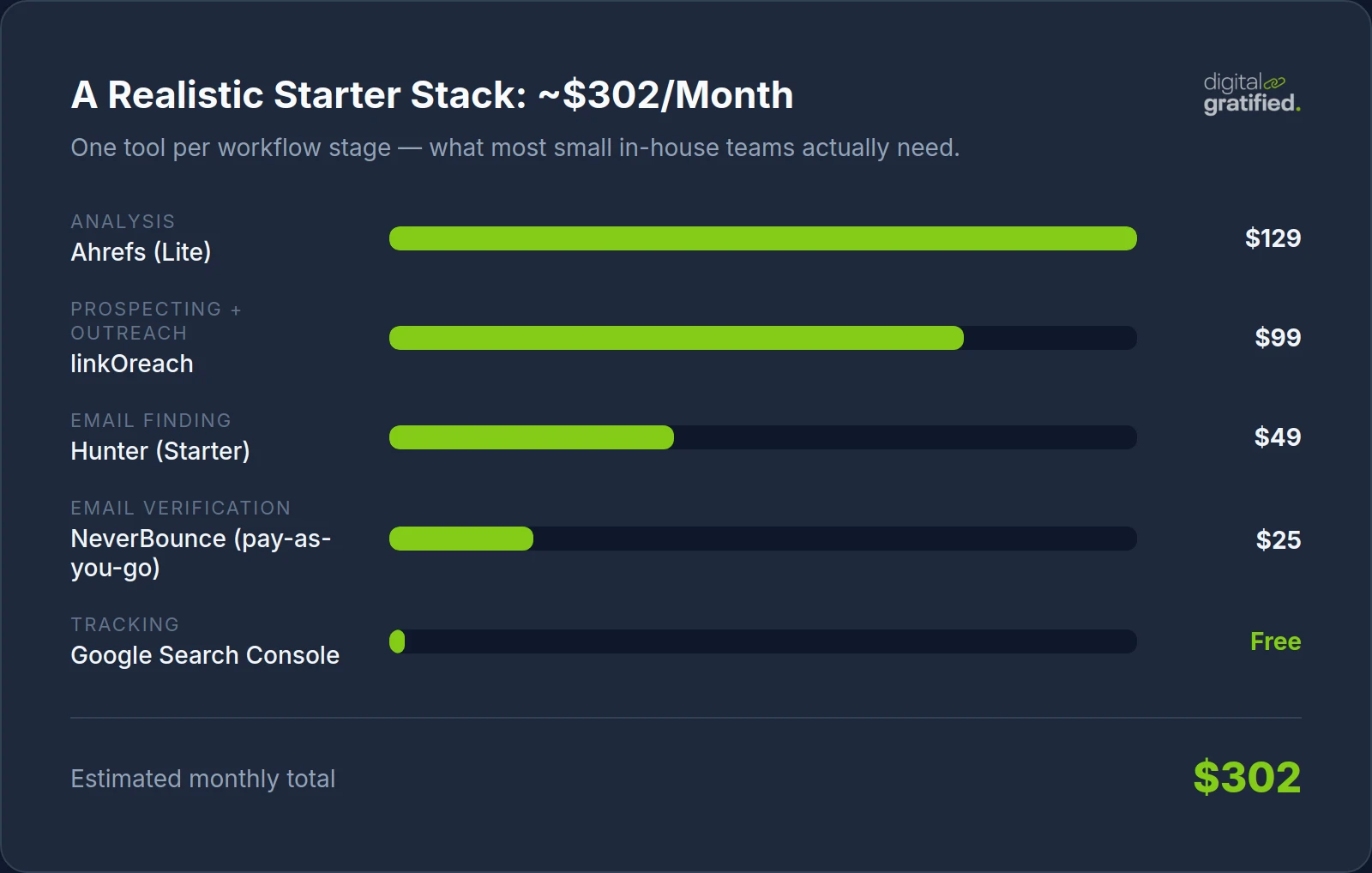
- Pick one analysis tool (Ahrefs or Semrush.) Don't try to use both.
- Pick one prospecting + outreach tool (linkOreach, Pitchbox, or Respona.) This handles both finding sites and sending emails in one workflow.
- Pick one email finder + one verifier (Hunter + NeverBounce is the common default.)
- Use Google Search Console for tracking (supplement with Ahrefs Alerts when you need more.)
- Add content tools only when you're producing linkable assets monthly , they're useless if you're not.
Total cost for this stack lands somewhere between $300 and $600 per month for a small in-house team, scaling up from there for agencies. Compare that against the realistic per-link cost we break down in our piece on link building pricing in 2026.
When the Tooling Isn't the Problem
One pattern we see repeatedly: teams add another tool when the actual issue is process. The right outreach tool can't fix bad targeting. A better email finder can't fix a weak content asset. A new analytics platform can't fix the absence of campaign goals.
If you're already running a campaign and the numbers aren't moving, it's worth auditing the workflow before adding software. Our SaaS link building playbook covers the workflow patterns that consistently work for B2B clients, and the broken-link approach in our broken link building guide uses tools you likely already pay for.
And if running the workflow yourself isn't where you want to spend the next year, a specialized partner , including white label link building arrangements for agencies , often delivers better unit economics than building the tool stack and team from scratch.
Final Take
The best link building tool is the one that fits the stage of the workflow you're actually weakest at , not the one with the loudest marketing. Audit where your current campaign is leaking (bad prospects, low reply rates, lost links, slow reporting), then add the smallest possible tool that closes that gap.
Everything else is overhead. And in link building, overhead doesn't earn links.
If you'd rather skip the tool-stack-assembly phase entirely and go straight to results, the team at Digital Gratified runs the full workflow on behalf of B2B SaaS clients , using a stack we've refined across hundreds of campaigns so you don't have to.
About the author
Let's Scale Your SaaS Together
Get a custom SEO and link building strategy tailored for your SaaS business.
Get SEO insights that actually move rankings
Link building tactics, case studies, and SaaS SEO playbooks. No fluff, no spam.
You're subscribed!
SEO and link building insights, straight to your inbox.