Most international link building advice is written for e-commerce. Here's the SaaS version: when building links in other markets actually pays back, how site structure and hreflang decide where the equity goes, and what a multi-region program really costs.

Founder, Digital Gratified
International link building can help a SaaS company win visibility in new markets, but only at the right moment. The key question isn't which local tactics to use. It's whether building links in other markets is worth the money yet, and if so, when.
The short answer is that it works once a real localized experience exists for those links to point to, and once your site structure and hreflang setup let the right regional pages collect the benefit. This guide shows how to tell when you're ready and how to approach it for SaaS specifically. Get those foundations right and the tactics become the easy part.
What International Link Building Means for a SaaS Site
International link building is the practice of earning backlinks from sites in the countries and languages you're expanding into: German industry publications linking to your German pages, Brazilian tech blogs linking to your Portuguese pricing page, regional SaaS directories listing your localized product. The mechanics of earning any single link don't change. What changes is the target, the language, and the job the link does.
In a domestic program, every link builds one pile of authority for one set of pages. In an international program, links carry an extra signal: they help search engines decide which regional version of your site deserves to rank in which market. A backlink profile dominated by US sites tells Google your site is primarily relevant to US searchers, no matter how many hreflang tags say otherwise. That's the core difference, and it's why global link building is a targeting problem before it's a volume problem.
The Prerequisite Almost Every Guide Skips
Before spending anything on international backlinks, ask one question: if this link sends a visitor from that market, do they land on an experience built for them?
That means translated product and pricing pages, regional currency and payment methods, and some answer for support coverage in their time zone. If the honest answer is that a German visitor lands on a US English page with dollar pricing, international link building is premature. You'd be paying to acquire authority in a market you can't yet convert, which is the definition of vanity traffic.
This is also the cheapest place to make the go or no-go decision. Localizing a pricing page costs far less than six months of German outreach, and it has to happen first anyway. Sequence it: localize the money pages, confirm demand with a small paid or organic test, then point link budget at the market.
Site Structure Decides Where Your Link Equity Goes
Every SaaS company expanding internationally hits the same fork: ccTLD (yoursite.de), subdomain (de.yoursite.com), or subfolder (yoursite.com/de/). It's usually framed as a technical SEO decision, and it is one, but it's equally a link building decision, because each option distributes link equity differently.
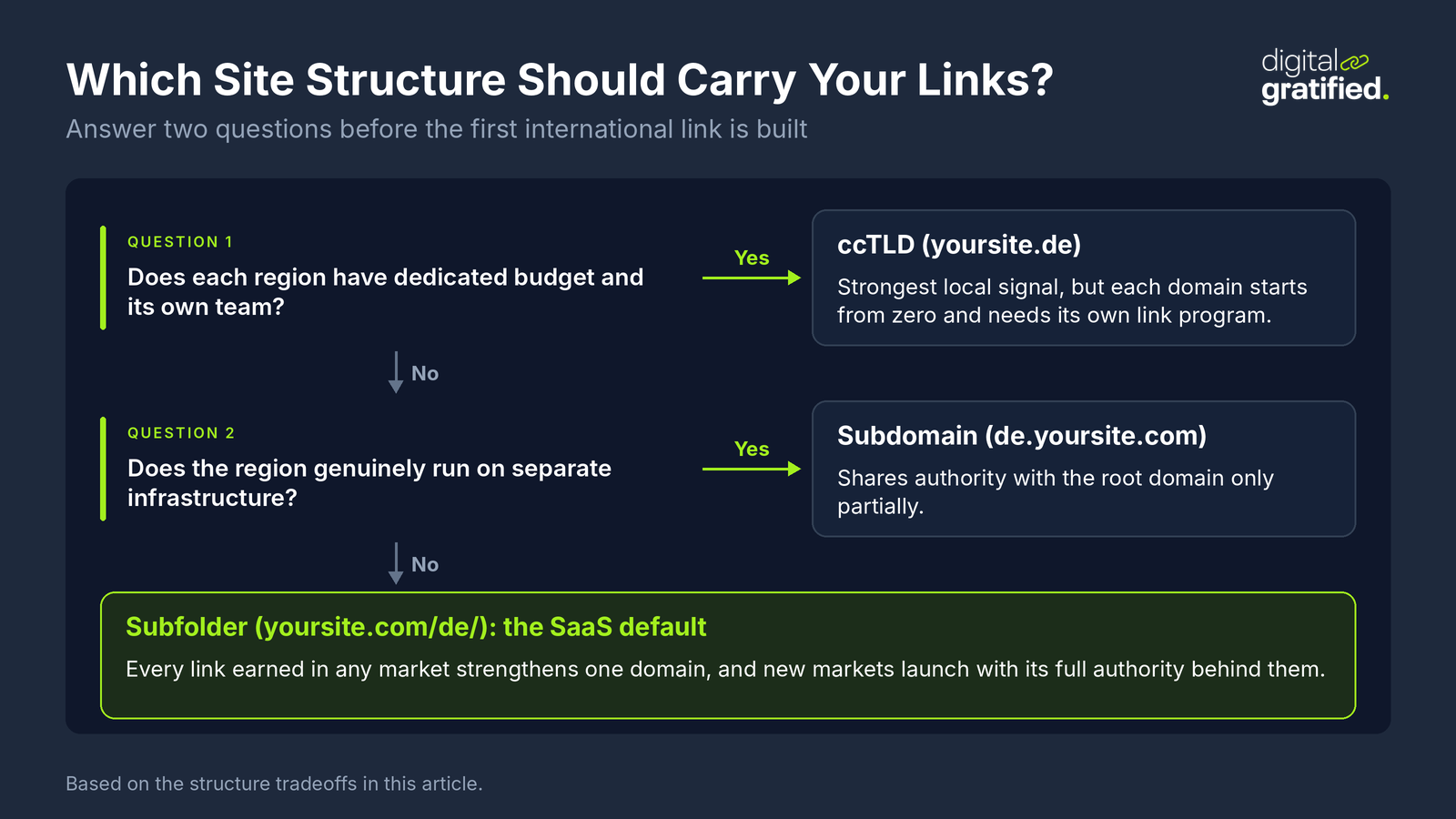
Subfolders keep everything on one domain, so every link you earn in any market strengthens the whole site. A new regional section launches with the domain's full accumulated authority behind it. For most SaaS companies, especially lean ones, this is the right default: it means your years of domestic link building aren't starting over in each market.
ccTLDs send the strongest local signal to both search engines and users, which is why large enterprises with country offices use them. But each ccTLD is a separate domain that starts from zero authority, which means a separate link building program per country. Unless there's dedicated budget and a team per region, that math rarely works for SaaS.
Subdomains sit in between, sharing authority with the root domain only partially. They make sense when a region genuinely runs on separate infrastructure, and not often otherwise.
These tradeoffs connect to crawl budget, rendering, and the rest of the infrastructure decisions covered in technical SEO for SaaS, so make the structure call once, with both disciplines at the table. Changing it after two years of link acquisition means migrating the equity you paid for.
Why Hreflang Alone Won't Save You
Hreflang tags tell Google which language and regional versions of a page exist, and Google's documentation on localized versions is clear about their job: they're a hint for serving the right version to the right user, not a ranking boost.
Here's the failure mode that surprises teams: the hreflang setup is perfect, the German pages are beautifully translated, and Google still ranks the US page in Germany, or ranks nothing at all. That usually happens because the German version has no authority of its own. Hreflang maps equivalent pages to each other; it doesn't tell Google a regional page deserves to rank. Links do that.
In practice the two systems work together. Hreflang consolidates signals across your regional versions and routes users to the right one, while backlinks from German sites give the German cluster the standing to appear in German results in the first place. If you're choosing between fixing hreflang and earning local links, the honest answer is that you need both, but a page with local links and sloppy hreflang usually beats a page with perfect hreflang and zero local authority.
Acquisition Tactics That Work for SaaS
Once the foundation is set, the tactics that work internationally are the SaaS-appropriate ones, localized properly rather than translated lazily.
Localized data assets. Original data is the strongest link magnet in SaaS, and it gets stronger when it's regional. A benchmark report sliced by market ("SaaS pricing trends in the DACH region") gives local journalists a reason to cite you that no US-focused report provides. One regional data story per target market per quarter is a realistic and effective cadence.
Region-specific PR and outreach. Every market has its own trade publications, newsletters, podcasts, and journalist request services. Pitching them in their language, with a regional angle and a local spokesperson if you have one, converts at a completely different rate than blasting English pitches worldwide. The fundamentals of prospecting, personalization, and follow-up in link building outreach apply unchanged; the localization of those fundamentals is the work.
Regional SaaS and tech directories. Skip the generic web directories, but do claim the regional software comparison platforms your buyers actually use: OMR Reviews in the DACH market, Capterra's country properties, regional startup databases and industry association listings. These are modest links individually, but they're exactly the local relevance signals a new regional section lacks, and buyers genuinely browse them.
Partnerships and integrations with regional players. Local resellers, implementation consultancies, and complementary tools in each market all have partner pages and co-marketing appetites. These links come with referral traffic attached, which keeps the program honest.
The Mistakes That Waste International Budgets
Treating every market the same. The asset that earned forty US links may earn zero in Japan, where content formats, outreach etiquette, and publisher economics differ. Budget per market for adaptation, not just translation.
Over-relying on US links for global authority. Strong US links raise the whole domain, and that helps everywhere. But in any specific market, a competitor with genuinely local links and a localized experience will win the local SERP. Global authority is the floor, local relevance is the tiebreak.
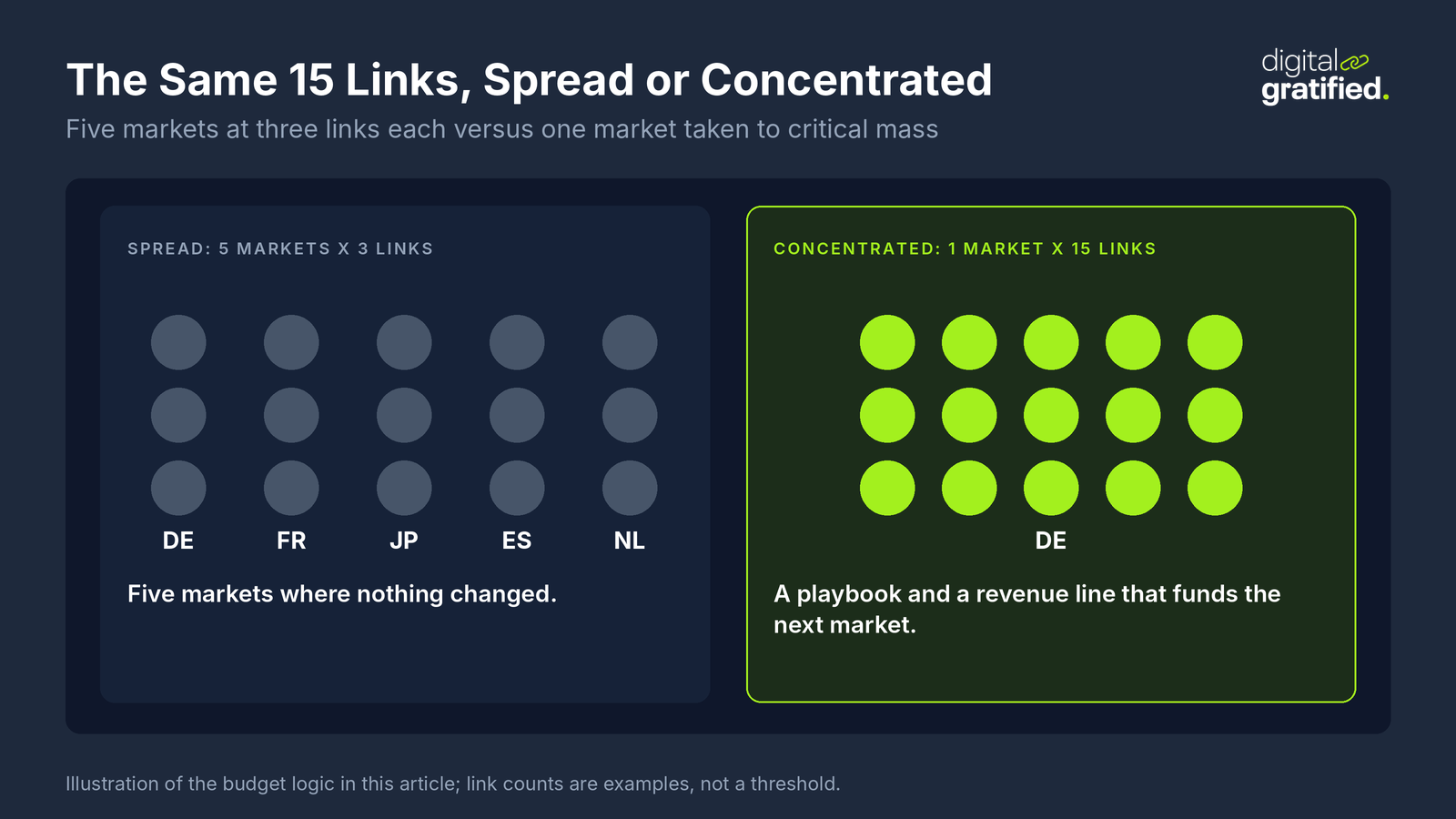
Spreading the budget too thin. Five markets at three links each produces five markets where nothing changed. One market pushed to critical mass produces a playbook and a revenue line that funds the next one. Sequence markets by demand evidence and go deep in one at a time. And once links start landing in three or four languages, disciplined backlink management stops being optional, because lost links and drifting anchors are much harder to spot in a language you don't read.
What a Multi-Region Program Costs and Where It Fits
International work is a layer on top of an existing program, not a replacement for it. Nothing about the core discipline changes either: the same SaaS link building fundamentals still decide which pages deserve authority and why. The international layer just decides where in the world that happens.
On cost: expect a modest premium over domestic rates. Native-language outreach, local content adaptation, and thinner publisher markets in smaller languages all add up. As a planning number, quality editorial placements run in the same range you'd see in any honest breakdown of link building pricing, plus roughly 20 to 40 percent per non-English market for localization overhead. A realistic single-market program (one region, 5 to 8 links a month, one localized asset a quarter) lands around $3,000 to $6,000 a month. Multiply by markets, which is exactly why sequencing beats sprinkling.
In-House or Outside Help?
The decision comes down to language coverage and publisher relationships, not headcount. An in-house team can run international acquisition well when it has native speakers for the target markets and time to build local publisher relationships from scratch. That's realistic for one market, occasionally two. Beyond that, most SaaS teams bring in help, either regional freelancers per market or a SaaS SEO agency that already holds relationships across markets.
The evaluation criteria don't change because the program crosses borders: transparent sourcing, editorial standards, and relevance over volume, the same bar you'd apply to any SaaS link building agency. Add one international-specific question: ask to see links they've earned in your specific target market and language. An agency with a strong US portfolio and nothing in German is learning Germany on your budget.
The Bottom Line
International link building rewards companies that do it in the right order. Localize the experience first, or there's nothing worth linking to. Pick your site structure deliberately, because it decides where every future link's equity lands. Treat hreflang and local backlinks as two halves of one system. Then go market by market with localized assets, local outreach, and the regional directories that matter, one region at a time until it ranks. Done in that order, international backlinks compound the same way domestic ones do. Done out of order, they're the most expensive way to buy traffic you can't convert.
International Link Building: Frequently Asked Questions
What is international link building?
International link building is earning backlinks from websites in the countries and languages you're expanding into, so search engines see your regional pages as relevant and authoritative in those markets. For SaaS companies it typically means local publications, regional software directories, and market-specific data assets pointing at localized product pages.
When should a SaaS company start building international links?
Only after a real localized experience exists: translated product and pricing pages, regional payment options, and viable support coverage. If links from a market land visitors on a US English page with dollar pricing, the budget is better spent finishing localization first.
Do backlinks matter more than hreflang for international SEO?
They solve different problems. Hreflang routes users to the correct regional version and consolidates signals between them, while local backlinks give a regional version the authority to rank at all. A page with local links and imperfect hreflang usually outperforms a page with perfect hreflang and no local authority.
Is a ccTLD or subfolder better for international link building?
Subfolders are the default answer for SaaS: every link earned anywhere strengthens one domain, and new markets inherit that authority. ccTLDs send stronger local signals but start from zero authority each, which means funding a separate link program per country. Choose ccTLDs only with dedicated budget per region.
How much does international link building cost?
Plan for standard quality-link rates plus roughly 20 to 40 percent per non-English market for native outreach and content adaptation. A focused single-market program running 5 to 8 links a month with one localized asset per quarter typically costs $3,000 to $6,000 monthly.
About the author
Let's Scale Your SaaS Together
Get a custom SEO and link building strategy tailored for your SaaS business.
Get SEO insights that actually move rankings
Link building tactics, case studies, and SaaS SEO playbooks. No fluff, no spam.
You're subscribed!
SEO and link building insights, straight to your inbox.