The fastest way for a SaaS company to get backlinks is to use what only it has: product data, partners, customers and expertise. Here are eight tactics that work, and how to route the links to the pages that sell.

Founder, Digital Gratified
The fastest way for a SaaS company to get backlinks is to use what only it has: product data no one else can publish, integration partners with their own audiences, customers who write about their tools, and people inside the company who know the problem better than any journalist. Then route those links, through internal links, toward the pages that produce demos, because a backlink that never touches a commercial page is a traffic metric, not a pipeline asset.
Most guides to getting backlinks list the same tactics for a bakery, a SaaS startup and an affiliate blog. The tactics are not wrong, but they ignore the assets a software company already owns and the way B2B buyers find vendors. This guide covers the eight tactics we use for SaaS sites, how to rank them by effort and pipeline value, what makes a single link worth having, and what Google treats as spam.
Why Backlinks Still Decide Which SaaS Pages Rank
Links remain one of the clearest signals Google uses to judge which page deserves to rank, and pages without them rarely earn search traffic. Ahrefs' 2023 study of about 14 billion pages found that 96.55% of pages get no traffic from Google. Of the roughly 20 million pages in that index with no referring domains, only 2,997 got more than 1,000 search visits a month: about 1 in every 6,671.
SaaS categories are worse than average because the competition is other software companies with large content teams and years of accumulated links. When we pulled data for our benchmark data from 420 SaaS link profiles, referring domains and organic traffic showed a 0.67 correlation on a log scale. That is correlation, not proof, but it matches what we see on client campaigns: a comparison page with no links behind it sits on page three regardless of how good it is. If you want the mechanics of why, our explainer on how backlinks pass authority between sites covers PageRank and link equity, and we have made the case that links still matter in 2026 even with AI answers on the results page.
Where Most Link Building Goes Wrong for SaaS
The problem is rarely a lack of tactics. It is where the links point and how the work is judged. Two industry surveys from 2025 show the gap clearly.
| Finding | Figure | Survey | What it means for a SaaS team |
|---|---|---|---|
| Link builders who prioritize links to blog posts | 68% | BuzzStream and Citation Labs, 2025 | Most links land on content that rarely converts |
| Link builders who prioritize links to product pages | 41% | BuzzStream and Citation Labs, 2025 | Commercial pages get links from a minority of programs |
| Link builders with a repeatable process for AI citations | 11% | BuzzStream and Citation Labs, 2025 | Almost nobody has a system for AI answers yet |
| SEOs who rate digital PR as the most effective tactic | 48.6% | Editorial.Link, 518 SEOs, 2025 | Earned media is the consensus leader for authority |
| Average "acceptable" cost for one high-quality link | $508.95 | Editorial.Link, 518 SEOs, 2025 | Every link should be tied to a page that can repay it |
Read together, the numbers describe programs that buy or earn links at a real cost per link, point most of them at blog posts, and then judge success by rankings. For a SaaS company that is backwards. A $500 link is only worth $500 if it helps a page that books demos, either directly or through internal links.
The measurement side is just as skewed. In the BuzzStream report, rankings and organic visibility are the most common ways to judge a published link, while revenue from organic visits comes last.
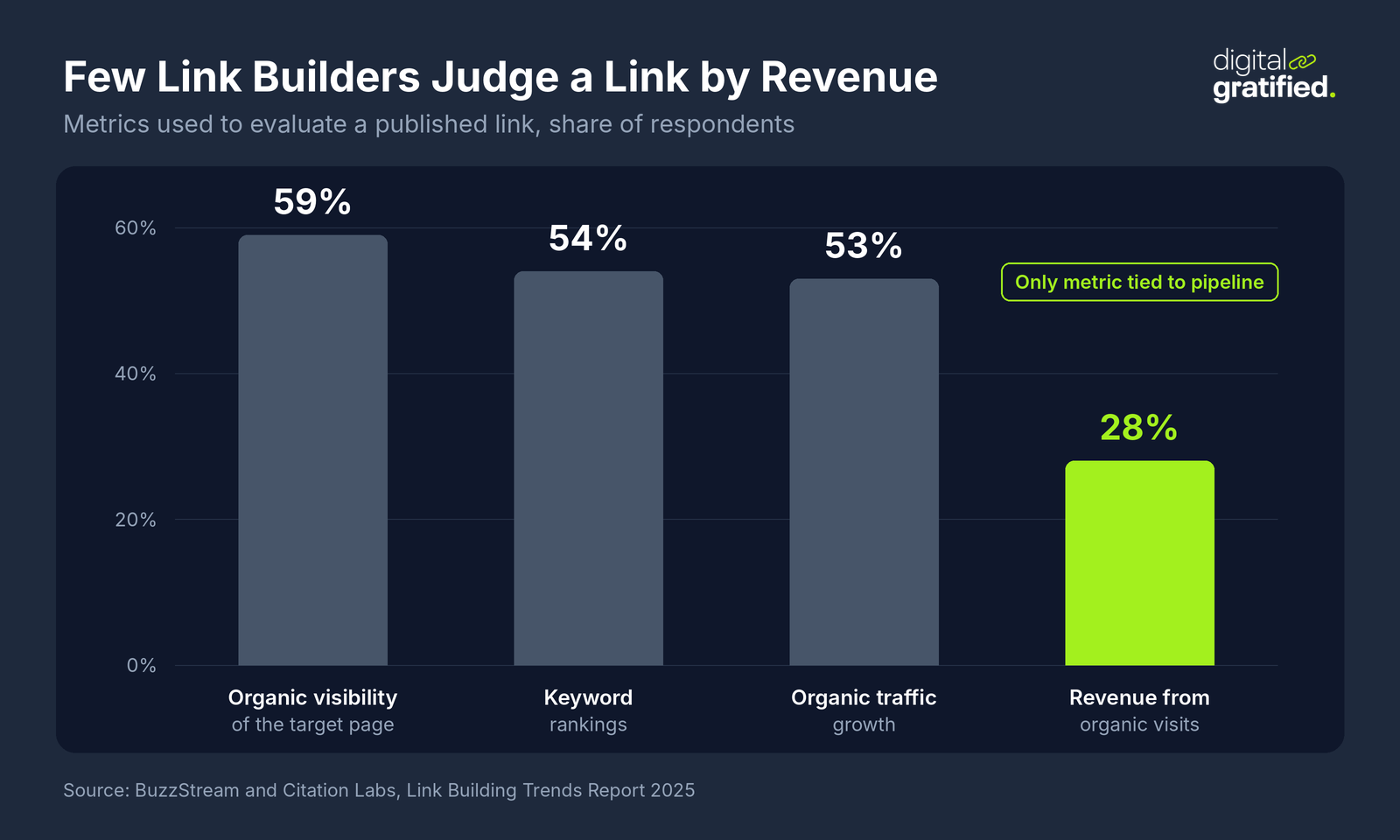
Our position is simple: decide which commercial pages need authority first, then pick tactics that can reach them. That one change does more for pipeline than adding a ninth tactic to the list.
How to Get Backlinks: 8 Tactics That Work for SaaS Sites
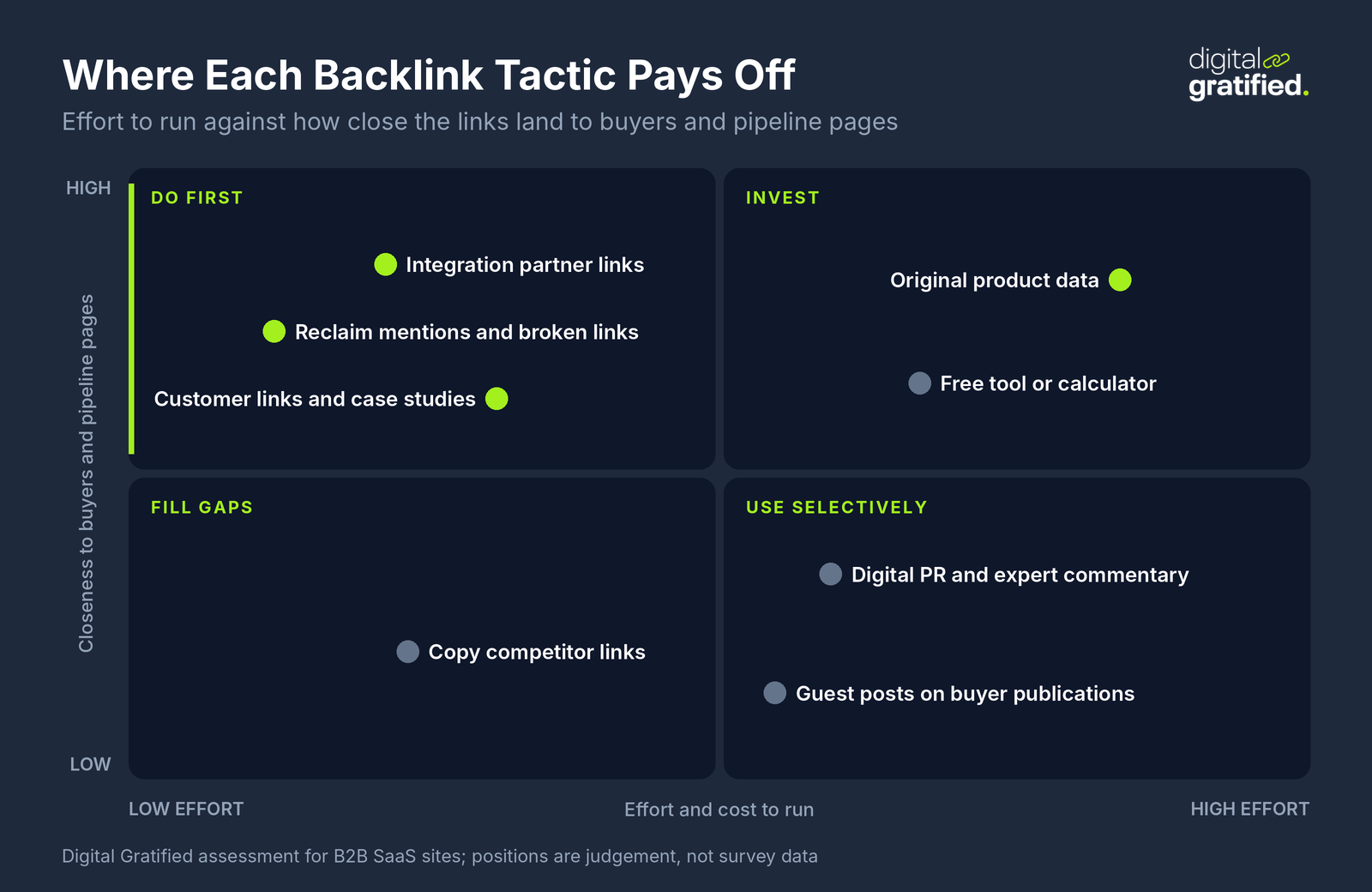
These are the tactics that hold up for B2B software, ordered roughly from the ones that use assets only a SaaS company has to the ones any site can run. Each one stays inside Google's spam policies, which spell out exactly what counts as a manipulative link.
1. Publish Product Data Nobody Else Has
A SaaS product sees patterns across thousands of customers: how long support tickets take to close, which days sales emails get replies, how fast invoices get paid by industry. Aggregated and anonymized, that is a dataset journalists, analysts and bloggers cannot get anywhere else, and original data is the most linkable content there is because writers need a number to cite.
Keep the study narrow and repeatable. One clear finding per chart, a methodology section that states the sample and the date range, and a yearly refresh so the links keep coming. This is the kind of work we produce as data studies built to earn citations, and it is why we published a SaaS backlink study rather than another opinion post.
2. Turn Integration and Technology Partners Into Links
Every integration you ship is a reason for another company to link to you: a listing in its app marketplace, a joint setup guide, an announcement post, a co-hosted webinar page. These links come from sites in your category, read by people who already use adjacent tools, which makes them some of the most relevant links a SaaS site can earn.
Two cautions. Marketplace listings are often nofollow, which is fine because their value is buyers, not ranking credit. And those policies name "partner pages exclusively for the sake of cross-linking" as link spam, so the link has to exist because the integration does, not the other way round.
3. Get Customers to Link to You
Customers write about the tools they use more often than marketing teams assume: in engineering blogs, in "how we work" posts, in conference talk pages and in their own case studies. Make it easy. Offer to co-publish case studies so both sides host a version, give champions a short paragraph and a logo they can use, and ask happy customers who already blog whether a workflow post would help their audience.
Do not trade discounts, credits or free seats for links. Google lists "exchanging goods or services for links" under link spam, and that includes product in exchange for a review with a link.
4. Become a Source for Journalists and Analysts
Digital PR tops SEOs' own effectiveness rankings for a reason: links from news and trade publications carry authority that is hard to get any other way, and they put your brand in front of buyers. For SaaS, the strongest angles are your product data (tactic 1), sharp expert commentary on news in your category, and named people inside the company who can speak with authority on a narrow topic.
Journalist request services that match reporters with expert sources still work, but the bar has risen; a fast, specific answer with a credible title beats a generic quote every time. We run digital PR for software companies through expert commentary placements and journalist relationships, because one placement in a publication your buyers read is worth more than a dozen links from sites they never visit.
That is also why digital PR sits in the use selectively corner of the matrix above. The authority is real, but the links usually land on a news hook rather than a page that sells, so pair every campaign with product data from tactic 1 and an internal link path to a commercial page.
5. Write Guest Posts for Publications Your Buyers Read
Guest posting still works when the publication has a real audience in your market and the article teaches something specific. It stops working when the goal is the link rather than the readers. Pick sites by audience overlap first and authority metrics second, write the piece your head of product would be proud to put their name on, and leave the link attributes to the editor.
Watch your anchors. Google treats "links with optimized anchor text in articles, guest posts, or press releases distributed on other sites" as spam, so link with your brand name or a natural description of the page, not the keyword you want to rank for.
6. Reclaim Unlinked Mentions and Broken Links
This is the cheapest link building there is, because the hard part is already done. Somewhere, a writer has mentioned your product without linking, or linked to a page you deleted during the last site redesign. Our guide to turning unlinked mentions of your product into links covers the search and the email; on the technical side, redirect every old URL that still has backlinks to its closest live equivalent.
Once your own house is in order, look outward: replacing dead links on relevant pages with your better resource is slower but scales well in categories where tools and companies come and go.
7. Copy Your Competitors' Best Links, Selectively
Your competitors' backlink profiles show which publications, roundups and directories cover your category. Auditing where competitors earn their links gives you a prospect list in an afternoon. Be selective: skip the low-quality directories and anything that looks paid, and focus on editorial roundups and comparison articles where you deserve a mention. Two in three respondents in the Editorial.Link survey said finding unique link opportunities beats copying competitors, so treat this as a gap filler rather than the strategy.
8. Build a Free Tool, Calculator or Template
Free tools earn links for years because people reference them every time they explain the task. For a SaaS company, the best ones are a slice of the product: an ROI calculator for the problem you solve, a free version of one feature, a template your customers use inside the product. Keep the tool free of a signup wall for basic use, give it a page that ranks for the job it does, and link from it to the paid product page that solves the bigger version of the problem.
What Makes a Backlink Worth Having
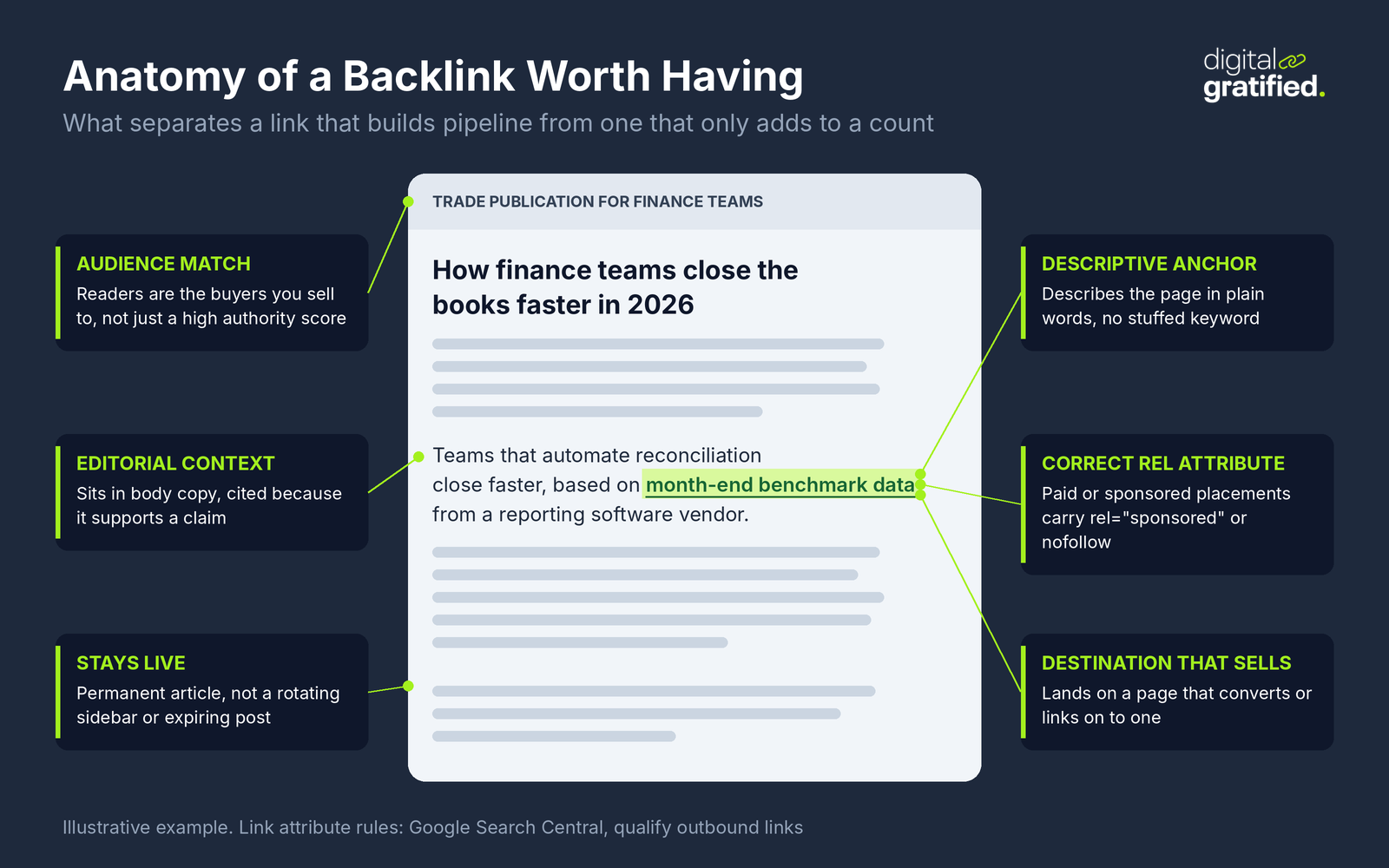
Not every link is worth chasing. A link from a site your buyers read, placed inside an article for a reason, beats a higher authority score on a site with no audience in your market. Authority metrics are useful filters, but relevance and real readers decide whether a link moves rankings and sends people who might buy.
Follow status matters less than most people think. Google asks sites to mark paid placements with rel="sponsored" or rel="nofollow", and says links with those attributes will generally not be followed. A healthy profile still contains plenty of them: the median SaaS site in our study had a dofollow ratio of 82.7%, which means roughly one referring domain in six was nofollow. A nofollow link in a trade publication that sends demo requests is a good link.
Route Link Equity to the Pages That Convert
Here is the part most guides skip. Publishers rarely link to your pricing page, your "alternatives" pages or your comparison pages, because those pages sell. They link to your research, your tools and your guides. So the job is to earn links to those linkable assets and then pass that authority on with internal links.
In practice: every data study links to the product page for the problem it measures, every free tool links to the paid product and the most relevant comparison page, and every guide links to the use case page a reader would want next. Our guide to internal links that pass authority to commercial pages covers the structure. Done well, one study that earns links lifts several commercial pages instead of one blog post.
What Not to Do: Paid Links, PBNs and Link Swaps
Google's spam policies are explicit. Link spam includes "buying or selling links for ranking purposes", "excessive link exchanges", "using automated programs or services to create links to your site", low-quality directory and bookmark links, and "creating low-value content primarily for the purposes of manipulating linking and ranking signals". Private blog networks exist to do exactly that last thing. Buying a placement is allowed only when the link is qualified with rel="sponsored" or rel="nofollow", at which point it passes no ranking credit.
None of this is risk free, and vendors that suggest otherwise are selling you their risk. We have written about why most link swaps backfire in more detail.
Two recent developments are worth knowing. Google's September 2026 spam update rolled out from September 24 to October 8, 2026, globally and in all languages; Google said at launch that the update does not target link spam, so if your rankings moved in that window, look at content quality first. And on September 2, 2026, Google's John Mueller said the disavow tool "has its place & time, it does have effects". Most SaaS sites never need it. Use it only for links you or a previous vendor built that clearly break the policies above, not for random low-quality links every site collects.
A 90-Day Backlink Plan for a SaaS Team
This is the order we run when a SaaS site starts from a thin profile. Adjust the timing to your team, but keep the sequence: fix what you already own, then use your unfair advantages, then scale outreach.
- Weeks 1 to 2: List the five to ten commercial pages that most need authority (alternatives, comparison, use case and pricing pages). Record their current rankings and the demos each one produces.
- Weeks 1 to 3: Redirect old URLs that still have backlinks, and email every writer who mentioned the product without a link.
- Weeks 2 to 4: Contact your top integration partners about marketplace listings, joint guides and announcement posts. Ask your five happiest customers about co-published case studies.
- Weeks 3 to 8: Build one linkable asset from product data or one free tool, and add internal links from it to the commercial pages on your list.
- Weeks 6 to 12: Pitch the asset to trade publications and journalists, and fill gaps from your competitors' editorial links. A spreadsheet is enough at low volume; once you pass a few dozen prospects a week, outreach tools such as BuzzStream, Pitchbox or linkOreach (which adds an AI agent called Linkzy for drafting pitches and follow-ups) save time.
- Week 12: Compare rankings and demo requests for the target pages with the baseline, and move effort toward the tactics that reached them.
The plan above is the internal version of what our playbook for building links to SaaS sites describes at the strategy level. When we run editorial link building for B2B software, we only pitch DR 50+ publications with a real audience in the client's market, and never PBNs. For CloudTalk, that meant 20+ DR 50+ backlinks monthly across an 18-month partnership, driving 250% organic traffic growth.
How to Know Whether Your Backlinks Are Working
Judge links by what happens to the pages they support. Track three things for each target page: rankings for its commercial terms, organic sessions, and demo or trial requests from organic visits that started on that page or on an asset linking to it.
A hypothetical example shows why the page matters more than the count. Say a team earns 20 links in a quarter. Fifteen go to a glossary post that gains 3,000 visits a month and produces two demos. Five go to a data study that links internally to an alternatives page, which climbs from position 14 to position 6 and starts producing eight demos a month. The study got a third of the links and produced four times the demos. Your numbers will differ; the pattern is what to look for. Our guide to putting a dollar value on each backlink turns that into a full ROI calculation.
The Bottom Line
Getting backlinks for a SaaS site is less about finding a clever tactic and more about using what you already have: product data, partners, customers and expertise. Start by naming the commercial pages that need authority, earn links with the assets publishers want to cite, and route that authority to the pages that sell through internal links.
Skip anything you would not want to explain to Google, and judge every link by the demos its target page produces. If you want a team that earns those links for you, plan a SaaS link program with us.
Frequently Asked Questions
How can I get backlinks for free?
Start with links that cost time rather than money: ask writers who mentioned your product without linking to add a link, redirect old URLs that still have backlinks, get listed by your integration partners, co-publish case studies with customers, and answer journalist requests in your area of expertise. Guest posts on publications your buyers read are also free, apart from the writing time.
Is it worth paying for backlinks?
Paying for links that pass ranking credit breaks Google's spam policies, which list buying or selling links for ranking purposes as link spam. Paid placements are allowed only when the link carries rel="sponsored" or rel="nofollow". Pay for the work that earns links instead: original research, digital PR, content and outreach.
How long does it take for backlinks to improve rankings?
Plan in months, not weeks. Google has to recrawl the linking page and reassess your page, and competitive SaaS terms usually need several good links before a page moves. Judge a link program on a quarter or more of data, and track rankings and demo requests for the specific pages the links support.
How many backlinks does a SaaS website need?
There is no fixed number. Compare the referring domains of the pages that rank in the top five for your target term, then aim to close that gap with relevant links. A comparison or alternatives page in a low competition niche can rank with a handful of good links; a category head term may need far more.
Do nofollow backlinks help SEO?
Google says links marked nofollow, sponsored or ugc will generally not be followed, so they pass little or no ranking credit. They still send referral visitors and build brand awareness, and every natural link profile contains them. A nofollow link from a trade publication your buyers read can be worth more in pipeline than a followed link from an irrelevant site.
What is the fastest way to get backlinks for a new SaaS website?
Use the relationships you already have. Ask integration partners for marketplace listings and joint guides, ask early customers for co-published case studies, claim every unlinked mention of your brand, and have founders answer journalist requests in their area of expertise. These links arrive faster than outreach to strangers and come from sites in your market.
Do backlinks still matter with AI search?
Yes. Google says pages need no special optimization to appear in AI features beyond standard SEO, and links remain part of how Google judges which pages rank. Mentions on third party sites also help AI tools see your brand in more than one place, so links and brand mentions from relevant publications support both.
About the author
Let's Scale Your SaaS Together
Get a custom SEO and link building strategy tailored for your SaaS business.
Get SEO insights that actually move rankings
Link building tactics, case studies, and SaaS SEO playbooks. No fluff, no spam.
You're subscribed!
SEO and link building insights, straight to your inbox.