B2B SEO decides which vendors make the shortlist before sales gets a call. Here is the build order we use for SaaS sites, and how to measure it in pipeline.
Digital Gratified
SaaS SEO Experts
B2B SEO is the work of making your company the obvious answer when a buying committee researches a problem you solve, long before anyone fills in a demo form. For a B2B SaaS company that means one thing above all: build the pages that put you on the shortlist first, and measure the program in qualified pipeline, not sessions.
Most B2B SEO guides treat the topic as B2C SEO with smaller numbers. That framing sends teams after high-volume glossary terms they cannot win and that rarely convert. This guide covers how B2B search behaves today, the build order we use for SaaS sites, what changed in Google Search over the last few weeks, and how to tell whether the program is paying for itself.
What Is B2B SEO?
B2B SEO is search engine optimization for companies that sell to other businesses. The mechanics are the same as any SEO program: Google has to crawl and index your pages, judge them relevant and trustworthy, and rank them for the searches your buyers run. What changes is who searches, how many of them there are and what a win is worth.
One visitor who reads a comparison page, forwards it to two colleagues and books a demo three weeks later can be worth a full annual contract. That economics shift is why B2B SEO rewards precision over reach.
If you sell software specifically, our full SaaS SEO framework goes deeper on page types, technical setup and the ARR connection. This post stays at the B2B strategy level that applies to any SaaS team selling to companies.
How B2B SEO Differs From B2C SEO
The differences are practical, and each one changes a decision you make about keywords, content or measurement.
| Factor | B2C SEO | B2B SEO |
|---|---|---|
| Who decides | One person, often in one session | A buying group; Forrester puts the typical decision at 13 internal stakeholders and nine external influencers (as of October 2026) |
| Search volume | Large head terms worth chasing | Small, specific queries; the best ones often have a few hundred searches a month |
| Conversion | A purchase on the site | A demo request, trial or sign-up that turns into revenue weeks or months later |
| Value of one visit | Low and fairly uniform | Highly uneven; one decision maker can be worth more than thousands of students |
| Content that converts | Product and category pages | Comparison, alternatives, use case, integration and pricing pages |
| Success metric | Revenue per session | Qualified pipeline and closed ARR by landing page |
The table has one practical consequence. A B2B team that copies a B2C content calendar ends up with a traffic chart that goes up and a pipeline chart that stays flat. It is the first pattern we look for in an audit, and the first item in our list of SaaS SEO mistakes that stall growth.
Why B2B SEO Decides the Shortlist Before Sales Gets a Call
The strongest argument for B2B SEO is not traffic. It is timing. Buyers now do most of their homework alone, and the vendors they find during that homework are the ones who win.
The 6sense 2025 B2B Buyer Experience Report (as of October 2026) found that:
- Buyers made first contact with a seller about 61% of the way through their journey.
- Buyers, not sellers, initiated 79% of those first engagements.
- The eventual winner was on the buyer's day one shortlist 95% of the time.
- The vendor contacted first won 77% of deals in the main survey of 3,744 buyers.
- Buyers evaluated an average of 5.1 vendors.
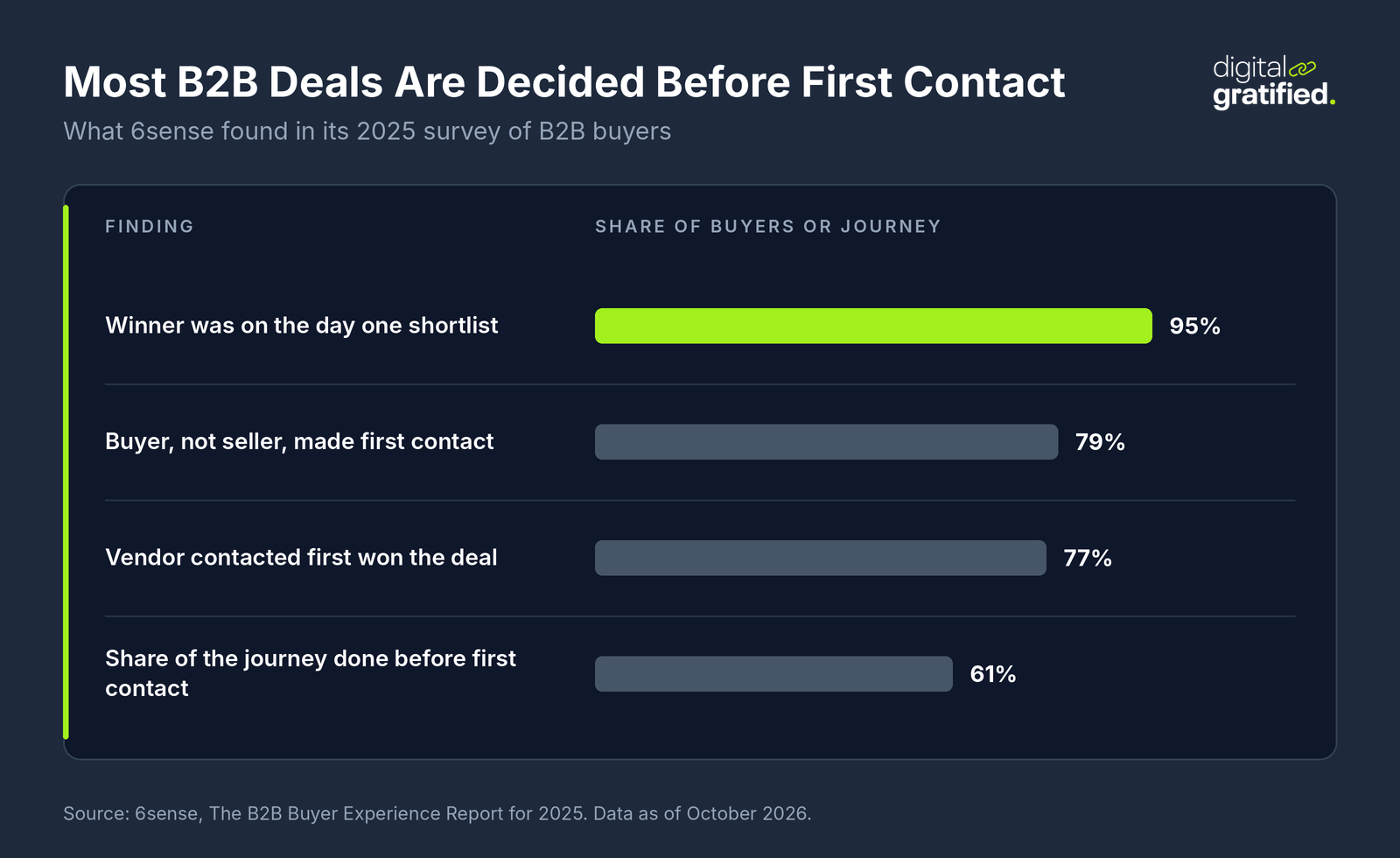
Put those numbers together and the job of B2B SEO becomes clear. If your product is missing from the searches a buyer runs before they ever talk to a rep, you are rarely on the shortlist, and if you are not on the shortlist you almost never win. SEO is how you get into that private research phase.
That research phase is also moving into AI tools. Forrester's State of Business Buying, 2026 says generative AI search is where business buyers typically start, and that more than 60% of buyers use a trial before purchasing (as of October 2026). For a SaaS company, that means two things: your pages need to be the sources AI answers draw from, and the path from search to trial has to be short.
How to Build a B2B SEO Strategy, in the Order That Pays Back
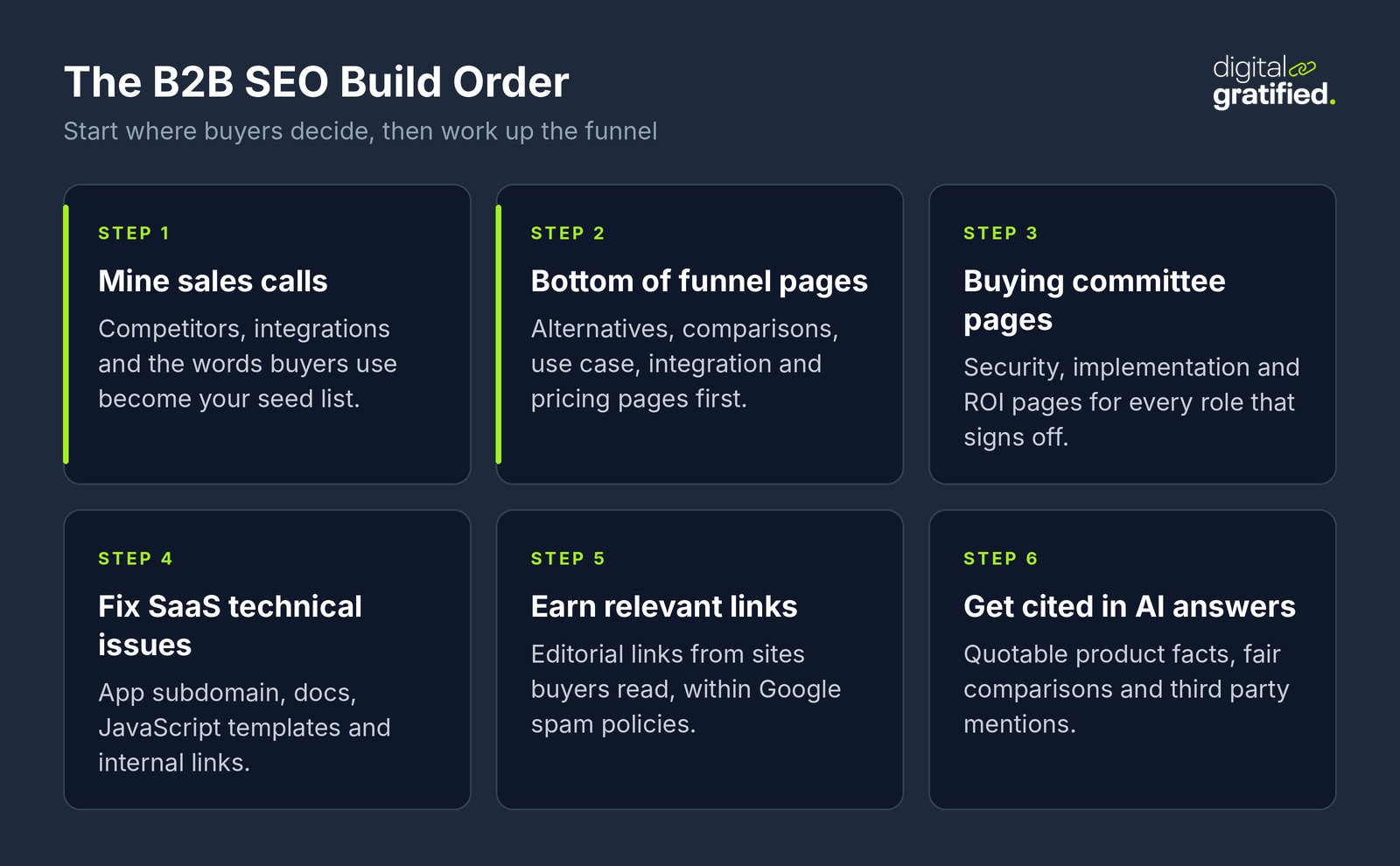
Our position is simple: build from the bottom of the funnel up. Most B2B SEO strategies start with awareness content because that is where the volume is. We start with the pages that sit closest to a buying decision, because that is where the pipeline is, and because those terms are usually far easier to rank for.
Step 1: Start From the Sales Conversation, Not the Keyword Tool
Before opening a keyword tool, pull 20 to 30 recent call recordings or CRM notes from deals you won and lost. Write down the competitors buyers mentioned, the tools they were replacing, the integrations they asked about and the words they used for the problem. Those phrases become your seed list.
This step matters more in B2B than anywhere else, because your internal product language rarely matches how buyers search. A team that calls its product a "revenue orchestration platform" will find that buyers search for the job it does or for the competitor they want to leave.
Step 2: Build Bottom of Funnel Pages First
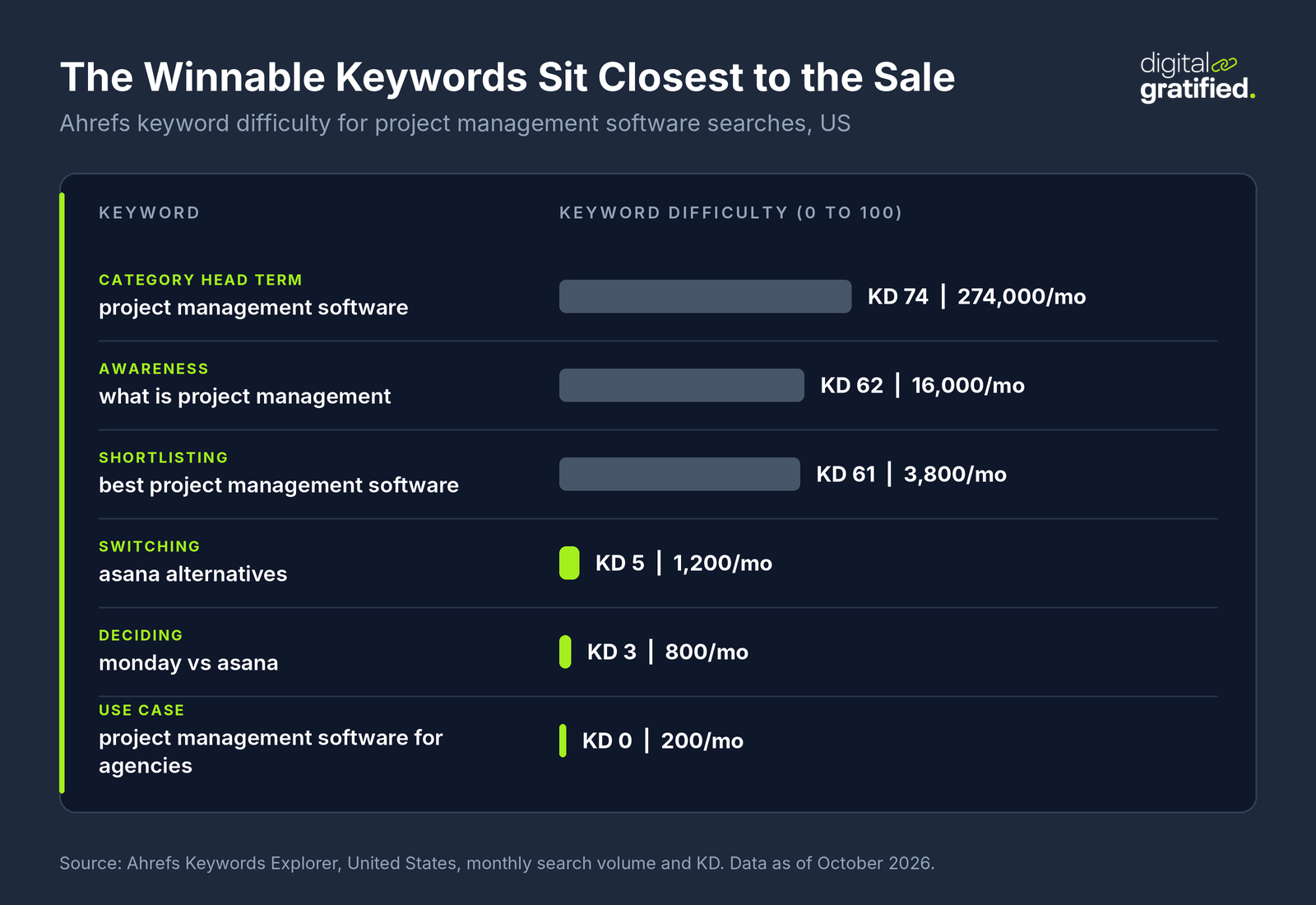
Here is what the keyword data looks like for one SaaS category, project management software, pulled from Ahrefs Keywords Explorer for the United States (as of October 2026). KD is Ahrefs' 0 to 100 keyword difficulty score, and CPC is what advertisers pay per click, a rough proxy for commercial value.
| Keyword | Funnel stage | US searches per month | KD | CPC |
|---|---|---|---|---|
| project management software | Category head term | 274,000 | 74 | $9.00 |
| what is project management | Awareness | 16,000 | 62 | $0.80 |
| best project management software | Shortlisting | 3,800 | 61 | $7.00 |
| asana alternatives | Switching | 1,200 | 5 | $9.00 |
| monday vs asana | Deciding | 800 | 3 | $3.50 |
| project management software for agencies | Use case | 200 | 0 | $0.10 |
The pattern is typical. The head term has huge volume and a difficulty score that rules it out for a young domain. The awareness query is nearly as hard and attracts advertisers paying 80 cents a click, which tells you how little commercial intent it carries. Meanwhile "asana alternatives" draws the same $9 CPC as the head term with a difficulty of 5. That is a buyer with budget who is already shopping, and the page that serves them is one a newer domain can realistically win.
For most B2B SaaS companies, the first pages to build are:
- Alternatives pages for each competitor buyers leave ("[competitor] alternatives").
- Comparison pages for your product against each serious competitor ("[you] vs [competitor]") and for head to head searches between two competitors.
- Use case and industry pages that match how buyers describe their situation ("[category] for agencies").
- Integration pages for the tools your buyers already run.
- A pricing page that answers the questions procurement will ask, because buyers search for your pricing whether you publish it or not.
Write these pages fairly. A comparison page that pretends the competitor has no strengths fails the buyer and the buying committee member who checks it. Show where each product fits, include real screenshots of your own product, and state plainly who should pick the other option.
Step 3: Write for the Whole Buying Committee
With 13 internal stakeholders on a typical decision, one page rarely persuades everyone. The champion wants to know whether the product solves the workflow problem. The finance lead wants total cost and payback. Security wants SOC 2 status, data residency and SSO. IT wants implementation time and integrations.
Map one or two pages to each of those roles. A security and compliance page, an implementation guide and an ROI page are what security and finance reviewers ask for late in a deal, and they also earn search traffic from the people running due diligence.
Step 4: Fix the Technical Problems SaaS Sites Create
B2B SaaS sites break in predictable ways: an app subdomain that leaks thin logged-in pages into the index, documentation on a separate platform that competes with marketing pages, JavaScript-rendered templates Google cannot fully see, and duplicate pages created by every marketing campaign. Our technical audit checklist for SaaS sites covers each of these.
Then connect the pages you built in step 2 with a deliberate internal linking structure, so authority flows from the blog posts that attract links to the commercial pages that convert.
Step 5: Earn Links From Sites Your Buyers Read
Commercial pages in competitive categories usually need links as well as content, and in B2B the best links come from the publications, review sites and partner blogs your buyers already read, because those links send qualified visitors as well as ranking signals.
This is the kind of work we do for SaaS clients through our SaaS link building service: editorial placements on DR 50+ publications earned through relationships, never PBNs. For CloudTalk, that meant securing 20+ DR 50+ backlinks monthly across an 18-month partnership, driving 250% organic traffic growth. Whoever does the work, hold it to Google's spam policies, which list "buying or selling links for ranking purposes" and "excessive link exchanges" as link spam (as of October 2026). Our guide to link building tactics for SaaS companies covers the methods that hold up.
Step 6: Become a Source AI Answers Cite
Google's documentation on AI features and your website says there are no additional requirements or special optimizations needed to appear in AI Overviews or AI Mode (as of October 2026). The same pages that rank tend to be the pages AI answers draw from.
What helps in practice: clear, quotable statements of what your product does and for whom; comparison pages with honest tradeoffs, since buyers ask AI tools to compare vendors; and mentions on third-party sites, so an answer engine sees your brand in more than one place. Our breakdown of how AI search changes SaaS SEO covers the measurement side.
What Changed in Google Search This Fall
Three developments from the last six weeks bear directly on B2B SEO programs.
The September 2026 spam update finished rolling out. Google's Search Status Dashboard shows it started on September 24, 2026 and was complete as of October 8, 2026, applying globally and in all languages. If organic demo requests dropped in that window, check which landing pages lost visibility before changing anything else.
Google warned about low-value programmatic pages. On September 7, 2026, Search Engine Roundtable reported that Google's John Mueller said its systems may "lose faith" in a site built on large sets of low-value programmatic pages, and that recovery takes considerable time. B2B SaaS teams love programmatic integration and "[tool] for [industry]" pages. Build them only where each page has something specific to say, such as real setup steps or real data.
AI visibility reporting reached every site. Search Engine Roundtable reported on September 1, 2026 that Search Console's generative AI performance report and AI controls had rolled out to all websites as of August 31, 2026. The report shows impressions by page, country, device and date, but no clicks or queries. Use it to see whether your commercial pages appear in AI features, and keep judging those pages on the demos they produce.
How to Measure B2B SEO in Pipeline, Not Traffic
B2B SEO earns its budget when you can trace a landing page to qualified opportunities. Set up the tracking before you publish, not after: record the organic landing page on every demo and trial form, pass it into the CRM, and report opportunities and closed ARR grouped by landing page type.
Here is a worked example with hypothetical inputs. None of these rates are benchmarks; replace each with your own numbers.
- Glossary post: 4,000 visits a month, 0.1% request a demo, which gives 4 demos, of which 1 qualifies.
- Alternatives page: 400 visits a month, 3% request a demo, which gives 12 demos, of which 5 qualify.
The alternatives page has a tenth of the traffic and produces five times the qualified pipeline. At a 25% win rate and a $12,000 annual contract, those 5 qualified opportunities are worth about $15,000 of new ARR a month, while the glossary post contributes about $3,000. Your numbers will differ. The gap between the two page types is what to look for in your own data.
Report three layers, in this order: leading indicators (indexation and rankings for commercial terms), conversion (demo requests and trials by landing page) and revenue (qualified pipeline and closed ARR, with first touch and assisted counts kept separate). Our guide to SEO reporting tied to pipeline covers the report itself, and budgeting SEO backwards from demo targets shows how to turn the same math into a spend decision.
A B2B SEO Checklist for the First 90 Days
- Weeks 1 to 2: Add the organic landing page to every form and confirm it reaches the CRM. Record a baseline of organic demos, trials and opportunities.
- Weeks 1 to 3: Mine 20 to 30 sales calls for competitor names, integrations and buyer language.
- Weeks 2 to 4: Crawl the site; fix indexing problems on the app subdomain, docs and templates.
- Weeks 3 to 8: Publish alternatives and comparison pages for your top three to five competitors.
- Weeks 6 to 10: Add use case, integration and buying committee pages (security, implementation, pricing).
- Weeks 6 to 12: Start earning links to the strongest commercial pages and the posts that support them.
- Week 12: Review rankings for commercial terms, demo requests by landing page and opportunities created. Double down on the page types that produce pipeline.
In-House Team, Expert or Agency?
The build order above needs four skills: research, writing that a buyer trusts, technical fixes and link acquisition. Give each skill a named owner, and buy the ones you cannot staff. If you are hiring a person, our guide to vetting a SaaS SEO expert lists the questions that expose generalists. If you are weighing a partner, start with deciding what to outsource before you compare quotes.
The Bottom Line
B2B SEO is a shortlist game. Buyers pick most of their vendors before they speak to sales, and they increasingly start that search in AI tools that draw on the same pages Google ranks. So build in the order buyers decide: alternatives, comparisons, use case and integration pages first, the buying committee pages next, and awareness content once the bottom of the funnel converts.
Judge every page on the qualified pipeline it creates, and cut what does not earn its place. If you want a team that builds and links those pages for you, talk to us about B2B SEO for your SaaS.
Frequently Asked Questions
What is B2B SEO?
B2B SEO is search engine optimization for companies that sell to other businesses. It focuses on the searches a buying committee runs while researching a problem and comparing vendors, and it is judged on demo requests, trials and qualified pipeline rather than raw traffic.
How is B2B SEO different from B2C SEO?
B2B buyers decide in groups, search with smaller and more specific queries, and convert weeks or months after the first visit. That shifts the work toward comparison, alternatives, use case and integration pages, and toward measuring results in pipeline and ARR instead of revenue per session.
What pages should a B2B SaaS company build first for SEO?
Start with the pages closest to a buying decision: competitor alternatives pages, product comparison pages, use case and industry pages, integration pages and a pricing page. These terms usually have lower keyword difficulty than category head terms and attract buyers who are already shopping.
How long does B2B SEO take to work?
Plan in months, not weeks. Google's own advice when hiring an SEO is to ask what results to expect and in what timeframe, and it states that no one can guarantee a #1 ranking. Track leading indicators such as rankings for commercial terms early, and judge pipeline over a longer window.
How do you measure B2B SEO ROI?
Capture the organic landing page on every demo and trial form, pass it into your CRM, and report qualified opportunities and closed ARR by landing page type. Keep first touch and assisted pipeline separate so the same deal is not counted twice.
Does B2B SEO still matter with AI search?
Yes. Forrester reports that business buyers typically start with generative AI search, and Google says no special optimization is needed to appear in AI Overviews or AI Mode beyond standard SEO. The pages that rank and are cited are usually the same clear, specific pages a good B2B SEO program builds anyway.
Let's Scale Your SaaS Together
Get a custom SEO and link building strategy tailored for your SaaS business.
Get SEO insights that actually move rankings
Link building tactics, case studies, and SaaS SEO playbooks. No fluff, no spam.
You're subscribed!
SEO and link building insights, straight to your inbox.