Learn when outsourcing link building makes sense, how to evaluate providers, the real cost comparison between in-house and outsourced, red flags to watch for, and how to manage the relationship for best results.

Digital Gratified
SaaS SEO Experts
Most guides about outsourcing link building read like they were written by someone who has never actually managed an outsourced campaign. They list the same generic advice: "check reviews," "ask for case studies," "avoid black hat tactics." None of that is wrong. But none of it helps you avoid the specific, expensive mistakes that companies make every quarter when they hand link building to an external team.
This guide is written from the other side of the table. Digital Gratified builds links for B2B SaaS companies and agencies. We see what works when clients outsource to us, and we see the damage that previous providers left behind. What follows is the honest version of what outsourcing link building involves, when it makes sense, when it does not, and how to set up the engagement so it actually produces results.
What Outsourcing Link Building Actually Means
Outsourcing link building means hiring an external specialist, whether a freelancer, an agency, or a white-label provider, to acquire backlinks on your behalf. The external team handles some or all of the work that goes into earning those links: prospecting target sites, qualifying them for relevance and authority, crafting outreach emails, negotiating placements, producing content when needed, and reporting on results.
That definition sounds simple, but the "some or all" part matters. Some companies outsource the entire link building function. Others keep strategy and target selection in-house but outsource execution. The model you choose affects cost, quality control, and how much internal bandwidth you still need.
If you are new to what link building involves, start there before evaluating outsourcing options. You need to understand the mechanics well enough to evaluate whether an external team is doing the work correctly.
When Outsourcing Link Building Makes Sense
Outsourcing is not universally the right call. It solves specific problems, and if those are not the problems you have, you will spend money without getting value.
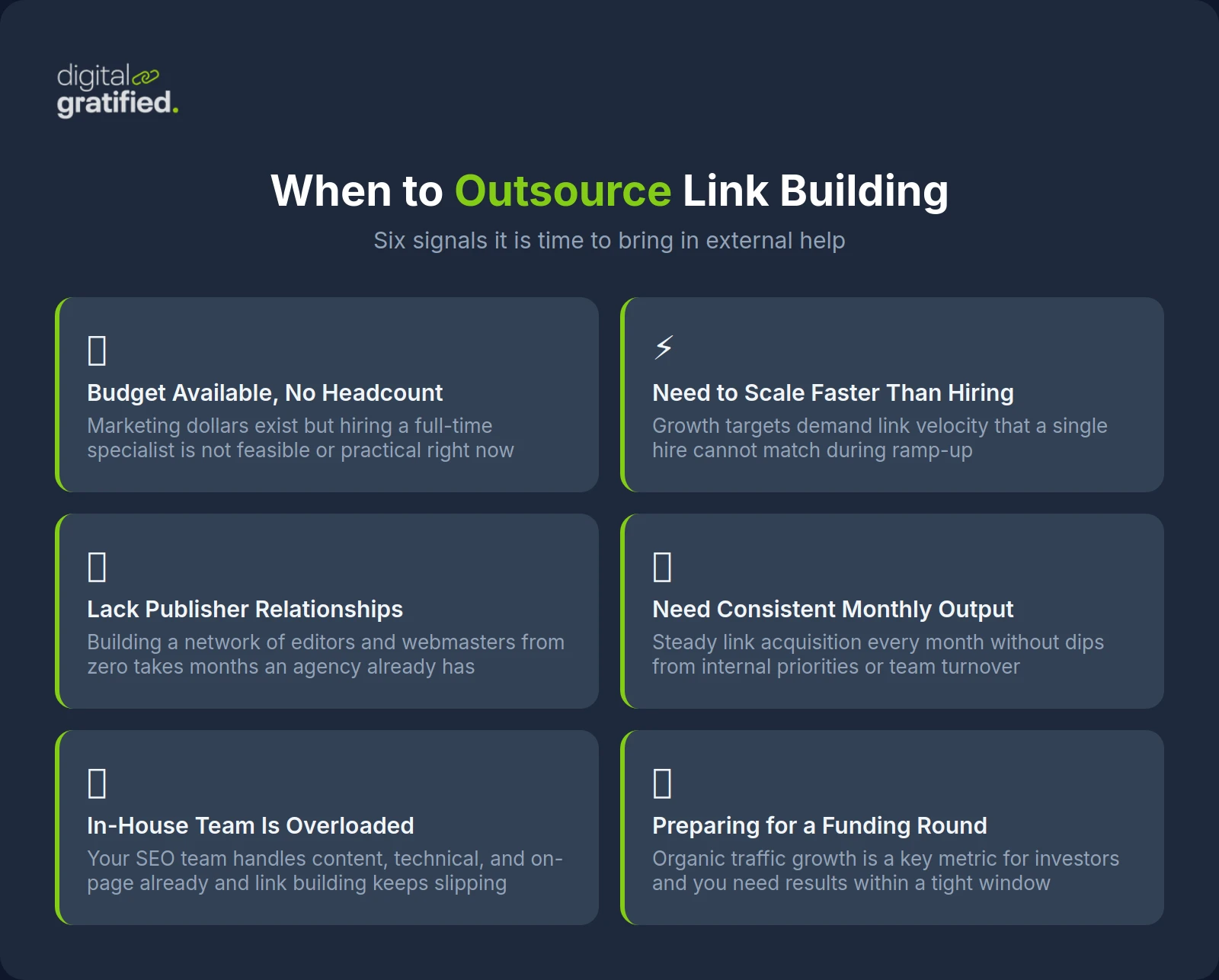
You have budget but not headcount
Link building is labor-intensive. A single link can require 40 to 80 prospecting emails, 5 to 15 follow-ups, content production, and editorial back-and-forth. If your marketing team is already stretched across content, paid acquisition, and product marketing, adding outreach to their plate is a recipe for half-done campaigns that produce nothing. Outsourcing lets you deploy budget without adding permanent headcount.
You need to scale faster than you can hire
Hiring an experienced link builder takes two to four months. Training someone with no link building background takes longer. An outsourced team can start delivering within the first month. For companies in growth mode or preparing for a funding round where organic metrics matter, outsourcing compresses the timeline significantly.
You lack the relationships and infrastructure
Effective link building outreach depends on established relationships with publishers, editors, and site owners. Building that network from scratch takes years. Agencies already have those relationships, along with the email infrastructure, tracking tools, and templated workflows that make outreach efficient.
You need consistent output, not bursts
In-house link building tends to happen in bursts: a push in Q1, nothing in Q2 because priorities shifted, another push in Q3. Search engines reward consistent link velocity over time. An outsourced partner with a monthly retainer delivers steady output regardless of what else is happening inside your company.
When Outsourcing Link Building Does Not Make Sense
There are situations where outsourcing creates more problems than it solves.
You do not have content worth linking to
No link building provider can consistently earn links to thin, outdated, or purely commercial pages. If your site lacks substantive content (research, tools, in-depth guides), you need to invest in content marketing before you invest in link building. An honest provider will tell you this during the sales process. A dishonest one will take your money and place links on low-quality sites that do not require good content as a prerequisite.
Your budget is under $2,000 per month
Quality link building has a cost floor. The math is straightforward: current link building pricing for editorially placed links from relevant, real-traffic sites runs $300 to $1,500 per link depending on the niche and the target site's authority. At $2,000 per month, you might get two to four quality links. That is enough to see results over six to twelve months. Below that threshold, the provider's account management overhead eats into the budget, and you end up with one link per month, which is too slow to move the needle for most sites.
You want guaranteed rankings
Link building is one input into a complex ranking algorithm. No provider can guarantee that ten links will move you from position 15 to position 3. If that is the expectation, outsourcing will feel like a failure even when the work itself is done well. Make sure your expectations are aligned around deliverables (links acquired, quality metrics, relevance) rather than ranking positions.
The Real Cost Comparison: In-House vs. Outsourced
The decision usually comes down to economics. Here is the math most companies do not do before deciding.
In-house link building costs
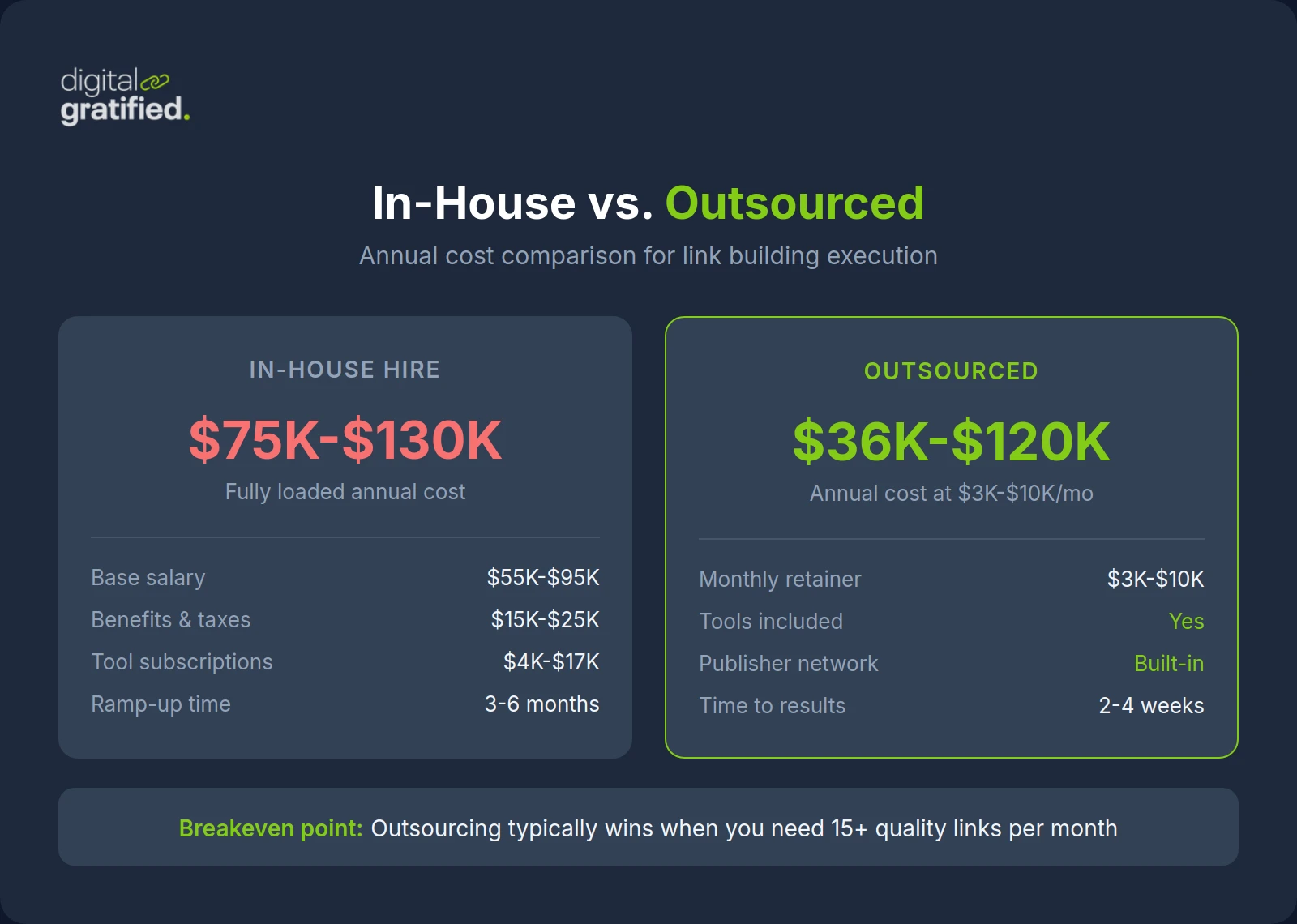
A full-time link building specialist in the US or UK commands $55,000 to $95,000 in salary. Add benefits, payroll taxes, and overhead, and the fully loaded cost is $75,000 to $130,000 per year. That person also needs tools: an outreach platform ($100 to $500/month), a backlink analysis tool ($99 to $399/month), email infrastructure ($50 to $200/month), and a prospecting database ($100 to $300/month). The minimum tool stack runs $4,000 to $17,000 per year.
A single in-house link builder, fully ramped, can typically produce 8 to 15 quality links per month. So your cost per link is roughly $550 to $1,500 when you factor in salary, tools, and management overhead.
Outsourced link building costs
Most agencies charge $3,000 to $10,000 per month for a managed link building campaign, delivering 5 to 20 links depending on quality tier and niche difficulty. The cost per link ranges from $300 to $1,500. The economics are similar, but the outsourced model eliminates recruiting risk, training time, and the fixed cost of a full-time hire.
The breakeven point is typically around 15 to 20 links per month. Below that volume, outsourcing is usually more cost-effective. Above it, an in-house team starts to make financial sense, though many companies run a hybrid model: an in-house strategist who manages one or more outsourced execution partners.
How to Evaluate a Link Building Partner
This is where most advice falls short. "Check their reviews" is not a vetting strategy. Here is what actually matters when you evaluate potential outsource link building partners.
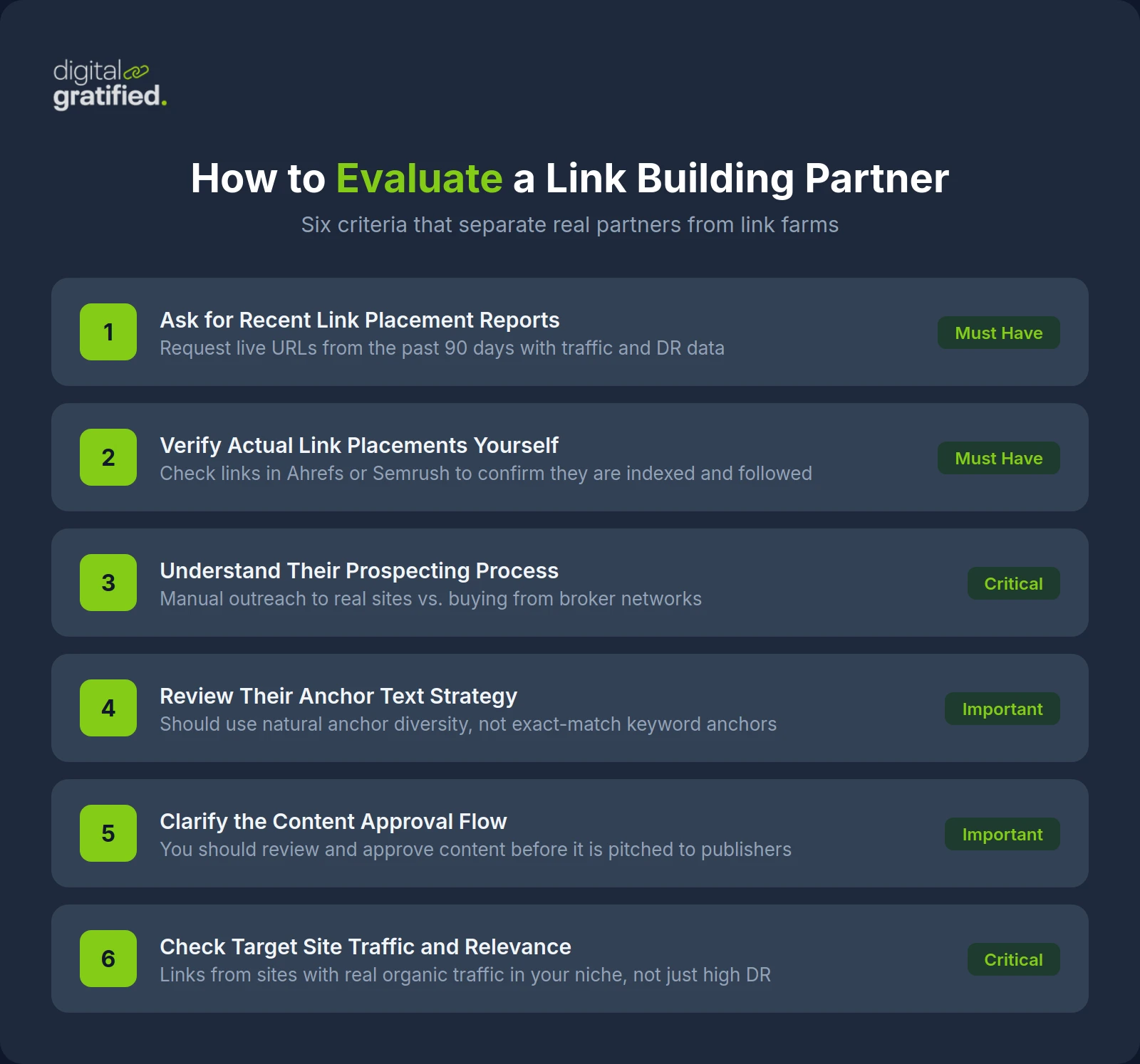
Ask for a sample link report, not a case study
Case studies are marketing materials. They show the best outcome under the best conditions. Instead, ask for a redacted sample of an actual monthly link report. You want to see the domains they placed links on, the metrics of those domains (traffic, Domain Rating, topical relevance), the anchor text distribution, and the pages that received links. This tells you more in five minutes than any case study ever will.
Check the links they have built for other clients
Ask for three to five example domains where they have placed links. Open those pages. Read the content. Check whether the site has real traffic (use any free traffic estimation tool). If the placements are on sites with no traffic, generic "write for us" blogs, or sites that exist solely to sell links, that tells you the quality you will get.
Ask about their link prospecting process
A good answer involves something like: "We identify sites ranking for related terms in your niche, analyze their content gaps, and pitch genuinely useful content." A bad answer is vague: "We have a network of publishers" or "We use our proprietary database." The first approach produces relevant, editorially earned links. The second often produces pay-for-placement links from sites that accept anyone willing to pay.
Understand their anchor text strategy
Over-optimized anchor text is one of the fastest ways to trigger a Google penalty. Ask how they decide what anchor text to use. The right answer involves analyzing your existing anchor text profile, maintaining a natural distribution (mostly branded and URL-based anchors, with a small percentage of exact-match keywords), and never forcing keyword-rich anchors. If they let you choose exact-match anchors for every link, that is a red flag.
Clarify what happens with content
Most link building strategies involve creating content for the target site (guest posts, contributed articles, resource mentions). Ask who writes the content, what the editorial process looks like, and whether you get approval before publication. Low-quality outsourced content can damage your brand reputation even if the link itself has technical SEO value.
The Three Outsourcing Models
Not all outsourcing arrangements work the same way. The model you choose should match your internal capabilities and how much control you want to retain.
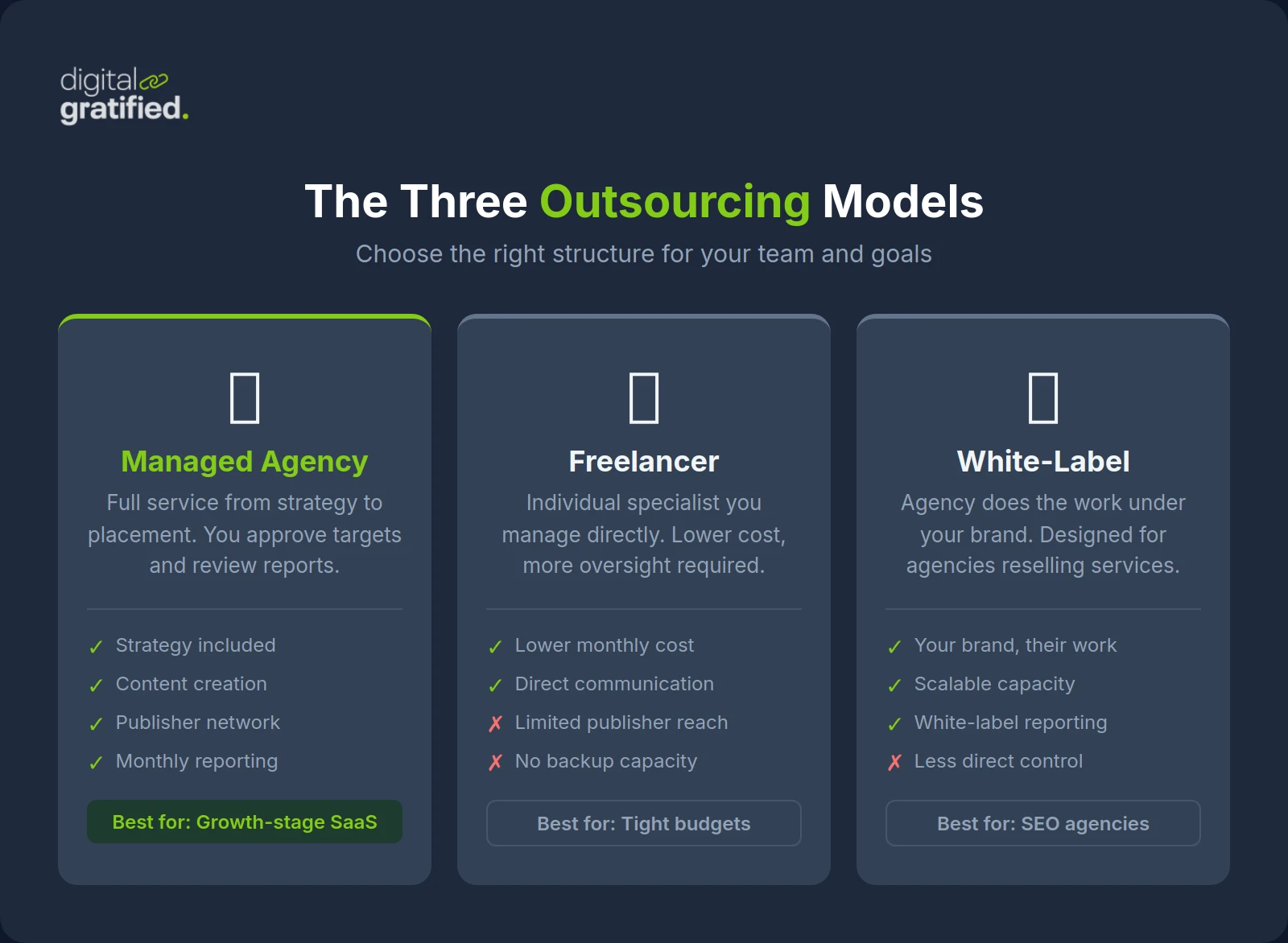
Managed agency model
You hire a link building agency that handles everything: strategy, prospecting, outreach, content creation, and reporting. This is the most hands-off option. It works well for companies that do not have in-house SEO expertise and want to delegate the entire function. The tradeoff is that you have less control over targeting and you are dependent on the agency's judgment about what constitutes a good link.
If you are evaluating agencies, our buyer's guide for SaaS link building agencies covers the specific criteria that matter for B2B software companies.
Freelancer or specialist model
You hire an individual link builder, typically through platforms or referrals, to execute outreach based on your strategy and target list. This gives you more control but requires more management. It works best when you have an in-house SEO strategist who can set direction and quality standards. The risk is that individual freelancers may lack the publisher relationships that agencies have built over years.
White-label model
If you run a marketing agency and need to offer link building to your clients without building the capability in-house, a white-label link building partner does the work under your brand. The end client never knows a third party is involved. This model is common among SEO and digital marketing agencies that want to expand their service offering without the overhead of hiring link builders.
What a Good Outsourced Link Building Process Looks Like
Understanding the process helps you evaluate whether a provider is doing the work properly. Here is what each phase should involve.
Discovery and goal setting
The provider should start by analyzing your current backlink profile, identifying gaps relative to competitors, and understanding your business goals. Are you trying to rank for specific keywords? Build topical authority in a new area? Support a product launch? The link building strategy should be shaped by these goals, not by a one-size-fits-all template.
A thorough discovery phase also involves reviewing your existing content to identify the best link targets: pages that are genuinely useful, well-written, and likely to earn editorial links. If you want to understand how competitors approach this, our guide on finding competitor backlinks walks through the process.
Prospecting and qualification
The provider builds a list of target sites for outreach. Quality prospecting means filtering for relevance (the site covers topics related to your business), authority (the site has real traffic and a credible backlink profile of its own), and editorial standards (the site publishes original content, not just sponsored posts).
Outreach and negotiation
This is the execution phase. The provider contacts site owners and editors, pitches content or link opportunities, and negotiates placements. Good outreach is personalized, references the target site's content specifically, and offers genuine value. Template-blast outreach that starts with "Dear Webmaster" has extremely low conversion rates and can damage your brand.
Content creation and placement
When the outreach results in an opportunity, the provider creates content (a guest post, a contributed quote, a resource) and works with the target site's editorial team to get it published. The content should meet the publishing site's quality standards, not just serve as a vehicle for your link.
Reporting and iteration
Monthly reporting should include: links acquired (with URLs), metrics of the linking domains, anchor text used, the target pages that received links, and a summary of outreach activity (emails sent, response rates, conversion rates). This data lets you evaluate quality and gives the provider feedback to refine their approach.
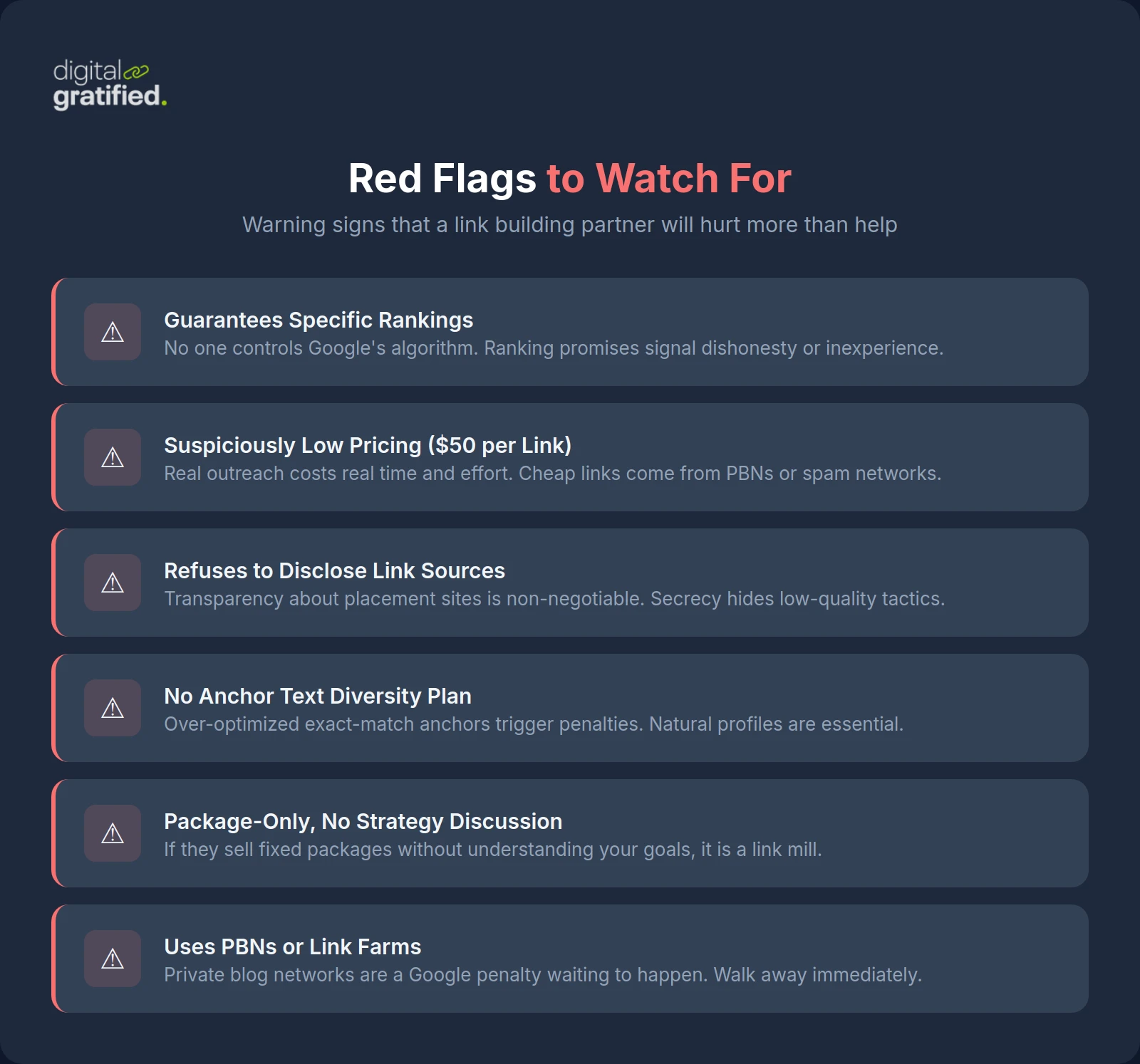
Red Flags That Should Make You Walk Away
After working in this space for years, these are the warning signs that consistently predict a bad outcome.
They guarantee specific ranking improvements
No legitimate provider promises rankings. They can promise deliverables (number of links, quality thresholds, reporting cadence), but rankings depend on dozens of factors outside the link builder's control, including your content quality, technical SEO, and what competitors are doing.
They offer links at below-market prices
If someone offers "DR 50+ links for $50 each," the links are almost certainly from private blog networks (PBNs), link farms, or hacked sites. These links might show a short-term ranking boost but create serious long-term risk. When Google identifies the network (and they do), the links get devalued or your site gets penalized.
They will not disclose where links will come from
Legitimate providers can show you examples of sites they have placed links on. If a provider says their link sources are "proprietary" and refuses to share examples, they are hiding the quality of their placements. Transparency is non-negotiable.
They have no process for anchor text diversity
If every link uses your target keyword as anchor text, you will eventually trigger Google's spam detection. A provider who does not proactively manage anchor text distribution is either inexperienced or indifferent to the risk they are creating for your site.
They sell links by the package with no strategy discussion
"Buy 10 links for $X" with no conversation about your goals, your niche, or your existing backlink profile is a transaction, not a service. Link building without strategy produces random links that do not compound into authority for the topics you care about.
Managing the Outsourced Relationship
Even with a good provider, the relationship needs active management to produce the best results.
Set clear expectations in writing
Before the engagement starts, document: the number of links expected per month, the minimum quality thresholds (traffic, relevance, domain metrics), the anchor text guidelines, the reporting format and frequency, and the escalation process for links that do not meet quality standards. Verbal agreements lead to misaligned expectations.
Review every link, at least initially
For the first two to three months, manually review every link your provider delivers. Open the page. Read the content. Check whether the link is contextually placed or awkwardly inserted. Verify that the linking site has real traffic. This takes 15 to 30 minutes per reporting cycle and gives you confidence that quality standards are being met before you move to spot-checking.
Give feedback on link quality, not just quantity
If a link is placed on an irrelevant site or the content quality is poor, tell your provider immediately. Good providers appreciate specific feedback because it helps them calibrate. If you stay silent, they will assume the quality is acceptable and continue at that level.
Share your content calendar
When your provider knows what content you are publishing and when, they can align their outreach to promote your strongest assets. This coordination between content creation and link building produces significantly better results than operating both functions independently.
Plan for a six-month evaluation, not a six-week one
Link building results compound over time. A link placed today might not influence rankings for 8 to 12 weeks. Evaluating an outsourced campaign after one month is premature. Set a six-month checkpoint for a meaningful performance review, with monthly check-ins on deliverables and quality in between.
SaaS Companies: Special Considerations for Outsourcing Link Building
If you run a SaaS business, outsourcing link building has a few additional considerations that general advice does not cover.
First, SaaS link building requires niche expertise. Your link builder needs to understand your product category well enough to pitch stories that make sense to technology editors and SaaS-focused publishers. A generalist who builds links for local plumbers and dentists is not equipped to pitch a B2B analytics platform.
Second, SaaS companies often have complex internal linking structures with feature pages, integration pages, comparison pages, and documentation. Your link building partner needs to understand which pages benefit most from external links and how those pages fit into your broader SaaS SEO strategy.
Third, the SaaS space moves fast. Product positioning changes, new competitors emerge, and messaging evolves quarterly. Your outsourced link building partner needs to stay current with your positioning, not run the same pitch for twelve months straight.
Frequently Asked Questions
How much does it cost to outsource link building?
Most agencies charge between $3,000 and $10,000 per month for a managed link building campaign. The cost per individual link typically ranges from $300 to $1,500 depending on the authority of the target site, the niche difficulty, and whether content creation is included. For a detailed breakdown of pricing models and what drives costs, see our link building pricing guide.
How do I know if an outsourced link building provider is using white hat methods?
Ask to see the actual sites where they have placed links. Visit those sites and check whether they have real content, real traffic, and an editorial process. White hat link building results in links on sites that a real person would actually visit and read. If the sites look like they exist solely to sell links, the methods are not white hat, regardless of what the provider claims.
How long does it take to see results from outsourced link building?
Most campaigns take three to six months before you see measurable improvements in rankings and organic traffic. Links placed today need time to be crawled, indexed, and factored into Google's ranking calculations. Additionally, the authority signals from new links compound gradually. Companies that commit to consistent link building for 12+ months typically see the strongest returns.
Should I outsource link building to a freelancer or an agency?
It depends on your internal capabilities. If you have an in-house SEO strategist who can define targets, set quality standards, and manage the relationship, a freelancer can be cost-effective. If you need a fully managed solution with strategy, execution, and reporting included, an agency is usually the better fit. Agencies also tend to have broader publisher networks and more consistent output.
Can I outsource link building if I am an agency myself?
Yes. Many SEO and digital marketing agencies outsource link building execution to specialized providers through white-label arrangements. The link building partner does the work under your brand, and your client never knows a third party is involved. This lets you offer link building as a service without building the capability in-house.
What should I look for in a link building outsourcing contract?
Key terms to clarify include: the monthly deliverable count, minimum quality thresholds for linking domains (traffic, relevance, authority metrics), anchor text guidelines, content approval process, reporting format and frequency, and the cancellation terms. Avoid contracts that lock you in for 12 months with no performance review checkpoints.
Is it safe to outsource link building to providers in other countries?
Geography matters less than quality. There are excellent link building providers based around the world, and there are poor ones in every country. The key evaluation criteria remain the same: the quality of sites they place links on, the relevance of those sites to your niche, their anchor text practices, and their transparency about the process. Evaluate the work itself, not the location of the team doing it.
Let's Scale Your SaaS Together
Get a custom SEO and link building strategy tailored for your SaaS business.
Get SEO insights that actually move rankings
Link building tactics, case studies, and SaaS SEO playbooks. No fluff, no spam.
You're subscribed!
SEO and link building insights, straight to your inbox.