A realistic SaaS link building campaign framework: what to do over 12 weeks, what it costs, why campaigns stall, and how to measure results without pretending every link creates pipeline.

Founder, Digital Gratified
Successful link building campaigns start with a clear agreement on what the campaign is supposed to change. Without one, a prospect list becomes the strategy, replies become the goal, and any live backlink gets reported as a win even when it points to the wrong page.
That matters even more in SaaS, where buyers move from an educational article to a comparison page, a demo, a security review and a contract over months. This guide covers the operational side, including what separates a campaign from scattered outreach, how to run one over 12 weeks, what to budget, and whether your team should own the work or hand off part of it.
What Is a Link Building Campaign?
A link building campaign is a time-bounded, coordinated effort to earn relevant backlinks for a defined business and search objective. It connects a target page, a linkable reason, a qualified publisher audience, an outreach process, and a measurement plan.
The time boundary doesn't mean every link must arrive before the end date. It creates a planning and learning cycle. At the end, you should know which angle earned attention, which publishers engaged, what landed, and what to repeat. Random outreach has activity. A campaign has a hypothesis and a feedback loop.
This sits inside a broader SaaS link building strategy. The broader strategy decides where authority could support growth over years. A campaign turns one part of that strategy into a focused piece of work with an owner, budget, deadline, and success criteria.
Why SaaS Link Building Campaigns Stall
The goal is “get backlinks.” That isn't specific enough to guide decisions. A campaign for a new category page needs different publishers, anchors, and evidence than one designed to make an annual benchmark report the industry's default source.
The target page isn't ready. Teams often choose a page because it needs links, not because anyone would want to cite it. A commercial page can be the eventual beneficiary while a useful report, template, calculator, or technical guide earns the actual coverage. Internal links can pass relevance and authority onward.
The asset arrives after prospecting. Building a list before the story is clear produces a spreadsheet of vaguely relevant domains. The better order is asset angle first, then journalists, editors, partners, and resource owners who have a recognizable reason to care.
Volume hides poor fit. Sending 2,000 emails can produce a few links, but it teaches little if every pitch and prospect is interchangeable. Small waves expose whether the problem is the subject line, story, destination, or audience.
Reporting stops at delivery. A live URL is an output, not the business outcome. SaaS teams need to track whether the linked page gains visibility, whether qualified visitors arrive, and whether assisted demos or signups change over a realistic period.
A Five-Step SaaS Campaign Framework
1. Set one primary goal and a measurement ladder
Start with the business reason. Perhaps a comparison page has strong conversion but sits below older competitors. Maybe a new research report should become the cited source for a category statistic. Or perhaps the company needs recognition among security leaders before an enterprise launch.
Then build a measurement ladder. Track inputs such as qualified prospects and pitches sent; immediate outputs such as positive replies, coverage, new referring domains, and referral visits; search outcomes such as rankings and target-page impressions; and commercial outcomes such as assisted demos and influenced pipeline.
Choose one primary campaign metric, but don't pretend it proves everything. “Ten relevant referring domains to the report” is controllable enough for execution. “Increase qualified organic demos from the topic cluster over six months” tests whether the work eventually mattered.
2. Build a linkable asset list before choosing one
Inventory what already exists: proprietary product data, customer patterns that can be anonymized, original surveys, strong templates, free tools, technical experts, partner ecosystems, and useful pages with weak promotion. Score each idea for publisher value, relevance to the target topic, production effort, and shelf life.
The winning asset doesn't have to be a 40-page report. A narrow dataset with a surprising finding is often easier to pitch. So is a calculator that answers a costly question or a technical teardown that saves practitioners time. What matters is that the publisher gets a story, evidence, or utility rather than a request to help your rankings.
Before launch, use a quality-gated link building checklist to confirm the destination works, tracking is installed, internal links are sensible, claims are supportable, and the team knows who can approve quotes quickly.
3. Find prospects by editorial reason, not only domain metrics
Build prospect groups around why each person might reference the asset. For a SaaS benchmark, those groups might include beat journalists who cover the trend, newsletters serving the affected role, analysts maintaining market pages, adjacent tools writing educational content, and associations curating member resources.
Qualify for topical fit, a real audience, editorial consistency, and a plausible page or upcoming story. Authority metrics can help prioritize, but they cannot tell you whether the pitch makes sense. Record the relevant article, author, angle, and likely destination for every priority prospect.
Tooling should remove repetitive research without erasing judgment. A practical stack might combine a backlink index, search operators, an email finder, an outreach platform, and a simple reporting sheet. The right choices depend on volume and workflow, which is why a workflow-based comparison of the best tools for link building is more useful than buying every popular subscription.
4. Personalize outreach in controlled waves
Personalization isn't a compliment about the publisher's latest article. It is a specific explanation of why this evidence or resource fits what they cover. Lead with the useful finding. Make the request easy to understand. Give them enough proof to assess it without opening five attachments.
Start with 20 to 40 high-fit prospects. Review replies before sending the next wave. If editors like the topic but not the asset, improve the evidence. If they open but don't respond, tighten the pitch. If the wrong people reply, revisit segmentation. This is where a disciplined link building outreach process protects both sender reputation and learning quality.
Follow up once or twice when there is a genuine fit. Stop when there isn't. Rejection is normal and useful. A campaign with no rejection probably relies on inventory the sender controls rather than editorial choice.
5. Track delivery, impact, and lessons separately
Verify each link's destination, context, anchor, qualification, and status. Google's Search Console links report can help confirm Google's view of top linked pages and sites, though it isn't designed as a complete live backlink index.
Keep three reporting views. The delivery view shows outreach and coverage. The search view shows impressions, ranking direction, and organic visits for the target and connected pages. The commercial view shows assisted conversions and pipeline over a longer window. Separating them prevents a good outreach month from being confused with proven revenue impact.
A Realistic Timeline for a SaaS Campaign
Weeks 1 and 2: foundation. Select the business objective, target page or cluster, baseline metrics, campaign owner, and asset hypothesis. Review competing pages and the site's existing referring domains. Decide what success would justify another cycle.
Weeks 3 and 4: production and prospecting. Finish the asset, supporting page, expert quotes, visual material, and tracking. Build and qualify an initial prospect list. Draft two or three pitch angles for distinct publisher groups rather than one universal template.
Weeks 5 through 8: launch and iteration. Send controlled waves, follow up, answer editorial questions, and log objections. Links may begin appearing here, but complex research-led coverage often takes longer because publishers work to their own calendars.
Weeks 9 through 12: close and learn. Continue active conversations, verify placements, reclaim broken attribution, and write the campaign review. Decide which angle becomes an ongoing program, which needs another test, and which should stop.
The ranking and pipeline window continues after week 12. A page can be recrawled quickly while meaningful movement takes months, particularly in a competitive SaaS category. Sales-cycle effects arrive later still. Report leading indicators during the campaign and revisit search and commercial outcomes at roughly three, six, and nine months.
What Does a SaaS Backlink Campaign Cost?
There is no honest universal average because campaign scope changes the inputs. Original research, an interactive tool, and a founder-commentary campaign have very different production costs. Use a bottom-up model instead of multiplying a promised link count by a price.
For a 12-week campaign, a lean in-house model might allocate $2,500 to $7,000 in cash plus 60 to 100 internal hours. That can cover a modest survey or data analysis, design, a focused tool stack, and one experienced operator. It does not price internal time at zero.
A hybrid model might allocate $8,000 to $18,000 plus 30 to 60 internal hours. The internal team owns the subject expertise and approvals while specialists support asset production, prospect research, or outreach. A fully managed research-led campaign can reasonably require $15,000 to $30,000 plus 15 to 30 client hours for inputs and approvals.
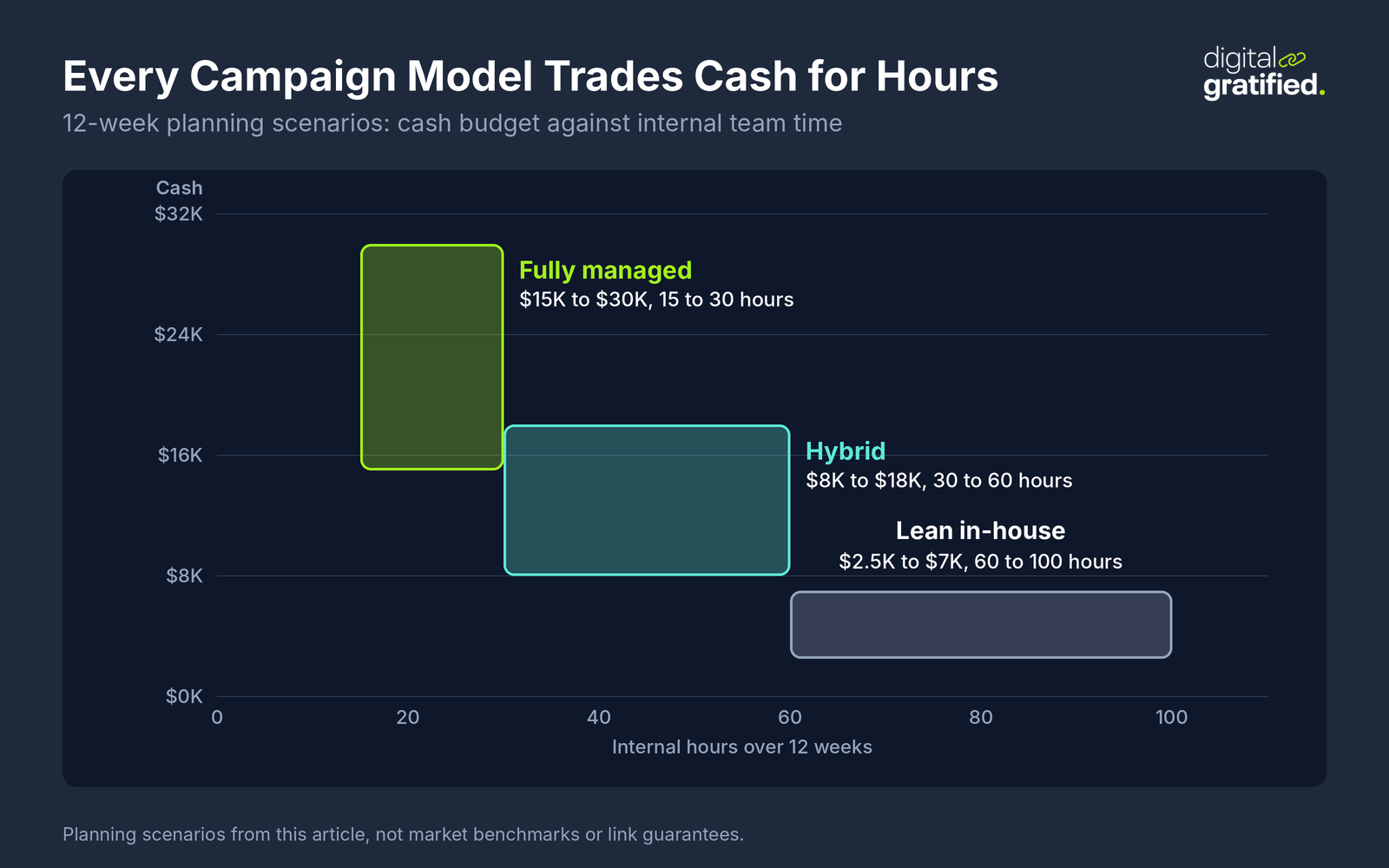
These are planning scenarios, not market benchmarks or link guarantees. Geography, technical complexity, data availability, publisher tier, and whether the asset already exists can move them substantially. For vendor models and per-link economics, the detailed link building pricing breakdown is the better reference.
Example: A 12-Week Campaign for a Security SaaS
Imagine a vendor selling access-review software to mid-market security teams. Its product page converts well, but its non-brand visibility is weak. The team decides not to pitch that page directly. Instead, it creates an anonymized benchmark showing how long access reviews take across company sizes and where delays occur.
The primary campaign goal is eight relevant referring domains from security, IT operations, and compliance publications. The longer outcome is growth in non-brand impressions and assisted demos across the access-review cluster over nine months.
During weeks 1 to 4, the team validates the methodology, publishes a concise report, adds an explorable table, and internally links the report to the relevant product and educational pages. It creates three prospect groups: security journalists interested in the main finding, compliance practitioners who need benchmarks, and SaaS partners whose audiences run access reviews.
During weeks 5 to 8, the first 30 pitches produce four positive replies but only one quick citation. Editors ask for a breakdown by company size, so the team adds it and makes that the lead for the second wave. By week 12, six links are live, two agreed stories are awaiting publication, and three partner conversations may create webinars or co-marketing later.
Was the campaign successful? Operationally, yes: it produced six live links, two likely links, a better asset, and reusable publisher relationships. It missed the arbitrary “eight live by week 12” line because editorial calendars aren't controlled by the SaaS company. Commercially, the answer remains open. The team should not attribute every later ranking gain to those links, but it can compare the cluster's impressions, qualified visits, assisted conversions, and pipeline with the baseline while recording content and technical changes that happened at the same time.
Should You Run the Campaign In-House or Outsource It?
Keep it in-house when your advantage is access to proprietary data, deep subject expertise, or existing industry relationships, and when one person can protect consistent execution for the full cycle. In-house teams also learn directly from every objection and can turn publisher feedback into better positioning.
Outsource when the strategy is clear but the team lacks prospecting and outreach capacity, needs specialist research or design, or cannot support the operational rhythm. The decision to outsource link building should solve a capacity or capability gap, not transfer responsibility for goals and quality.
Before hiring, ask who owns the prospect list, how publishers are qualified, whether you approve targets, who writes pitches, what rejection looks like, how links are verified, and what the report shows beyond domain metrics. Ask to see recent SaaS work and the actual process behind it. A credible shortlist of SaaS link building agencies should still be evaluated against your campaign type rather than treated as interchangeable vendors.
Marketplaces can help with discovery or controlled placements, but they don't replace campaign strategy or editorial judgment. If that route is relevant, the comparison of link building marketplaces covers the tradeoffs without turning this campaign framework into another vendor directory.
Why the Best Campaign Becomes an Ongoing Program
A one-time campaign is useful for testing an asset, audience, or message. It is weak as the entire strategy. Publisher relationships cool, useful data ages, competitors keep earning coverage, and the links acquired today may not support the next product priority.
The better model is a series of learning cycles inside an ongoing program. One quarter might establish an annual benchmark. The next turns customer expertise into commentary. Another refreshes the dataset and returns to editors with a real update. Each cycle starts with more evidence, warmer relationships, and a clearer view of what the market cites.
That compounding matters for SaaS because the buying journey is long. A link earned in March may help a buyer discover an educational page in June, revisit a comparison in August, and request a demo in October. The campaign supplies a focused execution window. The program stays present long enough for authority and demand to mature.
The Bottom Line
A useful link building campaign is not a burst of emails with a backlink quota. It is a controlled business experiment: one goal, a credible asset, publishers with a reason to care, measured outreach, and a review that changes the next cycle.
Give the execution 12 focused weeks, give search and pipeline longer to respond, and budget for the real inputs rather than buying a promised number of links. If the first campaign produces learning and relationships as well as coverage, it has the raw material to become something more valuable than a one-time push.
Link Building Campaigns: Frequently Asked Questions
What are link building campaigns?
Link building campaigns are coordinated, time-bounded efforts to earn relevant backlinks for a defined objective. They connect a target page or topic, a useful asset, qualified publishers, an outreach process, and metrics that show both delivery and longer-term impact.
Is link building still relevant to SEO?
Yes, but relevance and editorial value matter more than raw volume. Links can help search engines discover pages, understand relationships, and assess authority. Manipulative scale can waste money or create risk, so Google's link spam policies should set the campaign's boundaries.
How long should a link building campaign run?
Twelve weeks is a practical first operating cycle: enough time to plan, build an asset, run multiple outreach waves, and learn. Links and coverage may continue landing afterward, while meaningful ranking and pipeline effects can take three to nine months or longer.
What are the top three link building strategies for SaaS?
Original data that publishers can cite, expert-led digital PR tied to real industry questions, and strategic contributions or partnerships with publications your buyers already trust are strong starting points. The right choice depends on your product, assets, audience, and target pages.
How do you measure a backlink campaign?
Track qualified prospects and outreach, positive replies and earned coverage, target-page impressions and ranking direction, referral visits, assisted conversions, and influenced pipeline. Report these as separate layers so delivered links are not mistaken for proven revenue.
About the author
Let's Scale Your SaaS Together
Get a custom SEO and link building strategy tailored for your SaaS business.
Get SEO insights that actually move rankings
Link building tactics, case studies, and SaaS SEO playbooks. No fluff, no spam.
You're subscribed!
SEO and link building insights, straight to your inbox.