Most B2B SEO tool lists stop at features and prices. Here is the stack a SaaS team needs by job, how much history each tool keeps against a long sales cycle, what seats cost, and which tool to buy first.

Founder, Digital Gratified
The best B2B SEO tools are the ones that tell you which searches turn into pipeline, and for most SaaS teams that stack is smaller and cheaper than the roundups suggest: two free Google tools, one crawler, one research suite and an attribution report in your CRM. Our position is that you should buy the measurement layer before the research layer, because a team that cannot see demo requests by landing page will spend its tool budget optimizing pages nobody buys from.
The pages that rank for this term are mostly lists of ten to fourteen tools with a price under each, several of them written by a vendor that ranks its own product first. They rarely ask the questions a SaaS founder or head of growth has to answer: which job each tool does, which tools overlap, what happens when your sales cycle outlasts your tools' data history, and what the stack costs once five stakeholders need a login. This guide covers all of that. Tools are one layer of a SaaS SEO program that compounds into ARR, and the advice here assumes the goal is pipeline, not a prettier dashboard.
What Makes an SEO Tool a B2B SEO Tool?
No SEO tool is built only for B2B. The same suites serve recipe blogs and enterprise software companies. What changes is the job you hire them for, and B2B SaaS puts four demands on a stack that consumer sites do not.
First, the keywords that matter are small. A query like "SOC 2 compliance software for startups" may show 50 searches a month in a keyword tool and still be worth more than a 10,000-search informational term, because every searcher is a potential buyer. A tool that hides low-volume terms or rounds them to zero is a poor fit. Second, the sales cycle is long, so the visit that started a deal can be months older than the closed-won date. Third, a buying committee reads your reports: a founder, a head of marketing, a sales leader and often finance. Fourth, the outcome you report is pipeline, which lives in your CRM, not in any SEO tool.
That last point is why we judge every B2B SEO tool on one test: does it help you connect a search to a demo request, a trial or an opportunity? A tool that only adds more keyword data fails that test, however good the data is. If you have not yet sorted your target searches by buying stage, do that before you buy anything, because the map decides which tools you need.
The B2B SEO Tool Stack, by Job
Think in jobs, not brands. Every B2B SaaS SEO program needs six things done, and for most of them one tool is enough. The table sets out each job, the free option and the paid tool we would look at first, with entry prices from each vendor's own pricing page.
| Job | Free option | Paid option to look at first | Entry price |
|---|---|---|---|
| Measure clicks, queries and indexing | Google Search Console | None needed | Free |
| Track sessions and key events | Google Analytics 4 | Analytics 360 for longer retention | Free; 360 priced separately |
| Keyword, competitor and backlink research | Ahrefs' free plan | Ahrefs Lite or the Semrush SEO plan | $129/mo (Ahrefs Lite); $139/mo (Semrush SEO) |
| Technical crawling | Screaming Frog, up to 500 URLs | Screaming Frog paid licence | £199 per year |
| Content optimization | Search Console query data per page | Clearscope Essentials | $129/mo |
| Pipeline attribution | A source field on every CRM record | HubSpot deal revenue attribution | Marketing Hub Enterprise |
Annual billing lowers most of these prices. The Ahrefs pricing page says annual plans save up to 17%, and the Semrush SEO plan drops to $117.33 a month when billed annually.
Measurement: Search Console and GA4
Search Console is the only source of Google's own click, impression and query data for your site, and it is free. For a B2B team, two features matter more than the rest. The branded and non-branded query filter in the Performance report separates searches for your name from searches for your category, and non-branded clicks are the number that shows whether SEO is reaching new buyers. Search Console also stores only the most important rows and leaves out anonymized queries, so for a complete query list you need its bulk export to BigQuery.
Search Console now covers AI search too. Google said in June that it would add insights about how pages appear in AI Overviews and AI Mode, and an update to Google's announcement for site owners says those features rolled out to all websites worldwide on August 31, 2026. That gives every team a free baseline for AI visibility before it pays for a tracker.
GA4 is where search visits meet your conversions. Mark demo requests, trial starts and sign-ups as key events, and record the landing page for each. Then pass the original source into your CRM with every form fill, because GA4 is not built to hold a deal's history, as the next section shows.
Research: Pick One Suite
Ahrefs and Semrush cover the same core jobs: keyword research, competitor gaps, rank tracking, site audits and backlink data. Buying both is the most common waste we see in SaaS SEO budgets. Pick the one whose data you trust in your category, run both trials against ten keywords you already rank for, and compare the estimates with your Search Console numbers. The suite that comes closer for your niche is the one to keep.
Two differences are worth knowing before you choose. Ahrefs limits historical data by plan: six months on Lite, two years on Standard and five years on Advanced. Semrush bundles AI search features into its Starter, Pro+ and Advanced plans, while Ahrefs sells its AI tracker, Brand Radar AI, separately from $199 a month.
If backlink research is a large part of your work, the suite's link data is your starting point, and our guide to choosing link building tools by workflow covers prospecting in more depth. Outreach platforms such as BuzzStream, Pitchbox or linkOreach sit on top of that data when you start contacting sites.
Technical Crawling
SaaS sites tend to break in the same places: JavaScript that hides copy from crawlers, docs on a subdomain nobody audits, faceted templates that multiply URLs, and redirects left behind by renames. A desktop crawler finds these faster than any suite's cloud audit. Screaming Frog's free version crawls up to 500 URLs, which covers many early-stage marketing sites, and the paid licence removes the limit. Run it as part of a technical audit built for SaaS templates before every major release, not once a year.
Content Optimization
Content tools compare a draft with the pages already ranking and suggest the terms and questions it misses. They help most when a page sits between positions 4 and 15 and needs depth to move up. They help least on a new comparison or integration page, where the facts only your team knows matter more than term coverage. Clearscope's Essentials plan tracks 50 queries and 50 pages, and every Clearscope plan includes unlimited users, which matters for a B2B team where writers, product marketers and subject experts all touch a draft.
AI Search Visibility
Buyers increasingly meet your brand in an AI answer before they see your site. In G2's survey of 1,076 B2B software buyers, 51% now start research with an AI chatbot more often than with Google, up from 29% the year before. G2 sells visibility products, so read that with its source in mind, but the direction is clear. Start with the free AI insights in Search Console, and add a paid tracker only when you have a short list of buyer prompts you will check every month and someone who will act on the results. The tracker will not change what gets you named; the work described in earning mentions in AI answers about your category does.
The CRM Report That Ties It Together
This is the layer most tool roundups leave out, and it is the one that decides whether your SEO program survives the next budget review. Your CRM must record the first-touch source and landing page for every contact, and you need a report that rolls those up to opportunities and revenue. In HubSpot, contact create attribution is available on Marketing Hub or Content Hub Professional and Enterprise, while deal create and deal revenue attribution need Marketing Hub Enterprise, with first touch, last touch, linear, time decay and empirical models. If you are not on that tier, a required source field on every record and a monthly export get you most of the way. The report feeds the SEO metrics worth putting in front of leadership.
Why Your SEO Tools Forget Before Your Deals Close
Here is the problem almost no B2B SEO tool guide mentions: most tools keep less history than a B2B deal takes to close. In a standard GA4 property, the data retention setting can be 2 or 14 months, and it governs explorations and funnel reports, the ones you would use to trace a buyer's path. Analytics 360 raises the ceiling to 50 months. On the research side, Ahrefs Lite keeps six months of history.
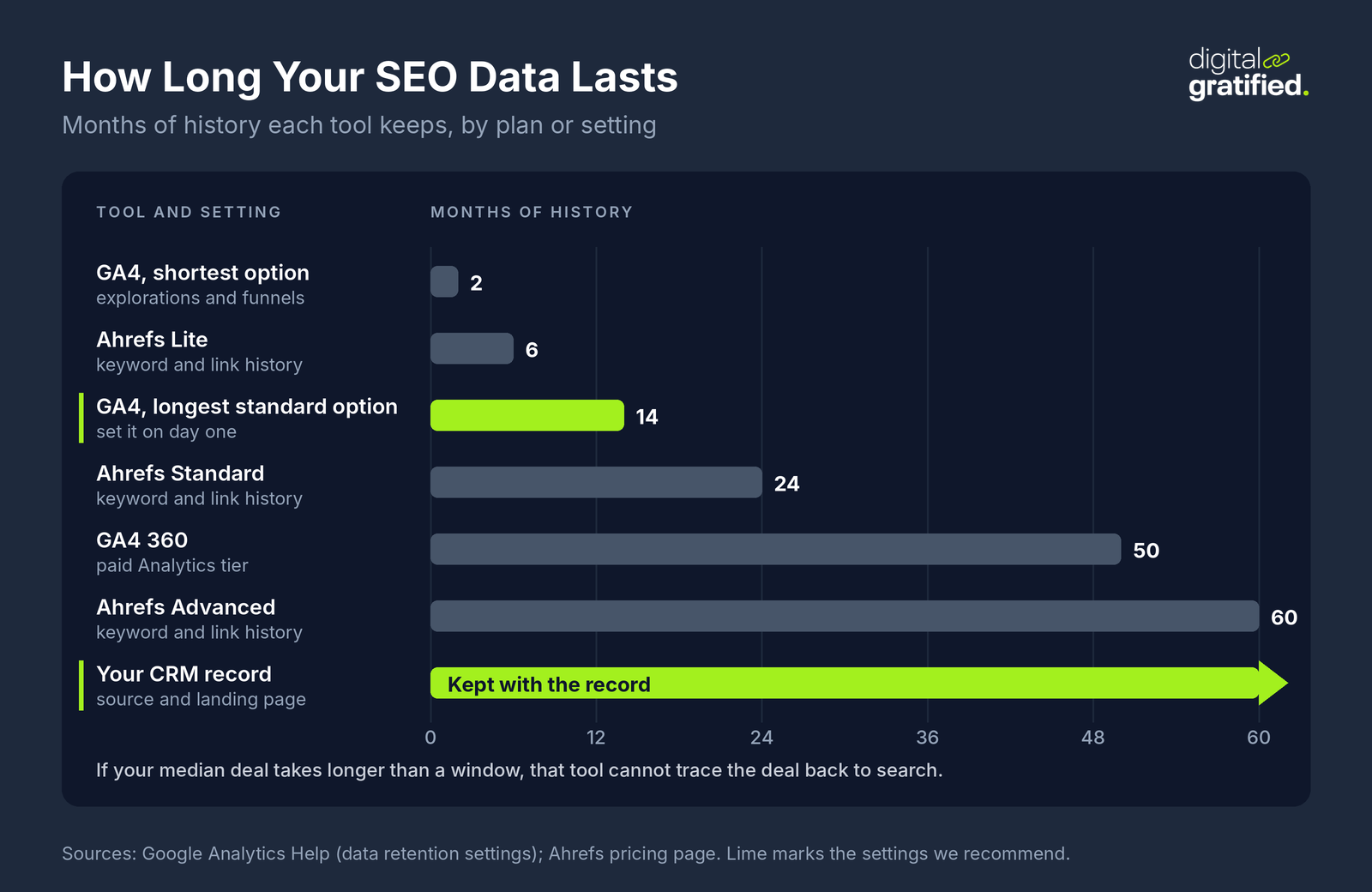
Three settings fix most of this. Change GA4 retention to 14 months on the day you set up the property, before any deal you want to trace has started. Write the original source and landing page onto the CRM record at the first form fill, where it stays for the life of the account. And if your team reports on year-over-year rankings or link growth, buy the research plan whose history covers the comparison you report, or export the numbers each month. Your sales team can tell you the median days from first touch to closed-won; any window shorter than that is one you cannot report pipeline through.
What B2B SEO Tools Cost Once the Team Needs Access
List prices assume one user, and B2B teams are rarely one user. A founder, a content lead, a product marketer and an agency all want to log in, and seat pricing differs more between tools than plan pricing does. On Ahrefs, Lite includes one user and allows up to two more at $40 a month each; Standard charges $60 per extra user, up to five; Advanced charges $80, up to ten. Semrush additional users start at $45 a month. Clearscope charges nothing for extra users.
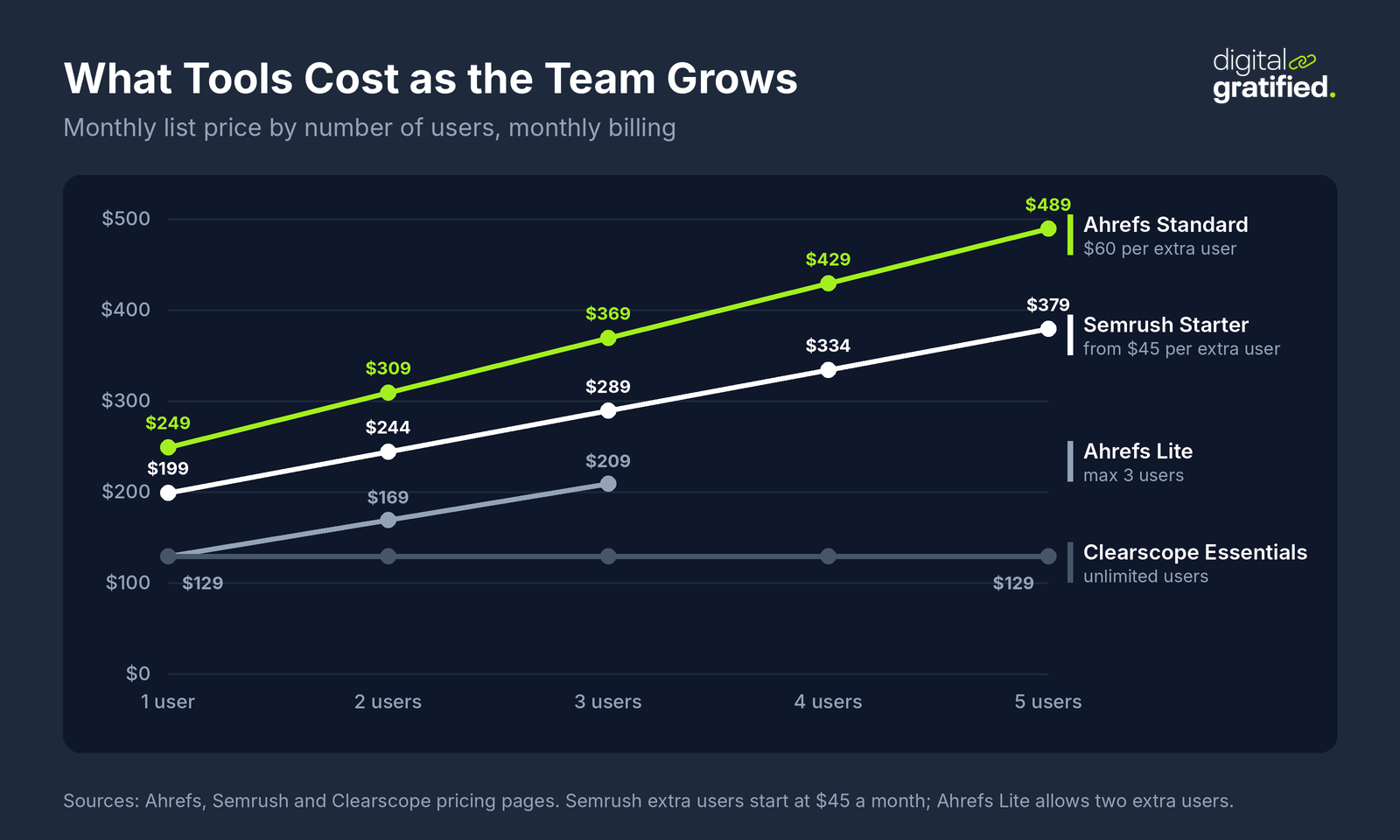
The practical rule is to give full seats only to the people who run the work, and share everything else through reports. Most stakeholders need a monthly view of non-branded clicks, demos and pipeline, not a login to a keyword tool. Building a stakeholder SEO report that leads with pipeline once saves more seat money than any annual discount.
Which B2B SEO Tool to Buy First
Buy tools in the order your bottleneck appears, not in the order a roundup lists them. If you cannot yet see demos by landing page, no paid tool will help, so the first step costs nothing. If pages are not being crawled or indexed, a crawler comes before any research suite. Research earns its price once the site is healthy and you need to find the buyer searches you are missing, and content and AI tools come last, when you have pages close to the top and prompts worth tracking.
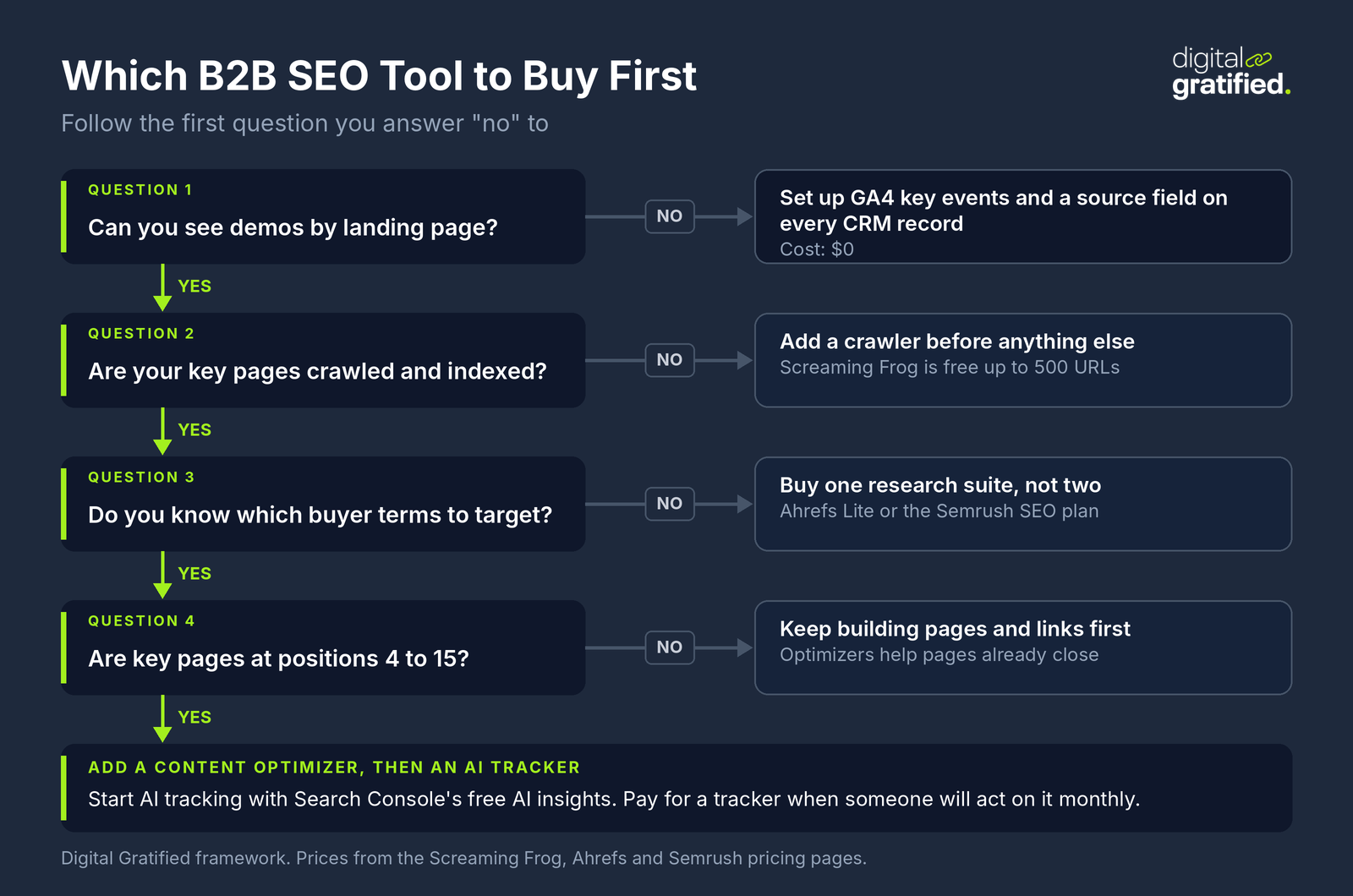
Before you sign any annual contract, put the tool through five questions:
- Which job does it do that nothing in the stack does now? If the answer is "a bit of everything," you are probably buying a second suite.
- Does it show the low-volume B2B terms you care about? Search the ten queries your best customers used and see what the tool reports.
- How much history does the plan keep? Compare it with your median sales cycle and with the period your reports compare.
- Who needs a seat, and what does each one cost? Price the plan at the number of users you will have in a year.
- Who will act on its output every month? A tool without an owner is a subscription, not a capability.
A Worked Example: A Stack for a Series A SaaS Team
Here is a worked example with illustrative circumstances. A Series A company selling compliance software has one marketer who owns SEO, a part-time writer and a founder who reviews results monthly. The site has 300 URLs, the team uses HubSpot Marketing Hub Professional, and organic search produces a handful of demo requests a month that nobody can trace to a page.
The team starts with the free layer: Search Console with the non-branded filter, GA4 with demo requests marked as key events and retention set to 14 months, and a required original source field on every HubSpot contact. The free Screaming Frog crawl covers the site because it is under 500 URLs. Only then does it buy one research suite, Ahrefs Lite at $129 a month, for keyword and competitor work, with the marketer as the only seat. The writer works from briefs the marketer exports, and the founder reads a one-page monthly report. New tool spend is $129 a month, or less on annual billing.
What the team does not buy matters as much. It skips a second suite, a content optimizer and a paid AI tracker until it has comparison and integration pages ranking between positions 4 and 15. When the site passes 500 URLs, the crawler licence is the next purchase. The money saved goes into content and links, which is where the budget belongs; our guide to planning an SEO budget backwards from demos shows how to split it.
B2B SEO Tools vs. an SEO Agency
Tools show you what is wrong; they do not fix it. The constraint for most SaaS teams under 50 people is not data but hours: someone has to write the comparison pages, fix the templates, earn the links and build the report. If you are deciding between doing it yourself, hiring a freelancer or bringing in a team, our breakdown of DIY, freelancer and agency options for startups covers the trade-offs.
This is the kind of work we do for SaaS clients: technical audits, buyer-intent keyword mapping and content architecture, planned around the searches that lead to demo requests. You can see how that fits together on our SaaS SEO and link building services page.
One timing note if you are judging a new tool this month: Google's November 2026 core update started rolling out on November 10 and may take up to two weeks to finish. Let it settle before you read a trial's rank tracking as a verdict on anything. The same goes for any numbers you plan to use when forecasting what organic search will add to pipeline.
The Bottom Line
Buy B2B SEO tools in the order of what you cannot see. Set up Search Console, GA4 key events and a source field in your CRM first, because they cost nothing and decide whether SEO can ever be credited with pipeline. Then add one crawler and one research suite, check that each plan's history covers your sales cycle, and give seats only to the people who do the work.
Leave content optimizers and AI trackers until you have pages close to the top and someone who will act on them every month. If you would rather spend the budget on the work than on the tools, talk to us about SaaS SEO built around pipeline.
Frequently Asked Questions
What are the best B2B SEO tools?
For most B2B SaaS teams: Google Search Console and GA4 for measurement, one research suite such as Ahrefs or Semrush, a crawler such as Screaming Frog, and an attribution report in your CRM. Add a content optimizer and an AI visibility tracker later, once you have pages close to the top and someone to act on the data.
Are there free B2B SEO tools?
Yes. Search Console gives you Google's own query, click and indexing data, including a branded versus non-branded filter and insights on AI Overviews and AI Mode. GA4 records key events such as demo requests, and Screaming Frog's free version crawls up to 500 URLs. A source field on every CRM record costs nothing and matters most.
How much do B2B SEO tools cost?
A lean stack can run on one paid suite: Ahrefs Lite lists at $129 a month and the Semrush SEO plan at $139 a month on monthly billing, with lower rates billed annually. Screaming Frog's paid licence is £199 a year. Costs climb with seats, so price each plan at the number of users you will have in a year.
Do I need both Ahrefs and Semrush?
Rarely. Both cover keyword research, competitor gaps, rank tracking, site audits and backlink data. Trial both against ten keywords you already rank for, compare the estimates with your Search Console numbers, and keep the one that matches your niche more closely.
Which SEO tools track AI search visibility?
Start with Search Console, which now reports how your pages appear in AI Overviews and AI Mode. Semrush includes AI search features in its Starter, Pro+ and Advanced plans, and Ahrefs sells Brand Radar AI separately. Pay for a tracker only when you have a fixed list of buyer prompts and an owner who reviews them monthly.
Do B2B SEO tools connect to a CRM?
Most SEO suites do not report pipeline. The connection runs through your analytics and CRM: record the first-touch source and landing page on every contact, then report on opportunities and revenue. In HubSpot, deal revenue attribution needs Marketing Hub Enterprise; contact create attribution is available on Professional.
Do I need SEO tools if I hire an agency?
You still need your own Search Console, analytics and CRM reporting, because they hold the data that shows whether the agency is producing pipeline. Research suites and crawlers are usually part of what the agency brings.
About the author
Let's Scale Your SaaS Together
Get a custom SEO and link building strategy tailored for your SaaS business.
Get SEO insights that actually move rankings
Link building tactics, case studies, and SaaS SEO playbooks. No fluff, no spam.
You're subscribed!
SEO and link building insights, straight to your inbox.