What a SaaS SEO expert actually does, the three roles behind the title, what each costs, and how to vet a consultant before you hand over your pipeline.

Digital Gratified
SaaS SEO Experts
Most people searching for a SaaS SEO expert have already been burned once. Maybe it was a freelancer who sent monthly ranking screenshots while signups stayed flat. Maybe it was a "growth hacker" who published 40 blog posts nobody read. Either way, you're not looking for someone who knows SEO. You're looking for someone who knows how SEO turns into trials, demos, and revenue for a software company.
That's a much smaller group of people, and they're harder to spot than they should be.
This guide covers what a SaaS SEO expert actually does, the three very different roles hiding behind that job title, what each one costs, and how to vet someone properly before you hand over the keys. We'll also be upfront about when you don't need one yet, because that answer saves some teams a lot of money.
What a SaaS SEO Expert Actually Does
At a basic level, a SaaS SEO expert figures out which searches your future customers make, builds or fixes the pages that should win those searches, and makes sure the traffic turns into pipeline. That last part is where most generalists fall apart.
A day in the life usually looks something like this:
- Keyword and intent mapping. Not just "what has volume," but which terms signal someone evaluating a tool like yours versus someone who wants a free template and will never pay.
- Page type strategy. Deciding whether you need integration pages, alternatives pages, use-case pages or comparison pages, and in what order.
- Technical fixes. Crawl issues, JavaScript rendering, the marketing site and app living on different subdomains, docs that compete with your blog, that kind of thing.
- Content direction. Briefing writers, editing for accuracy, and making sure product-led content shows the product instead of just talking around it.
- Links and authority. Building enough credibility for Google to trust your pages in a crowded category.
- Reporting tied to revenue. Connecting organic sessions to signups, activated accounts and demo requests, not just positions.
What Makes Someone a SaaS SEO Expert, Not Just an SEO Expert
Plenty of good SEOs have never worked on a subscription business, and it shows fast. The difference comes down to a few things a SaaS specialist understands without being told.
The conversion isn't a sale. It's a trial, a freemium signup or a demo request, and the real value shows up months later in retention. Someone used to ecommerce will optimize for the wrong finish line.
The keyword universe is weird. Searches like "[competitor] alternatives," "[tool] vs [tool]" and "[your product] + [integration]" can be your highest-converting pages, and most generic SEO playbooks don't cover them. If you want the full picture of how SaaS SEO is built around these page types, it's worth understanding before you start interviewing, so you can tell who actually knows it.
Sales cycles are long. A B2B buyer might read three of your articles over six weeks before booking a demo. A SaaS SEO expert plans content across that whole journey and knows last-click attribution will undersell their work.
The site has a product attached to it. App subdomains, login walls, help centers and changelogs all create problems a brochure site never deals with.
Expert, Consultant, Specialist: Three Different Jobs Behind One Title
Here's the thing nobody on page one of Google will tell you: "SaaS SEO expert" can mean three completely different hires, and picking the wrong type causes more failed engagements than picking the wrong person.
| In-house SaaS SEO specialist | Freelance SaaS SEO consultant | Fractional SEO lead | |
|---|---|---|---|
| What they do | Owns SEO full time, executes most of the work, sits in your team | Audits, builds strategy, advises; your team does most of the execution | Acts as your head of SEO part time; owns strategy, manages writers, devs and vendors |
| Best for | Companies where organic is already a major channel | Teams with writers and dev time but no SEO direction | Series A to C companies that need leadership before a full-time hire |
| Time commitment | 40 hours a week | A few hours a week, or a fixed project | Usually 1 to 3 days a week |
| Typical cost | Six-figure salary in the US plus benefits | Hourly, per project or a monthly advisory retainer | Monthly retainer, typically above a consultant's |
| Biggest risk | One person rarely covers technical, content and links equally well | Great plan, nobody to execute it | Spread thin if they're running too many clients |
A quick way to pick: if your problem is "we don't know what to do," you want a consultant. If it's "we know what to do but nobody owns it," you want a fractional lead. If it's "SEO is already working and we need more hands on it every day," you want an in-house specialist.
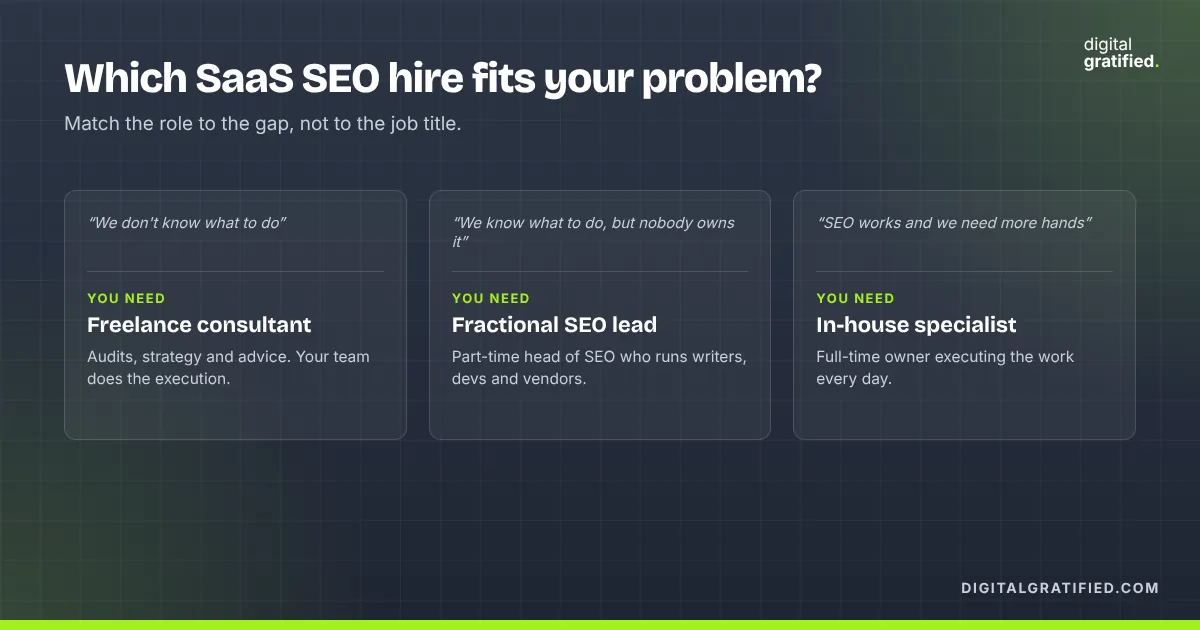
How you slot that person into your existing setup matters as much as who you hire. If you're still figuring out who owns what, it helps to think through how your SEO team should be structured before you write the job description.
How Much Does a SaaS SEO Expert Cost?
This is the question everyone actually wants answered, and most pages dodge it.
The most useful public data comes from Ahrefs' survey of 439 SEO service providers. It found that consultants charge noticeably more per hour than agencies or freelancers, with an average upper-tier rate of about $171 an hour for consultants, compared with roughly $99 for agencies and $72 for freelancers. That gap makes sense. You're paying a consultant for judgment, not hours of execution.
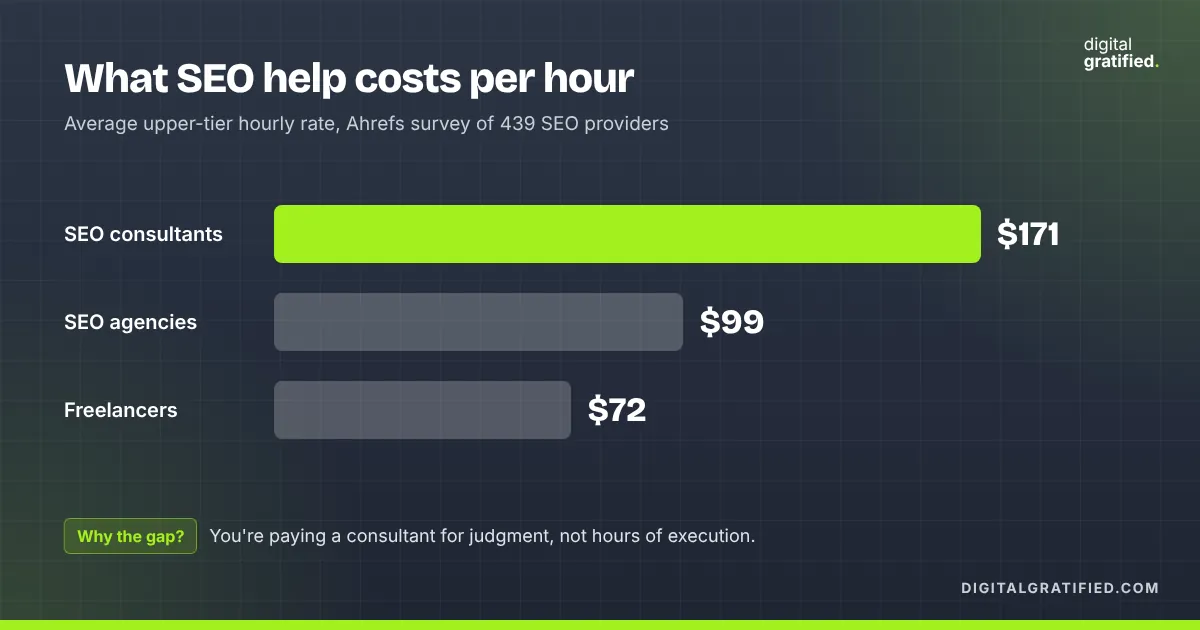
For SaaS work specifically, here's roughly what you'll see in the market:
- One-off SEO audit: a few thousand dollars for a solid technical and content audit, more for large sites with complex app and docs setups.
- Advisory retainer (consultant): commonly in the low thousands per month for strategy calls, roadmap updates and review of your team's work.
- Fractional SEO lead: usually higher than a consultant, since they're managing people and owning outcomes.
- In-house specialist: a senior SaaS SEO in the US typically commands a six-figure base, and you'll add benefits, tools and a few months of ramp-up on top.
Why the Cheapest Option Usually Costs the Most
If someone promises a full SaaS SEO program for a few hundred dollars a month, what you're getting is a checklist. Meta tags get tweaked, a report goes out, and nothing that moves pipeline happens. The real cost is the six months you lose before you realize it.
On the flip side, spending more doesn't fix a bad fit. A $250-an-hour consultant handing a 60-page strategy deck to a team with no writers is still money down the drain. Work out what you can sustain for at least six months, then hire to that number. If you're not sure what that number should be, start with a realistic SEO budget that works backwards from the pipeline you need, not from what feels comfortable.
Do You Actually Need a SaaS SEO Expert Yet?
Not every SaaS company does, at least not right now. Hiring too early is one of the more expensive mistakes we see.
You probably need one if:
- You've found product-market fit and paid acquisition is getting more expensive every quarter
- Competitors are ranking for "[your category] software" and "[competitor] alternatives" and you're nowhere
- You're publishing content regularly but it isn't bringing in signups
- A site migration, redesign or replatform is coming up (this alone can justify a consultant)
- Your traffic dropped and nobody can explain why
You can probably wait if:
- You're still pre-product-market fit and changing who you sell to every few months
- Your buyers don't search for solutions (some very niche enterprise tools live entirely on outbound and referrals)
- You can't commit any writer or developer time to act on recommendations
- You need results in the next 60 days. SEO won't get you there.
If you're on the fence about whether organic is worth the investment at your stage at all, it's worth looking at how important SEO really is for SaaS compared with the other channels you could fund instead.
SaaS SEO Expert vs Agency: Which Should You Hire?
An individual expert gives you focus and direct access. You talk to the person doing the thinking, there's no account manager in the middle, and they usually cost less than a full agency retainer.
The trade-off is range and capacity. One person is rarely brilliant at technical SEO, content strategy and link building, and if they get sick or take on too many clients, everything stalls.
An agency brings a team, more capacity and coverage across disciplines, but you'll pay for it and you'll need to make sure senior people are actually doing the work. Choosing a SaaS SEO agency comes with its own set of red flags, and it's worth knowing them before you compare quotes side by side.
A lot of growing SaaS companies end up somewhere in between: an in-house or fractional expert owns the strategy, and specialist partners handle the heavy lifting, especially content production and link building for SaaS, where a single person rarely has the relationships or bandwidth to do it at scale. If you go that way, outsourcing parts of your SEO works best when someone internal still owns the plan.
How to Vet a SaaS SEO Expert Before You Sign
Here's where most hiring goes wrong, whether you're bringing on a SaaS SEO consultant for a few hours a week or a full-time specialist. Teams judge candidates on how confident they sound in a call, and confidence is cheap in SEO.
Look at Their Work, Not Their Follower Count
Ask for two or three SaaS examples with real numbers: traffic, signups or pipeline before and after, and what they specifically did. "I grew a SaaS company's traffic by 300%" means nothing without context. Was it 300% of 500 visits? Was it all blog traffic from people who'll never buy?
Good experts will happily walk you through what didn't work too. Someone who has only success stories either hasn't done much or isn't telling you everything.
Run a Small Paid Test, Not a Free Pitch
Free proposals tell you how well someone sells. A paid mini project tells you how well they work. Try something like:
- A focused audit of five of your most important commercial pages
- A content plan for one product line or use case
- A review of a competitor's organic strategy with three things you should copy and one you should ignore
Two weeks and a fixed fee is usually enough to see how they think, how they communicate and whether their recommendations are specific to your product or could apply to anyone.
Questions Worth Asking (and What a Good Answer Sounds Like)
Google has its own guidance on hiring an SEO, and it's worth reading even if you've hired SEOs before. On top of the basics, these questions separate SaaS specialists from generalists quickly:
- "Which pages on our site would you prioritize first, and why?" A strong answer names specific page types tied to buying intent, like comparison or integration pages, not "we'll start with a full audit and see."
- "How would you measure success in month three versus month twelve?" Look for leading indicators early (indexation, rankings for commercial terms, engaged sessions) and revenue signals later (trials, demos, pipeline influenced).
- "What would you need from our team every week?" Experienced people will be clear about writer hours, dev tickets and access. Vague answers here mean trouble later.
- "How do you handle the app subdomain, docs and help center?" This is a quick test of technical SEO knowledge specific to SaaS. A generalist will hesitate.
- "How is AI search changing your approach?" You want someone with a practical view, not someone selling a magic fix. They should be able to talk about how AI-driven search affects SaaS SEO without hand-waving.
- "What does your monthly report look like?" Ask to see a real one, anonymized. You'll learn a lot about what good SEO reporting looks like to them.
Red Flags That Should End the Conversation
- Guaranteed rankings. Google is blunt about this: nobody can guarantee a #1 spot. Anyone who promises one is either naive or not being straight with you.
- No SaaS examples. General SEO experience is fine, but you shouldn't be their first software client.
- Rankings-only reporting. If they never mention signups or pipeline, they're optimizing for the wrong scoreboard.
- Secret methods. If they won't explain what they're doing to your site, walk away. You're the one who carries the risk.
- A plan that ignores your product. If their recommendations could be copied and pasted onto any other company's site, they didn't do the work.
A lot of these red flags show up later as the same handful of SaaS SEO mistakes that quietly stall growth, so it pays to screen for them upfront.
What the First 90 Days Should Look Like
A good SaaS SEO expert should be able to tell you roughly what happens in their first three months. If they can't, that's a sign in itself.
Month 1: Diagnose. Technical audit, analytics and conversion tracking check, keyword and competitor research, and a review of existing content. By the end you should have a prioritized list of what to fix, what to build and what to leave alone.
Month 2: Fix and build the foundation. Critical technical issues go to your dev team, the first commercial pages get briefed or rewritten, and underperforming content gets updated or consolidated. This is often where the quickest wins come from, especially pages already sitting on page two.
Month 3: Scale what's working. New content starts publishing on a steady cadence, link building begins in earnest, and reporting shifts from "here's what we did" to "here's what changed."
Don't expect a flood of signups by day 90. Do expect clear movement on leading indicators and a plan you understand. SEO for SaaS usually takes six to twelve months to show up meaningfully in pipeline, and anyone telling you otherwise is guessing.
How to Get More Out of Whoever You Hire
Even the best SaaS SEO expert will underdeliver if they're set up badly. A few things make a big difference:
- Give them real access. Analytics, Search Console, your CMS and, ideally, a way to see signup and pipeline data. Half-blind SEO is slow SEO.
- Reserve developer time. Technical fixes that sit in the backlog for three months wipe out the value of the audit that found them.
- Name one internal owner. Someone on your side needs to unblock things, approve content and keep momentum going.
- Share product and customer context. Sales call notes, churn reasons, customer language. The best SaaS content comes from understanding why people buy.
- Agree on what success means upfront. Write down the metrics you'll judge them on at three, six and twelve months, then stick to them.
The Bottom Line
The right SaaS SEO expert won't just get you more traffic. They'll tell you which searches are worth winning, which ones aren't, and how all of it connects to the number your CEO actually cares about. Figure out which of the three roles you need, set a budget you can stick with for six months, run a paid test before committing, and judge them on pipeline, not positions.
Do that, and you'll avoid the most common outcome in SaaS SEO hiring: a year of reports that look busy and a signup chart that hasn't moved.
Frequently Asked Questions
What does a SaaS SEO expert do?
A SaaS SEO expert grows organic traffic that turns into trials, demos and revenue for software companies. That covers keyword and intent research, building SaaS-specific pages like comparison and integration pages, fixing technical issues, guiding content, earning links and reporting results in terms of pipeline rather than just rankings.
How much does an SEO expert cost?
It depends on the model. Ahrefs' pricing survey found consultants average around $171 an hour at the upper end of their pricing, higher than agencies or freelancers. SaaS consultants often work on a monthly advisory retainer, fractional leads cost more because they own execution, and a senior in-house hire in the US usually means a six-figure salary plus benefits.
Is a SaaS SEO consultant better than an agency?
Neither is better across the board. A consultant suits teams that can execute but need direction. An agency suits teams that want a full program handled for them. Many SaaS companies combine the two, with an expert owning strategy and specialist partners handling content or links.
How long does it take a SaaS SEO expert to get results?
Expect early signals, like better indexation and rising rankings for commercial terms, within the first three months. Meaningful impact on signups and pipeline usually takes six to twelve months, depending on your domain's authority, how competitive your category is and how fast your team acts on recommendations.
Is SEO still worth it for SaaS in 2026?
For most SaaS companies with product-market fit, yes. AI search has changed how people discover tools, but buyers still search to compare options, find alternatives and research problems. The pages that win those searches, and get cited in AI answers, tend to be the same ones a good SaaS SEO expert would build anyway.
Let's Scale Your SaaS Together
Get a custom SEO and link building strategy tailored for your SaaS business.
Get SEO insights that actually move rankings
Link building tactics, case studies, and SaaS SEO playbooks. No fluff, no spam.
You're subscribed!
SEO and link building insights, straight to your inbox.