Most free backlink lists send you to directories and profiles that Google ignores. Here is which free links are worth a SaaS team's time, what Google's spam policies say, and a five-day plan to earn the ones that count.

Founder, Digital Gratified
Free backlinks are links to your site that you did not pay for, and most of the ones on "free backlink sites" lists do nothing for a B2B SaaS company's rankings. Our position is simple: skip the directory, profile and Web 2.0 lists, and spend the same hours on the free placements your buyers see, such as review profiles, integration marketplaces, communities, expert quotes and unlinked mentions, because those bring in demo requests and shape AI answers even when the link itself passes no ranking credit.
The pages that rank for this term are mostly long lists of directories, social networks and blogging platforms sorted by a Domain Authority score. Few of them say which of those links Google ignores, which ones its spam policies name outright, or what a SaaS team should do with a week and no budget. This guide covers all three: what counts as a free backlink, what Google has said about each kind, a way to sort free link sources by what they do for pipeline, and a five-day plan you can run this week. Free links are one corner of how link building earns rankings, and the same rules apply to them as to every other link.
What Are Free Backlinks?
A free backlink is any link to your site that cost you nothing but time. The term covers two very different things. The first is a link you place yourself: a directory listing, a social profile, a forum signature, a blog comment, a post on a free blogging platform. The second is a link someone else decides to give you without payment: a journalist citing your data, a partner listing your integration, a blogger linking to your template because it saved them an hour.
Both are free. Only the second kind is what Google rewards when it treats links as a sign that other sites vouch for a page. A link you can create yourself in two minutes says very little about your product, because your competitors and every spammer in your category can create the same link in the same two minutes. Every link is an attempt to pass value from one page to another, and a self-made link has almost no value to pass.
So the useful question is not whether a link is free. It is who decided the link should exist. If the answer is you, expect little from it in rankings. If the answer is an editor, a partner or a customer, it can be worth more than most links money can buy.
Do Free Backlinks Work for SEO?
Self-placed free links rarely move rankings, and Google has been blunt about it for years. Asked about the links SEOs create to rank, John Mueller replied that "most of those links do nothing, we've spent many years ignoring that kind of thing". Asked whether profile links are enough to rank, he answered with a one-word "No".
The same goes for the other staples of free backlink lists. On building links through free blogging platforms, Mueller said that "this kind of activity has zero value for SEO". He has also described directory, article submission and bookmarking links as links Google generally sees as artificial.
What Google's Spam Policies Say
Being ignored is the usual outcome, not the worst one. Google's spam policies define link spam as "creating links to or from a site primarily for the purpose of manipulating search rankings". Several examples on that list read like a summary of a typical free backlink guide: "low-quality directory or bookmark site links", "forum comments with optimized links in the post or signature", "using automated programs or services to create links to your site", and "creating low-value content primarily for the purposes of manipulating linking and ranking signals".
A few dozen profile links will simply be discounted. A program that creates hundreds of them with keyword anchors, or a backlink generator tool that drops your URL onto thousands of pages, matches the pattern the policy describes. For a SaaS company the risk is not the lost afternoon. It is the trust of the pricing, comparison and integration pages that bring in pipeline.
Nofollow and UGC Links
Most platforms that let anyone post a link also tell search engines not to count it. Google recommends marking links in "comments and forum posts" with the ugc value, and paid links with sponsored, in its guidance on qualifying outbound links. Before you count any free link, open the page source and check its rel attribute.
A nofollow link is not worthless. Google said in 2019 that nofollow, sponsored and ugc are treated as hints about which links to consider, so it may still use some of them. But a hint is not a vote you can plan around, and SEOs read far more into these links than Google has ever confirmed. In a survey of 518 SEO professionals run by Editorial.Link, a link building agency, 78.8% said nofollow links affect rankings and 80.9% said unlinked brand mentions do.
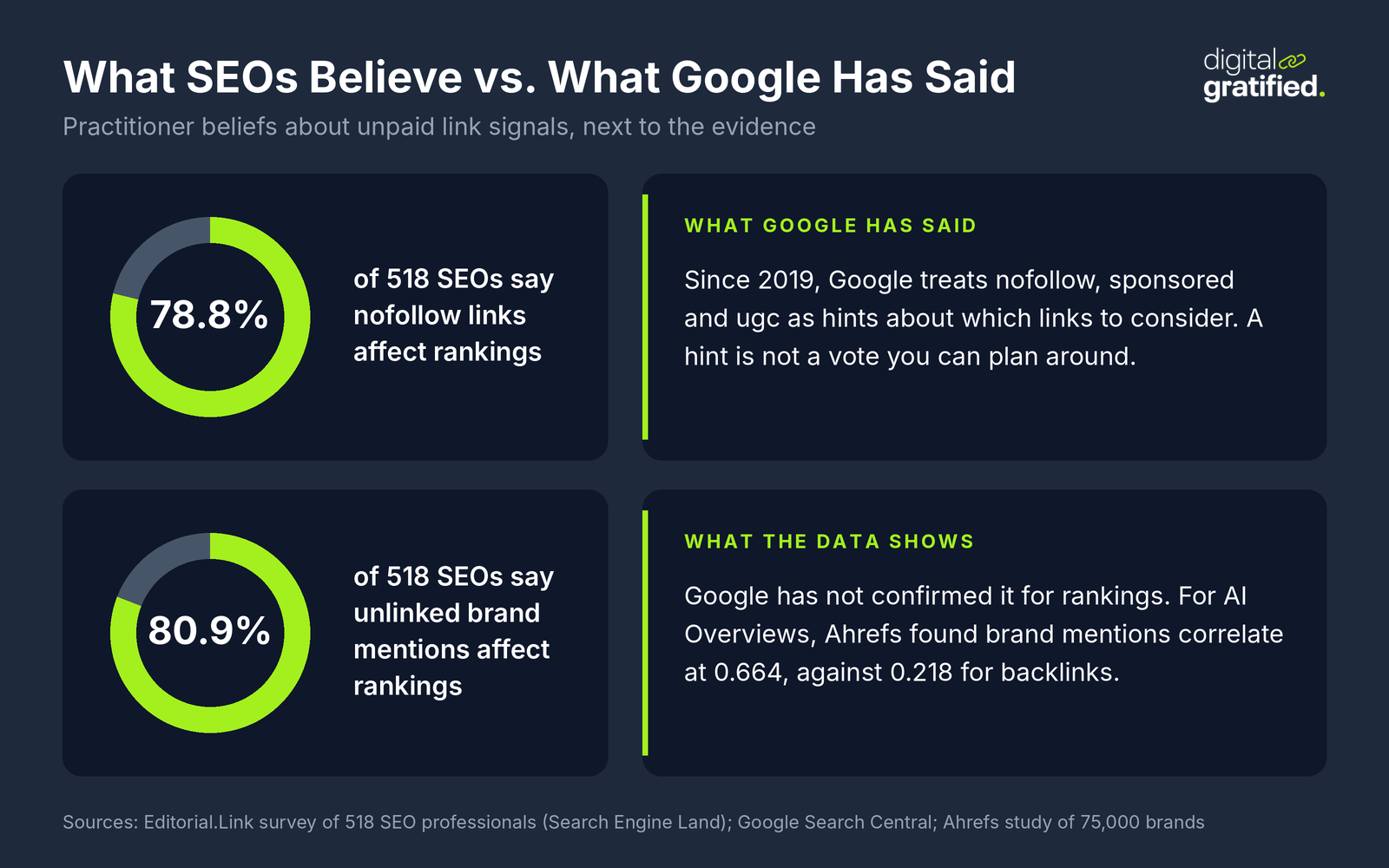
The gap in that chart is the reason we treat free links differently from most guides. The ranking value of a self-placed link is uncertain at best. The value of being visible where buyers and AI systems look is easier to see, so that is what free link work should be judged on.
Which Free Backlinks Are Worth Your Time?
Sort free link sources on two questions before you spend an hour on any of them. Who decides whether the link exists: you, or someone with a reason to say no? And will the people who see it include buyers? The table sets out the common sources against what Google has said about each.
| Free link source | Who decides the link exists | What Google has said | Worth it for SaaS? |
|---|---|---|---|
| General web directories and bookmarking sites | You | Named in the spam policies as low-quality directory or bookmark links | No |
| Free blogging platforms (Web 2.0) | You | "Zero value for SEO" | No |
| Blog comments and forum signatures | You | Forum comments with optimized links are named as link spam | No, as a link tactic |
| Social and community profiles | You | Profile links are not enough to rank | Yes, once, for brand searches and referral |
| Software review profiles | You list; customers review | Not named; a listing buyers read | Yes |
| Integration marketplaces and partner pages | The partner | An editorial choice by another company | Yes |
| Expert quotes for journalists | The journalist | Editorial | Yes |
| Unlinked brand mentions | The publisher | Editorial | Yes |
| Original data, free tools and templates | Other sites | The kind of link links are meant to reward | Yes, with the highest ceiling |
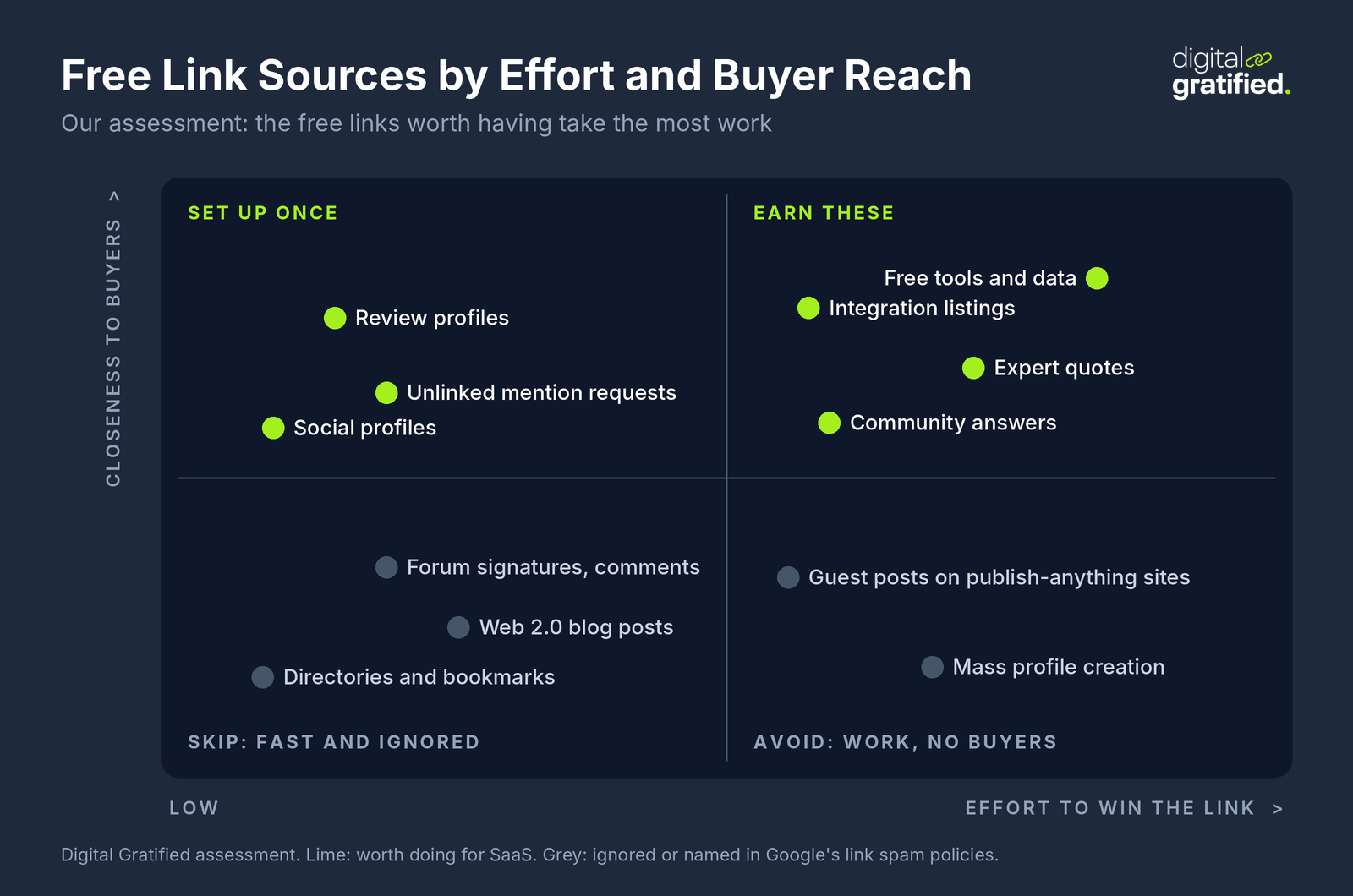
The worthwhile sources also differ in how much work they take and how close they sit to a buying decision. Plotted on those two axes, the self-placed links cluster in the corner nobody should spend time in, and the best free links turn out to be the ones that take the most effort.
Software Review Profiles
A complete profile on the main software review sites in your category is free, and it is one of the few self-created listings that buyers read on purpose. It matters more now that research starts in AI assistants. In G2's survey of 1,076 B2B software buyers, 51% now start research with an AI chatbot more often than with Google, up from 29% a year earlier, and buyers named citations from software review sites as their top trust signal in AI answers. G2 sells review visibility, so weigh that finding with its source in mind. Whatever the link on the profile passes, the reviews are what buyers and assistants quote.
Integration Marketplaces and Partner Pages
If your product connects to other tools, each partner usually runs a marketplace or directory of integrations, and a listing there is free. It is also an editorial link in the sense that matters: another company chose to list you, and the people browsing that marketplace already use a tool you connect to. Ask each partner for a listing, a link from their setup documentation and, where you share customers, a co-written guide. These are the free links we would chase first for most SaaS products.
Communities Your Buyers Read
Answering questions in the forums, subreddits, Slack groups and Q&A sites where your buyers ask for advice earns almost nothing as a link: most of those links carry ugc or nofollow, and dropping links into answers is the fastest way to get banned. Do it for the mention instead. A helpful answer from a named person at your company is seen by buyers comparing tools, and threads like these are often what AI assistants draw on when they recommend software.
Unlinked Mentions and Expert Quotes
Two of the best free links come from writers who have already decided to talk about you or are looking for someone to quote. The first is an article that names your product without linking to it; asking for a link on an existing mention takes a search and a short email. The second is a journalist request: answering queries on journalist request platforms like HARO and its successors with a specific, quotable answer can win coverage in publications your buyers read, though the inboxes are crowded and most pitches get no reply.
Free Tools, Templates and Original Data
The highest-value free links cost the most effort: a calculator, a template, a benchmark from anonymized product data. Nobody pays for the links they earn, but somebody has to build the asset. These are the links that carry real weight, and they share the traits of an authority link rather than a filler link: an editor chose to link, the linking page has readers, and the link sits in the body of an article.
Free Backlinks to Skip
Some free link tactics are a waste of time, and a few carry real risk. Skip mass directory submission, profile creation at scale, posts on free blogging platforms written only to hold a link, blog comments with keyword anchors, and "backlink generator" tools that promise hundreds of links in minutes. Each one appears, almost word for word, in the link spam examples above.
Two other "free" tactics deserve a closer look. A link swap costs nothing, but excessive link exchanges are on the same spam list, and trading links with other sites at any scale is easy for Google to spot. Free guest posts on sites that publish anything with a link are the other trap: the site's lack of standards is exactly why its links pass so little.
Free Backlinks and AI Search
AI search makes the case for free placements stronger, even where the link passes nothing. In Ahrefs' study of 75,000 brands and their AI Overview visibility, branded web mentions correlated with being mentioned in AI Overviews at 0.664, while the number of backlinks correlated at 0.218 and Domain Rating at 0.326. Correlation is not cause, and the study only covered brands above DR 40, but it points one way: being named often, in places people trust, matters more for AI answers than adding another link.
That changes how a SaaS team should value free work. A review profile, a partner listing or a helpful community answer can earn mentions that feed showing up in AI answers about your category, even when every link on the page is nofollow. A directory listing nobody reads earns neither the link value nor the mention.
Rankings are also moving right now. Google's November 2026 core update began rolling out on November 10 and may take up to two weeks to complete, so wait for it to finish before you read anything into ranking changes after a burst of free link work.
A Five-Day Free Backlink Plan for SaaS Teams
Here is the plan we would give a SaaS team with no link budget. Each day takes a few hours, and every task produces something a buyer can see.
- Day 1: Fix the profiles you already have. Claim or update your listings on the main software review sites in your category, your company pages on the social networks your buyers use, and your startup database entries. Make the facts match everywhere: what the product does, who it is for, pricing model and integrations.
- Day 2: List every integration partner. Check whether each one lists you in its marketplace or directory, and whether its setup docs link to your page. Email the partner manager for each missing listing.
- Day 3: Search for unlinked mentions. Search for your brand and product names, excluding your own domain, in a web search and in your SEO tool. Send a short, polite request to each author who mentioned you without a link.
- Day 4: Answer journalist requests and community questions. Sign up to one journalist request platform and answer only the queries in your field. Then answer three questions in the community your buyers use most, as a named person and without a link.
- Day 5: Choose one asset to build. Pick the template, calculator or data point that your sales team gets asked about most, and plan to build it next quarter as the asset that earns links on its own.
Measure the week by referral visits and demo or trial requests from those sources, not by the number of links. A listing that sends five qualified visitors a month is worth more than fifty directory links that send none.
A Worked Example: A Developer Tools Company
Here is a worked example. A small company selling an API monitoring tool has no link budget and a founder who has been told to "get some backlinks". A free backlink list would send them to a hundred directories. The plan above sends them somewhere else: their package registry and code hosting pages, which developers read; listings in the marketplaces of the three alerting and incident tools they integrate with; answers in the developer communities where engineers ask how to monitor third-party APIs; and one free tool, an API uptime checker, to build next quarter.
None of those links is guaranteed to pass ranking credit, and some will be nofollow. Every one of them sits in front of the engineers who choose monitoring tools, which is why free work like this is usually the first stage of link building for developer tools companies, before any budget goes into outreach.
When Free Backlinks Stop Being Enough
Free sources run out. Once your profiles are complete, your partners list you and your mentions are linked, the only free links left are the ones you earn with assets and expertise, and those take months. For competitive commercial terms, you also need editorial links from publications in your category, which take either a lot of time or a budget.
That is the point where most SaaS teams add outreach and digital PR to the free work, while keeping both inside link building that stays within Google's rules. When we run link building for SaaS clients, every placement is on a site with a Domain Rating of 50 or higher, clients approve the domains before outreach starts, and we never use PBNs or link farms.
Free links and earned placements work best together as part of the rest of your off-page SEO work. Over time, your profile should look like the mix of backlink types SaaS sites earn, not a pile of profiles and directory listings.
The Bottom Line
Stop judging free backlinks by whether they are free, and start judging them by who decided they should exist. Links you place yourself on directories, profiles, free blogs and forums are ignored at best and named in Google's spam policies at worst. Links that a partner, a journalist, a publisher or another site chose to give you are worth chasing, and so are the review profiles and community answers that put your product in front of buyers and AI assistants, link or no link.
Run the five-day plan, measure it in referral visits and demo requests, and when the free sources run dry, talk to us about SaaS link building and digital PR that earns the editorial links free work cannot.
Frequently Asked Questions
Are free backlinks good for SEO?
Most are not. Links you place yourself, such as directory listings, social profiles, blog comments and posts on free blogging platforms, are largely ignored by Google, and some are named as link spam in its policies. Free links that someone else chooses to give you, such as a partner listing, a journalist's citation or a link to your free tool, can be worth more than links you pay for.
Where can a SaaS company get free backlinks?
Start with the sources buyers see: complete profiles on the software review sites in your category, listings in your integration partners' marketplaces and setup docs, links on existing articles that mention your product, expert quotes for journalists, and free tools, templates or data that other sites cite.
Are nofollow backlinks worth getting?
They can be, but not for ranking credit. Google treats nofollow, sponsored and ugc as hints, so it may use some of them, but you cannot plan around that. Judge a nofollow link on the referral visits, brand searches and demo requests it brings, and on whether it puts your product in front of buyers.
Can free backlinks hurt my site?
A few ignored profile links will not. Building them at scale with keyword anchors, using automated link tools, or dropping optimized links into forum posts and signatures matches examples in Google's link spam policies, and that can put trust in your commercial pages at risk.
Are free backlink generator tools safe?
No. Tools that promise hundreds of links in minutes create exactly the automated links Google's spam policies name. At best the links are ignored; at worst they add a pattern of manipulative links to your profile that you then have to explain or clean up.
Do directory submissions still work for SEO?
General web directories and bookmarking sites do not help rankings, and Google's spam policies list low-quality directory and bookmark links as link spam. Listings that buyers use, such as software review sites and partner marketplaces, are worth having for visibility and referrals rather than for ranking credit.
Do free backlinks help with AI search?
The ones that come with a mention in a trusted place can. In Ahrefs' study of 75,000 brands, branded web mentions correlated more closely with AI Overview visibility than the number of backlinks did, so review profiles, community answers and press quotes can help even when the link itself is nofollow.
About the author
Let's Scale Your SaaS Together
Get a custom SEO and link building strategy tailored for your SaaS business.
Get SEO insights that actually move rankings
Link building tactics, case studies, and SaaS SEO playbooks. No fluff, no spam.
You're subscribed!
SEO and link building insights, straight to your inbox.