Learn how to evaluate and choose the right SEO agency partnership model for your business. Covers white label partnerships, evaluation criteria, red flags to avoid, and what to expect from a great agency partner.

Founder, Digital Gratified
An SEO partnership is an arrangement where one company delivers SEO strategy and execution for another, either for that company's clients (referral, white label or reseller) or for its own growth (a direct partnership). Choose the model by deciding who should own the client relationship and the margin, then judge partners on work you can verify rather than promises about rankings.
The right SEO agency partnership gives you a specialist team without the hiring cost, while the wrong one can quietly put your clients' domains or your own pipeline at risk. Whether you're an agency adding SEO to your services or a SaaS company deciding whether to hand SEO to an outside team, this guide covers the partnership models, what real partner programs pay, how to vet a partner, how white label delivery works, why partnerships fail, and how to tell whether a partner is delivering.
What Is an SEO Agency Partnership?
An SEO agency partnership is a structured relationship where one company handles SEO strategy and execution on behalf of another. The specifics vary by model, but the core idea is the same: use outside specialists instead of building every skill from scratch. The agency on the other side of that arrangement is what most people mean by an SEO partner.
For marketing agencies, this often means a white label arrangement: you sell SEO services to your clients, and a specialized partner does the work under your brand. Some providers call this private label SEO or SEO fulfillment; the mechanics are the same. For SaaS companies, it usually means engaging an agency as a growth partner rather than hiring a full in-house team.
One naming trap is worth knowing about. "Partner SEO" is also a channel marketing term for the SEO work a vendor helps its resellers and channel partners do on their own websites, as ZINFI's glossary defines it. That is a different job. This guide is about partnering with an SEO agency.
The best partnerships share a few traits: deep specialization, transparent communication, aligned incentives and outcomes you can measure in pipeline. The worst ones share the opposite: vague deliverables, opaque methods and promises nobody can verify.
SEO Partnership Models Compared
Most "SEO partnership" programs fall into one of four models. The difference that matters is who owns the client relationship, because that decides who earns the margin and who takes the blame when something goes wrong.
| Model | Who owns the client | Who does the work | How the money moves | Best for |
|---|---|---|---|---|
| Referral | The SEO agency | The SEO agency | You earn a commission on the client's fees | Consultants and agencies with no SEO delivery team |
| White label | You, under your brand | The partner, behind the scenes | The partner bills you; you bill the client and keep the margin | Agencies building SEO into a revenue line |
| Reseller | You | The provider, as fixed packages | Wholesale package price plus your markup | Agencies testing demand with standard bundles |
| Direct partnership | Your own company | Shared: you bring product context, the agency executes | A retainer tied to agreed KPIs | SaaS teams without a full in-house SEO team |
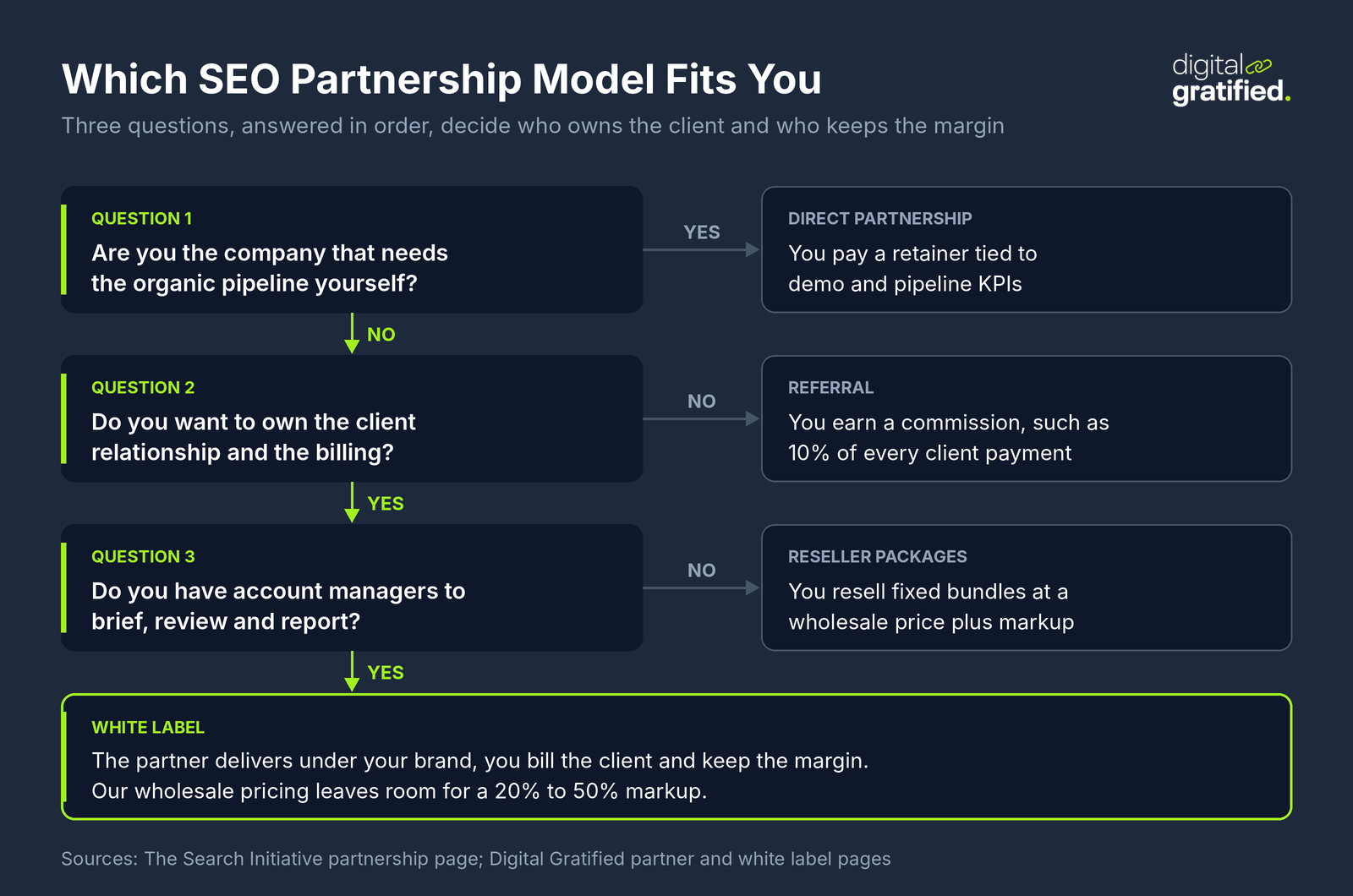
Most teams can place themselves with three questions, asked in order. If you are the company that needs the pipeline, you want a direct partnership. If you are an agency that does not want to own the client, refer. If you do want to own the client, the deciding factor is whether you have people to brief the partner, review the work and report to the client.
If reselling fixed packages is the model you're weighing, compare pricing structures and red flags before choosing an SEO reseller program. The full white label workflow is about running white label SEO without losing the client relationship.
Co-Branded and Strategic SEO Partnerships
Two hybrids sit between those four models. In a co-branded partnership, both companies stay visible: the agency is introduced to the client by name and joins calls, or the two firms market together through webinars, podcasts and guest posts. It suits a design, development or PPC agency whose clients trust them but who are happy to meet a named SEO specialist. The trade-off is that the client learns who does the work, so you give up the option to switch partners quietly later.
A strategic SEO partnership is the long-form version of the direct model: a SaaS company and an agency agree shared targets for a year or more, the agency gets access to product, sales and analytics data, and both sides review pipeline together each quarter. It only works when the company can give the partner that access and an internal owner who acts on its recommendations. Without both, it is a retainer with a grander name.
SEO Partner Programs Compared
Partner programs publish less than you would expect, so read the terms on each provider's own page before you sign. Here is what five of the programs that show up for "SEO partnership" searches state publicly:
| Program | Referral terms | Client minimum | White label option |
|---|---|---|---|
| The Search Initiative | 10% of every payment the referred client makes | $3,600 a month | Editable deliverables you rebrand; it invoices you and you set your own margin |
| Sure Oak | A commission on each referred client who signs; rate not published | Not published | White label link building, plus a white label SEO partner track with training to sell, onboard and support clients |
| SimpleTiger | 10% of closed deals as the standard rate; partners can propose other terms | Not published | None described; asks partners about co-marketing such as webinars, podcasts and guest posts |
| Zeigler SEO (independent consultant) | 50% commission on reselling her DIY SEO course | Not published | Outsourced SEO for agencies, designers and developers |
| Digital Gratified | 10% of the client's monthly bill for the lifetime of the client, paid monthly | Not published | White label link building at $180 to $600 per link, priced so agencies can mark up 20% to 50% |
Two things stand out. Referral rates cluster around 10% of fees, so the real difference between programs is the client minimum and how long the commission runs. And a commission is only worth as much as the client's tenure: 10% of a $3,000 monthly bill is $3,600 a year while the client stays, and nothing once they leave. Ask every program how it tracks commissions and what happens to them if the client pauses.
SEO Sparring Partner: Advisory, Not Delivery
Another arrangement shows up in searches as an "SEO sparring partner" (in German, "SEO Sparringspartner"): a senior consultant who reviews your in-house team's plans and work on a regular call but does none of the execution. It suits teams that already have SEO staff and want a second opinion on priorities, migrations or vendor choices. It is not a substitute for delivery capacity, so if the bottleneck is output rather than judgment, one of the models above fits better.
Why More Agencies Are Partnering Instead of Building In-House
The math on staffing an SEO team in-house is often harder to justify than it looks. In the cost comparison on our white label page, a link builder, a writer and editorial fees come to $100K to $180K a year, plus about 40% for benefits, taxes and overhead and $5K to $12K a year in tools, before the team has delivered a single result.
A partnership changes the equation. You get a team of specialists for a variable fee, with no hiring cycle, no training curve and no risk of the knowledge leaving when one person does.
Scalability Without the Growing Pains
In-house teams create a ceiling. Win three new clients? You need to hire. Lose two? You've got expensive idle capacity. A good agency partner scales with your demand: ramp up when you win new business, scale back during quieter periods.
This flexibility matters most for agencies serving SaaS clients, where needs shift quickly with funding rounds, product launches and changes in the client's SaaS marketing plan.
Specialized Expertise You Can't Easily Replicate
SEO has become deeply specialized. SaaS-specific technical SEO requires different skills than content strategy. Content strategy, in turn, requires different skills than earning links for a SaaS site. Finding one person, or even a small team, who excels across all three is hard.
A specialized partner brings depth across those disciplines, along with publisher relationships, tested processes and industry knowledge that would take years to build internally.
How to Evaluate a Potential SEO Agency Partner
Not all SEO agencies are equal, and the wrong partnership can damage your reputation with clients. Here's what to look for, and what to avoid.
Ask These Questions Before Signing
- What does your link building process look like? The answer should involve editorial outreach to real websites, not automated link schemes or networks of sites built to sell links.
- Can you share recent work with metrics? Real results include organic traffic growth, rankings for commercial terms and the pages that earned links, not just vanity metrics.
- How do you handle communication and reporting? Great partners fit into your workflow (Slack, email, project management tools) and send regular, actionable updates.
- What happens if results aren't meeting expectations? The right answer involves transparency, strategy changes and open dialogue, not blame-shifting.
- Do you work with our competitors? Legitimate agencies are open about potential conflicts and have policies to handle them.
- What are the contract terms? A partner confident in its work does not need a long lock-in before it has shown results.
Google's own guide on hiring an SEO adds questions worth copying into your checklist: whether the provider follows Google Search Essentials, what results they expect over what timeframe and how they measure success, how long they have been in business, and whether they will share every change along with the reasoning behind it.
Verify Claims with Third-Party Platforms
Self-published testimonials are easy to fabricate. Check verified review platforms like Clutch.co, where clients leave detailed feedback about timelines, communication and results. Look for patterns in the reviews: consistent praise for communication and delivery is a strong signal, and one glowing review surrounded by silence is not.
How the White Label SEO Partnership Model Works
The white label model is the most common partnership structure for marketing agencies, and it is what most providers mean when they sell "SEO fulfillment for agencies". In practice, a working arrangement runs through five stages:
- Onboarding: the partner learns your brand guidelines, each client's expectations, your communication preferences and your reporting format.
- Planning: the partner builds a plan for each client (keyword research, competitor analysis, link prospecting) that you review and present under your brand.
- Fulfillment: outreach, content, link placements and technical fixes happen behind the scenes.
- Reporting: reports arrive in your branding, covering links acquired, rankings and the business numbers your client cares about.
- Scaling: as your client roster grows, the partner adds capacity so you don't have to hire.
What "White Label" Actually Means for Your Agency
In a white label partnership, your SEO partner works entirely behind the scenes. Your clients deal with your team, receive reports under your brand and never meet the partner. The partner handles the heavy lifting (link prospecting, outreach, content creation, technical audits) while you keep the client relationship.
This model works best for agencies with strong client relationships and sales capability but without the specialist SEO team to deliver consistently. Rather than turning away SEO work or delivering mediocre results, you deliver specialist work through your partner. Whether you need a private label partner at all comes down to the third question in the decision tree above: if nobody on your side can brief, review and report, the client will notice, and a referral is the safer model.
Pricing and Margins in White Label Partnerships
White label pricing works on a wholesale model. You buy at a partner rate, resell at your client-facing price and keep the margin. On our own white label program, wholesale pricing is set so agencies can mark up by 20% to 50% and still quote competitive rates, and placements are secured in 24 hours to 10 days.
At the provider level, what a link costs varies by quality tier, so compare wholesale quotes on the same quality bar before you compare margins.
Why SaaS-Specialized Partners Outperform Generalists
If your clients are SaaS companies, or you are one, a generalist SEO agency is a risky choice. Generalists know the basics, but SaaS search rewards specific page types and specific links that a local-business playbook never builds.
SaaS SEO Has Unique Requirements
SaaS SEO requires an understanding of product-led growth, trial conversion funnels, competitor comparison keywords, integration pages and the technical setup of modern web applications. A partner who specializes in SaaS already knows:
- Which publications matter for SaaS backlinks (not generic directories)
- How to find the links competitors in a SaaS vertical have earned, and which of them are worth pursuing
- Why SaaS content has to map to buying stages, not just traffic
- How technical SEO for SaaS platforms (JavaScript rendering, dynamic routing, crawl budget) differs from traditional websites
- Why Google's spam policies treat buying links and excessive link exchanges as link spam, and what that rules out
Before you shortlist anyone, ask the questions that expose generalists when you vet a SaaS SEO agency.
What a SaaS-Focused Partnership Looks Like
We built Digital Gratified as a SaaS-focused SEO and link building agency, and we work with 60+ SaaS clients worldwide, with a 4.9 rating on Clutch and a 90% client retention rate. For CloudTalk, we secured 20+ DR 50+ backlinks monthly across an 18-month partnership, driving 250% organic traffic growth.
Whoever you shortlist, ask for this level of specificity: the client, the work done, how long it took and what moved. A partner who can only offer adjectives is asking you to take the results on trust.
Why SEO Partnerships Fail
Most partnerships that end badly were set up badly. In our experience the causes repeat, and each one is cheaper to prevent at signing than to fix in month six:
- The wrong model for the agency's capacity. An agency picks white label for the margin, then has nobody to review the partner's work, so problems reach the client before anyone inside the agency sees them.
- Targets in rankings, not pipeline. Both sides agree on keyword positions, the positions move, and the client still asks why demo requests have not. Agree on organic demos and trials by landing page from the start.
- No access to the product or the buyer. A partner who never speaks to sales or sees the product writes generic content and pitches generic links. Give it the context an employee would get.
- Hidden link methods. If the partner will not show live placements, you cannot tell earned editorial links from bought ones until a spam update does it for you.
- Judging the work too early. Cancelling in month two, before placements have had time to count, wastes the setup cost and teaches nothing.
Red Flags vs. Green Flags in SEO Agency Partners
Experience has taught us what separates reliable SEO partners from those that waste your time and budget. Use this as a quick screen on every call:
| Red flag | Green flag |
|---|---|
| Guaranteed #1 rankings in weeks | Timelines in months, with the leading indicators expected to move first |
| Refuses to share link sources or sample placements | Shows live placements and explains how each was earned |
| Private blog networks or content farm links | Editorial placements on real sites relevant to the client |
| No verifiable reviews or named results | Verified reviews on platforms like Clutch and named client results |
| Long lock-in contracts with no exit clause | Terms that let you leave if the work does not deliver |
| The same plan for every client | A plan built around the client's market and pages that sell |
The Biggest Red Flag: Guaranteed Rankings
Google states plainly that "no one can guarantee a #1 ranking on Google," and the same hiring guide tells you to find someone else if a provider promises first place. If a potential partner promises "#1 in 30 days," walk away.
Reliable partners set expectations in months, not weeks, and show you the leading indicators they expect to move first. In our experience, meaningful traction takes three to six months, with returns that compound after that. They focus on the quality of links and content, not on magic-bullet promises.
Link Schemes Carry More Risk After 2026's Spam and Core Updates
Google's September 2026 spam update started on September 24 and finished rolling out on October 8, 2026, and its November 2026 core update began on November 10 with a rollout of up to two weeks. In a white label arrangement, the domain that absorbs any ranking loss belongs to your client, and the reputational damage lands on your agency, not on the partner who placed the links. Ask every partner to show you a sample of live placements, and treat a refusal as a red flag.
Making the Partnership Work: Communication and Expectations
Set Clear KPIs from Day One
Ambiguous goals produce ambiguous results. Before starting any engagement, agree on specific metrics:
- Business outcomes: Organic demo requests, trials and the pipeline they create, reported by landing page
- Link quality targets: Minimum domain rating, topical relevance requirements, editorial standards
- Volume expectations: Monthly link targets with clear quality parameters
- Reporting cadence: Weekly updates, monthly reports, quarterly strategy reviews
- Escalation process: What happens when something isn't working, and how quickly changes are made
Structure the monthly report around pipeline-focused SEO reporting, so a partner is judged on outcomes rather than activity.
Treat It as a Partnership, Not a Vendor Relationship
The best SEO partnerships work like an extension of your team. Share your business context: product roadmap, target audience, competitive landscape, growth goals. The more context your partner has, the better they can tailor the strategy.
Avoid treating your SEO partner as a task-execution service. Give them the context to make good decisions, and you'll get better outcomes than if you micromanage deliverables.
Getting Started: What to Expect in the First 90 Days
A well-structured partnership follows a predictable ramp-up. This is what a business can reasonably expect from an established agency in the first quarter:
- Month 1 (Foundation): Onboarding, brand guidelines, competitor analysis, link prospecting, content strategy. Initial outreach begins.
- Month 2 (Momentum): First editorial placements secured. Reporting cadence established. Strategy refined based on early outreach response rates.
- Month 3 (Results): Consistent link acquisition at target quality levels. Rankings for commercial terms start to move.
After month three, the work should compound: each strong link and page builds on the ones before it. That is why the best partnerships are measured in years, not months.
Conclusion: The Right Partnership Multiplies Your Growth
An SEO agency partnership is a decision about ownership before it is a decision about vendors. Decide who should own the client relationship and the margin, and the model follows: refer when you have no delivery team, go co-branded when both names help the sale, white label when SEO is becoming a revenue line and you can manage the account, and partner directly when you are the SaaS company that needs the pipeline.
Then hold every candidate to what you can verify: published program terms, live placements, named results, methods that sit inside Google's spam policies and KPIs written in demos and pipeline. If you want to introduce SaaS clients to a team that delivers under those terms, our partner program is the place to start.
Frequently Asked Questions
What is an SEO partnership?
An arrangement where one company delivers SEO strategy and execution for another. The common models are referral, white label, reseller, co-branded and direct partnerships, and they differ mainly in who owns the client relationship and who keeps the margin.
What does an SEO partner do?
It does the SEO work you lack the team for: technical audits, content, link building and reporting. In a white label arrangement it works behind your brand; in a referral it takes over the client; in a direct partnership it works alongside your own marketing team.
How do SEO referral partnerships pay?
Usually as a commission on the referred client's fees, and 10% is the common rate. The Search Initiative pays 10% of every payment a referred client makes, with a $3,600 a month client minimum; SimpleTiger's standard rate is 10% of closed deals; and our own referral program pays 10% of the client's monthly bill for the lifetime of the client.
What is the difference between white label SEO and an SEO referral?
In a referral, the client signs with the SEO agency and you earn a commission. In white label, the client stays yours, the partner does the work under your brand, and you earn the margin between the wholesale price and what you charge.
What is a co-branded SEO partnership?
One where both companies are visible to the client or audience: the agency is introduced by name, or the two firms market together through webinars, podcasts and guest posts. It sits between a referral and white label, and works when both brands add credibility and the client is comfortable dealing with two teams.
Can an SEO agency guarantee rankings?
No. Google states that no one can guarantee a #1 ranking on Google and advises finding someone else if a provider promises first place.
What outcomes should you expect from an SEO partnership?
Expect onboarding and first placements in the first two months and movement on commercial terms from around month three. Judge the partnership on demo requests and pipeline from organic search over a longer window, not on one month of rankings.
About the author
Let's Scale Your SaaS Together
Get a custom SEO and link building strategy tailored for your SaaS business.
Get SEO insights that actually move rankings
Link building tactics, case studies, and SaaS SEO playbooks. No fluff, no spam.
You're subscribed!
SEO and link building insights, straight to your inbox.