Most skyscraper technique guides still say to make it longer. Here is what the published tests won, where skyscraper links come from, and how a SaaS team should pick targets and build assets that earn links near pipeline pages.

Founder, Digital Gratified
The skyscraper technique is a link building method: find a page that has already earned a lot of backlinks, publish something clearly better, and ask the sites linking to the original to link to yours instead. It still works, but not the way most guides teach it. Our position for B2B SaaS is simple: skyscraper the asset, not the word count. A longer rewrite of a competitor's guide wins almost nothing today, while original data, a working tool or a benchmark only your product can produce still earns links, and it earns them from the publications your buyers read.
The pages that rank for this term mostly repeat the original three steps, add a tool walkthrough and end with an email template. Few of them show what the published experiments returned, where the links on a skyscraper page come from, or how to pick a target that helps pipeline rather than traffic. This guide covers all three, along with a scorecard for choosing targets and a worked example. The technique is one tactic inside a link building program built around SaaS buyers, and it should be judged by the same test as every other tactic: does it put links near the pages that produce demo requests?
What Is the Skyscraper Technique?
Brian Dean named the method on Backlinko, comparing it to building the tallest skyscraper on the block. People notice the tallest building, not the tenth tallest, and in his view the same goes for content. His recipe had three steps: find content that has already earned many links, make something better, then reach out to the people who linked to the original.
His own test set the expectations for a decade of copycats. He published a list of Google ranking factors in April 2013, emailed 160 people who had linked to similar content, and won 17 links, an 11% success rate, as he describes in his original case study. His improvements were the four that every guide since has repeated: make it longer, more up to date, better designed and more thorough.
The logic is sound. A page with hundreds of referring domains proves that a topic attracts links, and the people who linked to it have already shown they will cite a resource on that subject. You are not guessing at demand; you are going after links that already exist. The trouble is everything that happened after thousands of marketers ran the same play.
Does the Skyscraper Technique Still Work?
It works for teams that bring something new, and it fails for teams that bring something longer. The public experiments since Dean's tell a consistent story. Chanty's marketing team sent 230 skyscraper emails and won zero links in 2017; three sites promised a link and never added it, and 15 offered to sell one for $45 to $200. Mangools ran 28 skyscraper emails alongside a list campaign in 2018 and won a single link from them, a 3.6% success rate.
The better results came from teams that offered something the original lacked. Ahrefs built an SEO statistics page and pitched it to sites citing outdated figures: of 473 delivered emails, 27 sites linked, a 5.71% conversion rate, and the page ranked first for its term, per its link building case study. WPMU DEV ran 12 skyscraper campaigns against 71 competing posts in 2022, contacted 1,108 sites and won 72 links, a 6.5% success rate, with its best campaign at 19.3% and its worst at 2.2%.
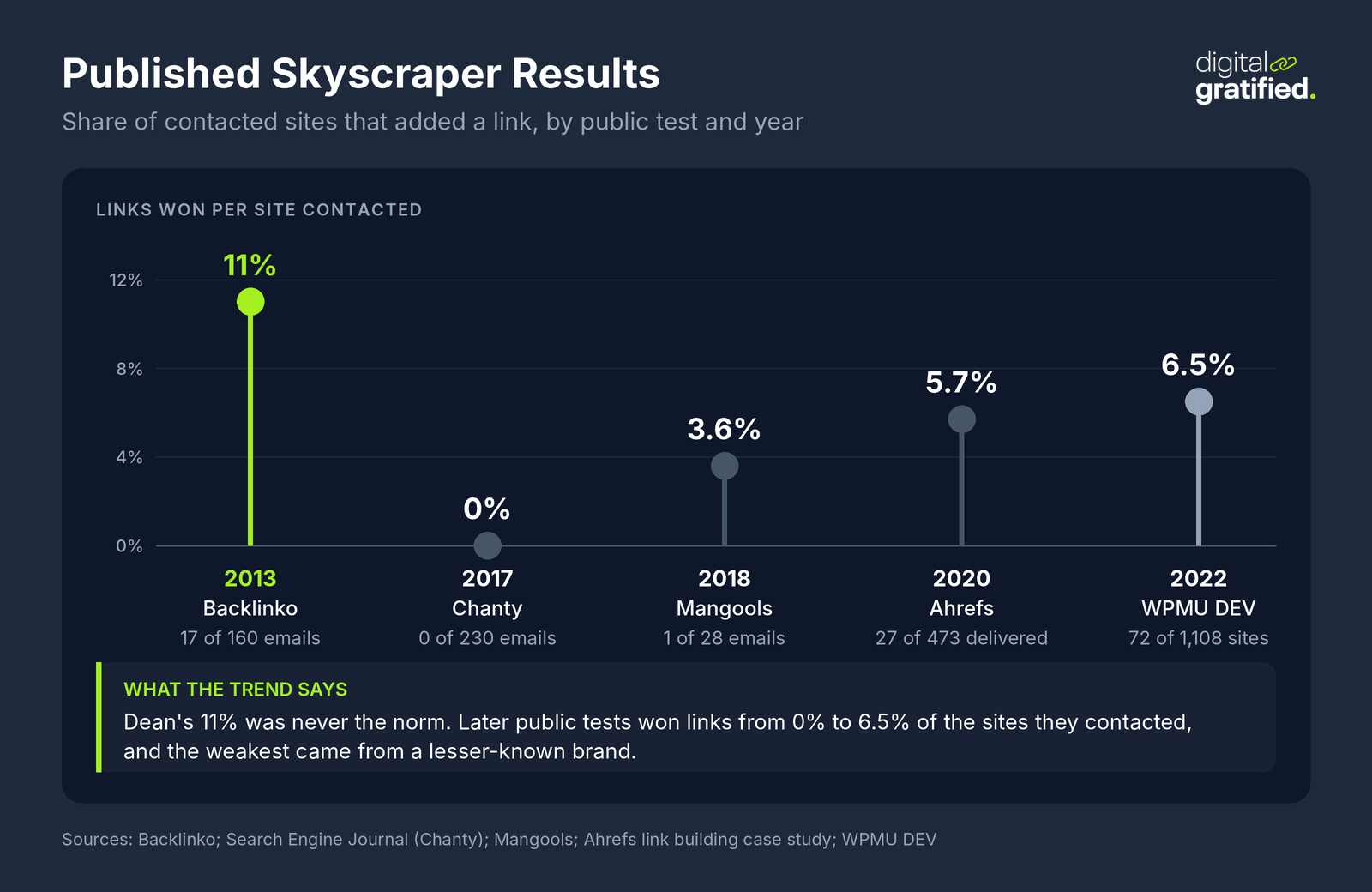
Read together, those numbers set a realistic expectation: a well-run campaign wins links from about one in 15 to one in 18 of the sites it contacts, and a weak one wins none. They also show two things the success stories leave out. Brand matters: Chanty's own write-up blamed its topic choice and its low recognition as a newer company. And a share of the replies will be offers to sell you the link. Google's spam policies list "buying or selling links for ranking purposes" as link spam, so a paid placement has to carry a sponsored or nofollow attribute, and at that point it is no longer the editorial link the technique was meant to earn.
Why "10x Content" Stopped Working
The original advice treated length as the main lever, and that is the part that has aged worst. Google's guidance on creating helpful content asks whether a page "provides substantial value when compared to other pages in search results" and whether you are "mainly summarizing what others have to say without adding much value." It also answers the word count question directly: asked whether Google has a preferred word count, the page says, "No, we don't."
Generative AI finished the job. Anyone can now produce a 6,000-word guide in an afternoon, so length signals nothing to the editor deciding whether to link. Publishing many padded pages to chase links can also cross into what the same spam policies call scaled content abuse, which includes using generative AI tools to produce many pages "without adding value for users." The bar for "better" moved from more words to more information: data the other page does not have, a tool it cannot offer, or a judgment its author is not qualified to make.
Where Skyscraper Links Really Come From
The most useful finding in the WPMU DEV experiment is not the success rate. It is that, on average, more than 90% of the backlinks its skyscraper articles earned came from organic search rather than outreach. Outreach gave each article a start; ranking did the rest, because writers looking for a source search for one and link to what they find near the top.
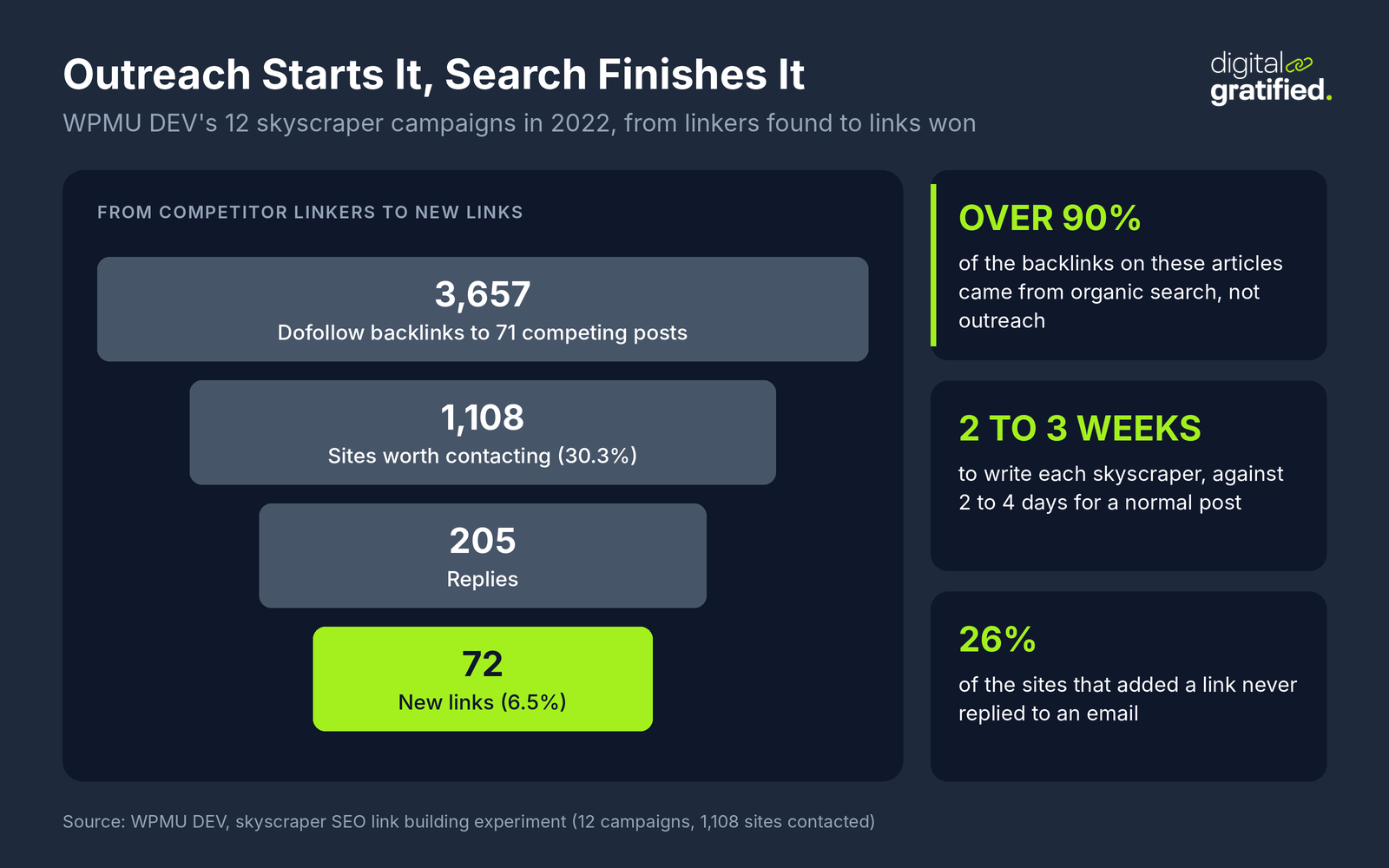
The cost is real. Each WPMU DEV skyscraper took two to three weeks to write, against two to four days for a normal post, plus eight to ten hours of outreach and tracking. That changes how a SaaS team should think about the technique. A skyscraper page is a ranking bet first and an outreach campaign second, so the target has to be a term writers search when they need a citation: statistics, benchmarks, definitions, templates and calculators. A page that ranks for "customer churn benchmarks" keeps collecting links for years. A page that ranks for nothing depends on a few dozen emails, and most of them will not be answered.
This is also why the technique overlaps with links that publishers add without being asked: the outreach is how you get a strong asset noticed, but the asset earns most of its links on its own.
The Classic Skyscraper vs. a SaaS Skyscraper
For a B2B SaaS company, the technique needs four changes. The table sets the original recipe against the version we would run.
| Decision | Classic skyscraper | SaaS skyscraper |
|---|---|---|
| Which page to beat | The page with the most backlinks on a broad topic | A page whose linkers are publications and tools your buyers use |
| What "better" means | Longer, newer, better designed, more thorough | Original data, a working tool or expert judgment the original lacks |
| Where the links point | The new article, wherever it sits | An asset one internal link away from an integration, comparison or pricing page |
| Who gets contacted | Everyone linking to the original, with one template | Linkers segmented by why they linked, with weak and non-editorial sites removed |
| How success is judged | Links won | Links from relevant sites, rankings for the asset, and demo requests from pages it supports |
The third row is the one most guides miss. A skyscraper about remote work statistics can win 50 links and do nothing for an HR platform's pipeline if the page links nowhere useful. The same asset, with links into the product's pages for time tracking and payroll integrations, passes authority to the pages that sell.
How to Do the Skyscraper Technique for a SaaS Site
Step 1: Pick a Target Whose Linkers Your Buyers Read
Start in your backlink tool with the competitor and category pages that have the most referring domains, then open the list of sites linking to each one. The count matters less than who is on it. A page linked from 40 trade publications, review sites and partner blogs in your category is a better target than one linked from 400 general marketing blogs, because those 40 links come from places your buyers spend time. Drop forums, directories, scraper sites and pages with no traffic of their own before you count anything; the WPMU DEV team found only 30.3% of the links to its targets were worth contacting.
Then check the search side: does the target rank for a term writers search when they need a source? If it ranks only for a broad informational query, your version will struggle to collect links after the outreach ends.
Step 2: Build Something Competitors Cannot Copy
A SaaS company has one advantage most publishers lack: its product produces data. Anonymized usage figures, aggregated benchmarks, survey results from your customer base and calculators built on your own logic are all things a competitor cannot rewrite in an afternoon. When we pulled together the backlink data we gathered from 420 SaaS sites, the point was exactly that: a page with numbers nobody else had published.
If you have no data yet, curation can still win. The Ahrefs statistics page worked because it replaced outdated figures that other sites were already citing, with a source for each one. What does not work is the original advice taken literally: the same subtopics as the competitor, in more words.
Step 3: Connect the Asset to Pipeline Pages
Before you publish, decide which two or three commercial pages the asset should support, and link to them from the sections where they help the reader. A churn benchmark page can link to the retention feature it measures; a payroll cost calculator can link to the payroll integration. Those links are how authority from the asset reaches the pages that bring in demo requests, and planning them belongs in an internal linking plan that feeds revenue pages, not in a cleanup six months later.
Step 4: Reach Out to the Right Linkers
Group the linkers by why they linked: a statistic they quoted, a definition they cited, a tool they recommended. Each group needs a different reason to update their page, and one template sent to everyone is the main reason the technique earned its reputation as spam. Keep the message short, name the exact page and the exact link, and say what your version adds for their readers.
The mechanics of pitching and following up are covered in a repeatable outreach process for link builders. If you run skyscraper campaigns at volume, tools such as BuzzStream, Pitchbox or linkOreach keep prospects, replies and follow-ups in one place; for a single campaign of 100 contacts, a spreadsheet is enough.
Step 5: Help the Asset Rank
Since most of the links will come from search, treat ranking as the second half of the campaign. Link to the asset from your related posts, update its figures on a schedule so it stays the freshest source, and give it a title that matches how writers search for the data. A benchmark page updated every year can keep earning links long after the outreach list is exhausted.
A Skyscraper Scorecard for SaaS Targets
Before committing three weeks to a skyscraper, score the target from 1 to 3 on four questions and add the scores.
- Linker relevance. Are the sites linking to the original read by your buyers? Mostly category publications, review sites and partners scores 3; mostly general blogs scores 1.
- Search demand for sources. Does the original rank for a term writers search for citations, such as statistics, benchmarks or a template? A clear yes scores 3; a broad informational query scores 1.
- Your unfair advantage. Can you add something the original cannot: product data, a working tool, a named expert? Proprietary data scores 3; curation scores 2; more words scores 1.
- Distance to pipeline. Can the asset link naturally to an integration, comparison or pricing page? Direct fit scores 3; one step removed scores 2; no fit scores 1.
Targets scoring 10 to 12 are worth the full effort. Targets scoring 7 to 9 are worth a lighter version, usually an update of an existing page instead of a new one. Anything at 6 or below is a traffic project, not a link building one, and your time is better spent elsewhere.
A Worked Example: An HR SaaS Company
Here is a worked example with illustrative circumstances. An HR platform that sells time tracking and payroll software wants links to its payroll integration pages. Its marketer finds a widely linked page of remote work statistics on a large publisher's site, linked from general business blogs, two HR trade publications and several payroll vendors. It scores 2 on linker relevance, 3 on search demand, 3 on advantage, because the company holds anonymized data on overtime and pay cycles across thousands of small businesses, and 2 on distance to pipeline: a total of 10.
The team does not rewrite the statistics page. It publishes an annual overtime and payroll benchmark built from its own data, with a short methodology section and a downloadable table, and links from the payroll section to its payroll integration page. Outreach goes only to the trade publications, payroll vendors and HR bloggers who cited figures on the topic, each pitched with the specific number that updates what they quoted. The general business blogs are left out.
The measure of success is not the number of links in the first month. It is whether the benchmark ranks for the terms HR writers search, whether the trade publications cite it, and whether the payroll integration page gains positions and demo requests over the next two quarters. That is the same sequence we would follow in link building for HR tech companies, where trade publications carry far more weight than volume.
When to Skip the Skyscraper Technique
Skip it when you have no advantage to bring. If your version would cover the same ground in more words, the published results suggest you will win few links, and three weeks of writing time is a large bet on a few dozen emails. Skip it too when the best targets in your category are linked mostly from general blogs, because those links will not move a B2B SaaS site's commercial pages.
Several cheaper tactics share the skyscraper's core idea of going after links that already exist. Finding dead pages your content can replace targets linkers whose current link is broken, which gives them a reason to reply. Winning back links your own URL changes broke needs no outreach at all for most of the links involved. And a strong page often earns a long tail of mentions that only need a link added. Which of these to run first depends on your assets and your team, and we set out how to choose in deciding which link strategies fit your team.
When we run SaaS link building campaigns, skyscraper-style assets are one input among several. Every placement we build is on a site with a Domain Rating of 50 or higher, clients review the prospected domains before outreach starts, and we never use PBNs or link farms. You can see how that work fits together on our SaaS link building and digital PR page.
The Skyscraper Technique and AI Search
AI search raises the value of the SaaS version and lowers the value of the classic one. An original benchmark gives an assistant a fact it can attribute to you; a longer rewrite of an existing guide adds nothing an assistant cannot already summarize. An asset with your own figures gives writers and AI systems a reason to name you, which supports earning a place in AI answers for your category as well as rankings.
Rankings are also moving. Google's November 2026 core update began rolling out on November 10, and Google said the rollout could take up to two weeks. If you launch a skyscraper asset now, wait for the update to settle before you judge its rankings.
The Bottom Line
Use the skyscraper technique only when you can bring something the original page cannot: your own data, a working tool or a judgment your team is qualified to make. Pick targets by who links to them, not by how many, build the asset one internal link away from a page that sells, and treat ranking as the main source of links, with outreach as the start.
If a target scores low on the scorecard, spend the three weeks on broken link building, reclamation or digital PR instead. If you want a team to run skyscraper assets alongside editorial placements, talk to us about SaaS link building that points links at pipeline pages.
Frequently Asked Questions
What is the skyscraper technique in SEO?
It is a link building method named by Brian Dean of Backlinko: find a page that has earned many backlinks, publish a clearly better resource on the same topic, and ask the sites linking to the original to link to yours. For a SaaS company, "better" should mean original data, a working tool or expert judgment, not more words.
Does the skyscraper technique still work?
Yes, when you bring something the original page lacks. Public tests since Dean's 11% have ranged from zero links out of 230 emails to 72 links from 1,108 sites contacted, about 6.5%. In those tests, the campaign that won nothing came from a newer brand pitching a rewrite of a familiar topic.
What is skyscraper content?
Skyscraper content is the page you build to replace a widely linked resource. The strongest versions add information the original does not have, such as proprietary benchmarks, survey results, calculators or templates, and they rank for the terms writers search when they need a source to cite.
What success rate should I expect from skyscraper outreach?
Plan for roughly one link for every 15 to 18 sites you contact on a well-run campaign, and none on a weak one. In WPMU DEV's tests, most of the backlinks its skyscraper articles earned came from organic search over time rather than from the outreach itself.
How long does a skyscraper campaign take?
WPMU DEV reported two to three weeks to write each skyscraper article, against two to four days for a normal post, plus eight to ten hours of outreach and tracking. Plan time to update the asset's figures each year as well, so it stays the freshest source on its topic.
Is the skyscraper technique white hat?
Asking sites to link to a better resource is within Google's rules. Paying for the link is not: Google's spam policies list buying or selling links for ranking purposes as link spam, so any link offered for a fee in reply to your outreach must carry a sponsored or nofollow attribute.
What is the difference between the skyscraper technique and broken link building?
The skyscraper technique asks sites to swap a working link for a better resource. Broken link building targets links that point to dead pages, which gives the site owner a clearer reason to update. Many SaaS teams run both from the same list of competitor linkers.
About the author
Let's Scale Your SaaS Together
Get a custom SEO and link building strategy tailored for your SaaS business.
Get SEO insights that actually move rankings
Link building tactics, case studies, and SaaS SEO playbooks. No fluff, no spam.
You're subscribed!
SEO and link building insights, straight to your inbox.