We pulled backlink data on 420 SaaS websites with DR 70+ and 20K+ monthly traffic. Here are the 10 most significant findings, including a 50x traffic gap between referring domain tiers, a $1,311 per-referring-domain traffic value metric, and 26 sites breaking 300K monthly visits without needing DR 85+.

Founder, Digital Gratified
What does the backlink profile of a successful SaaS website actually look like? To find out, we analyzed third-party backlink data for 420 B2B and B2C SaaS companies with meaningful organic presence, building a large, current, cross-category dataset from scratch.
This SaaS backlink study spans multiple software categories, so the patterns hold beyond a single niche. Below are the 10 most significant findings, including several that challenge assumptions repeated across the industry every week. For broader benchmarks, see our roundup of link building statistics.
Methodology
Dataset: 420 SaaS websites with 20,000+ monthly organic traffic and DR 70+
Date pulled: March 2026
Categories covered: CRM, marketing automation, HR, security, analytics, eCommerce, vertical SaaS, and more
We excluded consumer mega-platforms, social networks, developer infrastructure marketplaces, and education marketplaces to focus purely on SaaS products with an SEO-driven growth model. For each domain we pulled: domain rating, organic traffic, organic keywords, referring domains (dofollow and nofollow), total backlinks, and organic traffic value.
Quick Summary: 10 Findings at a Glance
- Finding 1: SaaS sites with 100K+ referring domains get 50x more median traffic than those with fewer than 5K
- Finding 2: The median SaaS site in this dataset has a DR of 82 and 12,058 referring domains
- Finding 3: Referring domains and organic traffic have a 0.67 Pearson correlation (log scale)
- Finding 4: The median dofollow ratio is 82.7%
- Finding 5: The median SaaS site gets 44.7 backlinks per referring domain
- Finding 6: Each referring domain is worth a median of $1,311 in organic traffic value
- Finding 7: The most traffic-efficient SaaS sites generate 30 to 300x more visits per referring domain than the median
- Finding 8: 26 SaaS sites break 300K monthly traffic with a DR below 85
- Finding 9: Keyword efficiency varies 100x across the dataset
- Finding 10: 420 SaaS sites command a combined $23.7B in estimated organic traffic value
Finding 1: SaaS Sites with 100K+ Referring Domains Get 50x More Median Traffic
The relationship between referring domains and traffic is not linear: it is exponential. When we segmented the dataset into six referring domain tiers, the difference between the bottom and top tiers was not a 2x or 5x gap. It was a 50x gap in median monthly organic traffic.
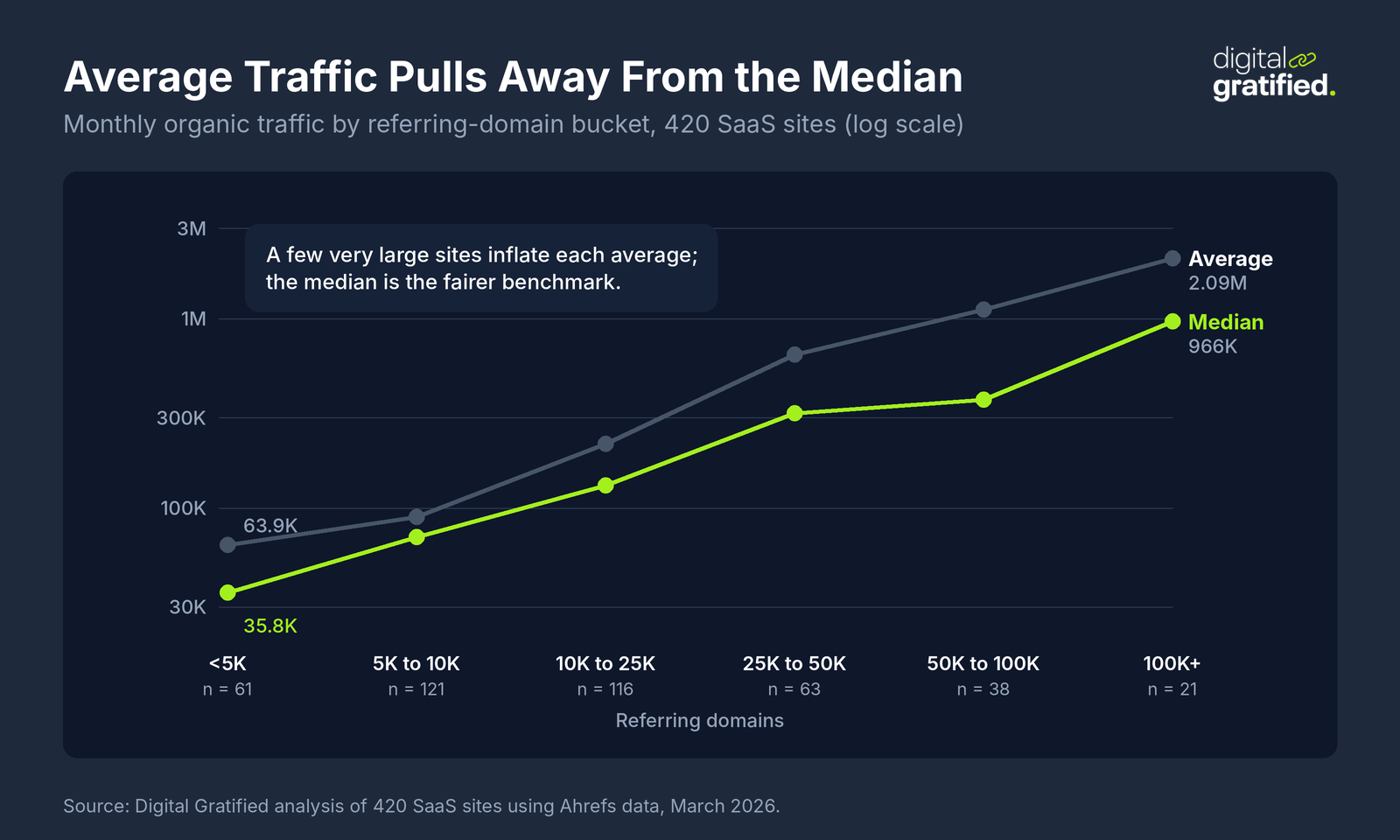
| Referring Domains | Sites (n) | Median Traffic | Avg Traffic |
|---|---|---|---|
| <5K | 61 | 35,811 | 63,857 |
| 5K to 10K | 121 | 70,290 | 89,576 |
| 10K to 25K | 116 | 131,392 | 217,856 |
| 25K to 50K | 63 | 317,392 | 647,029 |
| 50K to 100K | 38 | 373,224 | 1,115,034 |
| 100K+ | 21 | 966,023 | 2,088,051 |
What this tells you practically: getting from the sub-5K tier to the 10K to 25K tier is the single biggest leverage point in the data. That jump correlates with median traffic moving from 35K to 131K per month, a 3.7x increase. Every link acquisition decision should be framed around which tier you are trying to reach and how close you are to the threshold.
If your SaaS site currently has fewer than 5,000 referring domains, you are competing in the tier with the lowest median traffic. The data does not say you cannot rank for high-value keywords at that level, but it does say that your ceiling is fundamentally different from sites in the 25K+ tier.
Finding 2: The Median SaaS Site Has DR 82 and 12,058 Referring Domains
If you want a single benchmark for what a successful SaaS site looks like from a backlink profile standpoint, here it is:
- Median Domain Rating: 82
- Mean Domain Rating: 82.6
- Median Referring Domains: 12,058
- Median Backlinks: 515,117
- Median Organic Keywords: 8,198
Importantly, this dataset was filtered to DR 70+ sites with 20K+ monthly traffic. These are not random SaaS companies: they are SaaS companies that have already built meaningful organic visibility. The median here represents the competitive floor for link-driven organic growth in SaaS, not the average across all SaaS websites.
| DR Range | Sites | % of Total | Avg Traffic | Avg Referring Domains |
|---|---|---|---|---|
| DR 90+ | 83 | 19.8% | 1,202,424 | 97,838 |
| DR 80 to 89 | 186 | 44.3% | 288,198 | 19,332 |
| DR 70 to 79 | 151 | 36.0% | 89,950 | 5,838 |
The DR 80 to 89 bucket is the most populated: 44.3% of the dataset. These are sites with mature organic programs that have not yet crossed into the DR 90+ tier. The average traffic for this group is 288K per month, which is a meaningful benchmark for mid-market SaaS companies with active SEO programs.
Finding 3: Referring Domains and Organic Traffic Have a 0.67 Correlation
There is an ongoing debate about whether link building still matters as much as it did five years ago. This dataset offers direct evidence for that question.
The Pearson correlation between log(referring domains) and log(organic traffic) across all 420 sites is r = 0.673. This is a strong correlation for SEO data, which is notoriously noisy. At log scale, it means that a doubling of your referring domain count is associated with a consistent, measurable increase in organic traffic across a large, diverse sample of SaaS sites, which is the most defensible way to quantify the value of backlinks for a B2B SaaS business.
Some caveats: correlation is not causation, and the causal pathway may run in both directions (sites with more traffic also attract more links organically). But the direction and strength of this relationship is consistent with what we observe working on client link building campaigns: referring domain growth is one of the most reliable predictors of organic traffic growth in competitive SaaS niches.
Findings 4 and 5: Dofollow Ratio and Backlinks per Referring Domain
The Dofollow Ratio Benchmark
Across 420 SaaS sites:
- Median dofollow ratio: 82.7%
- Mean dofollow ratio: 81.6%
This tells you what a healthy backlink profile looks like for a SaaS company. Roughly 17 to 18% of the referring domains pointing to successful SaaS sites are nofollow. If your dofollow ratio is significantly below 80%, it is worth auditing whether your link building efforts have been too focused on nofollow sources (press mentions, directory listings, social profiles) at the expense of editorial dofollow links.
Conversely, if your dofollow ratio is above 95%, your profile may lack the natural diversity that editorial link profiles typically include. A mix trending toward 80 to 85% dofollow is consistent with what high-performing SaaS sites accumulate over time.
Backlinks per Referring Domain
- Median backlinks per referring domain: 44.7
- Mean backlinks per referring domain: 229.8
The gap between median and mean is significant: the mean is inflated by a small number of sites with massive backlink counts from a limited number of referring domains. Sites like livechat.com (359M backlinks from 365K referring domains) and calendly.com (79M backlinks from 769K referring domains) dramatically skew the mean upward. For most SaaS sites, a ratio of 40 to 60 backlinks per referring domain is a reasonable expectation.
Finding 6: Each Referring Domain Is Worth a Median of $1,311 in Traffic Value
This is the finding we find most useful for framing link building investment decisions:
- Median traffic value per referring domain: $1,311
- Mean traffic value per referring domain: $2,896
Traffic value here is the data provider's estimate of what the traffic driven by organic rankings would cost if purchased through Google Ads. Dividing total traffic value by referring domain count gives you an economic lens on what each referring domain contributes.
What this means practically: if you are budgeting for a SaaS link building campaign and you add 100 quality referring domains, you can expect those domains to contribute somewhere in the range of $130,000 per month in traffic value at the median, and potentially $290,000 at the mean. The implication for pricing: at $1,311 per referring domain in median traffic value, a single high-quality editorial link from a relevant publication is an asset that pays a recurring traffic dividend, not a one-time line item.
Finding 7: The Most Traffic-Efficient SaaS Sites Generate 30 to 300x More Visits per Referring Domain
The median traffic-per-referring-domain ratio across the full dataset is 9.6 monthly visits per referring domain. But the range is extraordinary. The top 15 most efficient sites are generating between 50x and 309x more traffic per referring domain than the median:
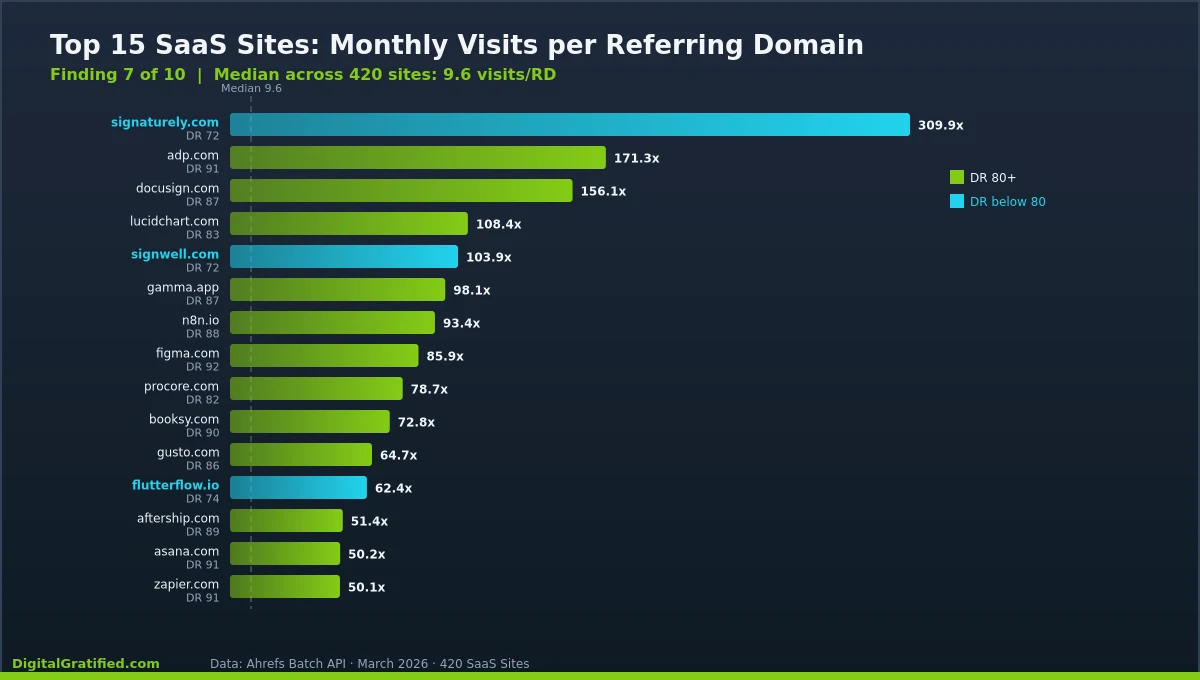
| SaaS Site | Visits/RD | DR | Monthly Traffic | Ref. Domains |
|---|---|---|---|---|
| signaturely.com | 309.9 | 72 | 709,618 | 2,290 |
| adp.com | 171.3 | 91 | 9,639,025 | 56,282 |
| docusign.com | 156.1 | 87 | 4,150,627 | 26,595 |
| lucidchart.com | 108.4 | 83 | 2,161,341 | 19,937 |
| signwell.com | 103.9 | 72 | 264,409 | 2,544 |
| gamma.app | 98.1 | 87 | 3,216,548 | 32,804 |
| n8n.io | 93.4 | 88 | 2,338,794 | 25,036 |
| figma.com | 85.9 | 92 | 10,641,968 | 123,869 |
| procore.com | 78.7 | 82 | 1,170,987 | 14,876 |
| booksy.com | 72.8 | 90 | 2,324,553 | 31,918 |
| gusto.com | 64.7 | 86 | 1,206,920 | 18,665 |
| flutterflow.io | 62.4 | 74 | 320,641 | 5,137 |
| aftership.com | 51.4 | 89 | 904,437 | 17,610 |
| asana.com | 50.2 | 91 | 4,046,340 | 80,564 |
| zapier.com | 50.1 | 91 | 4,518,746 | 90,250 |
Two things stand out in this table. First, traffic efficiency is not simply a function of high DR. signaturely.com (DR 72) and signwell.com (DR 72) both appear in the top 5: two e-signature tools with relatively modest domain authority but exceptional traffic-per-domain ratios. Their efficiency comes from owning specific high-volume, commercial-intent keyword clusters with very targeted content, not from raw authority.
Second, the high-DR sites at the top (figma, asana, zapier) are efficient because they have built content programs that extract maximum traffic from each referring domain through large keyword footprints. figma.com ranks for 245,829 keywords. The referral authority is amplified across a massive content library.
The takeaway for SaaS growth teams: raw referring domain count matters, but the traffic you extract from those domains is determined by how well your content is structured to capture keyword intent. Two sites with identical referring domain counts can have 30x different traffic levels depending on their content strategy. This is why at Digital Gratified, we always pair link acquisition with content architecture: links without ranking-ready content are underutilized authority.
Finding 8: 26 SaaS Sites Break 300K Monthly Traffic with DR Below 85
This is the finding that most directly challenges the "you need DR 90+ to compete" narrative. We found 26 sites in the dataset generating more than 300,000 monthly organic visits despite having a domain rating below 85.
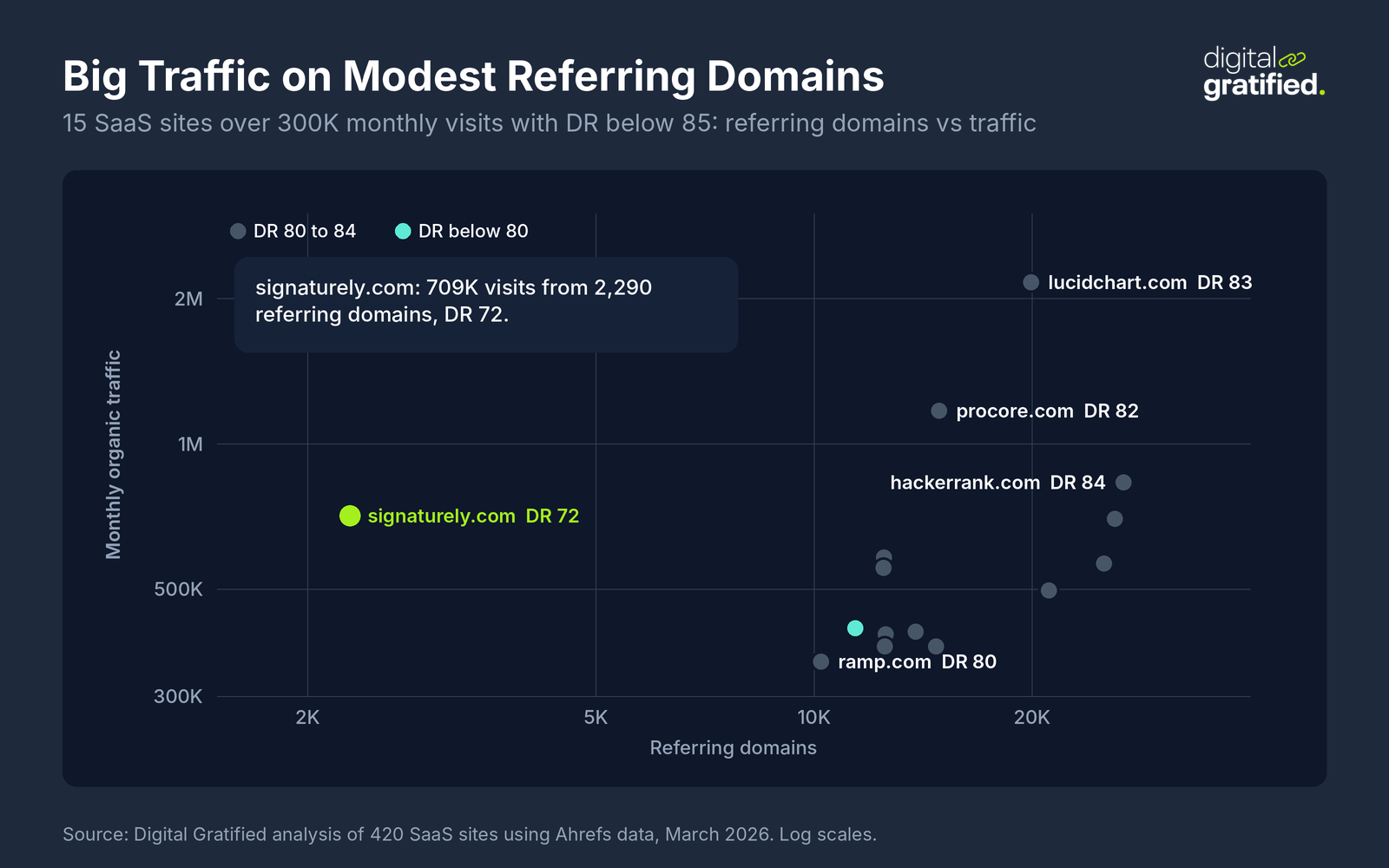
| SaaS Site | DR | Monthly Traffic | Ref. Domains | Keywords |
|---|---|---|---|---|
| lucidchart.com | 83 | 2,161,341 | 19,937 | 63,027 |
| procore.com | 82 | 1,170,987 | 14,876 | 84,368 |
| hackerrank.com | 84 | 832,029 | 26,737 | 10,988 |
| signaturely.com | 72 | 709,618 | 2,290 | 10,791 |
| betterup.com | 83 | 699,510 | 26,015 | 90,569 |
| dialpad.com | 82 | 580,911 | 12,499 | 41,700 |
| otter.ai | 84 | 564,407 | 25,149 | 11,747 |
| rippling.com | 83 | 553,463 | 12,483 | 49,483 |
| wrike.com | 84 | 496,610 | 21,114 | 40,255 |
| servicetitan.com | 79 | 414,690 | 11,411 | 18,539 |
| deel.com | 80 | 403,369 | 12,557 | 57,810 |
| streamyard.com | 83 | 380,215 | 14,748 | 6,798 |
| pandadoc.com | 83 | 380,099 | 12,526 | 39,829 |
| ramp.com | 80 | 353,886 | 10,222 | 48,616 |
The standout is signaturely.com: DR 72, 709K monthly visits from just 2,290 referring domains. That is 309 visits per referring domain, the highest ratio in the entire dataset. The explanation: signaturely.com has built an extraordinarily tight content strategy around e-signature and document-related keywords. Almost every keyword they rank for is directly relevant to their product and commercial intent. Narrow vertical focus combined with strong content execution drove 700K+ monthly organic visits without needing a massive referring domain footprint.
For SaaS companies in the DR 75 to 84 range, the data is clear: you do not need to wait until you have DR 90 to drive significant organic traffic. betterup.com (DR 83) ranks 90,569 keywords and drives 699K monthly visits. ramp.com (DR 80) ranks 48,616 keywords and drives 353K monthly visits. The differentiator is keyword breadth relative to your referring domain base, not domain rating alone.
Finding 9: Keyword Efficiency Varies 100x Across the Dataset
We calculated keywords-per-referring-domain as a measure of how effectively each site converts its link authority into keyword rankings. The median across 420 sites is 0.70 keywords per referring domain. The top 10 most keyword-efficient sites range from 4.4 to 10.4, a 100x range from the lowest performers to the top of the list.
| SaaS Site | Keywords/RD | DR |
|---|---|---|
| fresha.com | 10.4 | 91 |
| booksy.com | 6.5 | 90 |
| birdeye.com | 5.9 | 85 |
| procore.com | 5.7 | 82 |
| kenjo.io | 4.8 | 70 |
| ramp.com | 4.8 | 80 |
| signaturely.com | 4.7 | 72 |
| deel.com | 4.6 | 80 |
| oysterhr.com | 4.6 | 71 |
| educative.io | 4.4 | 76 |
fresha.com (DR 91, 417,000 keywords, 39,967 referring domains) is the most keyword-efficient site in the dataset. Their 10.4 keywords per referring domain is achieved through a combination of appointment booking and local SaaS content that generates enormous long-tail keyword coverage from a relatively modest referring domain base.
What all ten of these sites share: they are in verticals with high keyword volume, they have built content architectures that expand keyword footprint systematically, and they have done so without needing to build as many referring domains as their competitors. The practical implication: before you scale link acquisition, audit whether your content architecture is set up to convert the authority you already have into keyword rankings.
Finding 10: 420 SaaS Sites Command $23.7 Billion in Combined Monthly Traffic Value
The scale of organic traffic in SaaS is staggering. Across the 420 sites in this dataset:
- Total combined organic traffic: 166,988,400 monthly visits
- Total combined referring domains: 12,597,699
- Total combined backlinks: 4,770,977,359
- Total combined organic traffic value: $23,699,258,931
The $23.7 billion in combined traffic value is an estimate of what these 420 companies would need to spend on Google Ads to replicate their organic traffic. That number underscores why organic search remains the most capital-efficient acquisition channel in SaaS: once you build the referring domain base and content infrastructure that generates those rankings, the traffic compounds without incremental spend.
What These Findings Mean for Your SaaS SEO Strategy
The 10 findings above are descriptive: they tell you what successful SaaS sites look like. Here is what we take away from the data in terms of actionable implications:
1. Referring domain tiers are the most useful planning framework
Instead of asking the three-part answer on backlink counts you need, ask which tier you are targeting and what it takes to reach the next threshold. Moving from under 5K to 10K to 25K referring domains is the highest-leverage jump in the data. Set your link building targets accordingly.
2. DR is a floor, not a ceiling
26 sites in this dataset are generating 300K+ monthly visits with DR below 85. The limiting factor in almost every case was not domain authority: it was keyword footprint. If your content library is thin, you will underperform your DR. If your content is deep and targeted, you can punch significantly above your DR weight.
3. The $1,311 per referring domain benchmark changes how to value link building
At the median, every new referring domain you add is associated with $1,311 per month in organic traffic value. A campaign that adds 200 referring domains is potentially worth roughly $262,200 per month in traffic value at the median. Frame your link building investment against this number, not against cost-per-link.
This benchmark also reframes the buy-versus-build decision on agencies. If a single referring domain is worth $1,311/month in traffic value at the median, the question stops being "what is the cheapest cost per link" and becomes "who can reliably place the kind of domains that move my ranking." That decision is worth taking seriously: we wrote an honest buyer's guide to SaaS link building agencies covering how to evaluate vendors against this kind of ROI math, and a separate breakdown of when (not) to use link marketplaces if you are weighing paid placements as part of the mix.
4. Traffic efficiency is a product of content architecture, not just link volume
The sites generating 30 to 300x more traffic per referring domain than the median have built content programs that extract maximum value from each domain. Before scaling link acquisition, make sure your content is set up to rank for the keywords the links are supposed to support. Links without ranking-ready content are underutilized authority.
"Ranking-ready" in practice means two things: a clean crawl and indexation foundation, and a deliberate internal link graph that channels authority to the pages you actually want to rank. Audit both before you scale outreach: our guide to technical SEO for SaaS covers the indexation, site-speed and JS-rendering issues that quietly cap traffic efficiency, and our internal linking strategy guide walks through the pillar-cluster and equity-flow work that turns each new referring domain into ranking gains instead of orphaned authority.
5. Monitor your dofollow ratio
The 82.7% median dofollow ratio gives you a calibration point. If you are significantly below this, your link building efforts may be weighted too heavily toward nofollow sources. If you are above 95%, your profile may lack natural diversity.
6. Pick a link acquisition model that actually fits your stage
Findings 1 and 6 together imply a clear order of operations: you need a defensible referring-domain growth rate, and you need it produced by a repeatable process, not ad-hoc one-off placements. The mechanism you choose to get there should match your team and budget rather than industry default. For most SaaS teams that means picking deliberately between three paths: build the engine in-house using the 5-phase link building framework we use with clients; run a hybrid program where you keep strategy internal but outsource link building the right way for execution capacity; or, if you do not yet have an internal owner, retain a specialised partner end-to-end.
Whichever model you pick, the activities themselves do not change much: the data in this study is the output of disciplined link building outreach that gets replies, supported by a stack of workflow-based link building tools used to find prospects, manage sequences and verify placements. Sites in the top traffic tier in this dataset almost universally run that combination month over month, not in quarterly bursts.
7. Reclaim the links you already earned
One pattern that consistently shows up in the high-efficiency sites in Finding 7 is that they do not only acquire new links: they recover and consolidate existing ones. Mentions without links, dead pages on referring sites and old redirects all bleed authority that you have already paid for. A standing broken link building process applied to your own backlink profile (and to high-relevance external sites in your category) tends to add 5–15% to a mature site's referring-domain count without any net-new outreach, and it directly improves the dofollow ratio in Finding 4.
Frequently Asked Questions
How many referring domains does the average SaaS company have?
Across 420 SaaS sites with DR 70+ and 20K+ monthly organic traffic, the median is 12,058 referring domains. For companies in the early to mid stages of their SEO program, targeting 10,000 to 25,000 referring domains should be a clear long-term objective based on the traffic tier data.
What is a good domain rating for a SaaS company?
The median DR in this dataset is 82. The vast majority of sites sit between DR 70 and DR 89. DR 90+ sites represent only 19.8% of the dataset but account for a disproportionate share of traffic. That said, 26 sites in this dataset break 300K monthly visits with DR below 85, which demonstrates that DR is one factor among several, not the determining constraint.
How does link building affect SaaS organic traffic?
The Pearson correlation between log(referring domains) and log(organic traffic) across 420 sites is r = 0.673: a strong positive relationship. This confirms that referring domain count is one of the strongest measurable predictors of organic traffic for SaaS websites. The relationship is not one-to-one, and content quality matters, but the data supports treating link acquisition as a primary organic growth lever.
What is the ROI of link building for SaaS?
At the median across 420 sites, each referring domain is associated with $1,311 per month in organic traffic value. At the mean, it is $2,896 per month. A campaign adding 100 high-quality referring domains is potentially worth $131,000 to $290,000 per month in traffic value at scale.
Can a SaaS company with low DR compete with high-DR sites?
Yes, the data shows it happening. signaturely.com (DR 72) drives 709K monthly visits from 2,290 referring domains: 309 visits per referring domain, the highest ratio in the dataset. The mechanism: narrow vertical focus, high keyword relevance, and a content strategy built around e-signature intent. Low DR is not a permanent ceiling; it is a starting point that content depth and targeted link building can overcome for specific keyword clusters.
About the author
Let's Scale Your SaaS Together
Get a custom SEO and link building strategy tailored for your SaaS business.
Get SEO insights that actually move rankings
Link building tactics, case studies, and SaaS SEO playbooks. No fluff, no spam.
You're subscribed!
SEO and link building insights, straight to your inbox.