Most lists of link building strategies leave the hard part to you: choosing. Here is how SaaS teams pick three strategies that fit the assets they already have, point the links at pipeline pages and stay inside Google's spam policies.

Founder, Digital Gratified
A link building strategy is a decision about which two or three ways of earning links fit what your company already has, and which pages those links should help rank. For a B2B SaaS company, our position is that you choose strategies by the asset each one turns into links (your data, your experts, your product or your partners), point the results at pages that create pipeline, and say no to everything else on the list.
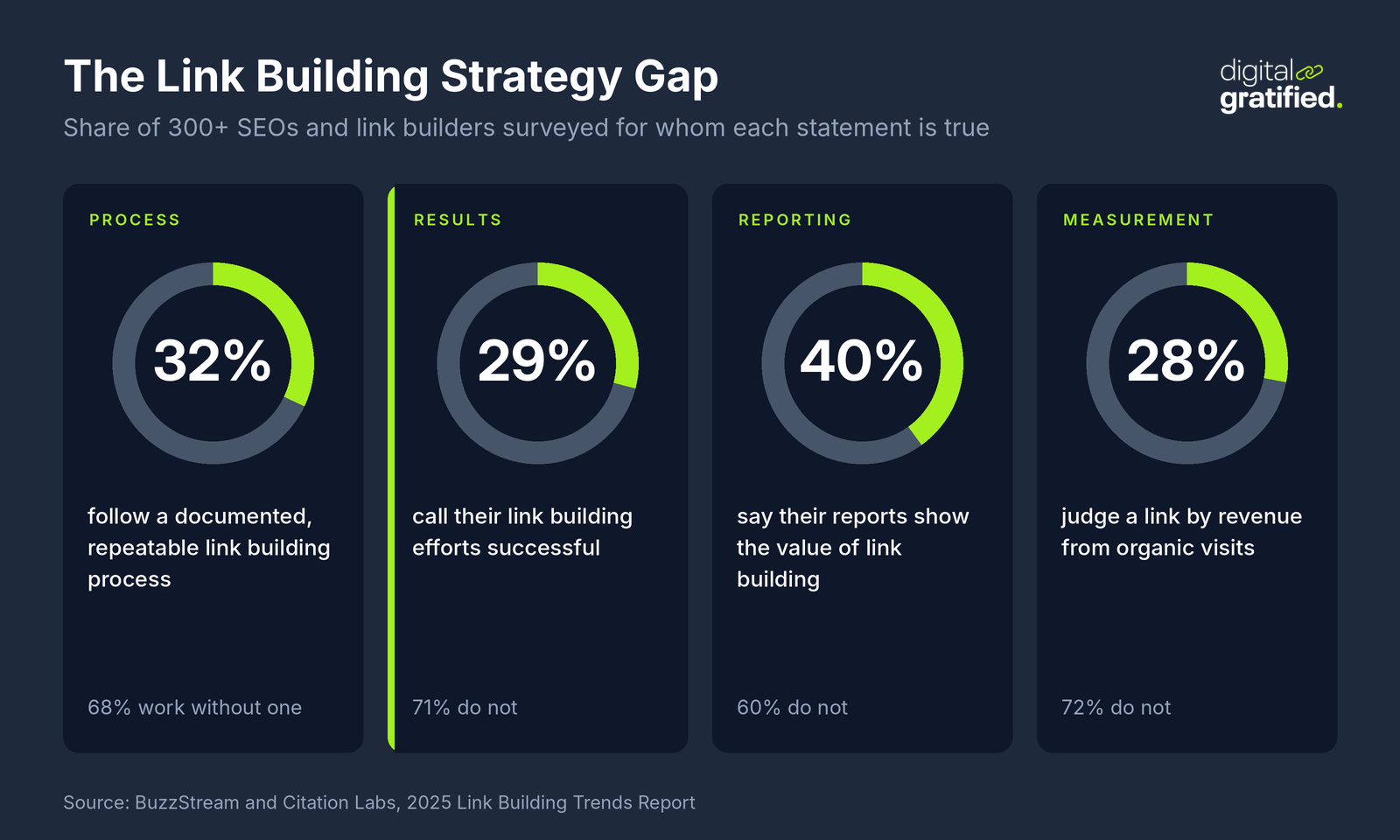
Most guides to link building strategies hand you ten or fifteen tactics and leave the choosing to you. That is the hard part. In the 2025 Link Building Trends Report from BuzzStream and Citation Labs, a survey of more than 300 SEOs and link builders, 66% of in-house respondents named choosing the right backlink tactics as the skill they most wanted to improve, and only 29% of all respondents called their link building successful. This guide covers the strategies that work for SaaS companies, which assets each one needs, the ones Google's spam policies rule out, how to pick your three, and how to measure them in pipeline. It sits under our full SaaS link building playbook, which covers the wider program.
What Is a Link Building Strategy?
Three words get used interchangeably and should not be. A tactic is a single method, such as broken link building or answering journalist requests. A campaign is one time-boxed push using a tactic, such as pitching a salary report to HR publications for six weeks. A strategy sits above both: it says which tactics you will run, for which pages, with which people, and which ones you will ignore.
The ignoring is what most teams skip. Only 32% of those respondents follow a documented, repeatable process and only 16% stick to a fixed set of strategies. The rest try whatever looks promising that quarter, which makes it impossible to tell what worked.
A SaaS company has a structural reason to be stricter than most sites. Your buyers are a small, specific group, your commercial pages are few, and the expert time that most good strategies need belongs to people who also sell, build or run a team. A strategy that produces 40 links from sites your buyers never read can still leave the pages that bring in demo requests exactly where they were.
Start From the Assets You Already Have
Every strategy that earns links turns something you have into something another site wants to cite. So the first question is not "which tactics are best" but "what do we have that other sites lack". For most SaaS companies the answer falls into four groups:
| Asset | Strategies it powers | What the links usually look like | Who has to be involved |
|---|---|---|---|
| Data: product usage, benchmarks, survey results | Original research, data-led digital PR, statistics pages | Editorial links from trade and business press, often to a report page | A data or product analyst plus a writer |
| Experts: founders, product leads, practitioners | Expert commentary, podcasts, contributed articles | Quotes and bylines, with a mix of followed, nofollow and unlinked mentions | The named expert, for a few hours a week |
| Product: templates, calculators, free tiers, public pages | Free tools, templates, resource page inclusion | Links from guides, roundups and resource lists that recommend the tool | Product or engineering, plus marketing |
| Partners: integrations, resellers, agencies, customers | Integration directories, co-marketing, customer stories | Listing pages and joint content on sites your buyers already use | Partnerships, customer marketing |
Two more assets support every row rather than forming their own: budget, which buys time and specialist help, and the authority your domain already has, which decides how quickly any of this moves rankings. A seed-stage company with one technical founder and no data will run different strategies from a Series C company with a research team, and both can be right.
Link Building Strategies That Work for SaaS Companies
These are the strategies we see produce links that matter for B2B software. For the tactical detail behind several of them, see our guide on how to get backlinks to a SaaS site, tactic by tactic. Here the focus is on when each one fits.
1. Original Research and Data Studies
Publish numbers nobody else has: a benchmark drawn from anonymized product data, an annual survey of your buyers, or an analysis of public data in your category. Journalists and bloggers need figures, and the page that holds the figure collects the links. This is the strongest strategy for SaaS companies with usage data, and the slowest to start: in our experience a credible study takes four to eight weeks to produce. It also keeps paying: a good benchmark gets cited for years if you refresh it. We published our findings from 420 SaaS backlink profiles for the same reason.
2. Expert Commentary and Journalist Requests
Put a credible expert in front of writers who need a quote: through request platforms, reactive comment on industry news, and podcast appearances. It needs no campaign, only one person who can answer fast and well. The trade-off is that many quotes run without a followed link, which matters less than most teams think because buyers read the coverage. Our guide to how HARO and the newer request platforms work now covers the platforms and what to expect from each.
3. Integration Directories and Partner Pages
Every integration you ship can come with a listing in the partner's app marketplace or integrations directory, and often a co-written tutorial or launch post. These links sit on sites your buyers already use, and they send referral traffic from people who already run a tool you connect to. This strategy is close to unique to software companies and most link building guides barely mention it. One caution: Google's spam policies name "partner pages exclusively for the sake of cross-linking" as link spam. A real integration with a useful listing is fine. A page of logos that exists to swap links is not.
4. Inclusion in Comparison Lists and Roundups
Buyers shortlist software from "best tools for X" articles and from the AI answers that summarize them. Getting your product listed, accurately, in the roundups that rank for your category terms earns a link and a recommendation on the page buyers read just before they visit vendor sites. Find the lists that rank, check whether you are on them, and give each editor what they need to evaluate you: a short positioning line, pricing, a trial or demo account, and screenshots. Do not pay for placement on lists that present themselves as independent reviews.
5. Free Tools, Templates and Calculators
A free tool that solves one narrow job (an ROI calculator, a policy template, a checker, a generator) earns links from guides that recommend it and from resource pages, and it brings in visitors who already have the problem your product solves. It needs engineering or design time, so it fits companies whose product team can spare a sprint. Be careful with embeds: Google lists keyword-rich or hidden links in widgets distributed across sites, and links spread through the footers or templates of other sites, as link spam. A "powered by" credit on an embed should carry your brand name and, ideally, a nofollow attribute.
6. Contributed Articles on Niche Publications
Writing for a publication your buyers read still works when the article is good enough to stand on its own and the link is a natural reference rather than the point of the piece. It fails when it turns into mass guest posting on sites that publish anyone. Google's spam policies call out links with optimized anchor text in guest posts as an example of link spam, so link with your brand name or a plain description and let the article do the work. If outreach becomes a weekly habit, a tracker helps; tools such as BuzzStream or linkOreach, outreach software with an AI agent called Linkzy, manage prospect lists and email sequences.
7. Unlinked Mentions and Lost Link Reclamation
Once a SaaS brand has any visibility, other sites mention it without linking, link to an old URL, or drop a link during a redesign. Asking for the link on a mention that already exists is an easier request than cold outreach, because the writer already chose to talk about you. It is the cheapest strategy on this list and it scales with your brand, so it belongs in almost every program. Our guide shows how to chase the missing link on mentions of your product.
8. Broken Link Building
Find pages in your niche that link to resources that no longer exist, then offer your page as the replacement. It works best when you already have a strong guide or tool on the same subject, and it fits a team with more time than assets. Expect modest volume; our guide to finding dead resources your page can replace covers how to keep the prospecting from eating the week.
9. Competitor Link Gap Analysis
Strictly speaking this is a prospecting method, not a strategy, but it tells you which of the strategies above your competitors win with. If their strongest links come from integration directories and comparison lists, that is where your buyers' sources are. Start by mapping where competitors earn their links, then copy the strategy, not the individual links.
Link Building Strategies to Skip, and What Google Says About Them
Some strategies still appear in search results because they produce links quickly. Google's spam policies define link spam as "creating links to or from a site primarily for the purpose of manipulating search rankings", and they list the main offenders explicitly:
- Buying or selling links that pass ranking credit, including "exchanging money for links, or posts that contain links" and sending a product in exchange for a review with a link. Paid placements are allowed only when marked with rel="nofollow" or rel="sponsored".
- Excessive link exchanges ("link to me and I'll link to you") and partner pages built only for cross-linking.
- Automated link creation, low-quality directory and bookmark links, and forum comments with optimized links.
- Required links, such as a terms of service that makes customers link back without letting them qualify the link. This one catches SaaS companies that make a backlink a condition of a free plan.
- Widget, footer and template links distributed across many sites.
Private blog networks fall under the same definition, whatever a vendor calls them. Enforcement is active: Google's most recent spam update ran from September 24 to October 8, 2026, close to two weeks against about two days for earlier spam updates. For a SaaS company the risk is not only a ranking drop; it is losing the authority behind pricing and comparison pages that took years to build. When we run SaaS link building campaigns, we place links only on editorial sites with a Domain Rating of 50 or higher, never on PBNs, and clients approve the list of domains before any outreach starts.
Point Links at the Pages That Create Pipeline
Choosing strategies is half the job. The other half is deciding where their links should land, and most programs get this backwards. Among the same respondents, 68% prioritized links to blog posts and 41% to product pages, and very few targeted sales or demo pages at all.
There is a sound reason: publishers link to useful resources, not to pricing pages. But it means a link program can grow a blog's authority for a year while the integration, comparison and use case pages that turn visitors into demo requests barely move. The fix is architecture, not begging for links to money pages. Earn links to the assets publishers want, then pass that authority on with internal links to the commercial pages each asset relates to.
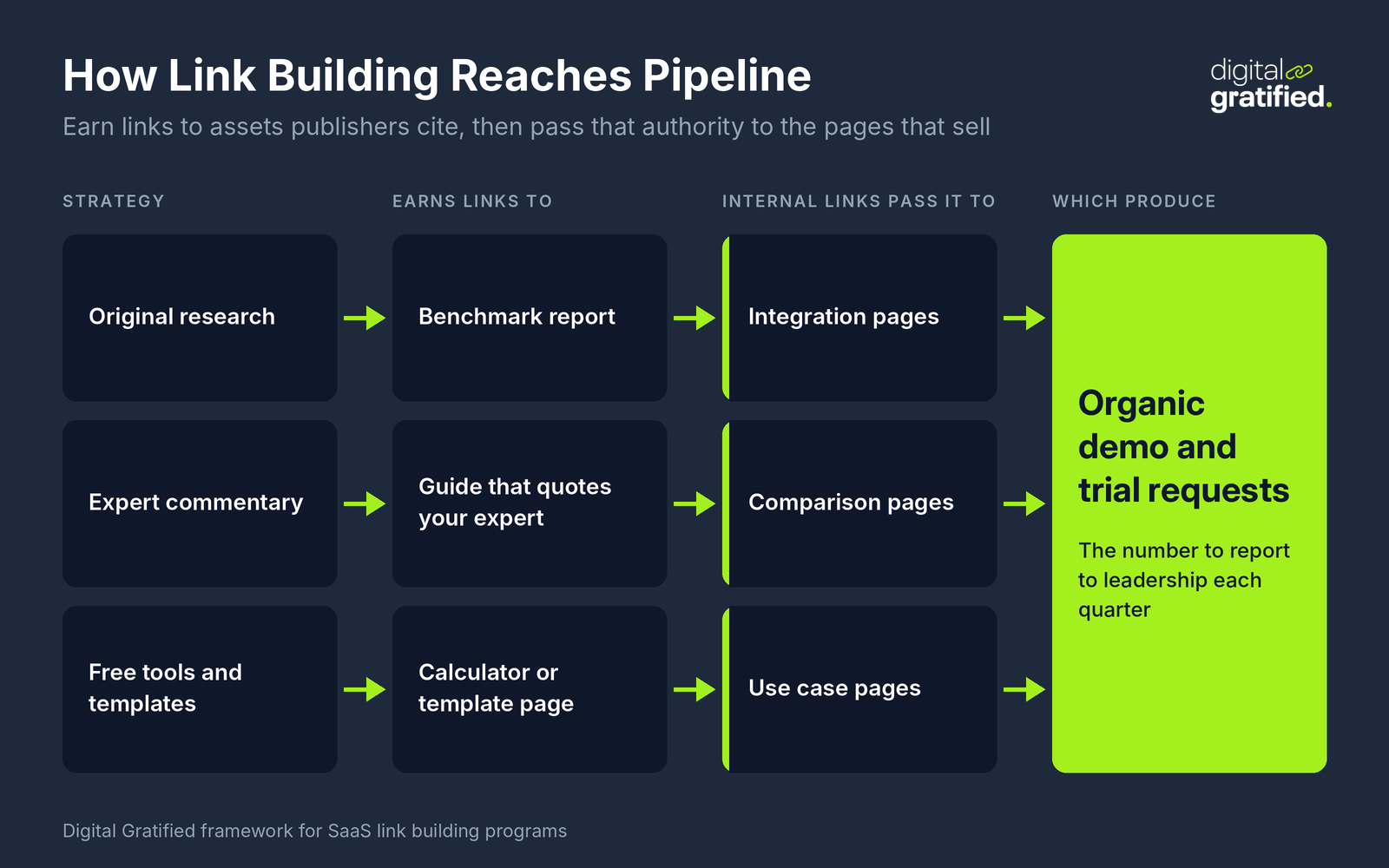
In practice, every linkable asset should have a planned destination. A benchmark on onboarding time links to your onboarding use case page; a free security checklist links to the compliance feature page; a roundup inclusion points at a comparison page rather than the homepage. Decide those destinations before the asset ships, not after the links arrive. That is also what makes it possible to estimate what a single link is worth in pipeline later.
How to Choose Your Three Strategies
Run fewer strategies, longer. Three is the number we recommend for most SaaS teams: one that builds authority at scale, one that earns coverage buyers read, and one cheap maintenance strategy such as mention reclamation. Score each candidate from 1 to 3 on four questions:
- Asset fit: do we already have the data, expert, product or partner this strategy needs, or would we have to create it?
- Buyer reach: will the linking sites be ones our buyers read or use while they shortlist vendors?
- Repeatability: can we run it every month with the people we have, or is it a one-off?
- Policy risk: would we be comfortable explaining every link it produces to someone reading Google's spam policies? Score a clear yes as 3 and anything that needs a sponsored attribute as 1.
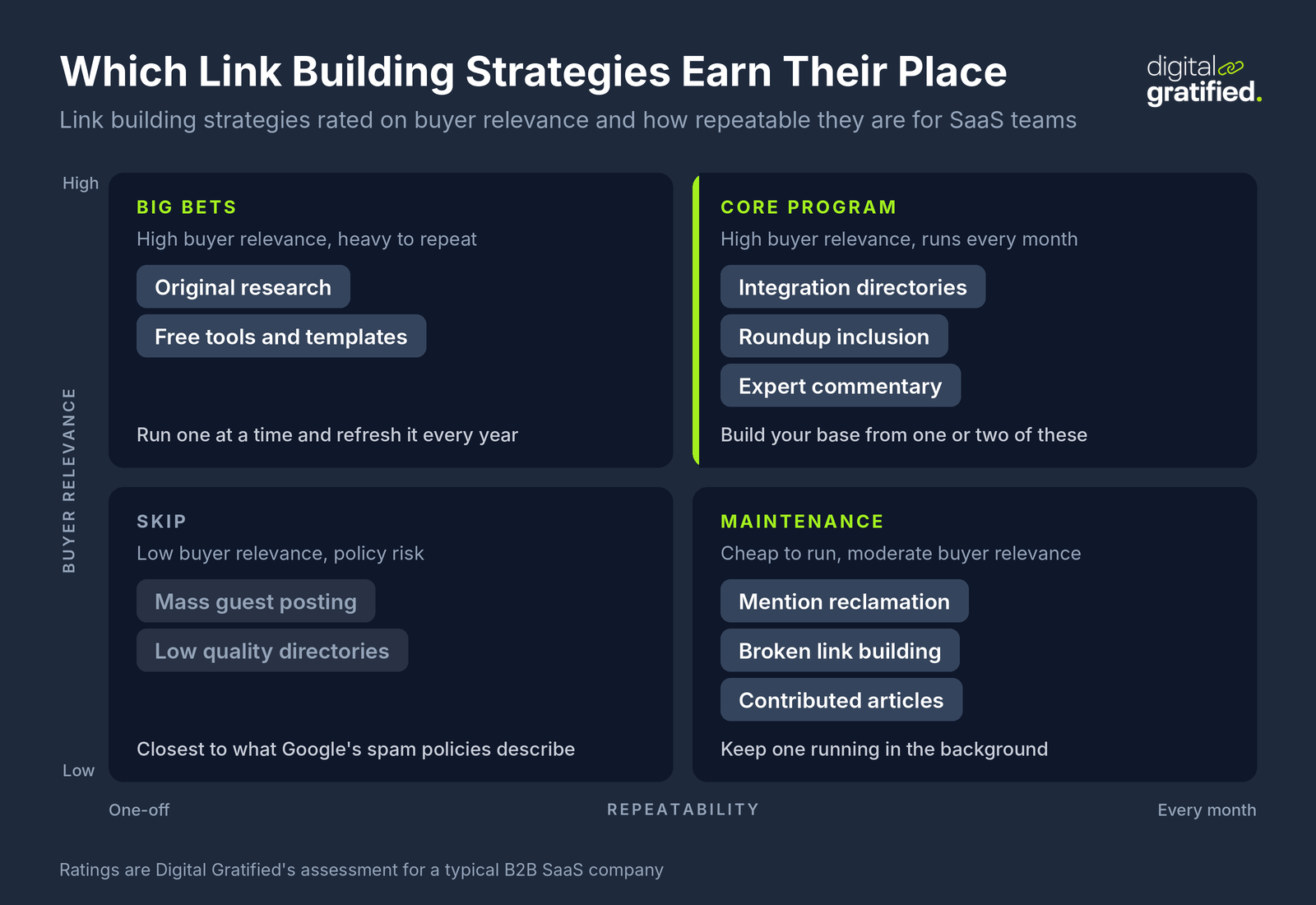
Pick the three highest totals, and break ties on buyer reach. The matrix below is our assessment of where the common strategies tend to land for a typical B2B SaaS company. Yours will differ with your assets, which is the point of scoring them.
A Worked Example
Here is a worked example with illustrative numbers. A Series A cybersecurity SaaS company has a small marketing team, a threat research group that publishes internally, 14 live integrations and a founder who speaks at conferences. Scoring the candidates, original research scores 11 of 12 because the research team already produces data; integration directories score 11 because the listings exist but have never been optimized; expert commentary scores 10 because the founder is credible and quotable. Broken link building scores 7: low risk and repeatable, but the sites it reaches rarely matter to security buyers. Contributed articles score 8.
So the team commits to a quarterly threat report, a cleanup of all 14 integration listings with co-written setup guides for the five largest partners, and two hours a week of founder commentary. Every report links internally to the matching detection feature page, every partner guide links to that integration's page, and the team reviews the three strategies against demo requests at the end of each quarter. That is the shape of link building for security software: credibility comes first, and the buyer reads the research before the vendor page.
Link Building Strategies for AI Search
Buyers now ask assistants which tools to shortlist, and those answers lean on what the web says about a brand, linked or not. In Ahrefs' study of 75,000 brands, branded web mentions correlated with AI Overview visibility at 0.664, against 0.295 for referring domains and 0.218 for backlinks. That is correlation, not proof, but it changes how to rank strategies. The ones that produce mentions in trusted sources (roundup inclusion, expert commentary, original research, partner content) count twice, once for rankings and once for AI answers. The ones that produce links on pages nobody reads count for neither.
Few teams have adjusted. Only 11% of the link builders surveyed had a repeatable process for earning citations in AI answers. You do not need a separate strategy for it; you need to track it. Add a monthly check of the prompts your buyers use and note which sources the answers cite, then aim your roundup and commentary work at those sources. We cover the wider shift in what AI search means for earning links.
How to Measure a Link Building Strategy
Most link builders measure what is easy to see. The survey's respondents judged a link's impact mainly by organic visibility for the target page (59%), rankings (54%) and organic traffic (53%), while 28% looked at revenue from organic visits. Leadership, meanwhile, is impatient: 75% of respondents get six months or less to prove value. A SaaS team should report on a short list that connects the two:
- Links and mentions by strategy, counted separately for sites on your buyers' reading list.
- Ranking movement for the commercial pages each strategy feeds through internal links, not only for the pages that received the links.
- Organic demo and trial requests from those commercial pages, compared with a set of similar pages that received no links.
- AI answer citations for your category prompts, checked monthly.
Set the expectation early. In our experience, new links are indexed within weeks, while measurable ranking shifts usually show between months three and six of a consistent program. Review each strategy at the end of every quarter, give it two quarters to prove itself, and replace the weakest one if its links still are not reaching buyers. Running each strategy as a scoped campaign with its own brief and target pages makes that review simple.
A focused strategy can carry a long program. For CloudTalk, our content-driven outreach strategy focused strictly on B2B SaaS publications secured 20+ DR 50+ backlinks a month across an 18-month partnership, alongside 250% organic traffic growth.
The Bottom Line
The best link building strategies for a SaaS company are the ones that turn assets you already have into links from sites your buyers read. Pick three: one that builds authority, one that earns coverage buyers see, and one cheap maintenance strategy. Point every linkable asset at a commercial page through internal links, stay inside Google's spam policies, and judge each strategy on demo requests after two quarters.
If you would rather have a team run that program for you, talk to us about SaaS link building on publications your buyers read.
Frequently Asked Questions
What are the best link building strategies for SaaS?
For B2B SaaS companies, the strategies that most often earn links from sites buyers read are original research, expert commentary, integration directory listings, inclusion in comparison roundups, free tools and templates, and reclaiming unlinked mentions. The best set for you is the two or three that fit the data, experts, product and partners you already have.
What is the difference between a link building strategy and a tactic?
A tactic is one method, such as broken link building. A campaign is a time-boxed push using a tactic. A strategy decides which tactics you run, which pages their links should help, who does the work and which tactics you ignore.
How many link building strategies should I run at once?
Three is enough for most SaaS teams: one that builds authority at scale, one that earns coverage your buyers read, and one cheap maintenance strategy such as mention reclamation. Running more usually means none of them gets the time to work.
Which link building strategies break Google's spam policies?
Google's spam policies list buying or selling links that pass ranking credit, excessive link exchanges, automated link creation, low-quality directory and bookmark links, keyword-rich links in widgets, links spread through other sites' footers or templates, and links required by terms of service. Paid placements are allowed when marked rel="sponsored" or rel="nofollow".
How long does a link building strategy take to work?
New links are usually indexed within weeks, but in our experience measurable ranking shifts show between months three and six of a consistent program. Give each strategy two quarters before you judge it, and judge it on the commercial pages it feeds and the demo requests they produce.
What is the best link building strategy for a new SaaS website?
A new site has few mentions to reclaim and little authority, so start with assets you control: integration listings with partners, founder commentary on journalist request platforms, and one free tool or small data study. Add reclamation once people start writing about you.
Do link building strategies help with AI search?
The ones that produce brand mentions in trusted sources do. In Ahrefs' study of 75,000 brands, branded web mentions correlated with AI Overview visibility at 0.664, against 0.218 for backlinks. Roundup inclusion, expert commentary and original research earn both links and mentions.
About the author
Let's Scale Your SaaS Together
Get a custom SEO and link building strategy tailored for your SaaS business.
Get SEO insights that actually move rankings
Link building tactics, case studies, and SaaS SEO playbooks. No fluff, no spam.
You're subscribed!
SEO and link building insights, straight to your inbox.