HARO is back, but it now works as an expert commentary channel rather than a link source. Here is how the request platforms compare, why AI-written pitches fail, and how SaaS teams should pick requests and measure the results.

Founder, Digital Gratified
HARO link building means answering journalists' requests for expert sources so that the published article quotes you and, ideally, links to your site. It still works, but not the way most guides describe it: for a B2B SaaS company it is an expert commentary channel that earns a few mentions a month in publications your buyers read, not a way to collect followed links at volume.
HARO itself has been through a shutdown and a relaunch, its inbox is now flooded with AI-written pitches, and most requests never promise a followed link. That changes what is worth doing. This guide covers how HARO link building works now, which platforms replaced or joined it, what the data says about link rates and AI pitches, how to decide which requests to answer, and how to measure the channel by pipeline instead of link count. It is one tactic inside the wider SaaS link building playbook, and one of the few where the expert matters more than the budget.
What Is HARO Link Building?
HARO (Help a Reporter Out) is a service that sends sources a digest of requests from journalists and writers who need an expert quote, a data point or an example for a story. You reply by email with a short, useful answer. If the writer uses it, the article names you, your title and your company, and many outlets add a link to your site.
"HARO link building" has become the umbrella term for that whole process, on HARO and on the platforms that copied it. The links it produces are editorial: a writer chose to cite you because your answer helped their reader. That makes them some of the cleanest links a SaaS company can earn, and also some of the least predictable, because the writer decides whether to link at all.
It sits between two other tactics. Unlike outreach, you do not pick the publication; you respond to a story already in progress. Unlike data-led digital PR, you do not need a campaign; you need one person with real expertise and the discipline to answer fast. Both differences matter when you decide who should own it.
What Happened to HARO, and What Replaced It
For years HARO was a Cision product. In 2024 Cision rebranded it as Connectively, and on December 9, 2024 it permanently discontinued the platform to focus on its main PR software. For about four months, the name most SEOs associated with this tactic did not exist.
In April 2025, Featured.com bought HARO from Cision and brought it back. The relaunch post says HARO will remain free for journalists and sources, supported by newsletter sponsors, and the first request emails went out on April 22, 2025. In an interview with BuzzStream around the relaunch, Featured's founder Brett Farmiloe described the new screening: AI text detection on pitches, AI checks on headshots, a required LinkedIn profile, community reporting, and a permanent ban for anyone who responds without helping a reporter.
HARO is not dead, then, but the market around it has changed. While HARO was gone, writers moved to other platforms, and many stayed. A source who only watches HARO now sees a fraction of the requests that exist.
HARO Alternatives Worth Watching
These are the platforms a B2B SaaS team should know, with what each costs a source. Prices come from each platform's own pages.
| Platform | Who runs it | Cost for sources | How requests arrive | Where it fits for SaaS |
|---|---|---|---|---|
| HARO | Featured, since April 2025 | Free, sponsor supported | Email digest | Broad business and consumer stories; high volume and high noise |
| Featured | Featured | Free tier with a few opportunities a week; paid plans at $39, $99 and $299 a month | Platform with AI-assisted answering | Founders who want a steady stream of expert questions |
| Qwoted | Qwoted | Free Basic plan with 2 pitches a month on a 2-hour delay; Pro allows 35 pitches a month with no delay | Platform and real-time alerts | Business press and higher-authority outlets |
| Source of Sources (SOS) | Peter Shankman, who founded HARO | Free | Up to three emails a day | Curated requests with strict on-topic rules |
| Help a B2B Writer | Acquired by Superpath; its address now redirects to MentionMatch, a B2B writer and source matching service | Free to join | Platform | B2B marketing and software topics, often without a named outlet |
| #journorequest on X and LinkedIn | No one; it is a hashtag | Free | Social posts | Fast UK and freelance requests, frequently posted before they reach a platform |
The paid tiers buy access and speed, not links. On Qwoted, the free plan's two-hour delay is the real cost: by the time a free user sees a request, the writer may already have the quotes they need.
Does HARO Link Building Still Work?
It works if you judge it as expert commentary, and disappoints if you judge it as a link source. Three numbers explain why.
First, the followed link is not the default. In a study of request platforms compiled with PressPulse and published by BuzzStream, only 21.9% of quote requests explicitly offered a followed link. SOS requests had the highest share of followed links, at 36.26%. Many outlets that do link mark the link nofollow, and plenty of quotes run with a name and no link at all. If you need to explain to leadership how followed and nofollow links differ, this is the channel where the difference shows up most.
Second, the authority is uneven. In the same study, just over 38% of HARO's requests came from sites in the DR 0 to 9 range, while 70.3% of Qwoted's opportunities came from high-DR outlets. The platforms are not interchangeable, and HARO alone is the noisiest of them.
Third, most of the inventory is not written for B2B buyers. Business and finance requests made up between roughly a quarter and a third of each platform's mix, while home and lifestyle requests alone made up about a quarter of all quote requests.
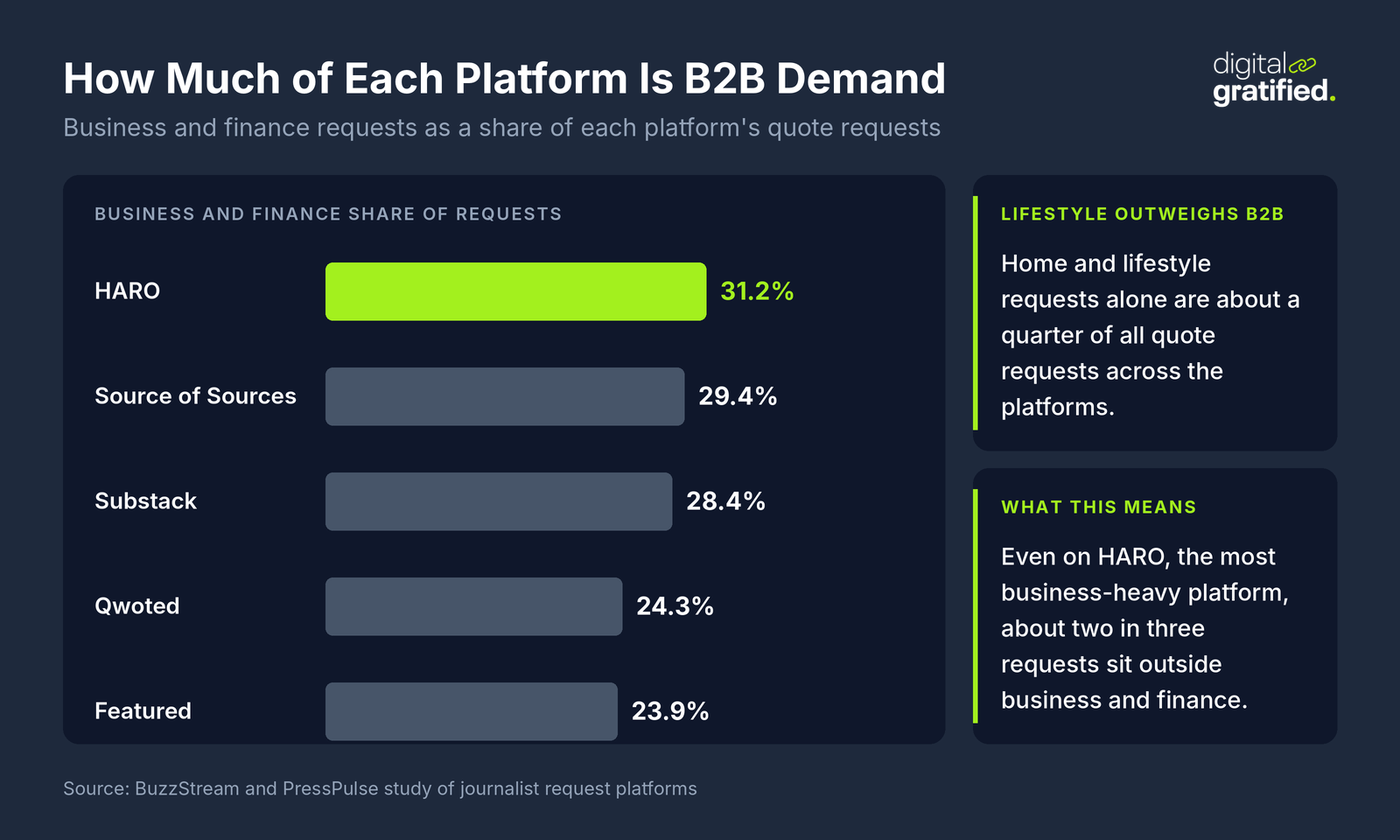
Put those together and the expected yield is modest. A realistic target for one expert answering consistently is a handful of published quotes a month, of which a minority carry a followed link. That is fine, as long as you choose requests by who reads the outlet rather than by its Domain Rating.
Why AI-Written Pitches Fail on HARO
The fastest way to waste this channel is to automate it. Featured analyzed 1,394,740 pitches sent to 42,392 journalist requests across Featured, HARO and Connectively, with detection by Pangram Labs, and published the results in September 2026. About 21% of the pitches were fully AI-generated. Journalists picked roughly 1 in 3 human-written pitches and roughly 1 in 10 fully AI-generated ones. And 35% of more than 2,500 HARO journalists switched on a filter that hides AI-flagged pitches, even though it is off by default.
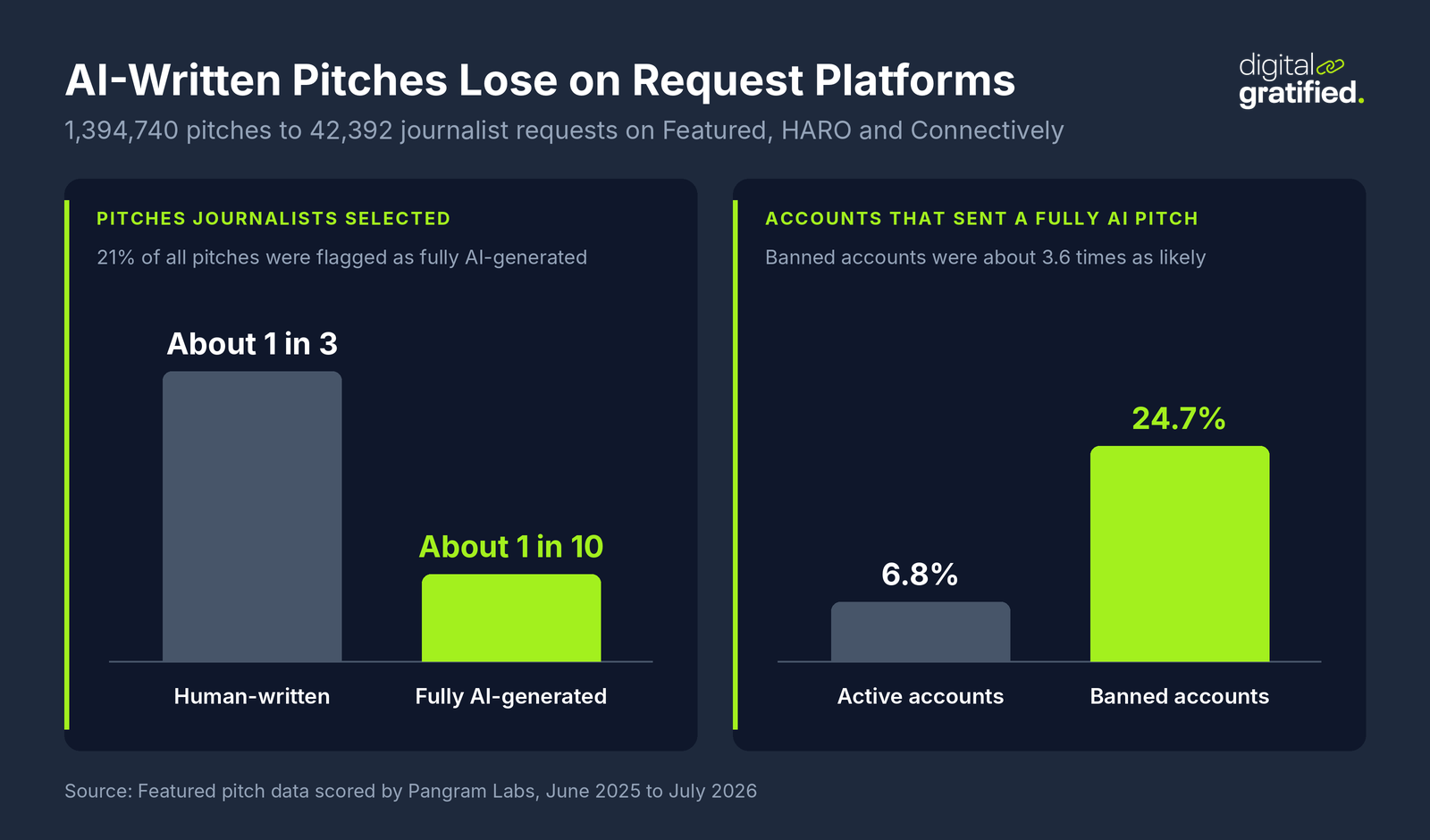
The ban data is the part SaaS teams should take seriously. Banned accounts were about 3.6 times as likely as active ones to have sent a fully AI-written pitch. A ban removes your founder's name from the platform, which is a poor trade for saving twenty minutes. Use AI to find and sort requests if you like; write the answer yourself, from experience no model has.
How to Do HARO Link Building Without Wasting Time
Most guides start with pitch tips. The bigger decision comes earlier: which requests deserve a reply at all. In our experience a good reply takes an expert 15 to 30 minutes, so a team answering everything that loosely matches a keyword will spend hours a week on stories its buyers will never read.
Choose the Expert Before the Platform
Requests are answered by a person, not a brand. Pick one or two people with a credible title and something to say: a founder, a head of product, a data lead or a practitioner who runs the workflow your product supports. Give them a real profile on each platform, with a headshot and LinkedIn link, because the relaunched HARO and its rivals check both. An agency or junior marketer can filter requests and draft logistics, but the substance has to come from the named expert, or it will read like every other reply in the writer's inbox.
Triage Requests by Buyer Fit, Not Domain Rating
Set keyword alerts for the problems your product solves, not for your product category alone, and run each request through the same short test before anyone writes a word. The order matters, and the link comes last.
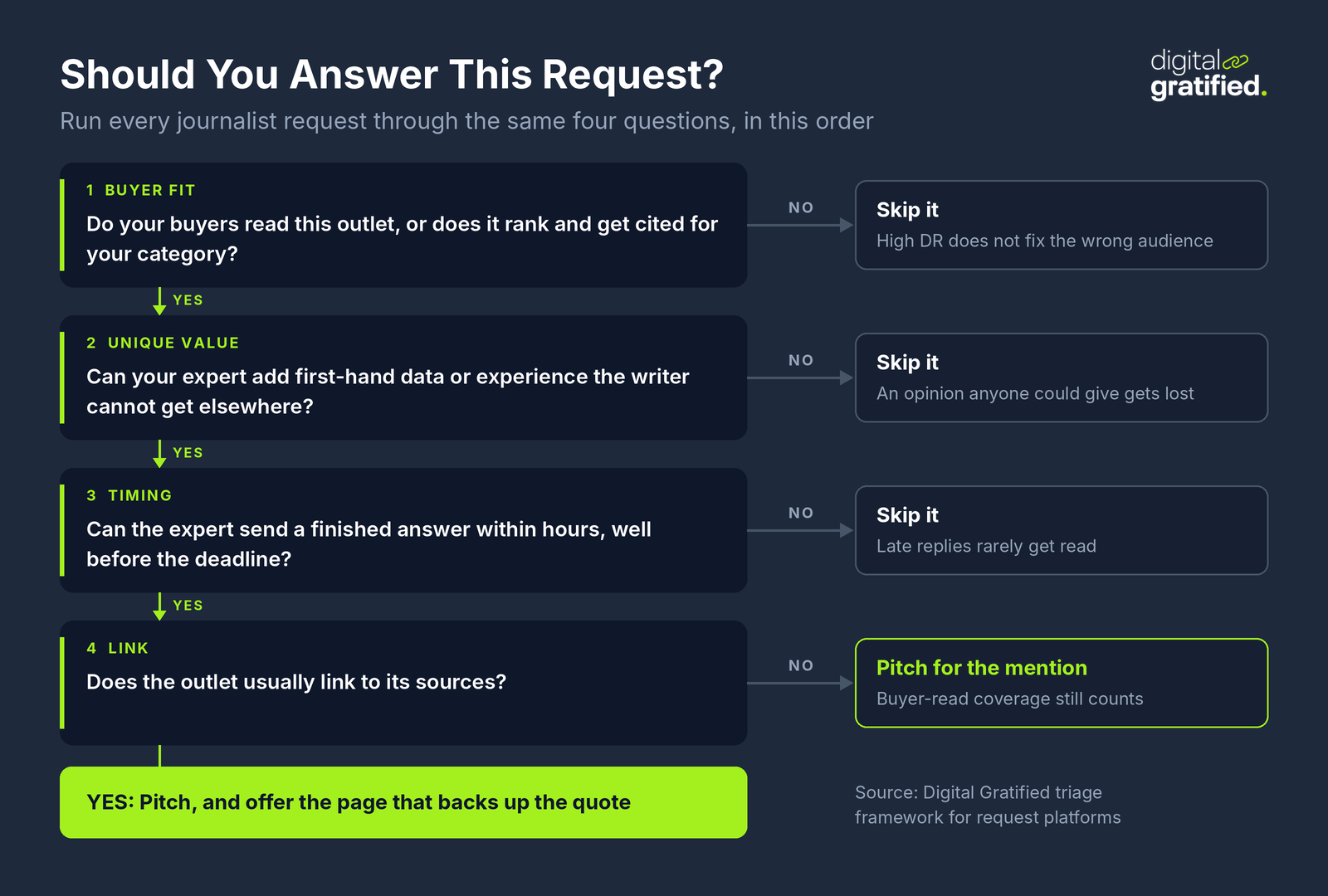
The last branch is the one most teams get wrong. A quote in a trade publication your buyers read is worth answering even when the writer will not link, because it puts your name in front of buyers and in the sources AI assistants draw on. A followed link from a lifestyle site that ranks for nothing in your market is worth very little to a company that sells annual contracts.
Write the Answer First, Then Prove It
Writers skim dozens of replies per request. The ones that get used share the same shape:
- One line of credentials that explains why this person can answer this question: title, company and the relevant experience.
- The answer in the first sentence, phrased so it can be pasted into the article as it stands.
- One piece of evidence the writer cannot get elsewhere: a number from your product data, a named customer pattern you are allowed to share, or a specific example from your own work.
- A short, quotable line of one or two sentences that states a clear opinion when the writer asked for one.
- Attribution details exactly as they should appear, plus the single most relevant URL to cite.
Keep the whole reply under about 200 words unless the request asks for more, answer within hours rather than days, and reply to follow-up questions the same day. Do not ask for a link in the pitch. The writer knows you would like one, and asking makes the reply look like it was written for you rather than for their reader.
Point the Link at the Page That Supports the Quote
Writers link to the page that backs up what you said, not to your pricing page. Offer the research report, benchmark or guide the quote draws on, and make sure that page passes authority on to your commercial pages through internal links. A quote built on a data point from a study you published gives the writer a reason to cite the study, which is why the companies that win most often on these platforms are the ones with original data. The 420 SaaS link profiles we analyzed were published for exactly that reason: a finding other writers can quote.
What Changes for a B2B SaaS Company
Most HARO guides are written by link building agencies for any kind of site, so they count links. A SaaS company should count something else.
Mentions Matter Even Without a Link
Buyers increasingly ask AI assistants which tools to shortlist, and those assistants lean on what reputable publications say about a category. In Ahrefs' study of 75,000 brands, branded web mentions correlated with AI Overview visibility at 0.664, against 0.295 for referring domains and 0.218 for backlinks. That is correlation, not proof, but it changes the math of HARO link building: a quote that names your company in a trusted trade publication has value even when the writer never links. If you want the link as well, you can ask for the missing link on an unlinked mention later, once the article is live. We cover the wider shift in how AI search is changing link building.
The Time Cost Is an Expert Cost
The real price of this channel is the expert's hours, and at a SaaS company those hours belong to someone who also sells, builds or runs a team. Budget it like any other investment: a fixed weekly block, a quarterly review, and a willingness to stop if the placements do not reach buyers. To compare it fairly with other channels, put a pipeline value on each link and each buyer-read mention, then set that against the hours spent.
A Worked Example
Here is a worked example with illustrative numbers. An HR software company asks its head of people analytics to answer requests for one quarter, using HARO, Qwoted's free plan and SOS. She spends about three hours a week and replies to 36 requests that pass the buyer fit test, skipping roughly four times as many that do not. Nine replies are published. Six of the nine articles link to the company; two of those links are followed. On a link count, that is a weak quarter.
Now look at it by audience. Four of the nine placements are in HR and people operations publications the company's buyers read, and two cite the company's annual pay transparency report, which picks up more links on its own afterwards. Sales starts sending those articles to prospects. That is the quarter's real result, and it is why link building for HR software leans so heavily on expert commentary: the buyer reads the trade press before the demo.
Should You Pay for HARO Link Building Services?
A page of search results for this topic is mostly agencies selling HARO placements. Outsourcing the filtering, tracking and logistics makes sense. Outsourcing the expertise does not. If a service writes quotes under your founder's name without your founder's input, you take on three risks: quotes you would not stand behind, a ban from platforms that screen for AI and misuse, and articles that misrepresent your product to the buyers reading them.
The policy line is simple. Paying a platform for faster access to requests is fine, because it buys access, not links. Paying a writer or publication to include a followed link is not: Google's spam policies list "exchanging money for links, or posts that contain links" as link spam. Any vendor promising guaranteed followed links from HARO is either selling something else or relying on outlets that sell placements. Compare those offers with what different link building models cost before you sign.
Expert commentary placements and journalist outreach are part of our Digital PR service: we find the requests and stories that reach a client's buyers, and the client's experts supply the substance. It works alongside earning links instead of building them, with research and guides that writers want to cite.
How to Measure HARO Link Building
Keep one log for every reply: the request, platform, outlet, date, whether it was published, the link type (followed, nofollow or none), the page it points at, and whether the outlet is one your buyers read. Review it monthly and judge the channel on three numbers:
- Buyer-read placements: published quotes in outlets on your target accounts' reading list. This is the headline metric.
- Followed links to supporting pages: the ranking contribution, tracked like any other link and checked a month later to confirm the link survived.
- Reuse: how often sales, social posts and later articles use the placement. A quote nobody reuses had a short life.
After two quarters you will know whether the channel deserves more expert time or less. If it is working, the next step is usually not more replies but more original data, because data turns a quoted expert into a cited source. That is the point where HARO stops being a standalone tactic and becomes part of the backlink types worth building for a SaaS site: editorial coverage that buyers see.
The Bottom Line
HARO link building is alive, but it is an expert commentary channel now, not a link vending machine. HARO is back under Featured, rival platforms carry much of the useful demand, most requests do not promise a followed link, and AI-written pitches get filtered, ignored or banned.
So pick one credible expert, watch three or four platforms, answer only the requests that reach your buyers, and write every reply yourself. Measure buyer-read placements first and followed links second. If you would rather have a team find those stories and shape your experts' answers into coverage, talk to us about Digital PR for your SaaS company.
Frequently Asked Questions
What is HARO link building?
HARO link building is answering journalists' requests for expert sources on HARO (Help a Reporter Out) and similar platforms, so that the published article quotes you and links to your site. The links are editorial, because the writer chooses whether to cite and link to you.
Is HARO still active?
Yes. Cision shut HARO down under its Connectively name on December 9, 2024. Featured.com bought it and relaunched it in April 2025 as a free email digest for journalists and sources, supported by newsletter sponsors.
What are the best HARO alternatives?
The main ones are Featured, Qwoted, Source of Sources (run by HARO's founder Peter Shankman), Help a B2B Writer for B2B topics, and the #journorequest hashtag on X and LinkedIn. Qwoted carries the largest share of high-authority opportunities; Source of Sources and HARO are free.
Are HARO backlinks dofollow?
Some are, most are not promised. In a study of journalist request platforms, only 21.9% of quote requests explicitly offered a followed link. Many outlets link with nofollow, and some quote sources by name without linking at all.
Can I use AI to write HARO pitches?
It is a poor trade. In Featured's data, journalists selected about 1 in 3 human-written pitches but only about 1 in 10 fully AI-generated ones, 35% of more than 2,500 HARO journalists chose to block AI-flagged pitches, and banned accounts were about 3.6 times as likely to have sent one.
Is HARO link building white hat?
Yes, when the link is earned by an answer the writer chose to use. Paying a platform for faster access to requests is fine. Paying a writer or publication for a link that passes ranking credit breaks Google's spam policies, which list exchanging money for links as link spam.
How long should a HARO response be?
Short. Open with one line of credentials, put the answer in the first sentence, add one piece of evidence the writer cannot get elsewhere, and keep the whole reply to about 200 words unless the request asks for more.
About the author
Let's Scale Your SaaS Together
Get a custom SEO and link building strategy tailored for your SaaS business.
Get SEO insights that actually move rankings
Link building tactics, case studies, and SaaS SEO playbooks. No fluff, no spam.
You're subscribed!
SEO and link building insights, straight to your inbox.