Most international SEO advice starts with translation. For SaaS it should start with pipeline: pick the markets you can already sell to, launch them in subdirectories, get hreflang right and localize the pages that convert first.

Founder, Digital Gratified
An international SEO strategy is the plan for which countries and languages your site targets, how those versions are structured, and how you tell search engines which version to show to whom. For a B2B SaaS company, our position is simple: expand into the markets your pipeline already points to, put them in subdirectories on your main domain, and localize the pages that convert before you translate a single blog post.
Most international SEO guides are written for ecommerce stores and publishers, so they start with translation and domains. SaaS has different economics. Every new market means pricing, billing, sales coverage and support, and a localized site that runs ahead of those things produces sign-ups nobody can close. This guide covers when international SEO is worth it for a SaaS company, how to pick markets, which URL structure to use, how to implement hreflang without the errors most sites ship with, what to localize first, and how to measure the result in pipeline. It is one part of our SaaS SEO guide that ties rankings to ARR.
What Is an International SEO Strategy?
International SEO is the work of making one company's site rank in more than one country or language, with each searcher landing on the version written for them. Google separates two cases in its guidance on multi-regional and multilingual sites: a multilingual site offers content in more than one language, while a multi-regional site explicitly targets users in different countries. A SaaS company selling in the US, the UK and Germany is usually both. It needs English for two countries that differ in spelling, currency and legal terms, and German for a third.
A strategy answers four questions in order: which markets deserve their own version, how those versions are organized in URLs, how you signal the relationship between them, and how much of each version you localize. Most failed expansions answer the last question first, translating hundreds of pages before anyone has decided whether the market was worth entering.
It is also different from local SEO. Local SEO helps a business rank in a city or region, through map listings and location pages. International SEO works at the level of countries and languages, and for a software company it rarely involves a map at all.
When Should a SaaS Company Invest in International SEO?
Start when two things are true: search demand from a market already reaches you, and your company can sell to and support customers there. If only the first is true, you will generate trials that churn and demo requests sales cannot take. If only the second is true, you are building a market from zero, which is a bigger bet than most SEO budgets can carry.
Read the Demand You Already Have
Open Search Console, filter performance by country, and look at impressions and average position for your non-branded commercial queries outside your home market. Then pull pipeline by country from your CRM: demo requests, trials and closed revenue for the last 12 months, tagged by billing country. Markets where your English pages already sit on page two and where sales already closes deals are the cheapest to win, because a localized version closes a gap rather than starting from nothing. The same numbers feed an organic pipeline forecast for each market, which is what your CFO will ask to see before approving the spend.
Check That You Can Close Deals There
Before anyone translates anything, run a short readiness check with sales, finance and support. Can you price and bill in the local currency? Do your contract, privacy terms and data residency answers hold up for buyers in that market? Is there a sales rep or partner in a workable time zone, and can support answer tickets in the language you plan to publish in? If the answer to any of these is no, fix it first or pick a different market. SEO amplifies a go-to-market motion. It cannot stand in for one.
How to Choose Target Markets and Languages
For a US-based SaaS company, the first international move is often not a translation at all. The UK, Canada, Australia and Ireland search in English, so you can start with country targeting: English versions that differ in spelling, currency, pricing, compliance pages and customer proof. These are cheap to produce and fast to test, and they teach your team the mechanics of hreflang and localized pricing before you take on a new language.
Language markets come next, and the case for them is stronger than many English-first teams assume. In CSA Research's survey of 1,116 B2B buyers, 66% of business users said they would pay up to 30% more for a localized product, and respondents in Sweden and Germany, where English proficiency is high, were among the most likely to want content in their own language. "Everyone there speaks English" is a reason to skip translating the blog, not the product and pricing pages.
Rank candidate markets on three things you can measure: the organic demand and pipeline you already get from them, the cost of localizing your core pages and your product, and how crowded the local results are with native competitors. Launch one market per quarter at most. A second market started before the first one converts splits the same small team across two half-finished sites.
Which URL Structure Is Best for International SEO?
Google lists four options: country code domains such as example.de, subdomains such as de.example.com, subdirectories such as example.com/de/, and URL parameters, which it does not recommend. It does not say that one structure ranks better than another. It does say that a country code domain gives a strong signal that a site is meant for one country, and that server location is not a definitive signal, so hosting location is a minor decision.
For SaaS, we default to subdirectories. Every new market inherits the authority your main domain has already earned, one CMS and one deployment pipeline serve every locale, and your Search Console and analytics data stay in one property you can filter by folder. A country code domain makes sense when a market expects it, when a local entity already runs its own site, or when legal or brand reasons require separation. Subdomains are the weakest default for most SaaS teams: they split the sites operationally without the clear country signal of a local domain, and Google itself notes that users cannot tell from the URL whether "de" means a language or a country.
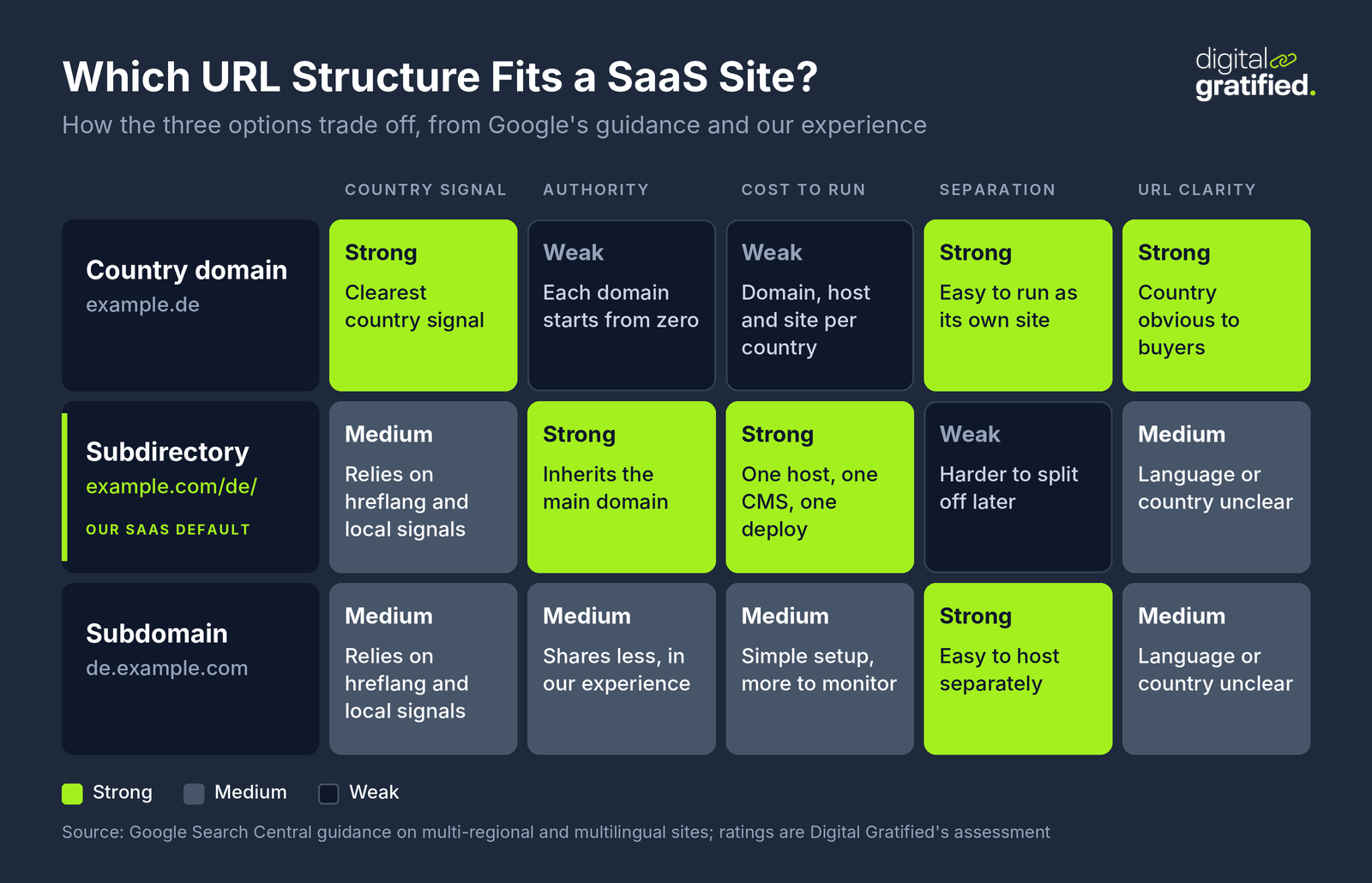
Whichever structure you choose, choose it once. Moving from subdomains to subdirectories later is a full migration, with a redirect map and months of recovery, so if you are already on the wrong structure, plan the change with the same care as any move that changes URLs across a whole site.
How to Implement Hreflang Without Breaking It
Hreflang annotations tell Google which URLs are language or regional versions of the same page, so that a buyer in London sees your en-gb pricing page instead of the en-us one. Google's documentation on telling it about localized versions of a page sets out the rules, and they are strict:
- Every version lists every version, including itself. The German pricing page lists the German, US English and UK English URLs.
- Annotations must be reciprocal. If two pages do not both point to each other, Google ignores the tags.
- Codes follow ISO standards: an ISO 639-1 language code, optionally followed by an ISO 3166-1 Alpha 2 region code. "en-gb" works. "uk" on its own, or a region with no language, does nothing.
- URLs are fully qualified, including https.
- Add an x-default for the page that should catch every searcher you have no version for, usually your main English page or a country selector.
You can place annotations in the HTML head, in HTTP headers or in your XML sitemap. Google treats the three methods as equivalent, so pick one and use it everywhere. On a modern SaaS marketing site, sitemap annotations are often the easiest to keep consistent, because one generated file covers every set.
The rules are short, and most sites still get them wrong. When Ahrefs studied 374,756 domains, 67% had at least one hreflang issue. The failures cluster around a handful of mistakes, and nearly all of them come from pages changing while their annotations stay the same.
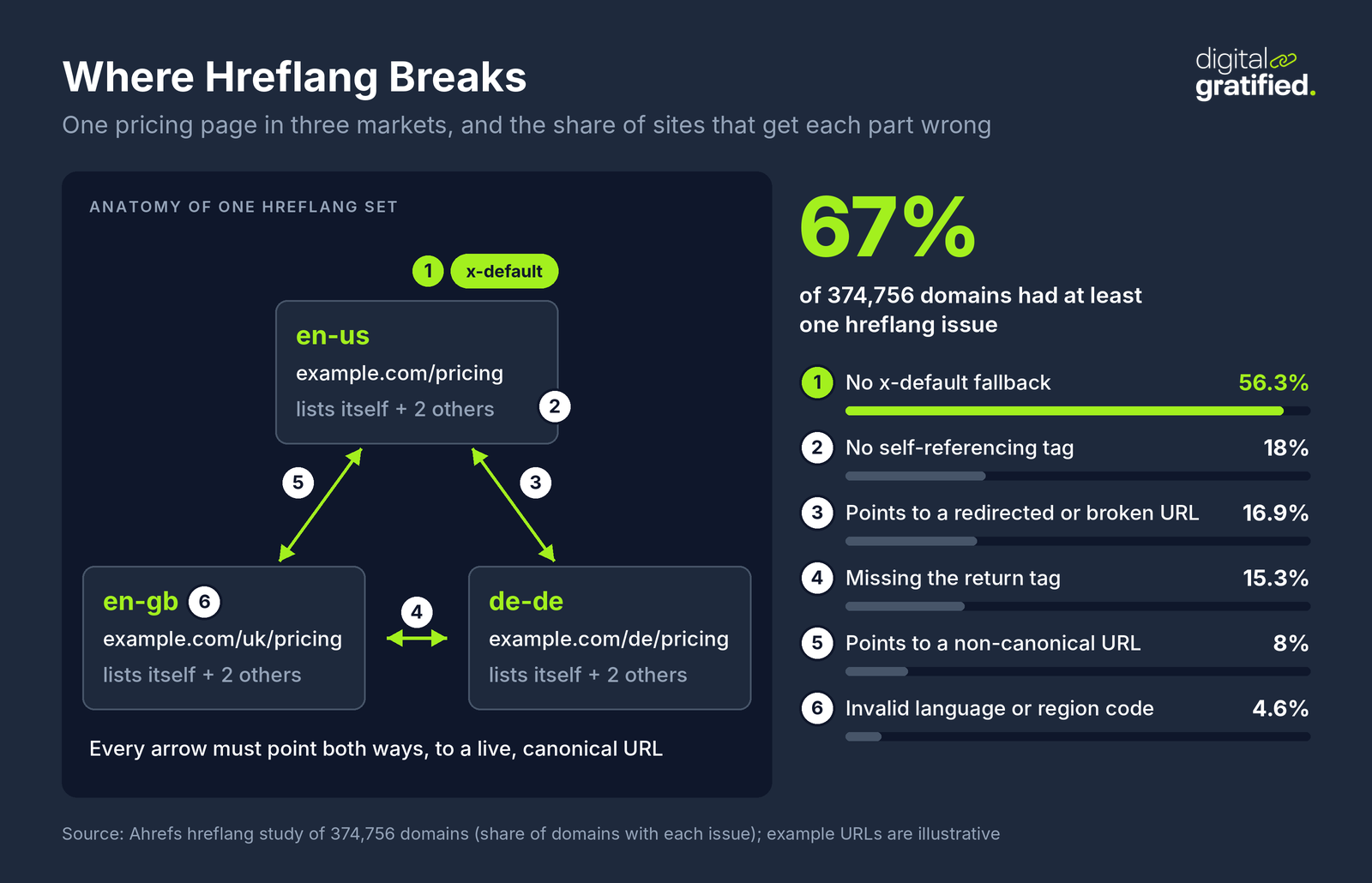
That is why hreflang belongs in your release process, not in a one-time audit. Every time a page is redirected, renamed, canonicalized or unpublished in one locale, its siblings need updating. Add an hreflang check to the recurring technical crawl of your SaaS site, and treat a broken set the way you would treat a broken signup form.
Do Not Redirect Visitors by IP Address
Sending visitors to a locale automatically, based on their IP address or browser language, feels helpful and causes two problems. Google says it does not vary its crawler's location to discover your versions, so automatic redirects can hide localized pages from it. And B2B buyers travel, use VPNs and forward links to colleagues in other offices. Google calls IP location analysis "generally not reliable" and recommends visible links that let people switch versions themselves. Show a banner that suggests the local version, and let the visitor choose.
What to Localize First on a SaaS Site
Localization depth is where SaaS budgets disappear. The instinct is to translate the whole site, blog included, because that is what the CMS plugin makes easy. But the pages that create pipeline are a small share of most SaaS sites, and they are the ones a buyer in a new market judges you by. This is the order we recommend:
| Page type | When to localize | What changes beyond language | Why it matters |
|---|---|---|---|
| Homepage and core product pages | At launch | Local customer proof and the integrations that market uses | First impression for buyers arriving from search |
| Pricing page | At launch | Currency, tax display, billing terms | The page closest to a buying decision |
| Demo and trial flows | At launch | Form fields, routing to local sales, time zones | Where pipeline is created |
| Security, privacy and compliance pages | At launch | Local regulation, such as GDPR in the EU, and data residency | Procurement checks these before signing |
| Comparison and alternatives pages | Within the first quarter | Local competitors, not only US ones | High intent from buyers already comparing vendors |
| Top use case and integration pages | Within the first quarter | Local search terms and examples | Captures mid-funnel demand |
| Blog and guides | Selectively, later | Rewritten for local search demand, not translated | Worth it only where local keyword research shows demand |
| Docs and help center | When support covers the language | Product terms that match the localized interface | Supports retention more than acquisition |
The first four rows are the minimum viable market. A localized homepage that hands the buyer an English pricing page in dollars and a demo form routed to a rep eight hours away tells them you are not serious about their market.
Research Keywords in Each Market, Do Not Translate Them
A translated keyword list is a list of guesses. German buyers may search for the English category term, a German compound, or both, and the split differs from one software category to the next. Run keyword research natively, with your tool's country and language set to the market, and have a native speaker who knows your category review the target terms before anyone writes. The goal of international keyword research is to find the words buyers in that market use, which are often not the words a translator would pick.
Machine Translation Is Fine; Unreviewed Translation at Scale Is Not
AI translation has made a first draft of a localized page cheap, and that is useful. The risk is publishing hundreds of pages of it without review. Google's spam policies list scaled content abuse, including generating many pages through "automated transformations like synonymizing, translating, or other obfuscation techniques" where little value is provided to users. A reviewed, localized pricing page is not that. A thousand auto-translated blog posts that nobody in the market searched for can be.
Keep each page in one language, too. Google works out a page's language from its visible content, not from the lang attribute or the URL, so a page with translated navigation wrapped around an English body sends mixed signals to searchers and to Google alike.
How to Build Authority in Each Market
A subdirectory inherits your domain's authority, but it still needs signals that it belongs in its market. Google lists links from local sites, along with local addresses, phone numbers, language and currency, among the signals it uses to understand a page's audience. For SaaS that means local coverage: trade publications in that market, regional partner and integration directories, case studies with local customers who link back, and speaking slots at local events. We cover how to plan that work in our guide to country-by-country link building for SaaS.
Internal links matter as much as external ones. Each locale folder needs its own navigation and hub pages that keep readers and crawlers inside the same language, using the same hub-and-cluster internal link model you use at home. A German page whose body links send readers back to English guides leaks attention out of the locale and thins the folder's depth on the topics it targets.
How AI Search Changes International SEO
AI answers are now international as well. In October 2025, Google launched AI Mode in more than 35 new languages and over 40 new countries and territories, which brought it to over 200 countries and territories. At the end of October 2026 it began showing ads in AI Mode in ten more countries, including Australia, Canada, India and Singapore, with Brazil, Mexico and the UK planned for the fourth quarter. Commercial searches in those markets are moving into AI answers the same way they have in the US.
For a SaaS brand, that works the same way abroad as at home: assistants recommend vendors that trusted sources name, and they answer in the language of the question. A buyer who asks in German gets an answer assembled from German-language pages and coverage. If your only German presence is a translated homepage, you are unlikely to be the vendor it suggests. Localized comparison pages, local press mentions and local customer proof are what get you into those answers, and they are the same assets that rank. We go deeper on this in our guide to optimizing a SaaS site for AI answers and classic rankings.
How to Measure International SEO
Measure each market as its own business line. In Search Console, filter by country and by locale folder to see impressions, clicks and positions for non-branded commercial queries. That is one more reason subdirectories are easier to run. In your analytics and CRM, attribute demo requests, trials and closed revenue to the locale of the landing page, not only to the visitor's country, so you can tell whether the German pages or the English ones started the deal.
Then hold each market to the same SEO KPIs that connect search to revenue you use at home. Expect long-tail and comparison terms to move before head terms. Review every market each quarter against its forecast, and stop adding pages to a market whose pipeline has not moved after two quarters.
A Worked Example: A US SaaS Company Expands to Germany
Here is a worked example with illustrative numbers. A US workflow automation company sells mostly in North America. Search Console shows its English pages already earning impressions in Germany for several commercial queries at an average position of around 15, and its CRM shows a steady trickle of German demo requests that sales closes in English, at a lower win rate than at home.
Germany passes both tests: there is demand, and a Berlin-based account executive plus euro billing mean deals can close. The team launches example.com/de/ with eight pages: the homepage, two product pages, pricing in euros, a demo flow routed to the German rep, a security page covering GDPR and EU data hosting, and two comparison pages against the local competitors German buyers named on sales calls. A native-speaking marketer rewrites machine-translated drafts against German keyword research. Hreflang goes into the sitemap for en-us, de-de and x-default, and the German folder joins the monthly crawl.
After two quarters, the team compares German non-branded impressions, demo requests from the /de/ folder, and the win rate on those deals against German deals that came through the English site. If the folder produces more qualified demos and a better win rate, it earns use case pages and selected guides next. If it does not, the team has spent eight pages, not eight hundred, finding out.
The Bottom Line
An international SEO strategy for SaaS is a go-to-market decision first and a technical project second. Pick the market your pipeline already points to, confirm you can sell and support customers there, and launch it in a subdirectory with hreflang that your release process keeps correct. Localize the pages that create pipeline, prove the market converts, then go deeper.
If you want help with that groundwork, talk to us about our SaaS SEO services, which start with a technical audit and buyer-intent keyword mapping before any new pages get written.
Frequently Asked Questions
What is an international SEO strategy?
It is the plan for which countries and languages your site targets, how each version is organized in URLs, how you tell search engines which version to show to whom (usually with hreflang), and how much of each version you localize. For SaaS it should start from where your pipeline already comes from.
Is a subdirectory or a country code domain better for international SEO?
Google does not say one ranks better than the other. A country code domain such as example.de sends the clearest country signal but starts with no authority and costs more to run. A subdirectory such as example.com/de/ inherits your main domain's authority and runs on one CMS, which is why it is our default for most SaaS companies.
Do I need hreflang for an international site?
If you have more than one language or regional version of the same page, yes. Hreflang tells Google which URL to show in each market, which matters most for same-language versions such as US and UK English. Every version must list itself and every other version, and the tags must be reciprocal or Google ignores them.
What is x-default in hreflang?
x-default marks the page Google should show to searchers whose language or country you have no version for, usually your main English page or a country selector. In Ahrefs' study of 374,756 domains, 56.3% were missing it, which made it the most common hreflang issue.
Should I redirect visitors to their country version automatically?
No. Google advises against automatic redirects based on IP address or browser language, because they can stop users and Google from reaching all your versions. Show a banner that suggests the local version and let the visitor choose.
Can I use machine translation for international SEO?
Yes, as a first draft that a native speaker reviews and localizes. Publishing many automatically translated pages that add little value can fall under scaled content abuse in Google's spam policies.
How long does international SEO take to show results?
Long-tail and comparison terms usually move before competitive head terms, and a new locale on an established domain starts with an advantage over a new country domain. Judge each market on qualified demos and win rate after two quarters, not on traffic after two weeks.
About the author
Let's Scale Your SaaS Together
Get a custom SEO and link building strategy tailored for your SaaS business.
Get SEO insights that actually move rankings
Link building tactics, case studies, and SaaS SEO playbooks. No fluff, no spam.
You're subscribed!
SEO and link building insights, straight to your inbox.