Learn how to find and qualify unlinked brand mentions, request useful backlinks, verify placements, and monitor brand visibility in AI-generated answers.

Founder, Digital Gratified
Brand mentions are one of the easiest link building wins available, because someone has already written about your company. They've explained your product, quoted your research, or recommended you in a software roundup. The only thing missing is a link readers can follow.
Turning unlinked brand mentions into backlinks is far easier than asking a stranger to add your business to an unrelated article. The mention already has a reason to exist. Your job is to find it, decide whether a link would help, and make the editor's next step easy. Here's a repeatable outreach process for doing exactly that, without treating every mention as a backlink you're owed.
What Are Brand Mentions?
Brand mentions are references to a company's name, products, or recognizable brand identifiers on websites, social platforms, forums, and other channels. A linked mention includes a clickable link to the brand's site. An unlinked mention names the brand without that link, creating a potential outreach opportunity when a reference would help readers.
Consider a fictional project-management app called TaskHarbor. A blogger writes, “TaskHarbor works well for small agency teams.” If the name points to the app's website, that's a linked mention. If it's plain text, it's unlinked.
Both provide exposure. Only the first creates that particular backlink.
Not every mention is a link prospect, though. A private community comment, an image containing your name, or an inaccessible social post may matter for reputation management without offering an editable editorial link.
Why Brand Mentions Matter for SEO
The useful way to think about brand mentions for SEO is to separate visibility from links.
A mention can introduce your business to a relevant audience or reinforce familiarity. When a publisher adds a useful link, readers get a direct route to your product or evidence. That link also becomes part of your backlink profile.
An unlinked mention isn't equivalent to a backlink, and counting mentions won't tell you how much ranking value you've gained. The value of backlinks depends on context, not just totals.
Independent coverage can also give readers evidence of your reputation. But don't turn E-E-A-T into a score you expect mentions to increase. Google's people-first content guidance explains that E-E-A-T itself isn't a specific ranking factor.
Domain authority is another useful distinction: it's a third-party metric, not a Google metric. Use it as supporting context, never as permission to ignore a site's audience or editorial quality.
Mention reclamation fits into a SaaS link-building strategy alongside original research, PR/earned media, and useful resources. Its opportunity pool depends on how often people already discuss your business.
How to Find Unlinked Brand Mentions
Start with names people actually use
List your company name, product names, former names, common misspellings, and distinctive research titles. Add founders' names only when the coverage clearly connects them to your business.
If your name is also an ordinary word, pair it with a product category or another identifying term. Otherwise, your queue will fill with unrelated results.
Combine manual searches with Google Alerts
For the fictional app, try searches such as:
"TaskHarbor" -site:taskharbor.example"Task Harbor" "project management""TaskHarbor" "agency"
Quotation marks focus the search on a phrase; the exclusion removes your own domain. These queries find candidates, not a certified list of unlinked pages.
Open results, locate the mention, and check whether it already links to you. Search snippets can be stale. Also check the surrounding paragraph and the rest of the page for an existing citation.
Set up Google Alerts for your main name and a few distinctive variants. Choose a manageable delivery frequency, then test and refine the queries. Alerts help surface new results but aren't an exhaustive historical index or a complete feed of social activity.
Use manual searches to build the initial backlog. To monitor brand mentions over time, review alerts on a regular schedule and add qualified results to the same queue.
Add a paid tool when review time grows
A brand mention tool is useful when manual checking becomes the bottleneck. Some content discovery tools, for example, support searching web content and highlighting unlinked domains. Treat that as a shortlist: a domain-level flag still needs a page-level check.
Dedicated brand monitoring and social listening tools serve a broader purpose, including sentiment, conversations, and customer issues. Before paying, test whether their coverage includes the publications and channels your buyers actually use.
Assess export options, duplicate handling, historical coverage, and query limits. Don't choose a subscription based on the largest raw mention count.
Keep one qualification sheet
Use these columns:
| Field | What to record |
|---|---|
| Source | Page URL, title, publisher, date found |
| Context | Exact sentence mentioning the brand |
| Link check | Unlinked, linked here, linked elsewhere, uncertain |
| Fit | Relevant audience and useful destination |
| Contact | Author or responsible editor |
| Progress | Queued, contacted, followed up, declined, linked |
| Verification | Live destination, link attributes, date checked |
Assign one owner to each opportunity. Remove duplicate URLs and group pages from the same publisher before anyone starts emailing.
How to Turn a Brand Mention Into a Backlink
1. Decide whether the link deserves to exist
Prioritize a relevant article with accurate coverage, a reachable editor, and a clear benefit for readers. A recent product comparison mentioning a specific feature is usually more promising than a scraped directory entry.
Ask: would this link still make sense if search engines didn't exist?
If the answer is no, skip it. Also skip private posts, unrelated namesakes, and pages that look like link-selling inventory.
A negative review needs judgment, not an automatic link request. If it contains a factual error, address that transparently first. Don't use a correction request to pressure someone into linking.
2. Choose the page that completes the reference
Match the destination to what the author discusses:
- General company introduction: your homepage.
- Specific capability: the relevant product or feature page.
- Statistic from your study: the original research.
- Quoted expert guidance: the source article or author resource.
Check that the destination loads, is publicly accessible, and supports the sentence. Don't send a pricing page when readers need methodology.
Keep the existing brand name as the anchor text when it fits. Readable, descriptive wording beats a forced commercial keyword.
3. Reach the person who can edit it
Start with the author byline or the publication's editorial contact page. If it's an older article, the current section editor may be a better choice than the original writer.
Avoid emailing several people at the same publication simultaneously. It creates duplicate work and makes a modest request feel like a campaign they need to escape.
Record how you found the business contact and respect opt-outs. A short, relevant message is more useful than a long introduction to your agency.
4. Send a specific, low-friction request
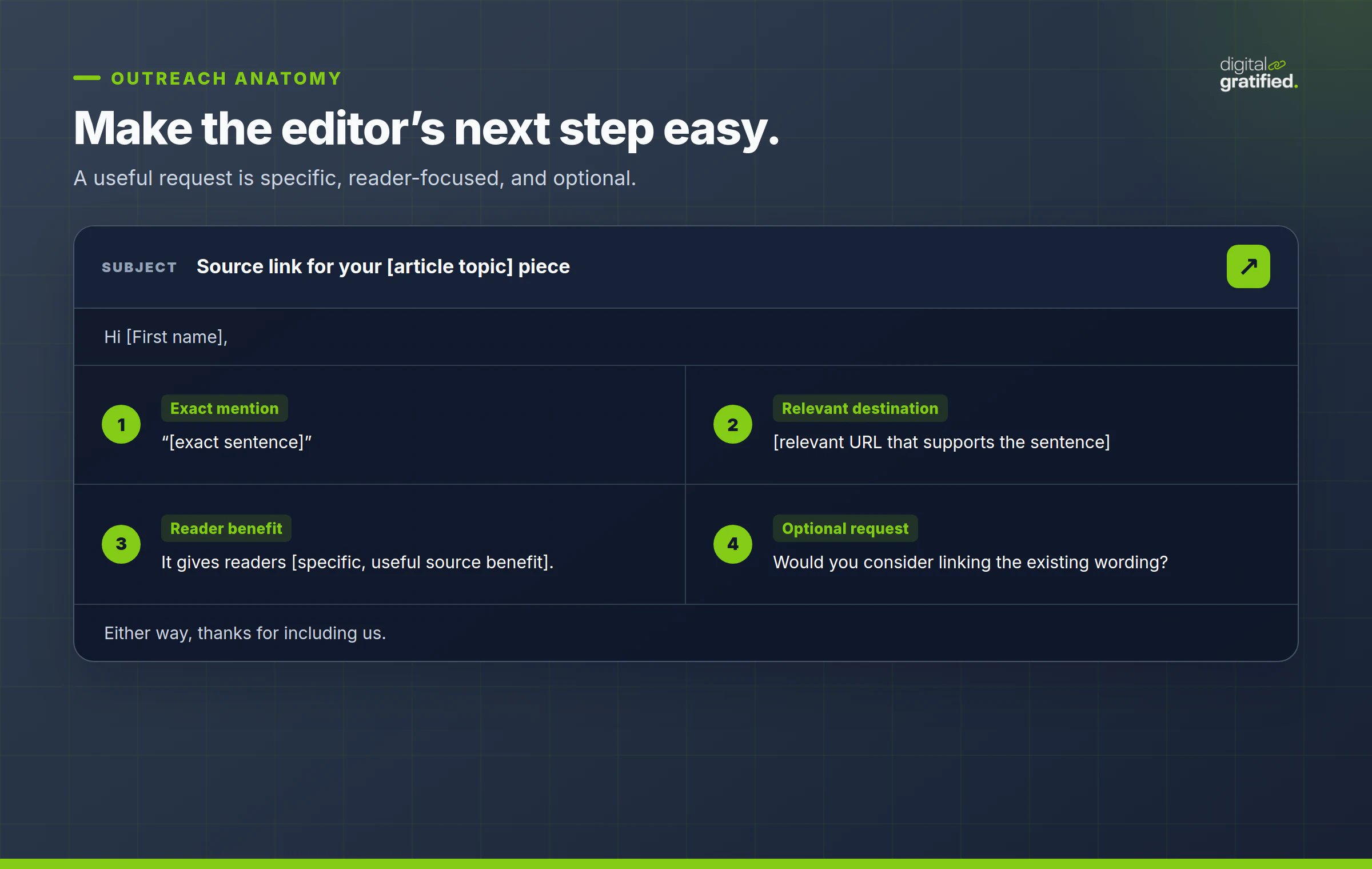
Your message should identify the article, quote the relevant passage, suggest one destination, and explain why a reader would use it.
Here's a template you can adapt:
Subject: Source link for your [article topic] piece
Hi [First name],
Thanks for mentioning [Brand] in “[Article title].”
In the section about [specific topic], you wrote: “[exact sentence].” Would you consider linking [existing brand name or source wording] to [relevant URL]?
It gives readers [specific benefit, such as the original study and its methodology], which supports that reference.
Happy to answer any questions about the source. Either way, thanks for including us.
[Name]
[Role], [Brand]
Replace every bracketed field. If you can't supply a specific reader benefit, reconsider the request.
Don't describe the omission as an error unless it actually is one. A publisher can mention a company without linking to it. Effective link-building outreach gives the editor a useful reason to add a link, rather than relying on clever subject lines.
5. Follow up once, then close the loop
As a practical starting cadence, wait about a week before sending one brief follow-up. That's a workflow recommendation, not an industry success benchmark.
Reference the original note, restate the useful destination, and leave room for a no. If there's no reply after that, mark the opportunity closed rather than creating an endless sequence.
If the editor requests payment, don't treat the placement as an ordinary earned link. Google's link spam policies distinguish manipulative paid links from advertising links appropriately qualified with attributes such as rel="sponsored" or rel="nofollow". Don't demand an unqualified link.
6. Verify the link before counting it
An affirmative reply isn't a live backlink. Revisit the source page, click the link, confirm the destination, and inspect its attributes.
Record redirects, broken destinations, and any nofollow or sponsored qualification. Such links may still help readers discover you, but don't report them as guaranteed ranking gains.
Track qualified opportunities, unique publishers contacted, replies, and verified live links separately. For a simple conversion measure, divide verified placements by contacted opportunities from the same campaign cohort.
Then review referral visits and useful business outcomes where measurement is available. A smaller number of relevant placements can be more useful than a spreadsheet full of weak ones.
Should you handle mention outreach in-house or hire help?
If you only find a few relevant mentions each month, an alert, a spreadsheet, and someone who knows your product may be enough. Start there before paying for tools or an ongoing service.
Outside support becomes worth considering when mentions arrive faster than your team can review them, several products need monitoring, or qualified opportunities sit untouched because nobody owns outreach. Compare the cost of support with the time your team spends finding contacts, personalizing requests, following up, and checking placements.
Before hiring a link-building agency, ask what the service includes:
- Discovery and qualification: Will they verify each mention and explain why a link would help readers?
- Outreach ownership: Who approves messages, handles replies, and prevents duplicate contact?
- Reporting: Will you see source URLs, destinations, link attributes, and verified placements rather than just activity totals?
- Scope and fees: Is mention reclamation included, and what happens if there aren't enough suitable opportunities?
Be cautious with guaranteed link quotas or ranking promises. Publishers control whether they add a link; a provider should be clear about the work you're buying and the outcomes it can't promise.
If outside help fits your workload, get link-building support from Digital Gratified.
Why AI Brand Mentions Matter Now Too
AI brand mentions are appearances of your company or product in AI-generated answers, including Google AI Overviews and conversational assistants. They're worth watching because a buyer may encounter a recommendation before visiting any supplier's website.
Keep three things separate: being named, being cited as a source, and receiving a clickable link. An answer can mention your product without citing your site. A citation might point to a third-party review instead.
There's no dependable formula where a set number of mentions produces AI recommendations. Google's guidance on AI features says existing SEO fundamentals remain relevant and that no special AI markup or dedicated schema is required for those features. That guidance describes Google, not every LLM.
For monitoring, choose a small, repeatable set of buyer questions. Record the platform, date, prompt, response, and cited URLs. Repeat observations because answers vary with context, product changes, and retrieval.
Look for inaccurate descriptions and gaps in accessible product information. Publish clear feature explanations, attributable research, and evidence that supports your claims. These resources help people and publishers evaluate you; they don't guarantee an AI citation.
As AI search changes how people discover brands, measure where you're being mentioned as well as where you're earning links. Useful editorial backlinks still belong in the picture.
Common Mistakes to Avoid When Tracking Brand Mentions
Counting alerts instead of opportunities. Syndicated copies, repeated social posts, and namesakes inflate totals. Deduplicate before assigning outreach.
Confusing domain-level and page-level checks. A site might link to you somewhere else while the relevant article remains unlinked. Open the actual page.
Chasing metrics over relevance. A high domain authority score doesn't make an unrelated placement useful.
Turning every mention into a demand. Editors owe you neither a backlink nor your preferred anchor text. Respect their judgment.
Mixing monitoring goals. Customer complaints belong in a support or reputation workflow. Editorial citations belong in the link-opportunity queue.
Forgetting to recheck. Pages change. Review important placements periodically and keep your destination URLs working.
The goal isn't to turn every mention into a link. It's to make the worthwhile references easier for readers to follow.
Frequently Asked Questions
What are brand mentions?
Brand mentions are references to your company, product, or recognizable brand identifiers online. They can appear in articles, reviews, forums, social posts, and AI-generated answers. A mention may include a backlink, but the two aren't interchangeable.
How to track brand mentions?
Combine Google Alerts and manual searches with a paid monitoring tool if you need broader coverage. Track name variants, remove duplicates, review context, and record link status in one sheet. Keep social conversations, editorial opportunities, and AI-answer observations in separate categories.
How can I find unlinked brand mentions?
Search for your brand name in quotation marks while excluding your own domain, then open each result and check whether the relevant mention links to your website. Use alerts for new results and a content-discovery tool to expand the shortlist, but verify each candidate manually before outreach.
About the author
Let's Scale Your SaaS Together
Get a custom SEO and link building strategy tailored for your SaaS business.
Get SEO insights that actually move rankings
Link building tactics, case studies, and SaaS SEO playbooks. No fluff, no spam.
You're subscribed!
SEO and link building insights, straight to your inbox.