Tiered link building stacks links behind your backlinks to push authority down a chain. Here is how it works, what Google's spam policies say about each tier, and the cleaner way SaaS teams strengthen a tier 1 link.

Founder, Digital Gratified
Tiered link building is the practice of building links to the pages that already link to you: tier 2 links point at your tier 1 backlinks, tier 3 links point at tier 2, and the authority is supposed to flow down the chain into your site. It still gets sold, but for a B2B SaaS company everything below tier 1 is link spam under Google's own definition, it brings no buyers, and it decays faster than the links it is meant to protect.
Our position is simple: buy or earn one tier of links, on publications your buyers read, and make those placements stronger with methods Google has no problem with. This guide explains how tiered link building works, what each tier usually contains, what Google's spam policies say about it, why the economics fail for SaaS, and what to do instead when a good placement is not moving rankings.
What Is Tiered Link Building?
Tiered link building is a layered link structure. Your site sits at the center. Tier 1 links point directly at your site, usually from guest posts, niche edits or articles on third-party sites. Tier 2 links point at those tier 1 pages instead of at you. Tier 3 links point at the tier 2 pages, and some sellers stack a fourth layer. Draw it out and you get the shape people call a link pyramid.
The idea grew popular after Google's Penguin update made it dangerous to point large volumes of low-quality links straight at a money site. Tiered builders kept the volume but moved it one step away, on the theory that Google would judge the clean tier 1 link and pass along the authority piled up behind it, while any penalty would land on the buffer pages rather than on the client.
Tier 1, Tier 2 and Tier 3 Links
Here is what each tier usually contains when an agency or marketplace sells a tiered package, set against the wording of Google's spam policies for web search:
| Tier | Points to | What sellers typically use | How Google's link spam policy describes it |
|---|---|---|---|
| Tier 1 | Your site | Guest posts, niche edits, sponsored articles, sometimes self-built blogs | Fine when editorial; paid placements that pass ranking credit count as "buying or selling links for ranking purposes" |
| Tier 2 | Your tier 1 pages | Web 2.0 blogs, article directories, cheaper guest posts, private blog networks | "Creating low-value content primarily for the purposes of manipulating linking and ranking signals" |
| Tier 3 | Your tier 2 pages | Blog comments, forum profiles, bookmarks, links made with automation software | "Using automated programs or services to create links", "low-quality directory or bookmark site links", "forum comments with optimized links" |
Read the right-hand column and the problem is plain. Tier 1 can be legitimate. Below that, the link types match Google's examples of link spam almost word for word. The policy's definition also covers "creating links to or from a site primarily for the purpose of manipulating search rankings", which does not require the links to point at your domain directly. Links built to boost a page that links to you are still built to manipulate your rankings.
How Tiered Link Building Is Supposed to Work
The case for tiers rests on three claims, and each one is worth testing before you pay for it.
Claim 1: More Authority Flows to Your Site
Links pass authority from page to page, so a tier 1 article with more links pointing at it should pass more to you. That part of the theory is sound; it is how a backlink passes authority from one page to another. The flaw is in what gets counted. Google says it uses SpamBrain to neutralize the impact of unnatural links, so a thousand automated tier 3 links do not add a thousand units of anything. They add a pattern for it to find.
Claim 2: The Buffer Protects Your Site
The second claim is that spam sitting two steps away cannot hurt you. Google's systems look at the network, not only at the final hop. In its December 2022 link spam update, Google said SpamBrain can now detect both sites buying links, and sites used for the purpose of passing outgoing links, and that credit passed by unnatural links is lost. A tier 1 page with hundreds of junk links pointing at it is the kind of site that sentence describes.
Claim 3: It Is Cheaper Than Good Links
Tier 2 and tier 3 links are cheap per unit because they are low quality, and that is the whole cost model. You pay a premium for one tier 1 placement, then pay again for volume that Google is designed to ignore. Cheap links that count for nothing are not cheaper than one good link; they are an extra line on the invoice.
What Google's Spam Policies Say About Tiered Links
Google has never published a policy titled "tiered link building", and some sellers use that gap as cover. The link spam section does not need a separate entry. Its examples cover the tactics that fill tiers 2 and 3: buying links for ranking purposes, automated link creation, low-quality directories and bookmarks, optimized forum comments and low-value content made to manipulate linking signals.
Three enforcement routes matter for a SaaS site:
- Algorithmic neutralization. SpamBrain discounts links it judges unnatural. You will not get a message; the links simply stop counting, which means you keep paying for a structure that does nothing.
- Manual actions. Google's manual action report lists "Unnatural links to your site", issued when it detects "a pattern of unnatural, artificial, deceptive, or manipulative links pointing to your site." The same report has an "Unnatural links from your site" action for sites that pass outbound links, which is the publisher's risk when you point spam at their article.
- Site reputation abuse. Tier 1 posts are often parked on large platforms because their authority is borrowed. The spam policies describe that as third-party content published on a host site "mainly because of that host's already-established ranking signals", and those pages can lose visibility under human review.
Google's own staff have been blunt about the tier 2 staples. Asked about posting links on free Web 2.0 platforms, John Mueller said this kind of activity "has zero value for SEO" and that a site owner whose agency did it should switch to a different agency.
Recent updates point the same way. Google's September 2026 spam update ran for about two weeks and finished on October 8, and it was not a link spam update. Our read: link spam is now handled continuously by SpamBrain rather than in announced waves, so "nothing happened after the last update" tells you nothing about whether your tier 2 links count.
Does Tiered Link Building Still Work in 2026?
Sometimes, briefly, in low-competition niches, and that is what sellers screenshot. A page with few competitors can move on almost any new link signal until Google's systems catch up. For a B2B SaaS company the question is different: does it work better than putting the same budget into tier 1 placements that also reach buyers? We have not seen a case where it does, for four reasons.
Tier 2 Links Bring No Buyers
Nobody in your buying committee reads a Web 2.0 blog built to pass links to a guest post. A tier 1 article on a publication your buyers read can send referral visits, get quoted in a sales deck and show up when a prospect researches your category. A tier 2 link can do none of that. Its only job is to move a ranking signal, and if the signal is neutralized, its value is zero. That is the opposite of how to value a backlink in pipeline terms, where referral traffic and brand exposure are part of the return.
You Put the Publisher at Risk
The best tier 1 links for SaaS sit on trade publications, partner blogs and industry sites that took months to win. Pointing spam at their article makes their page look like a node in a link scheme, which is exactly the outbound link pattern Google penalizes publishers for. If an editor notices, the cheapest outcome is a removed link. The expensive one is a burned relationship with a publication your buyers trust.
Every Tier Multiplies Link Decay
Links die. In Linkody's analysis of more than 865,000 monitored backlinks, 89% were still live after three months, around 63% after a year and 31% after five years or more. Links on weak sites fare worse: only 33% of links on sites under Moz DA 10 were still live, against about 70% on DA 30 to 49 sites. Tier 2 and tier 3 links live almost entirely on that weak end.
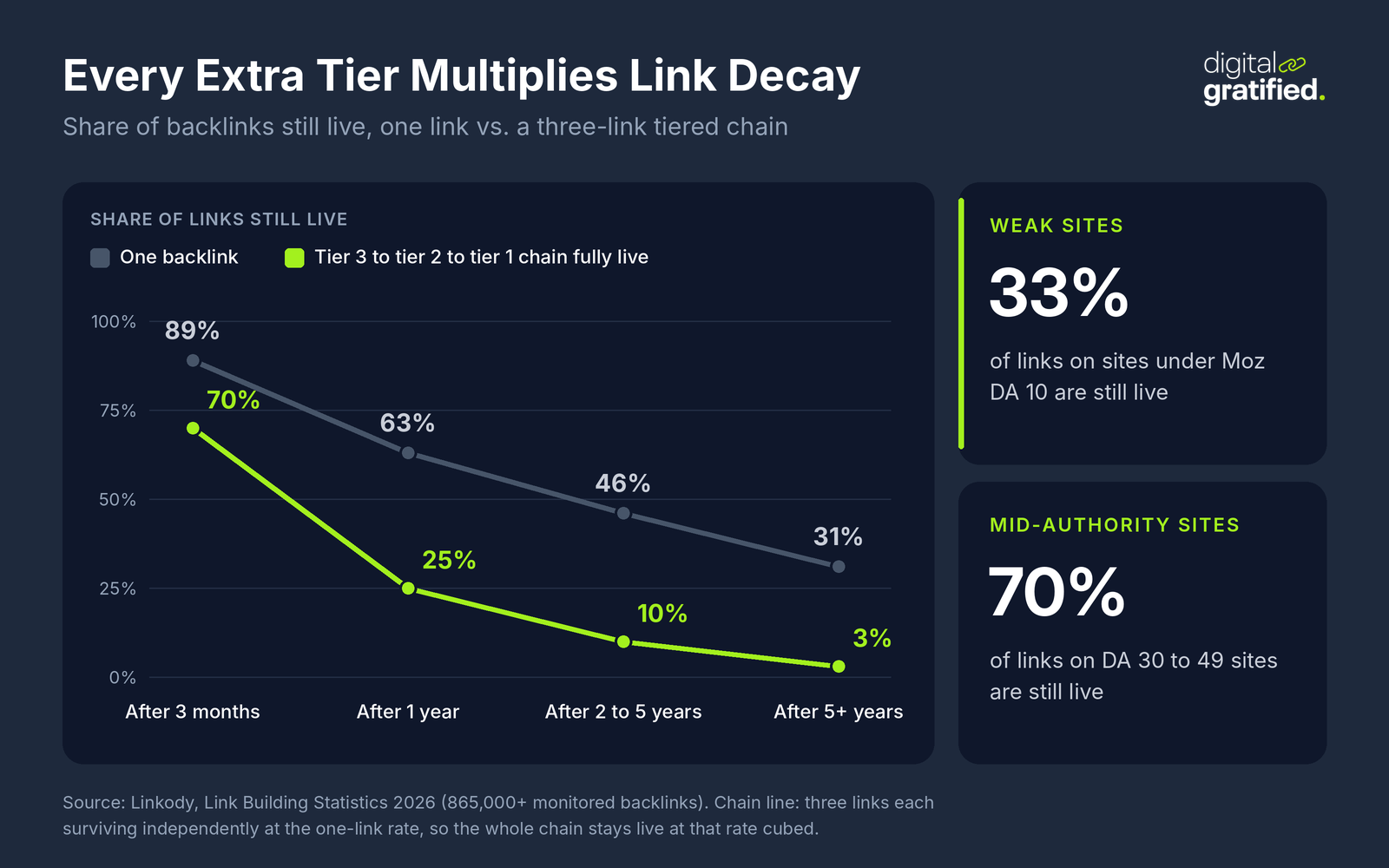
A chain only passes value while every link in it is live, so its survival is the product of each link's survival. Even at the survival rate of an average link, a three-link chain is fully intact about a quarter of the time after one year. Built on DA 10 sites, it is worse. You end up paying for maintenance on a structure that keeps breaking, when the same effort spent tracking every placement after it goes live would protect the one link that matters.
AI Search Rewards Mentions, Not Link Chains
More SaaS buyers now meet vendors inside AI answers before they reach a results page. In Ahrefs' study of 75,000 brands, branded web mentions had a 0.664 correlation with visibility in AI Overviews, against 0.218 for the raw number of backlinks and 0.295 for referring domains. A tier 2 network adds link count and no brand mentions on sites anyone reads. Editorial tier 1 coverage adds both. Correlation is not causation, but the direction is clear enough to plan around.
Tiered Link Building vs. Editorial Link Building
Put the two approaches side by side and the trade-off is not close for a company that sells on annual contracts:
| Factor | Tiered link building | Editorial tier 1 plus internal links |
|---|---|---|
| What you pay for | One placement plus volume pointed at it | Placements on sites your buyers read |
| Referral traffic from buyers | None from tiers 2 and 3 | Yes, from the placement itself |
| Status under Google's spam policies | Tiers 2 and 3 match the link spam examples | Within policy when editorial, or marked with rel="sponsored" when paid |
| Durability | Chain breaks when any link dies | One link to monitor and replace |
| Effect on AI answers | Adds links, not mentions | Adds mentions on trusted sites |
| What you can show leadership | Link counts | Named publications, referral visits, rankings on buying pages |
The policy row matters if you pay for placements at all. Google asks sites to mark paid placements with the sponsored value so they do not pass ranking credit. Paid tier 1 links that pass credit are already inside the link spam policy, before any tier 2 is added on top. If you want the full list of methods that stay clean, our guide to white hat tactics that stay within Google's rules covers them, and the same logic explains why excessive link swaps count as schemes.
How to Strengthen Your Tier 1 Links the Legitimate Way
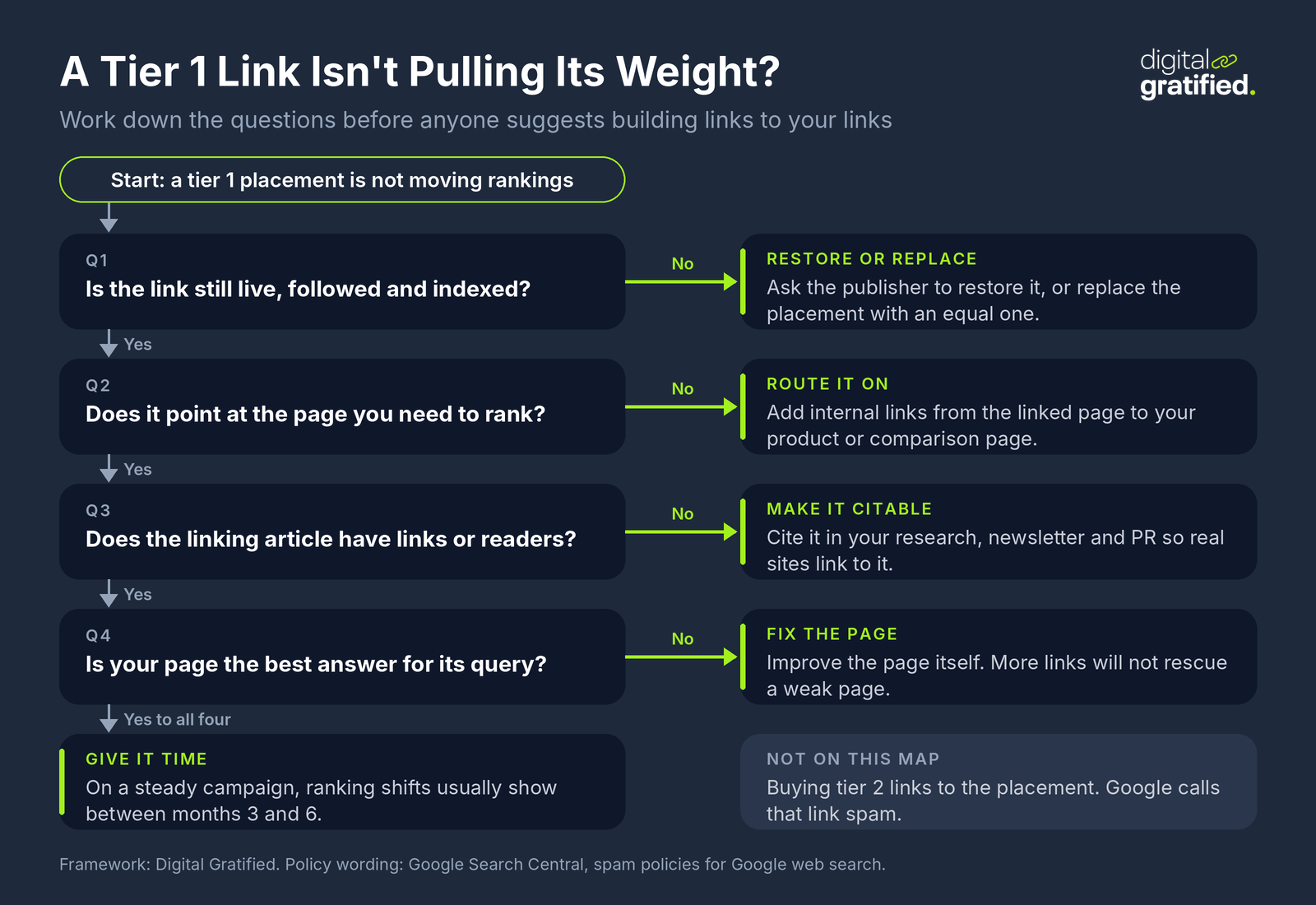
The real problem tiered link building claims to solve is a good placement that is not moving rankings. That problem is worth solving, and it rarely needs another tier of links. Start by finding out why the placement is underperforming:
Make the Linking Page Worth More
The honest version of "tier 2" is earning real attention for the article that mentions you. Cite the guest article in the research and newsletters you publish, share it where your buyers already follow you, and offer the publisher a data point or customer story that gives other writers a reason to reference it. When journalists quote your data, ask whether they can link to the source; our guide to turning press mentions into links walks through that request. None of this involves links created to manipulate rankings. It is promotion, and it is the reason the page deserved a link in the first place.
Route Authority With Internal Links
Most tier 1 links on SaaS sites point at a blog post or the home page, while the pages that close deals are comparison, use case and pricing pages. You control the next hop. Link from the page that receives external links to the commercial page that should rank, with descriptive anchors, and build an internal linking structure that routes authority to product pages. Internal links are the one second tier you fully control, and they carry no policy risk.
Replace Instead of Propping Up
When a placement dies or turns nofollow, the fix is to restore or replace it, not to point more links at a weakening page. This is why we build replacement into our campaigns: if a link we built is removed within 12 months of placement, we replace it with one of equal or greater authority at no extra cost. Keep anchors on the replacements varied too; our notes on keeping anchor text varied and natural apply to every tier 1 link.
How to Spot Tiered Links in a Link Building Proposal
Few sellers use the word "tiered" in a SaaS proposal anymore. Watch for the language instead:
- "Tier 2 boost", "power-up" or "link juice package" sold as an add-on to guest posts.
- "Indexing service" or "indexer links" for placements. A real editorial page gets crawled because the publisher links to it.
- Named automation tools such as GSA Search Engine Ranker or RankerX, which guides to tiered link building recommend for tier 3. Automated link creation is one of Google's named examples of link spam.
- Web 2.0 "buffer" sites or "parasite" pages on large platforms.
- Link counts with no domain list. If you cannot see and approve every site before outreach, you cannot tell which tier you are paying for.
Ask any vendor three questions: which domains will link to us, will anything be built to point at those pages, and what happens if a link disappears? This is how we run SaaS link building on DR 50+ publications: every placement is on a B2B or SaaS-relevant site, clients approve the domain list before outreach starts, and we never use PBNs or link farms. For how this fits the rest of a link program, from prospecting to measurement, see the link building approach we use for SaaS companies.
The Bottom Line
Tiered link building tries to make weak links count by stacking them behind a strong one. Google's spam policies describe the lower tiers almost line by line, its systems are built to neutralize them, and they reach none of your buyers. Every extra tier also adds another way for the chain to break.
So put the budget into one tier of placements on sites your buyers read, route that authority to your commercial pages with internal links, and replace placements that disappear. If you want a team to build those placements for you, talk to us about SaaS link building.
Frequently Asked Questions
What is tiered link building?
Tiered link building is building links to the pages that link to your site. Tier 1 links point at your site, tier 2 links point at the tier 1 pages, and tier 3 links point at tier 2. The aim is to pass more authority down the chain to your site while keeping low-quality links one step away from it.
What are tier 1, tier 2 and tier 3 backlinks?
Tier 1 backlinks link directly to your site, usually from guest posts or articles on other sites. Tier 2 backlinks link to those tier 1 pages, often from Web 2.0 blogs, directories or private blog networks. Tier 3 backlinks link to the tier 2 pages and are usually comments, profiles, bookmarks or links made with automation software.
Is tiered link building white hat?
No. A single editorial tier 1 link can be white hat, but the tiers below it are built to manipulate rankings, and the link types they use match the examples in Google's link spam policy, including automated link creation, low-quality directory and bookmark links and optimized forum comments.
Does tiered link building still work?
It can move rankings briefly in low-competition niches, but Google's SpamBrain system is designed to neutralize unnatural links, so much of the volume never counts. For a B2B SaaS company the same budget does more as editorial placements on sites buyers read, which also bring referral traffic and brand mentions.
Can tiered links get my site penalized?
Yes. Google can issue an "Unnatural links to your site" manual action when it detects a pattern of manipulative links pointing at a site, and links built to boost your backlinks are still built to manipulate your rankings. More often the links are simply discounted, so you pay for links that count for nothing.
What should I do instead of tiered link building?
Earn or place one tier of links on relevant publications, then make those placements stronger legitimately: check they are live and indexed, promote the linking article, cite it in your research and PR, and use internal links to pass authority from the linked page to your product and comparison pages. Replace placements that disappear rather than propping them up.
About the author
Let's Scale Your SaaS Together
Get a custom SEO and link building strategy tailored for your SaaS business.
Get SEO insights that actually move rankings
Link building tactics, case studies, and SaaS SEO playbooks. No fluff, no spam.
You're subscribed!
SEO and link building insights, straight to your inbox.