Most advice on authority backlinks starts and ends with a DR score. For SaaS, authority belongs to the linking page and the people who read it. Here is how to judge it, where to earn it, and when a bought link is not worth the risk.

Founder, Digital Gratified
An authority backlink is an editorial link from a page that has earned trust of its own, on a site the people you sell to read. For a B2B SaaS company, our position is that authority belongs to the linking page and its audience, not to the domain's score in a tool: Domain Rating is a useful filter for ruling sites out, and a poor reason for ruling them in.
Most advice on high authority backlinks treats a DR or DA number as the definition and then lists ways to get links from sites above it. That framing is how SaaS teams end up paying for placements on DR 80 sites that sell posts to anyone, while the trade publication their buyers read every week, at DR 45, never gets a pitch. This guide covers what makes a backlink authoritative, why third-party scores mislead, what authority links look like for software companies, how AI search changes the picture, and when a bought link is worth the risk. It builds on our explanation of how link building helps a site rank.
What Are Authority Backlinks?
An authority backlink is a link that passes real trust to your page because of where it comes from. Three things have to be true. A person at the linking site chose to link to you because your page helps their readers. The page carrying the link has standing of its own: other sites link to it, or searchers find it. And the site reaches an audience that overlaps with yours, so the link also sends people who might buy.
Links still matter to Google. Its guide to its ranking systems says PageRank was one of its core ranking systems at launch and "continues to be part of our core ranking systems", alongside other systems that understand how pages link to each other. What has changed is how much a single link can be gamed, and how many tools now sell a number that stands in for authority. If you want the basics of how a link passes value first, start with our guide to how backlinks work for SaaS sites.
Why Domain Rating Is Not the Same as Authority
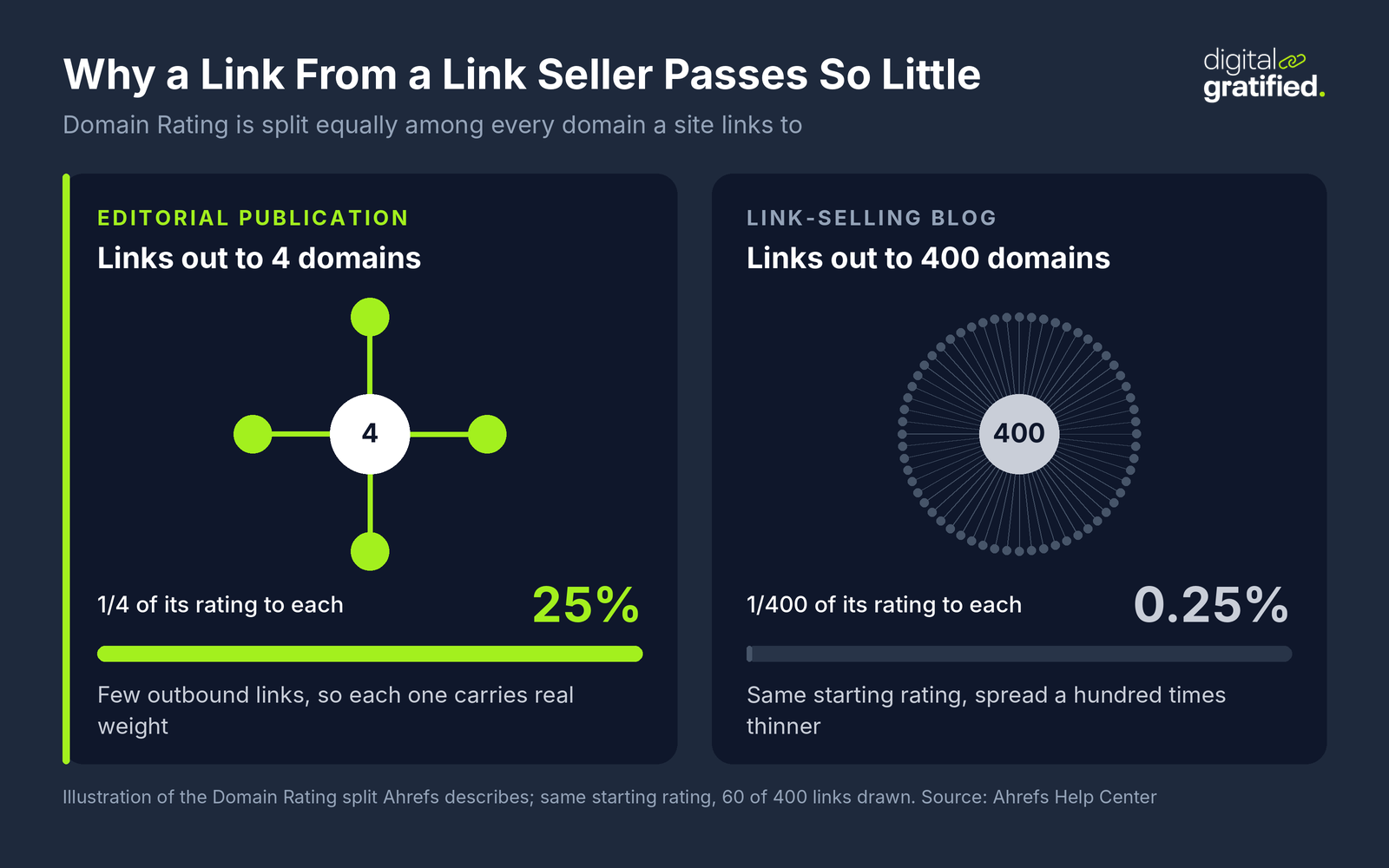
Domain Rating, Domain Authority and Authority Score are third-party estimates. Each is calculated from a vendor's own link index, and none of them is a number Google uses. Ahrefs explains in its description of how Domain Rating is calculated that DR is built from backlinks: each domain passes its rating to the domains it links to, and "the source domain splits its rating equally" among them. The calculation does not use the site's organic traffic or its topic. Ahrefs lists both as separate things to check when judging a site.
That design has a consequence most buyers miss. A site that links out to thousands of domains spreads whatever rating it has very thin, and a site whose DR came from a pile of links it bought or swapped can show a high score with no readers at all.
Google's own statements point the same way. Asked why a link from a well-known domain did little, John Mueller replied that "PageRank is per page, so a random page on an important domain is still a random page", adding that DA "is da, and not Google". Two years earlier he had said Google does not count links at the domain level. A guest post buried on page 40 of a big site's archive, with no links of its own and no traffic, inherits very little of that site's reputation.
None of this makes DR useless. It is a fast way to discard sites with no link profile, and a sudden spike in DR with flat traffic is a useful warning sign. The mistake is reading the score as a verdict.
What Makes a Backlink Authoritative
When we judge whether a link is worth winning, we look at five things in roughly this order. Only some of them show up on a tool's dashboard.
1. An Editor Chose to Link
The strongest signal is that someone with editorial standards decided your page was the best reference for a point they were making. A link that exists because money changed hands, because a contract required it, or because you wrote it into your own byline is a different kind of link, and Google's policies treat most of those differently too. Editorial links are slower to win, which is exactly why they carry more weight.
2. The Linking Page Has Standing of Its Own
Because PageRank flows page by page, look at the page that will carry your link, not only the homepage. A page that ranks for its own topic, earns organic visits or has backlinks pointing at it passes far more than a new post that nothing links to. For a placement that does not exist yet, look at comparable articles on the same site: if the site's recent posts never rank and never get linked, yours will not either.
3. Your Buyers Read the Site
A link from a publication your buyers read does two jobs: it passes ranking value and it puts your product in front of people with the problem you solve. Check where the site's organic traffic comes from, which countries and which topics, and ask whether your sales team would recognize the publication. For a SaaS company the second job is often worth more than the first, because a qualified visitor from a trade publication can become a demo request this quarter.
4. The Link Sits in the Main Content, in Context
A link inside the body of an article, next to words that describe what your page covers, tells search engines and readers what they will find. Links in footers, sidebars, author boxes and widget credits are weaker, and widely distributed footer and widget links appear in Google's list of link spam. Anchor text matters here as well: a plain description or your brand name reads naturally, while an exact-match commercial phrase on a guest post is one of the patterns Google names.
5. The Site Is Not a Link Seller
Sites that publish anything for a fee tend to show the same pattern: a high DR, thin traffic, a "write for us" page with a price list, and recent posts that each link out to an unrelated business. A practitioner survey run by Editorial.Link found that 89% of 518 SEO professionals avoid sites with spammy outbound links and 86.3% treat low-quality content as a dealbreaker. The survey's authors sell link building, so read it as a view from inside the industry rather than neutral research. If you are buying placements and need a full vetting process, that is a separate job from deciding what authority means.
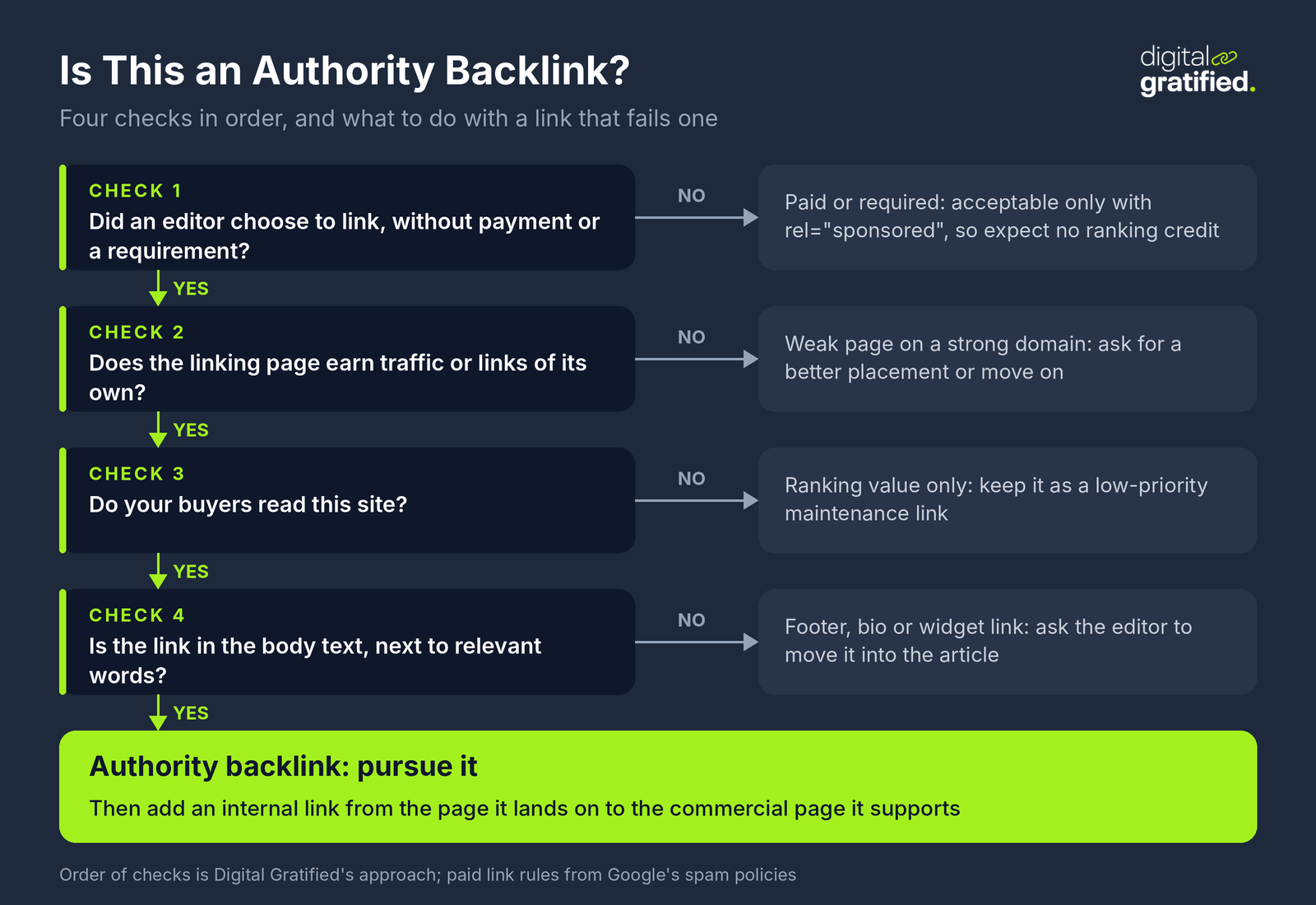
The decision tree below puts those checks in the order we use them and shows what to do with a link that fails each one, because a failed check does not always mean the link is worthless.
A Worked Example: Two Links, One Budget
Here is a worked example with illustrative numbers. An HR software company that sells performance review tools has the budget and time to pursue one of two links this month.
| Factor | Link A: general business blog | Link B: HR trade publication |
|---|---|---|
| Domain Rating | 82 | 48 |
| How the link is won | Paid guest post, published within a week | Expert quote in a feature on calibration meetings |
| Organic visits to comparable articles | Near zero; most recent posts do not rank | Several hundred a month to similar features |
| Outbound links in recent posts | Each post links to two or three unrelated companies | Links mostly to research and named sources |
| Audience | Mixed, mostly outside HR | HR directors and people operations leads |
| Placement | Author bio with a commercial anchor | In the body, next to a claim from your data |
| Policy risk | A paid link that passes ranking credit | None |
A team that buys by DR picks Link A every time. On the five signals, Link B passes all of them: an editor chose it, comparable pages earn traffic, the readers are buyers, the link sits in context, and the site does not sell placements. Link A passes none and wins only on the number. This is the trade-off that shapes link building for HR software companies, where the trade press is small and its readers book demos.
Where SaaS Companies Earn Authority Backlinks
Software companies have link sources most other businesses do not, and the best ones match the five signals almost by default.
- Trade and industry publications that cover your category, reached through expert commentary, data and contributed analysis.
- Integration partners, whose marketplaces and documentation link to your listing and are read by people who already use a tool you connect to.
- Original data, such as a benchmark drawn from anonymized product usage, which journalists and analysts cite when they need a number.
- Comparison and roundup articles that rank for your category terms and that buyers read just before they visit vendor sites.
- Existing mentions of your product that never got a link, which are some of the easiest authority links to win because the writer already chose to talk about you.
Which of these fit depends on the data, experts and partners you already have, and choosing among them is the subject of our guide to picking the link building strategies your assets can support. For the last item, start by tracking down mentions of your brand that are missing a link. Journalist request platforms are still a route to expert quotes, with more noise than they had, which we cover in our look at how HARO and its replacements work today. For a sense of which link sources tend to fit software, our breakdown of which backlink types move rankings for SaaS goes source by source.
This is the kind of work we do for SaaS clients. For SE Ranking, we ran a link building campaign that secured placements on authoritative tech publications and relevant SaaS review sites, consistently delivering 10+ DR 50+ backlinks a month alongside 25+ brand mentions, and the company's search visibility grew by 300%. When we run SaaS link building on publications buyers read, every domain is DR 50 or higher and clients approve the list before outreach starts, but the DR floor is the first filter, not the reason we pitch a site.
Why Authority Matters More in AI Search
AI answers have made the gap between a score and a reputation wider. In Ahrefs' study of 75,000 brands and their AI Overview visibility, the factor most closely tied to being mentioned in AI Overviews was branded web mentions, at a Spearman correlation of 0.664. Domain Rating came in at 0.326, the number of referring domains at 0.295 and the raw number of backlinks at 0.218. The study was limited to brands above DR 40, and correlation is not cause, but the ranking of the factors is hard to ignore.
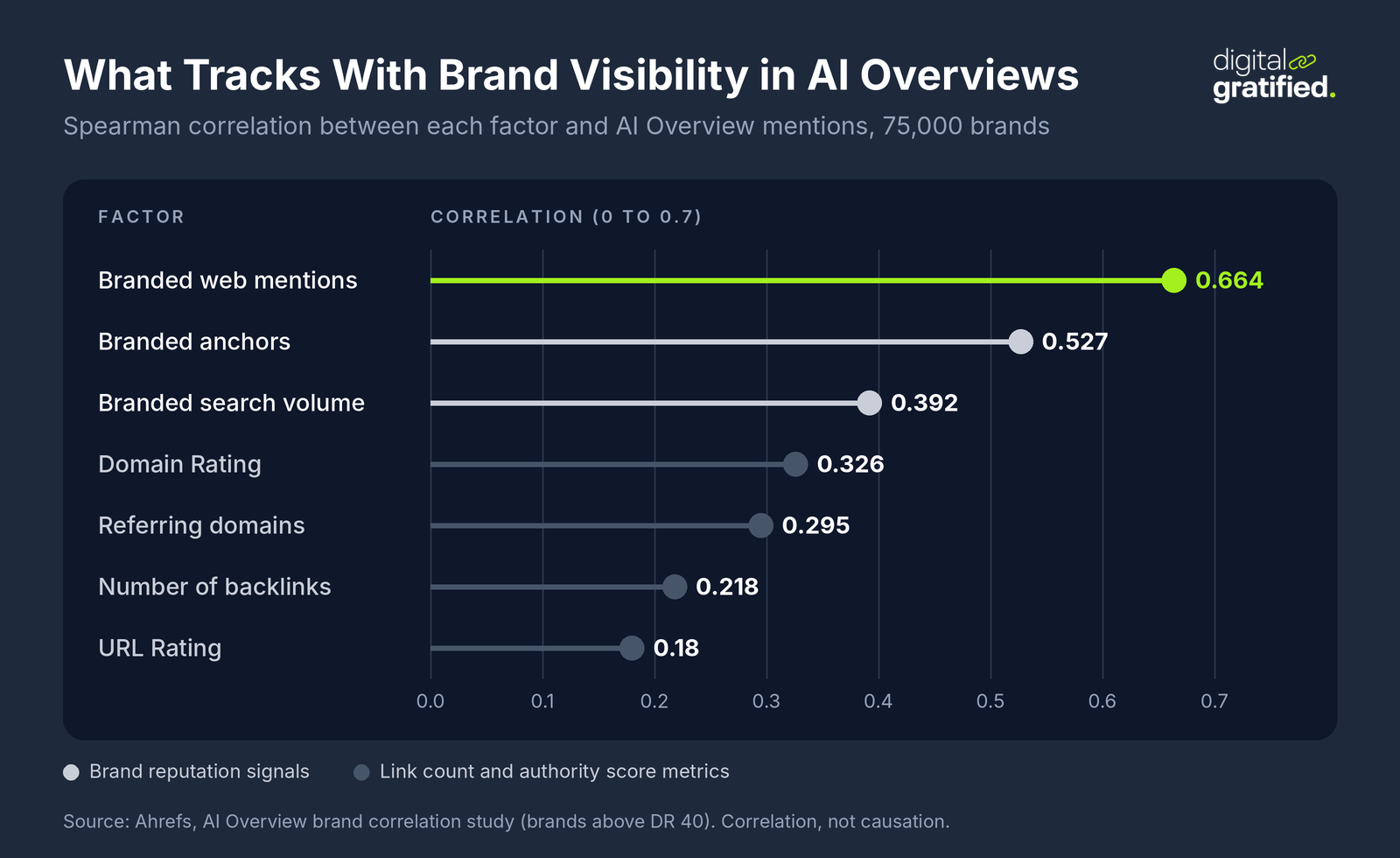
For a SaaS brand, the practical reading is that the links worth chasing are the ones that also produce mentions in sources AI systems trust: trade coverage, roundups, analyst notes and research citations. A link program built on placements nobody reads may lift a DR chart and leave your brand absent from the answers buyers now read first. That shift is why the question of whether link building still earns its budget in 2026 has a different answer for editorial links than for bought ones.
Should You Buy High Authority Backlinks?
Packages selling "high DA backlinks" are easy to find, and plenty of SEOs buy them: in the Editorial.Link survey cited above, 63.1% said they were open to sites that sell links if the quality is right, and respondents put the acceptable cost of one high-quality link at $508.95 on average. The demand is real. So is the policy.
Google's spam policies define link spam as "creating links to or from a site primarily for the purpose of manipulating search rankings". The examples include buying or selling links that pass ranking credit, paid guest posts and advertorials with links that pass credit or use optimized anchors, excessive link exchanges, and links required by contract. Paid links are allowed when they carry rel="sponsored" or rel="nofollow", which also means they stop passing the ranking value the buyer paid for. A bought link marketed as "high authority" is therefore either a sponsored link with no ranking credit or a policy risk, and the sites that sell them openly are the ones most likely to be discounted.
Google keeps adjusting how it weighs all of this. Its November 2026 core update began rolling out on November 10 and may take up to two weeks to complete. For a SaaS company, the cost of getting this wrong is not a lost link; it is lost trust in the pricing, comparison and integration pages that bring in pipeline. If you do pay for placements, mark them correctly and treat them as distribution, and see our breakdown of what link building really costs before you set a budget.
How to Point Authority at the Pages That Create Pipeline
Authority links rarely land on a pricing page. Editors link to research, guides and tools, because those help their readers. That is fine, as long as the authority keeps moving once it arrives. Every page that wins authority links should link, in its body, to the commercial page it relates to: a benchmark on review cycles links to the calibration use case page, a security checklist links to the compliance page, and a roundup inclusion should point at a comparison page rather than the homepage.
Plan those routes before the asset ships. Our guide to structuring internal links around hubs covers how to build them, and once they exist you can put a pipeline value on each authority link by tracking the demo requests from the commercial pages it feeds. That is the measure that matters: a link's authority is only as useful as the qualified visits and sign-ups it helps produce.
The Bottom Line
Treat authority as a property of the page that links to you and the people who read it. Use DR to rule out sites with no link profile, then judge every opportunity on five signals: an editor chose to link, the page has standing, your buyers read the site, the link sits in context, and the site does not sell links. A DR 48 trade publication that passes all five will do more for your pipeline than a DR 82 blog that passes none.
If you would rather have a team earn those links for you, talk to us about our SaaS link building and digital PR services.
Frequently Asked Questions
What is an authority backlink?
An authority backlink is an editorial link from a page that has earned trust of its own, on a site your target audience reads. The linking page ranks or earns links itself, an editor chose to link without payment, and the link sits in the body of the content. A high Domain Rating alone does not make a link authoritative.
What DR counts as a high authority backlink?
There is no Google threshold, because Google does not use DR or DA. Many SEOs treat DR 50 or higher as a reasonable floor for ruling sites in, but a DR 45 trade publication your buyers read can be worth more than a DR 80 blog that sells posts. Use DR to rule sites out, then judge the page, the audience and the placement.
How do I find good backlinks for a SaaS site?
Start with sources your buyers already read: trade publications in your category, integration partner marketplaces, comparison and roundup articles that rank for your category terms, and sites that already mention your product without linking. Check that the page carrying the link earns traffic or links itself, and that the site does not sell placements to anyone who pays.
Are high DA backlinks worth buying?
Rarely. Google's spam policies treat bought links that pass ranking credit as link spam. A paid link is allowed when it carries rel="sponsored" or rel="nofollow", but then it passes no ranking value. Sites that openly sell high DA links are also the ones most likely to have their links discounted.
Do authority backlinks help with AI search?
The ones that also produce brand mentions in trusted sources do. In Ahrefs' study of 75,000 brands, branded web mentions correlated with AI Overview visibility at 0.664, compared with 0.326 for Domain Rating and 0.218 for the number of backlinks. Trade coverage, roundups and research citations help on both fronts.
Does a link from a big website always pass authority?
No. Google's John Mueller has said PageRank is per page, so a random page on an important domain is still a random page. A guest post deep in a large site's archive, with no traffic and no links of its own, passes far less than its domain's reputation suggests.
How many authority backlinks does a SaaS site need?
It depends on how strong the pages ranking for your target terms are, not on a fixed number. Compare the referring domains pointing at the top results for the pages you want to rank, then aim for links that match their quality, and route the authority they bring to your commercial pages with internal links.
About the author
Let's Scale Your SaaS Together
Get a custom SEO and link building strategy tailored for your SaaS business.
Get SEO insights that actually move rankings
Link building tactics, case studies, and SaaS SEO playbooks. No fluff, no spam.
You're subscribed!
SEO and link building insights, straight to your inbox.