Backlinks are links from other sites to yours, and Google still uses them to find and rank pages. Here is how they work, why referring domains matter more than raw counts, and why so many backlinks quietly disappear.

Founder, Digital Gratified
Backlinks are links on other websites that point to yours, and Google still uses them to find your pages and judge which ones deserve to rank. For a SaaS company, the useful way to think about them is narrower than most guides suggest: count the sites your buyers read that link to you, not the raw number of links, and treat every backlink as an asset that decays unless someone maintains it.
This guide explains what a backlink is, how Google uses links today, which link attributes matter, where SaaS backlinks come from, why so many disappear, how to check yours, and what changes now that AI answers sit on top of the results page.
What Are Backlinks?
A backlink is a hyperlink on a page of another website that points to a page on your site. You will also see it called an inbound link, incoming link or external link. If a trade publication reviews your product and links the word "invoicing software" to your pricing page, that is a backlink to your pricing page.
Every backlink has four parts, and each one changes what the link is worth:
- The source page: the page that carries the link, with its own topic, audience and authority.
- The anchor text: the clickable words, which tell readers and Google what to expect on the other side.
- The rel attribute: optional labels such as nofollow or sponsored that tell Google how to treat the link.
- The destination: the page on your site the link points to, which decides whether the link helps a page that sells or a page that only informs.
Backlinks are one half of what people mean by link building; the other half is the work of earning them. Our explainer on how link building works and why it moves rankings covers that side. This post stays on the links themselves.
Backlinks vs. Referring Domains: The Number That Matters
Most backlink tools report two headline numbers, and confusing them is the most common mistake we see in SaaS board decks. Backlinks counts every individual link. Referring domains counts the distinct websites those links come from. One partner that links to you from the footer of 4,000 help center pages adds 4,000 backlinks and one referring domain.
| Term | What it counts | How to use it |
|---|---|---|
| Backlink | Each link from another site to yours | Rarely useful as a goal; inflates fast from sitewide and template links |
| Referring domain | Each distinct website that links to you at least once | The better measure of how many independent sources vouch for you |
| Internal link | A link from one page on your site to another | How you pass authority from linked pages to commercial pages |
| Unlinked mention | Your brand named on another site without a link | Not a backlink yet; often the easiest link to win |
The gap between the two counts is large. In our study of 420 established SaaS link profiles, the median site had 515,117 backlinks but only 12,058 referring domains, and a median of 44.7 backlinks for every linking site. Referring domains also tracked organic traffic closely: sites with 100,000 or more referring domains had a median of 966,023 monthly organic visits, against 35,811 for sites under 5,000.
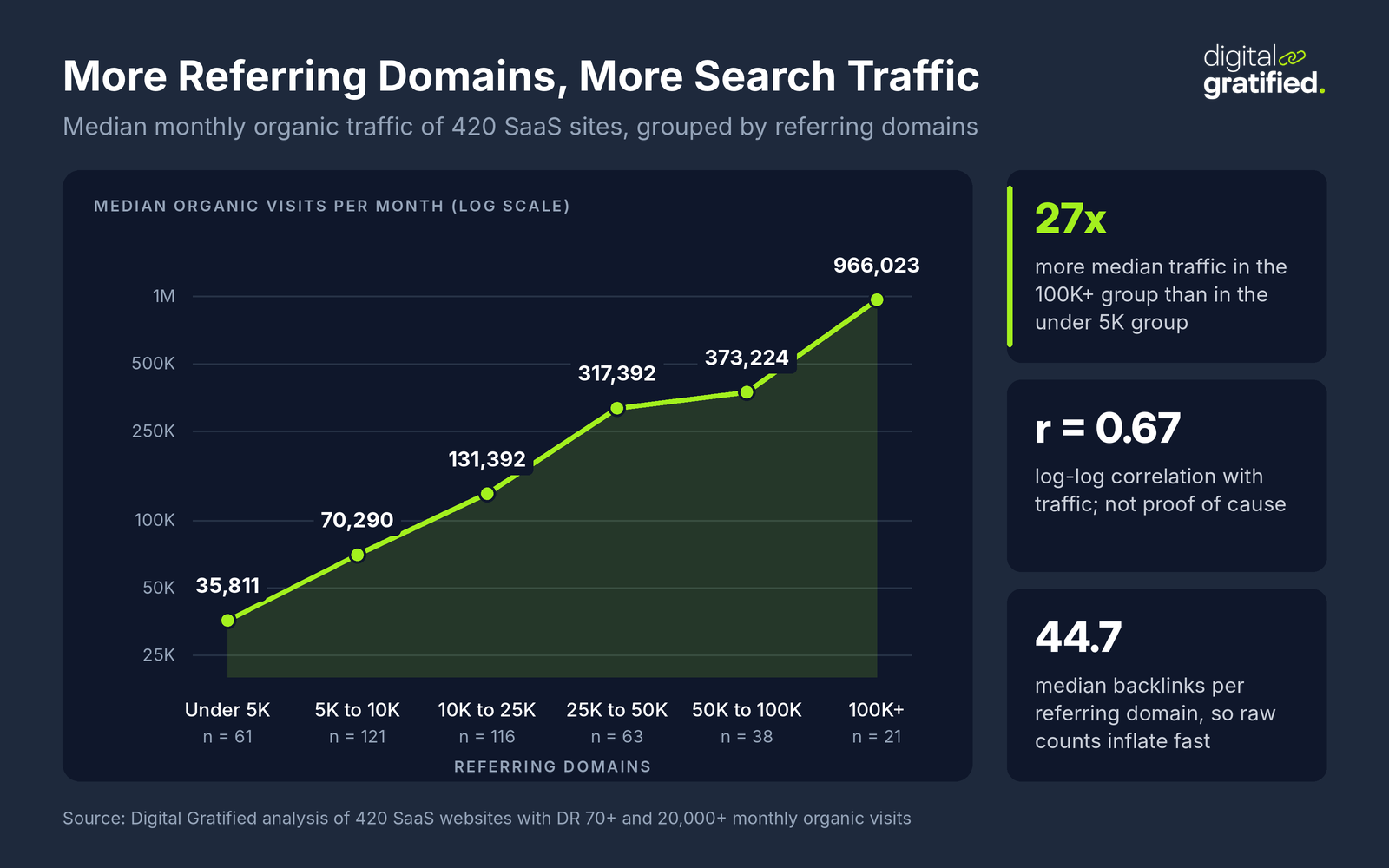
That is correlation, not proof that links caused the traffic; popular sites attract links because they are popular. But it is why we set link targets in referring domains from relevant sites, and why a report that celebrates 3,000 new backlinks from one directory tells you nothing. When you want to size the gap for a specific page, working out how many referring domains a page needs starts from the pages already in the top five.
How Google Uses Backlinks
Google is unusually direct about this. Its link documentation states that "Google uses links as a signal when determining the relevancy of pages and to find new pages to crawl." So a backlink does two jobs: it helps Googlebot discover your page, and it tells Google something about what the page is about and whether other sites consider it worth pointing to.
The original link algorithm is still in use. Google's guide to its ranking systems describes PageRank as "one of our core ranking systems used when Google first launched" and says it "continues to be part of our core ranking systems," even though how it works "has evolved a lot." The same page lists the retired Penguin system, which was built to combat link spam, so links are both a signal Google reads and a signal Google polices.
Three practical consequences follow for a SaaS site:
- Links have to be real HTML links. Google can generally crawl a link only when it is an a element with an href. A logo wall built from images with JavaScript click handlers, which is common on partner pages, may pass nothing.
- Anchor text carries meaning. Google asks for anchor text that is "descriptive, reasonably concise, and relevant," and warns against cramming keywords. You rarely control anchors on other sites, but you can suggest a natural description when a partner asks how to link. Our guide to choosing anchor text that reads naturally covers the mix that looks earned.
- The destination matters as much as the source. A link passes value to the page it points to. Publishers link to research, tools and guides far more often than to pricing or comparison pages, so the authority has to be routed onward with internal links.
Followed, Nofollow, Sponsored and UGC Links
A backlink with no rel attribute is what SEOs call a dofollow or followed link. Site owners can add one of three values to change how Google treats it. These are Google's own definitions of the rel values:
| Attribute | Google's intended use | What it means for a SaaS team |
|---|---|---|
| None (followed) | A normal editorial link | Can pass ranking credit; the kind most link programs aim for |
| rel="sponsored" | "Advertisements or paid placements" | Required on anything you pay for, including sponsored posts and paid listings |
| rel="ugc" | User-generated content "such as comments and forum posts" | Community and forum links; useful for visibility, not a ranking strategy |
| rel="nofollow" | When "other values don't apply" and the site would rather not be associated with the link | Common on press sites and marketplaces; still sends readers who may buy |
Google says links with these attributes "will generally not be followed," which in practice means they pass little or no ranking credit. That does not make them worthless. In our SaaS study the median site had a dofollow ratio of 82.7%, so roughly one referring domain in six was nofollow, and a nofollow link from an integration marketplace your buyers browse can produce more demo requests than a followed link from a blog nobody in your market reads. A profile with no nofollow links at all looks manufactured.
What Makes a Backlink Worth Having for a SaaS Company
Our position: judge a backlink by who reads the page it sits on and where it sends them, and use authority scores only as a filter. A DR 85 site with no audience in your category is worth less to a B2B SaaS company than a DR 45 newsletter archive read by the exact job titles that sign your contracts, because the second one moves rankings and sends buyers.
The decision tree below is the order we use, and the order matters: the cheapest checks come first, and a link that fails the first one should never reach a budget conversation, however good its metrics look. Two points trip up SaaS teams most often. Free seats, product credits and discounts traded for a link are still payment under Google's policies, so those links need a sponsored tag and belong in the ad budget. And the final check is the one most programs skip: a link to a glossary post helps that post, and only your internal links decide whether the authority reaches the alternatives page that books demos.
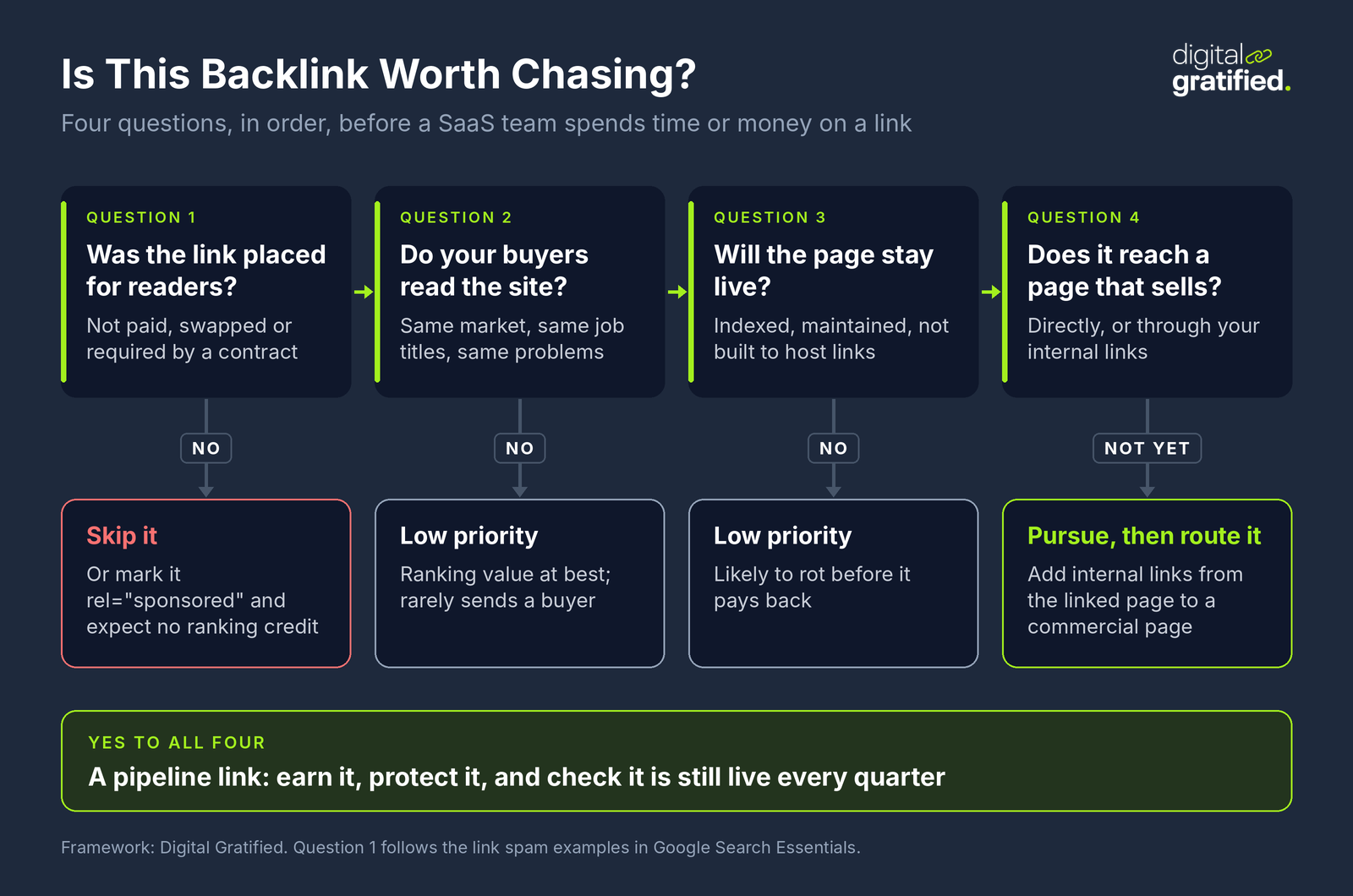
Run that test before you pay for anything. Our breakdown of estimating what a single backlink is worth in pipeline turns the last question into a number you can defend to finance.
Where SaaS Backlinks Usually Come From
A healthy SaaS link profile is not built from guest posts alone. When we audit software companies, the links that hold up tend to come from relationships the product already creates:
- Integration and technology partners: app marketplace listings, setup guides and announcement posts on the sites of the tools you connect to.
- Review and comparison sites: software directories and "best tools" roundups that buyers read while shortlisting.
- Customers: engineering blogs, case studies, conference talk pages and "our stack" posts that name the tools a team uses.
- Press and trade publications: coverage of funding, product data, research and expert commentary.
- Linkable assets you publish: original data, free tools and templates that writers cite when they explain the problem you solve.
- Mentions you already have: articles that name your product without a link, which are often one polite email away from becoming backlinks.
The last source is the cheapest. Our guide to reclaiming brand mentions that never got a link covers the search and the email, and our list of eight ways SaaS companies earn backlinks covers the rest. This is also the work we do on SaaS link building campaigns: we only pitch DR 50+ publications with a real audience in the client's market, earned through editorial relationships and never PBNs.
Backlinks Decay: Plan for Link Rot
A backlink is not permanent, and most SaaS teams never budget for that. Ahrefs tracked links pointing to 2,062,173 websites since 2013 and found that at least 66.5% of those links had rotted. The cause is rarely technical. Most lost links disappear because the linking site deleted the page, or because an editor took the link out of a page that still exists.
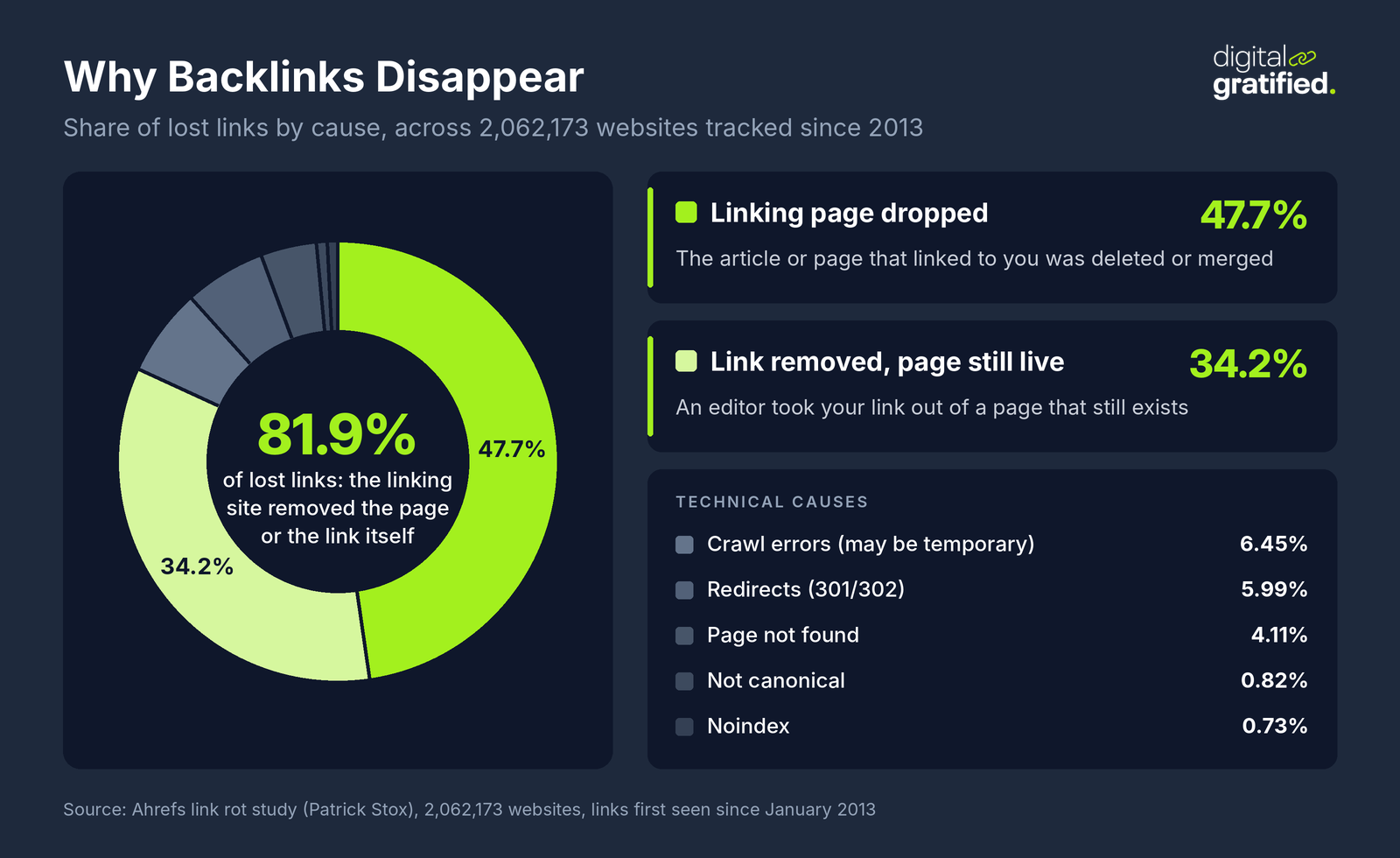
The wider web shows the same pattern. Pew Research Center found that 38% of webpages that existed in 2013 were no longer accessible a decade later, and that 23% of news pages contained at least one broken link. Publishers redesign, merge archives and prune old content, and your links go with it.
For a SaaS company this changes how to plan. A link program that adds 15 referring domains a quarter while quietly losing 10 is growing far slower than its report suggests. Track lost links alongside new ones, give priority to links on pages that are maintained (documentation, evergreen guides, partner directories), and redirect any URL of yours that still has backlinks when you restructure the site. On the SaaS link building campaigns we run, if a link we built is removed within 12 months, we provide an equal or greater replacement at no extra cost, because a placement that vanishes in month four was never worth the invoice.
How to Check Your Backlinks
Start with Google Search Console, because it is free and shows what Google has found. The Links report lists your top linked pages, top linking sites and top linking text. Know its limits: Google says the report "isn't a comprehensive list of every link," tables stop at 1,000 rows, and it "doesn't specify if a link is marked as nofollow." Third-party tools such as Ahrefs, Semrush and Moz fill those gaps with their own crawls, rel attributes and lost link history, and each one sees a slightly different slice of the web.
Here is the quarterly check we recommend for a SaaS team. It takes about 30 minutes once the exports are set up:
- Export referring domains, not backlinks, from Search Console and one third-party tool, and note the total for each.
- List lost links from the last quarter and sort them by the authority and relevance of the linking site. Ask for the important ones back, or point them at a live page.
- Check where links land. Group top linked pages by type (blog, research, tools, product, pricing, comparison) and see how much authority reaches pages that sell.
- Find 404s with backlinks on your site and redirect each to its closest live equivalent.
- Scan new referring domains for anything you did not earn and do not recognize, such as sudden sitewide links or scraped copies of your pages.
- Write down one decision: the commercial page that most needs links next quarter.
Most SaaS sites can ignore random low-quality links in step five. For known spam sites, Google says it "typically will ignore the links." Act only on links you or a past vendor built that break the rules below.
Backlinks That Break Google's Rules
Google's spam policies define link spam as "creating links to or from a site primarily for the purpose of manipulating search rankings." The examples include buying or selling links for ranking purposes, "exchanging goods or services for links," excessive link exchanges, automated link creation, low-quality directory links and "widely distributed links in the footers or templates of various sites." Private blog networks fall under the last example, "creating low-value content primarily for the purposes of manipulating linking and ranking signals."
Paid placements are allowed only when the link carries rel="sponsored" or rel="nofollow", at which point it passes no ranking credit. None of the alternatives are risk free. Our guide to link building methods that stay inside Google's rules covers the approaches that hold up, and we have written separately about what happens when link swaps get excessive.
One recent event to read correctly: Google's September 2026 spam update ran from September 24 to October 8, 2026, and Search Engine Roundtable's coverage of the completed rollout notes that it did not target link spam. If your rankings moved in that window, look at content quality before you start disavowing links.
Do Backlinks Still Matter in AI Search?
Yes. AI Overviews and AI Mode draw on pages from Google's index, and Google's documentation for site owners says "There are no additional requirements to appear in AI Overviews or AI Mode," and that "all existing SEO fundamentals continue to be worthwhile." Links are one of those fundamentals.
The links inside AI answers are also growing. On October 15, 2026, Google announced more inline links in AI Mode and AI Overviews, placed higher in responses, plus a section that surfaces the one or two official sites needed to complete some tasks. For a SaaS company, that rewards the same thing backlinks reward: being the page other sites already treat as the source for your category. Third-party mentions help AI tools see your brand in more than one place, linked or not, which is one more reason to chase coverage on sites your buyers read. We have made the longer case for whether links still carry weight in 2026 in a separate post.
The Bottom Line
A backlink is another site vouching for a page of yours, and Google still listens. For a SaaS company the useful measure is referring domains from sites your buyers read, landing on or routed to pages that sell, and kept alive long enough to pay back.
So stop reporting raw backlink counts. Audit your referring domains and lost links every quarter, pick the commercial pages that need authority next, and spend only on links that pass the four questions above. If you want a team that earns those links for you, talk to us about SaaS link building.
Frequently Asked Questions
What is a backlink in simple terms?
A backlink is a link on another website that points to a page on your site. Google uses backlinks to discover pages and as a signal of which pages other sites consider worth referencing, so they help decide how pages rank.
Are backlinks still important for SEO in 2026?
Yes. Google states that it uses links as a signal of relevance and to find new pages, and that PageRank is still part of its core ranking systems. AI Overviews and AI Mode have no separate requirements beyond standard SEO, so links matter there too.
What is the difference between a backlink and a referring domain?
A backlink is one individual link. A referring domain is one website that links to you, however many times. A partner that links to you from thousands of template pages adds thousands of backlinks but only one referring domain, which is why referring domains are the better number to track.
How do I check my website's backlinks?
Open the Links report in Google Search Console to see your top linked pages, top linking sites and top linking text. It is not a complete list and does not show which links are nofollow, so pair it with a third-party tool such as Ahrefs, Semrush or Moz for rel attributes and lost links.
Can backlinks hurt my site?
Links you or a vendor build to manipulate rankings, such as bought links that pass ranking credit, excessive link swaps or private blog networks, break Google's spam policies and can cost you rankings. Random low-quality links from spam sites are usually ignored by Google, so most sites do not need to act on them.
Do nofollow backlinks help SEO?
Google says links marked nofollow, sponsored or ugc will generally not be followed, so they pass little or no ranking credit. They can still send buyers and build brand awareness, and a natural link profile always contains some of them.
How many backlinks does a website need to rank?
There is no fixed number. Compare the referring domains pointing at the pages that already rank in the top five for your keyword, and aim to close that gap with relevant links to the page you want to rank.
About the author
Let's Scale Your SaaS Together
Get a custom SEO and link building strategy tailored for your SaaS business.
Get SEO insights that actually move rankings
Link building tactics, case studies, and SaaS SEO playbooks. No fluff, no spam.
You're subscribed!
SEO and link building insights, straight to your inbox.