Most SEO strategy templates are task lists that never connect a page to a deal. Here is a nine-section template for B2B SaaS that starts from a pipeline target, puts commercial pages first and ends with dated review gates.

Founder, Digital Gratified
An SEO strategy template is a short document that states what organic search must deliver for the business, which pages and links will deliver it, who owns each part, and how you will know it is working. For a B2B SaaS company, our position is that the template should start from a pipeline target and work backwards to pages, not start from a keyword list and hope it adds up to demo requests.
Most templates that rank for this term are task lists: audit, keywords, content calendar, backlinks, report. They rarely help a founder decide whether SEO deserves next year's budget, because none of their fields connect a page to a deal. Below is the template we use with SaaS teams, section by section, with a filled-in example, a way to turn it into a 12-month roadmap, and the changes AI search forces on any strategy written this year. It sits inside our wider guide to SaaS SEO and the ARR it drives, which covers execution in more depth.
What Is an SEO Strategy Template?
Three documents get called by the same name, and mixing them up is the first reason strategies stall. A strategy says what you are trying to achieve, for which buyers, with which kinds of pages, and what you will not do. A roadmap puts that strategy on a calendar, quarter by quarter, with owners and dependencies. A plan, or project plan, is the task list underneath: briefs, tickets, outreach, fixes.
Search results for "SEO plan template", "SEO roadmap template" and "SEO strategy document" mostly offer the third kind. That is fine for an SEO manager running the work week to week. It is the wrong document to put in front of a CEO, a CFO or a board, who need to see the bet, the cost and the expected return on one page. Write the strategy first, then the roadmap, and let the task list follow.
Why Most SEO Strategy Templates Fail SaaS Teams
Having a strategy is not the problem. In the Content Marketing Institute's B2B content marketing research for 2027, a survey of 861 B2B marketers, 60% rated their marketing as effective, and only 12% called it highly effective. Content relevance and quality was the factor most often credited for effectiveness, named by 47%. Nearly every team has a document; far fewer have one that changes results.
For a SaaS company the gap usually comes from three missing fields. The first is a revenue target: generic templates set goals in traffic and rankings, so nobody can tell whether a 30% traffic increase was worth the spend. The second is a page portfolio by buying stage: the templates list blog topics, while the pages that create pipeline for software companies are comparison, alternatives, integration, use case and pricing pages. The third is a decision rule: a strategy that never says what to stop doing becomes a list that only grows.
The same research shows why the old traffic-first framing is breaking down. Among the marketers surveyed, traffic rose for 31%, fell for 31%, held steady for 24% and was not tracked by 14%, and 79% of those who saw it fall blamed AI-powered search.
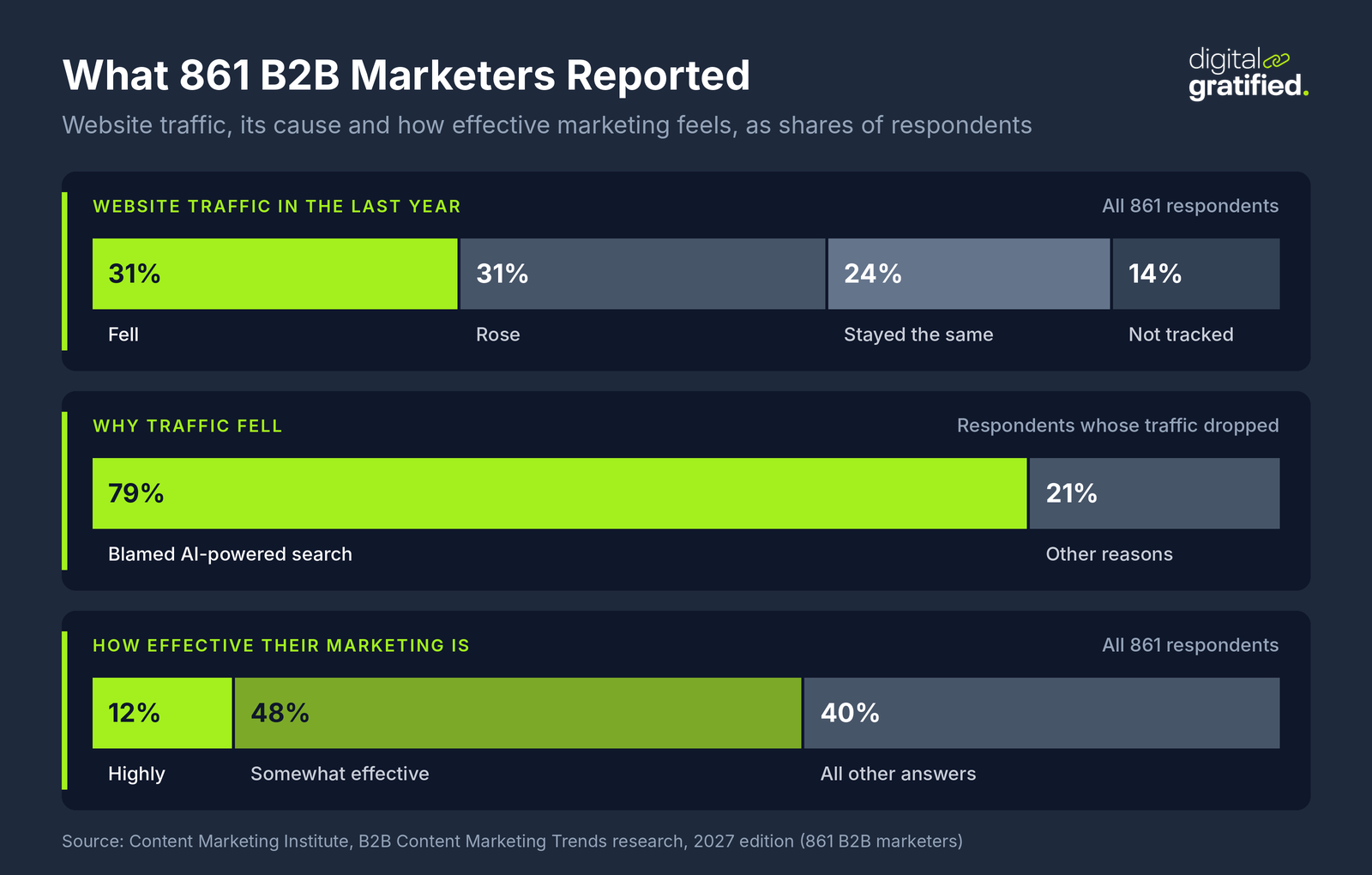
A strategy that promises traffic growth is now promising something partly outside your control. A strategy that promises qualified demo requests from pages buyers read before they shortlist vendors is still within it.
The SaaS SEO Strategy Template
This is the template, as a table you can copy into a doc or sheet. Every section has a question it must answer and a test for whether the answer is good enough. If a section cannot be filled in with a number, a page type or a name, the strategy is not ready.
| Section | Question it answers | What to fill in | Good enough when |
|---|---|---|---|
| 1. Business target | What must organic search deliver? | Organic demo requests, trials or sign-ups per quarter, and the pipeline or new ARR they imply | Finance agrees with the conversion rates used |
| 2. Buyers and problems | Who searches, and for what? | Two or three buyer roles, the problems they search for, and the words sales hears on calls | Sales can recognize every buyer described |
| 3. Baseline | Where are we starting from? | Non-branded clicks, pages ranking 4 to 20, organic demo requests by landing page, referring domains | Every number has a source and a date range |
| 4. Page portfolio | Which pages will produce the target? | Commercial pages first, then problem guides, each mapped to a buying stage and a conversion path | Every page has a target query and a next step |
| 5. Authority plan | How will those pages earn trust? | Link and mention sources, linkable assets, internal links from guides to commercial pages | Each asset names the commercial page it supports |
| 6. Technical guardrails | What must not break? | Crawl, indexing, speed and template rules, plus who signs off on releases that touch URLs | An owner exists for every guardrail |
| 7. AI search visibility | Are we named where buyers ask? | The prompts buyers use, the sources AI answers cite, and where you appear in them | Prompts are checked on a schedule |
| 8. Owners, budget and limits | Who does the work, with what? | Named owners, monthly budget, expert hours, and the work you have decided not to do | The "not doing" list is not empty |
| 9. Measurement and review | How do we know, and when do we decide? | Leading and lagging metrics, review dates, and the rule for cutting or doubling down | The first review date is on the calendar |
Nine sections fit on two pages. If yours runs longer, the extra length is almost always task detail that belongs in the roadmap or the project tracker.
1. Business Target: Start From Pipeline
Write the target in the unit your company sells by. A sales-led SaaS company counts qualified demo requests and the pipeline they create. A product-led company counts trial or free sign-ups that activate. Then show the math: how many organic conversions, at what conversion rate to opportunity, at what win rate and contract value, produce the new ARR you are promising. If you have never done that arithmetic, our method for forecasting organic pipeline from search demand walks through it, and the target should match the budget your finance team signs off.
Traffic still belongs in the document, as a leading indicator. It does not belong in the goal line.
2. Buyers and the Problems They Search For
Most B2B SaaS products are bought by a committee: the person with the problem, the person who owns the budget, and someone in IT or security who can say no. Each searches differently. The practitioner searches for the problem and for tools that fix it; the budget owner searches for comparisons and pricing; the security reviewer searches for your compliance pages. Pull the phrases from sales call notes and support tickets, not only from a keyword tool, and record them in the buyers' own words.
3. Baseline: Measure Before You Promise
Take the baseline from Search Console and your CRM, not from a tool's traffic estimate. The four numbers that matter most are non-branded clicks to commercial pages, the queries where you already sit between positions 4 and 20, organic demo requests or sign-ups by landing page, and the referring domains pointing at your commercial pages. In our experience, the middle group is where most first-year wins come from, because a page on page two needs less work than a page that does not exist.
4. Page Portfolio by Buying Stage
This is the section that separates a SaaS strategy from a blog calendar. List the commercial pages first: product and feature pages, use case pages, integration pages, comparison and alternatives pages, and pricing. Then add the problem guides that feed them. Every page in the portfolio gets a target query, a buying stage and a conversion path, so a guide on a problem links to the use case page that solves it. We set out how to choose and order these pages in our B2B SEO approach built around buying stages, and the guides that surround them are what build authority on the problems your product solves.
5. Authority Plan: Links and Mentions
Commercial pages rarely earn links on their own; publishers link to research, tools and guides. So the authority plan names the linkable assets you will build, the sources you will earn links and mentions from, and, for each asset, the commercial page it will pass authority to through internal links. Decide those destinations before an asset ships. Our SaaS link building playbook covers which strategies fit which assets.
6. Technical Guardrails
Write guardrails, not an audit. An audit is a one-off list of fixes; a guardrail is a rule that stays true: product templates ship with indexable, server-rendered copy, any release that changes URLs goes through a redirect review, the app subdomain stays out of the index, and a crawl runs every month. Name the engineer who owns each one. Our technical audit framework for SaaS sites is a good source for the rules worth writing down.
7. AI Search Visibility
List 20 to 30 prompts a buyer would type into an AI assistant while shortlisting tools in your category, check them monthly, and record which sources the answers cite and whether your product appears. That list tells your authority plan where mentions matter most. We cover the full approach in our guide to winning AI citations and rankings at the same time.
8. Owners, Budget and Limits
Every section above needs a name next to it. Content needs a writer and a subject expert, links need someone who can run outreach or a partner who does, technical guardrails need an engineer, and measurement needs someone with CRM access. If one person owns all of it, the strategy is a wish list. Our guide to who owns what on a SaaS SEO team covers the usual splits. Close the section with a "not doing" list: the keyword groups, channels or page types you have decided to ignore this year, and why.
9. Measurement and Review
Separate leading indicators, which move in weeks, from lagging ones, which move in quarters. Leading: pages published, pages indexed, positions for target queries, links and mentions earned. Lagging: organic demo requests, pipeline and closed revenue from organic first touches. Report both, judge the strategy on the second, and use five KPIs that tie search to pipeline as the starting set. Then write the decision rule: for example, a page group that has not produced a qualified conversion after two quarters gets no new pages until it does.
How to Write SEO Goals a CFO Will Accept
The fastest way to improve a strategy document is to rewrite its goal line. Most templates teach SMART goals and then fill them with rankings and sessions. The structure is right; the unit is wrong. A goal is good enough when it names a business outcome, the pages responsible for it, the date, and the evidence you will report.
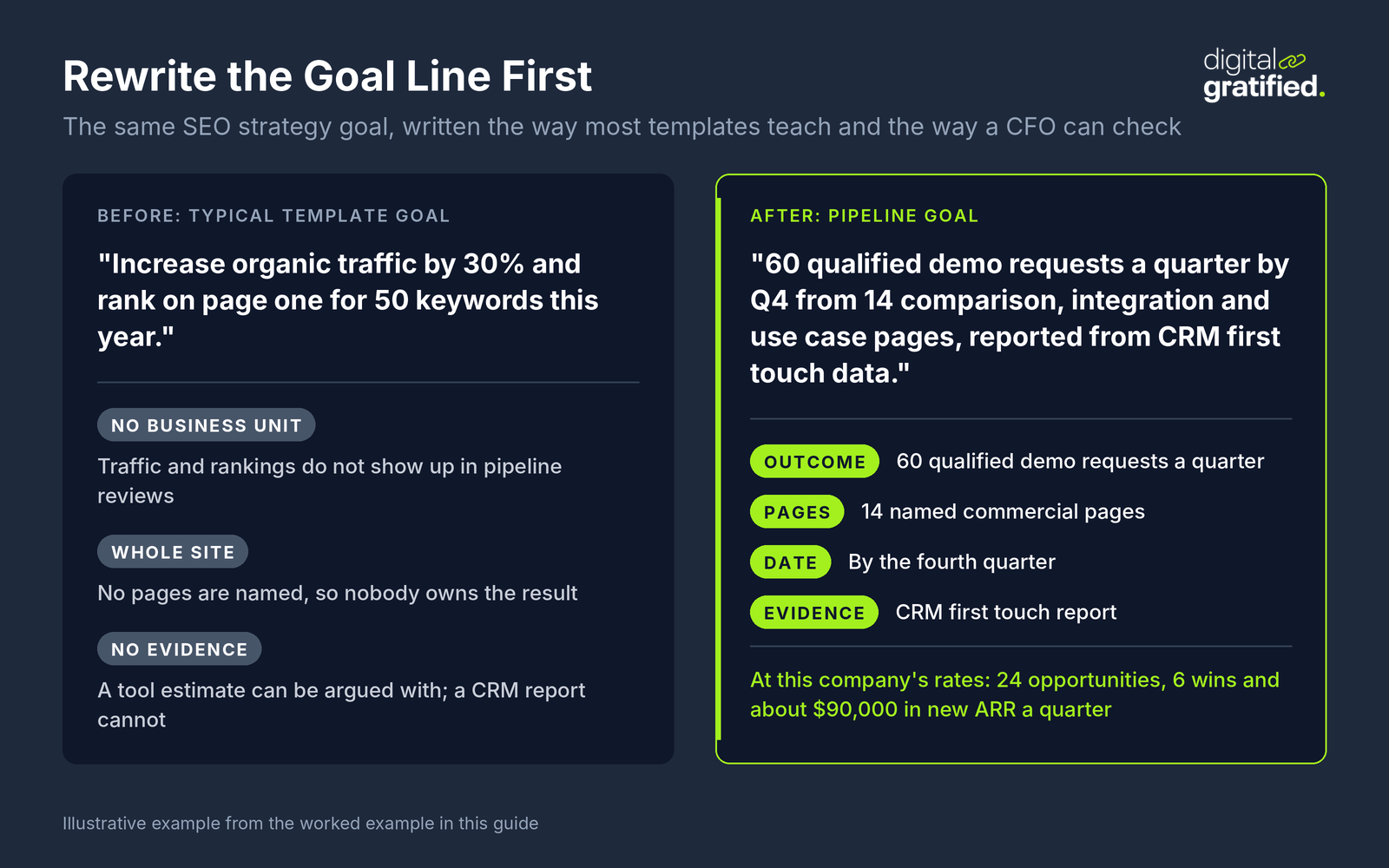
Notice that the rewritten goal is smaller. It covers 14 pages, not the whole site, and one outcome, not five. That is deliberate: a narrow goal you can attribute is worth more in a budget meeting than a broad one you cannot.
A Worked Example: Filling In the Template
Here is a worked example with illustrative numbers. An HR software company sells a performance review product to companies with 200 to 2,000 employees. Its average contract is $15,000 a year, sales closes 25% of opportunities, and 40% of qualified demo requests become opportunities. Organic search currently brings about 15 demo requests a quarter, mostly from its homepage and two blog posts.
Business target. Reach 60 organic demo requests a quarter by the fourth quarter. At the company's own rates, that is 24 opportunities, 6 wins and about $90,000 in new ARR a quarter from organic first touches.
Buyers and problems. HR directors searching for review process problems ("how to run calibration meetings"), people operations leads comparing tools, and IT reviewers checking SSO and data residency.
Baseline. 38 non-branded queries sit between positions 4 and 20, 11 of them on comparison terms; the company has no alternatives pages and no integration pages for the HRIS platforms its customers use.
Page portfolio. Six comparison and alternatives pages, five HRIS integration pages and three use case pages in the first half; ten problem guides in the second half, each linking to one use case page.
Authority plan. One annual benchmark on review cycle length from anonymized product data, linked internally to the calibration use case page, plus expert commentary from the head of people science in HR trade publications. That mix is typical of link building for HR software companies, where buyers read the trade press before they book a demo.
Not doing. No generic HR glossary, no topics outside performance management, no paid placements.
Review rule. At the end of each quarter, compare demo requests from the new pages against the target; a page group with no qualified demos after two quarters stops getting new pages.
The whole document fits on two pages, and every line can be checked against Search Console or the CRM.
How to Turn the Strategy Into a 12-Month SEO Roadmap
A roadmap is the strategy laid out over time, and its main job is to set expectations. The time it takes SEO to pay off is the number most often misjudged. A Google video on hiring an SEO says that "in most cases, SEOs need four months to a year" to implement improvements and see potential benefit. Ahrefs' study of how long pages take to rank found that only 1.74% of newly published pages reached the top 10 within a year, or 6.11% in a cleaner sample of 2 million English pages, and that 72.9% of pages in the top 10 are more than three years old. A first-year roadmap that promises page one for head terms is setting the team up to miss.
So sequence the roadmap by how fast each kind of work pays back. Fixes and improvements to pages already ranking on page two come first, because they move within weeks. New commercial pages come next. Linkable assets and the authority they build come later, and compound for the rest of the year.
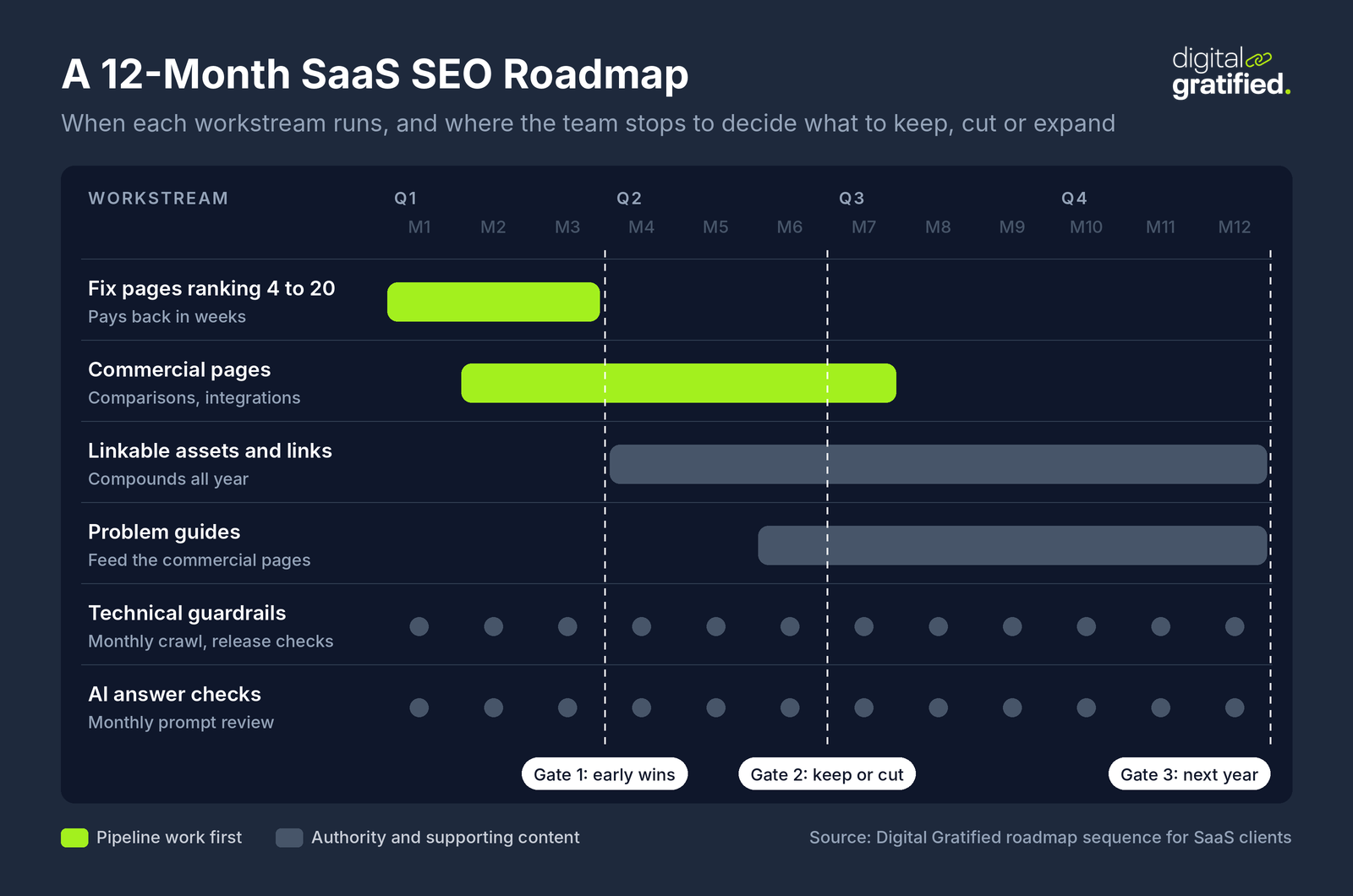
Put the review gates on the roadmap as dates, not intentions. A gate is where the team compares results with the target and decides, in writing, what to keep, cut or expand. Without gates, a roadmap drifts into the following year with every workstream still running and none of them judged. The monthly view that feeds those gates is covered in SEO reporting that tracks pipeline, not sessions.
How AI Search Changes Your SEO Strategy
Any strategy written in 2026 has to assume that fewer searches end in a click. An AI Overview now correlates with a 58% lower click-through rate for the top-ranking page, comparing December 2023 with December 2025 across 300,000 keywords. Software buyers have moved too: in G2's survey of 1,076 B2B software buyers, 51% now start their research with an AI chatbot more often than with Google, up from 29% a year earlier, and 69% chose a different vendor than they first planned because of what a chatbot recommended. G2 sells review and visibility products, which gives it a stake in that finding, but the direction is the same as the click data.
Three changes follow for the template. First, informational queries that AI answers fully are worth less, so weight the page portfolio toward commercial and comparison pages, where buyers still click through to evaluate. Second, mentions in sources that AI answers cite (review sites, trade publications, roundups) belong in the authority plan as targets in their own right, linked or not. Third, add AI visibility to the measurement section, so the strategy can show progress even in a quarter when clicks are flat.
What to Leave Out of an SEO Strategy
A strategy is defined as much by what it rules out. The most expensive thing to rule out this year is volume for its own sake. Google's spam policies define scaled content abuse as "when many pages are generated for the primary purpose of manipulating search rankings and not helping users", whether they are written by people or by AI, and the first example given is using generative AI tools to produce many pages without adding value. Google's most recent spam update finished rolling out on October 8, 2026. A template that measures success in pages published invites exactly the behavior those policies target.
The same logic applies to links. Bought links that pass ranking credit, private blog networks and excessive link exchanges are all listed as link spam in the same policies, and none of them belongs in a strategy you would show to your board. When we build SaaS SEO strategies for clients, we start with a technical audit and a keyword map tied to buyer intent, and the link side relies on editorial placements on sites with a Domain Rating of 50 or higher, never PBNs.
Leave out vanity sections too: a competitor list with no conclusions, a keyword spreadsheet with thousands of rows and no priorities, and a goals page with more than three goals. Each one makes the document longer and the decision harder.
The Bottom Line
A useful SEO strategy template for SaaS is short, starts from a pipeline target, puts commercial pages before blog posts, names an owner for every section and says what you will not do. Fill in the nine sections, check every number against Search Console and your CRM, turn it into a roadmap with dated review gates, and judge it on qualified demos and sign-ups after two quarters.
If you would like a team to build that strategy with you, start with an audit and a buyer-intent keyword map from our SaaS SEO services.
Frequently Asked Questions
What should an SEO strategy template include?
For a B2B SaaS company: a business target in demo requests, trials or pipeline; the buyers and problems they search for; a baseline from Search Console and the CRM; a page portfolio by buying stage; an authority plan; technical guardrails; AI search visibility; owners, budget and a list of what you will not do; and measurement with dated review points.
What is the difference between an SEO strategy and an SEO roadmap?
The strategy says what organic search must achieve, for which buyers, with which pages, and what you will not do. The roadmap puts that strategy on a calendar, quarter by quarter, with owners and review gates. The project plan or task list sits underneath both.
How long should an SEO strategy document be?
One to two pages. If it runs longer, the extra length is usually task detail that belongs in the roadmap or the project tracker. A CEO or CFO should be able to read the bet, the cost and the expected return in a few minutes.
How often should you update an SEO strategy?
Review it every quarter against the target and rewrite it once a year. Change it sooner if something structural shifts, such as a new product line, a site migration or a large change in how your buyers search, including a move toward AI assistants.
Who should own the SEO strategy at a SaaS company?
One person in marketing, usually the head of growth or the SEO lead, owns the document and the targets. Each section still needs a named owner: a writer and subject expert for content, an engineer for technical guardrails, and someone with CRM access for measurement.
Can an agency write our SEO strategy for us?
An agency can do the research, audit and drafting, but the targets, conversion rates and the list of what you will not do have to come from your own team and finance data. In our experience the strategy holds up when the agency proposes and the company decides.
How long does it take for an SEO strategy to show results?
Fixes to pages already ranking on page two can move within weeks, but most strategies need two quarters before qualified demo requests change in a way you can measure. Ahrefs found that only 1.74% of newly published pages reached the top 10 within a year, so plan first-year targets around pages that already rank.
About the author
Let's Scale Your SaaS Together
Get a custom SEO and link building strategy tailored for your SaaS business.
Get SEO insights that actually move rankings
Link building tactics, case studies, and SaaS SEO playbooks. No fluff, no spam.
You're subscribed!
SEO and link building insights, straight to your inbox.